- 224 pages
- English
- ePUB (mobile friendly)
- Available on iOS & Android
eBook - ePub
About this book
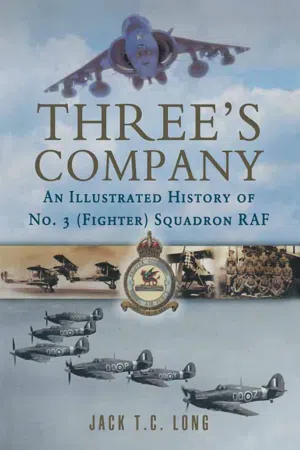
No 3 Squadron was formed at Larkhill in 1912 from the No 2 (Aeroplane} Company under the command of the famous Major Robert Brooke-Popham. More importantly the squadron was the first in the RFC to be equipped with fixed-wing aircraft. Thereafter the squadron distinguished itself in both World Wars, its battle honors including Mons, Neuve Chappelle, Loos, Somme 1916, Cambrai 1917, Somme 1918, The Battle of Britain, Normandy and Arnhem. More recently it has seen service in the Falklands, the Balkans, Iraq, and has just returned from Afghanistan. No 3 Squadron have recently been nominated to operate the Eurofighter Typhoon. This book is a highly-illustrated history of the Squadron's operations throughout its history. The rare photographs have been collected by the author over many years and the text includes firsthand accounts from the Squadron archives. This book is the ultimate record of one of the world's oldest and proudest military flying units.
Information
CONTENTS
Introduction
1. The Air Company
2. The Conception of Air Power
3. The Gestation of Air Power
4. The Birth of Air Power
5. The Growing Pains of Air Power
6. Baptism of Fire
7. Flying Moranes
8. The Sopwith Camel
9. Indian Interlude
10. Novar
11. The 1920s and 1930s
12. The Outbreak of War
13. The Wind of Change
14. Victory to Cold War
15. The Hawker Hunter
16. The Javelin
17. The Canberra
18. Hawker’s Bird of Prey – The Harrier
19. The New Millennium
Bibliography
Index
INTRODUCTION
THIS COLLECTION is the result of forty years’ labour of love, starting in 1963 at RAF Geilenkirchen in Germany. Originally intended as sixty pages of text for a booklet, the only problem was what to leave out and therefore who would be upset. To cover ninety years meant approximately two-thirds of a page per year; to cover fifty types of aeroplane meant just over a page each; but 3 Squadron had operated the Canberra for eleven years out of ninety, therefore requiring eight pages, and the Harrier for twenty-eight years, needing nineteen! Much of the material has appeared in our No. 3(F) Squadron Association Magazine Three’s Company, or is intended for it in the near future. Many were written to accompany my Model Moments, a type-by-type series, or as a response to it.
If you are looking for an alphabetical or chronological list, they are available elsewhere though prone to error in the first decade. So I ‘cop out’ by quoting Dr J. Bronowski in The Ascent of Man ‘History is not events, but people. And it is not just people remembering, it is people acting and living their past in the present. History is the pilot’s instant act of decision, which crystallises all the knowledge, all the science, all that has been learned since man began.’
Later I quote Santayana and I hope you agree with my choices and get the feel of the Squadron. You may ask: ‘What is so special about a squadron?’ Chaz Bowyer expressed it well in Fighter Command 1936–1968:
To don a flying overall carrying the cloth badge of a particular fighter squadron was an honour akin to admittance to a masonic enclave. Such an honour had to be ‘earned’ worthily and upheld in all matters. Unwritten codes of conduct were strictly observed, even at the expense, occasionally, of the written ‘rules’ laid down in King’s Regulations. The squadron came first – indeed, was first in all considerations. Such attitudes were virtually an extension of the British public school system of conduct. Such an attitude is almost wholly associated with maturing adolescence; akin to the muscle-testing capers of young cubs in any pride of lions, daring their elders and savouring the sheer joy of unknown danger in the maturing process.
Therefore I use some of the personal anecdotes and notes of the people who wrote this history for me to present as the text to accompany many illustrations. Throughout, any opinions not in quotation marks or italics are mine, based on sixty years of aeronautical ‘Anoraksia’ and twenty-two years in the Royal Air Force (eighteen as a service pilot) followed by twenty-seven as a civilian pilot.
Many of the books I have used are long out of print – and sometimes reprint! – but they can be found. The photographs were collected over forty years and, partly due to the loss of two files, the original source cannot always be quoted; especially those which have been copied and recopied and are then claimed as belonging to various archives or collections. I am thinking particularly of the original John Yoxall, Charles Sims and Charles E. Brown pictures of aeroplanes which appeared in the weekly Flight and Aeroplane, as well as the fortnightly Aeroplane Spotter, and may be seen in published volumes. Partly because of this, for each copy of this book sold, I intend to pay 50 pence each – i.e. £1 in total – to both the Soldiers, Sailors and Airmens Families Association and the Royal Air Force Benevolent Fund, to honour ‘the debt we owe’. Particular thanks is owed to the J. M. Bruce/G. S. Leslie collection – which is now owned by the Fleet Air Arm Museum, Yeovilton – for the early period. Jack Bruce and Bruce Robertson both died during this project, two historians I am proud to have known and count as friends, on whom I depended for advice and encouragement – so I hope I got it right!
I believe in the two sayings: ‘Freedom is cheap until you lose it’ and ‘It’s always politicians who lose the peace and the people who have to regain it.’ Beware weasel words such as those of Clausewitz: ‘War is an extension of policy.’ Who promotes policy? Politicians. Who dies in war? People. So this is mostly about people and their primary equipment – aeroplanes – and therefore about pilots, although we are the first to admit our dependence on others, particularly the ladies who are rarely rewarded or praised.
I dedicate this work to:
‘The First of the Many’,
Lieutenant Reginald Archibald Cammell, Royal Engineers (1886–1911), the first
British, Commonwealth and Empire aviator who was detailed to learn to fly the first
British service owned aeroplane and also the first to die in an aviation incident on duty.
Also to the many air and ground personnel who followed his superb example; at the
time of writing, the latest are the crew of a No. 9 Squadron Tornado, downed by a
‘friendly fire’ Patriot missile.
Went the day well?
we died and never knew,
but well or ill,
Freedom we died for you.
ANON
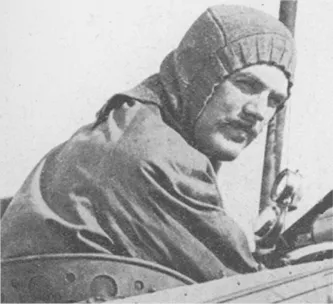
‘The First of the Many’, Lieutenant Reginald Archibald Cammell, Royal Engineers, 1886 – 1911, in the cockpit of his own Blériot XXI. (The woollen Balaclava being a prototype flying helmet). (Ron Ledwidge)
CHAPTER ONE
The Air Company
THE TITLE OF THIS CHAPTER properly reflects the fact that the direct antecedent of No. 3 Squadron (NOT No. 2 Squadron, as is so often written) is Britain’s first independent aviation unit – No. 2 (Aeroplane) Company, the Air Battalion, Royal Engineers, known to many, then and now, as ‘the Air Company’; No.1 (Airship) Company was ‘the Gas Company’.
There is a saying, ‘If the Army was meant to fly the sky would be brown.’ This is an insult to those pioneers of service aeronautical endeavour who began in 1878 as aeronauts and by 1918 were aviators. My concern is only with the latter, and only with the so-called ‘professionals’ who began as self-financing amateurs to gain their brevets.
The Air Battalion was formed on 1 April 1911, with No. 2 Company commanded by Captain J.D.B. Fulton RFA (Royal Field Artillery) at Larkhill; just prior to the formation of the Royal Flying Corps and the creation of the Central Flying School. He was posted there, first as an instructor in charge of the workshops and then to the Aeronautica...
Table of contents
- Cover
- Half Title
- Title Page
- Copyright
- Foreword
- Contents
Trusted by 375,005 students
Access to over 1.5 million titles for a fair monthly price.
Study more efficiently using our study tools.
Frequently asked questions
Yes, you can cancel anytime from the Subscription tab in your account settings on the Perlego website. Your subscription will stay active until the end of your current billing period. Learn how to cancel your subscription
No, books cannot be downloaded as external files, such as PDFs, for use outside of Perlego. However, you can download books within the Perlego app for offline reading on mobile or tablet. Learn how to download books offline
Perlego offers two plans: Essential and Complete
- Essential is ideal for learners and professionals who enjoy exploring a wide range of subjects. Access the Essential Library with 800,000+ trusted titles and best-sellers across business, personal growth, and the humanities. Includes unlimited reading time and Standard Read Aloud voice.
- Complete: Perfect for advanced learners and researchers needing full, unrestricted access. Unlock 1.5M+ books across hundreds of subjects, including academic and specialized titles. The Complete Plan also includes advanced features like Premium Read Aloud and Research Assistant.
We are an online textbook subscription service, where you can get access to an entire online library for less than the price of a single book per month. With over 1.5 million books across 990+ topics, we’ve got you covered! Learn about our mission
Look out for the read-aloud symbol on your next book to see if you can listen to it. The read-aloud tool reads text aloud for you, highlighting the text as it is being read. You can pause it, speed it up and slow it down. Learn more about Read Aloud
Yes! You can use the Perlego app on both iOS and Android devices to read anytime, anywhere — even offline. Perfect for commutes or when you’re on the go.
Please note we cannot support devices running on iOS 13 and Android 7 or earlier. Learn more about using the app
Please note we cannot support devices running on iOS 13 and Android 7 or earlier. Learn more about using the app
Yes, you can access Three's Company by Jack T.C. Long in PDF and/or ePUB format, as well as other popular books in History & Military & Maritime History. We have over 1.5 million books available in our catalogue for you to explore.