- 256 pages
- English
- ePUB (mobile friendly)
- Available on iOS & Android
eBook - ePub
About this book
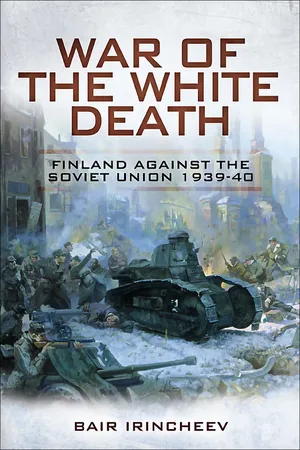
A thorough history of the Winter War, the uneven Russo-Finnish conflict that began shortly after the start of World War II.
On November 30, 1939, Stalin's Red Army attacked Finland, expecting to crush the outnumbered, ill-equipped Finnish forces in a matter of days. But, in one of the most astonishing upsets in modern military history, the Finnish defenders broke the Red Army's advance, inflicting devastating casualties and destroying some of the divisions that had been thrown against them.
Eventually, in March, 1940, the overhauled Red Army prevailed through the deployment of massive force. The Finns were compelled to cede territory and cities to their overbearing neighbor, but the moral victory was theirs. The courage and skill their army displayed in the face of the Soviet onslaught—and the chaotic, reckless performance of their opponents—had an important influence on the massive struggle soon to break out between Nazi Germany and the Soviet Union.
For this highly illustrated and original portrayal of this conflict, Bair Irincheev brings together a compelling selection of eyewitness accounts, war diaries, battle reports, and other records from the Finnish and Russian archives to reconstruct the frontline fighting, and he analyzes the reasons for the Red Army's poor performance. Never before has the harsh reality of the combat in the depths of the northern winter been conveyed in such authentic detail. The arduous daily experience of the troops on both sides, the brutality of combat, and the constant struggle against the elements are recalled in the words of the men who were there.
Trusted by 375,005 students
Access to over 1.5 million titles for a fair monthly price.
Study more efficiently using our study tools.
Information
Chapter 1
Plans and Preparations
Finland and Russia shared a troubled history in the 1900s, with the roots of the conflict going back to the Middle Ages. Starting from the thirteenth century, the Karelian Isthmus, Finland and the Baltics became a battlefield for two rising superpowers – Sweden and Russia. Borders were moved in favour of the country that had a winning hand or better army at any given moment. Wars and border skirmishes repeated themselves regularly throughout the Middle Ages. The Swedes founded the castle of Vyborg in 1293 and continued to expand their influence in Karelia and the Baltic.
Finland was traditionally a domain of Sweden, but with the rise of the Russian Empire in the 1700s the border moved closer and closer to Stockholm. Finally, the war of 1808–1809 changed the fate of Finland: Sweden lost the last major war against Russia and Finland was incorporated into the Russian Empire as the Grand Duchy of Finland. The new province retained vast autonomy and privileges, granted by Alexander I of Russia. Alexander even granted Vyborg to the Grand Duchy. Towards the end of the 1800s the new Russian Tsar, Alexander III, abolished most of these privileges in a project to make his vast empire more homogeneous in terms of language, government, bureaucracy and other aspects. The Finnish intellectual elite saw this as a threat to their national culture and autonomy. As in many other European empires, an independence movement began to grow.
The First World War, the Russian Revolution and the collapse of the Russian Empire gave Finland a chance to become independent for the first time in its history. On 6 December 1917 the country officially split with the Russian Empire or, rather, what was left of it.
However, independence did not bring peace. A bloody civil war was fought in 1918. The Whites were supported by Sweden and Germany, while the Reds were supported by Soviet Russia. The war ended with the defeat of the Reds and their flight to Russia or extermination. During the civil war Mannerheim, Commander-in-Chief of the White forces, gave his famous ‘Drawn Sword’ speech, in which he claimed that his sword would be drawn as long as Eastern Karelia remained in Soviet hands. Some ultra right-wing White officers made several raids into Soviet Karelia in order to annex these territories to Finland. Such raids were made on several occasions in 1918 and 1920. However, the local Karelian population was scared off by the atrocities that the Whites committed during these raids and mostly did not support them.
Peace between Soviet Russia and Finland was signed in 1920 in Tartu, Estonia. Russia was still torn and weakened by civil war and Finland received very favourable borders. On the strategically important Karelian Isthmus, the border was drawn along the Sister river (‘Raja-joki’ or ‘Border river’ in Finnish). At the closest point the border was only 32 kilometres from Petrograd (later Leningrad), the second-largest city of Soviet Russia. Proximity and lack of certainty regarding the Finnish border caused Lenin to shift the capital from Petrograd to Moscow in 1918.
It is important to note that, although diplomatic relations between the two countries were established and borders set, relations remained cool to say the least. Ideological differences, the imperial past and a nationalistic anti-Russian campaign triggered in Finland all contributed to this.
As the Soviet Union regained its status as a great European military power, Stalin started a project to expand Soviet influence in the Baltic. Soviet leaders approached the governments of Latvia, Lithuania and Estonia, requesting land and naval bases for the Soviet Armed Forces. A similar request was sent to Finland. In addition to the request to rent Hanko as a naval base, Soviet leaders demanded a shift of the border north from the Sister river, beyond Vyborg. The Soviets were offering an area three times larger in Karelia as compensation. However, such an exchange would have meant a loss of the Karelian Isthmus with all its fortifications and Vyborg – the second-largest city of Finland at that time. Several rounds of negotiations were held in Moscow but politicians failed to reach a compromise. Finally, in early November 1939, Stalin and his close associates decided to resolve the matter by war. Hasty preparation for a military campaign began. On the political front, Stalin formed a puppet government from surviving Finnish communists in the USSR and created the Finnish People’s Army. At the same time the regular Finnish Army had been secretly mobilized in October 1939, during the extraordinary exercises of the reservists, and was standing ready at the main defence line.
The casus belli appeared on 26 November 1939. The Soviet side claimed that Finnish artillery had fired across the border at Mainila village, killing seven Red Army men. The Finns denied all accusations and called for an international investigation but the USSR would not comply. A propaganda campaign was unleashed in the Soviet Union, calling on the Red Army to deal with the ‘troublesome’ neighbour’s rulers once and for all. The Red Army was to stretch out a helping hand to the oppressed Finnish people and bring freedom and democracy to Finland.
On 30 November 1939 the Soviet Air Force delivered several strikes on targets in Finland, including Helsinki, and the Red Army crossed the border. All this was done without an official declaration of war. The whole world believed the campaign would only last a couple of weeks and would end with the hoisting of the red banner atop the presidential palace in Helsinki. But things would turn out differently. The world looked on with awe as Finland defended its independence, stopping and defeating the Red Army. The course of events regarding the struggle on land is described in the pages that follow.
The Opposing Forces
The Winter War is often described as a ‘David and Goliath’ battle and indeed the contrast between the resources and equipment of the two armies is staggering. Nevertheless, it is important to note that the over-optimistic Soviet plan was to crush Finland with units of the Leningrad Military District only. Resources available in the Leningrad District were rather limited, and it would be wrong to state that, at the outbreak of the Winter War, Finland was facing the entire Red Army.
A basic unit in both armies was the infantry division, called a ‘rifle division’ in the Red Army. The basic composition of both Finnish and Soviet divisions was the same: each division had three regiments with supporting artillery and other units. The most important difference between Finnish and Soviet divisions was in their firepower and the equipment of supporting units. A Finnish infantry division had one artillery regiment of three battalions. Two-thirds of the artillery pieces were light 3-inch guns, most of them inherited from the Russian Imperial Army. Heavy howitzers made up the rest. Each Finnish division also had a light unit, comprising a cavalry squadron, a bicycle company, and a heavy machine-gun platoon.
A Soviet division had an artillery regiment and a howitzer regiment, with a greater share of large-calibre artillery pieces. Each division also had an anti-tank battalion with twelve 45mm anti-tank guns. In addition to division-level artillery, each rifle regiment had its own regimental battery of four regimental 3-inch guns and an AT battery of six 45mm anti-tank guns. Thus the superiority of a Soviet division over its Finnish opponent was more than twofold. Each Soviet rifle division had a tank battalion, but their composition varied greatly. A tank battalion could have from ten to forty tanks. The equipment of the tank battalions was light: T-37 and T-38 amphibious tanks and T-26 tanks of all models. Equivalent to a Finnish light unit in Soviet divisions was a scout battalion, with cavalry squadron, armoured car company and motorcycle company. The composition of Finnish and Soviet divisions is presented at the end of the book in Appendix II.
Four detached heavy artillery battalions represented the Finnish Army’s heavy artillery branch. Heavy, corps and supreme command reserve artillery regiments and independent battalions represented the Red Army’s artillery branch. These heavy units were attached to rifle corps and armies to strengthen the direction of the main axis of advance. Artillery units had guns and mortars up to 280mm in calibre.
The detached tank company represented Finnish tank units, with thirty-two Vickers 6-ton tanks and a bunch of outdated Renault FT-17 tanks. The 20th Heavy Tank Brigade (named after S. M. Kirov) and numerous light tank brigades represented Soviet tank units. Each brigade had from three to five tank battalions and fielded from 100–200 tanks with support and supply units.
Soviet tank battalions fielded specialized armoured vehicles known as ‘chemical tanks’ and ‘teletanks’. Chemical tanks, built on the chassis of the T-26 light tank, were armed with a compressed-air-operated thrower, which could spray poisonous chemicals, gases, burning liquids or decontaminating liquids onto the surrounding terrain. Detached tank battalions fielded some thirty to forty chemical tanks. In the Winter War they were used only as flamethrower tanks. The range of flame-throwers was 50–100 metres, depending on the tank’s model.
Teletanks were probably the most unusual and high-tech Soviet armoured weapon of the late 1930s. Teletanks were radio-operated chemical tanks, which could be deployed in battle without a crew. Each teletank had a control vehicle, from which the crew directed the world’s first battle robot. A teletank and a control vehicle formed a battle pair. A teletank could also be manned as a regular chemical tank. From the outside, a teletank looked like a regular chemical tank: the only difference was the presence of a second antenna on the turret. The 217th Detached Tank Battalion fielded eight battle pairs in the Battle of Summa in December 1939–February 1940. Detached tank battalions were attached either to tank brigades or to rifle divisions.
It is important to note the explosive growth of the Red Army in the 1930s and the purges that took place in the same period. This led to a degradation in the training level of commanders. Majors, not colonels, led regiments. There was a consistent lack of division-level commanders. However, it is important to note that most of the Soviet colonels, kombrigs and commanders of higher rank were not new to war: they all had battle experience from the First World War as non-commissioned officers or privates in the Russian Imperial Army, rising to commanders in the Red Army during the Russian Civil War.
In this book I do not use the terms ‘officers’ and ‘NCOs’ when referring to the Red Army. These terms were not officially used in the Red Army until 1943, as the words were connected with the Russian Imperial Army. The Red Army tried to distance itself from its imperial predecessor as much as possible. The term ‘senior commander’ or ‘commander’ was used for a commanding officer, and ‘junior commander’ was used for a non-commissioned officer.
The political branch of the Red Army was established during the Russian Civil War in order to ensure the loyalty of certain former Tsarist officers to the Soviet state. As time moved on, however, the role of political workers and commissars changed to encompass political education, morale and propaganda. At company and battalion level, political workers took part in combat together with their unit and often replaced a killed or wounded commander in battle. In fact, the casualty rate of company-level political workers was sometimes as high as that of commanders.
Red Army Plans
The Red Army had certain plans in case of war with Finland, just like any army. However, in autumn 1939 all plans were scrapped and a new plan for a military campaign against Finland was developed. The order to develop new invasion plans was issued to Kirill Meretskov, Commander of Leningrad Military District, shortly before the war, when it became obvious to the Soviet leadership that there would be no peaceful solution following negotiations with Finland.
The whole invasion of Finland was planned as a local military operation by the Leningrad Military District. The basic assumption of the plan was that the Finnish Army would not be able to resist due to its limited resources. Meretskov’s plan was to destroy the Finnish Army in a battle at the border and quickly march into the Finnish heartland via main roads leading from the USSR. The plan was hastily developed in November 1939 and was only completed in mid-November. Four armies were earmarked for the invasion; they were to operate along the entire length of the Finnish border, from the Gulf of Finland in the south to the tundra landscapes of Petsamo.
The Seventh Army, under Komandarm 2nd Class V. F. Yakovlev, attacked Finnish positions on the Karelian Isthmus. At the outbreak of hostilities the Seventh Army fielded nine rifle divisions (70th, 24th, 43rd, 49th, 90th, 123rd, 138th, 142nd and 150th) and four tank brigades (20th Heavy Tank Brigade, 35th Light Tank Brigade, 39th Light Tank Brigade and 40th Light Tank Brigade). The army was reinforced with several heavy artillery regiments. The X Tank Corps (with the 1st Light Tank, 13th Light Tank and 15th Motor Rifle Brigades) was in the army’s reserve, ready to exploit the success of the rifle units at the front. The mission of the Seventh Army was to break through the Finnish defences on the Karelian Isthmus, destroy Finnish units and reach the Viipuri–Vuoksi line. After this, the army was to continue its offensive in the direction of Lappeenranta, Lahti and finally Helsinki.
Although the Red Army was aware of the Finnish defences on the Karelian Isthmus, the latest intelligence dated back to 1937 and was incomplete, as the most important fortifications were built after that date. Furthermore, maps of the Finnish fortifications were sent to the troops too late or were too inaccurate to be of use.
The whole campaign was to last no more than three weeks. This meant the Seventh Army had to advance at a pace of 20 kilometres a day – almost the same pace as a peacetime march for a rifle division in those days.
The Eighth Army, under Komdiv Khabarov, was to advance north from Lake Ladoga. This army fielded the 139th, 56th, 168th, 18th and 155th Rifle Divisions, as well as the 34th Light Tank Brigade. The army was reinforced with several heavy artillery regiments. The mission of the Eighth Army was to reach the Sortavala–Joensuu line and continue west and south-west into the heartland of Finland. This also meant getting into the rear of the Finnish defences on the Karelian Isthmus.
The Ninth Army, under Komkor M. P. Dukhanov, was founded on 15 November even further to the north. The army fielded four rifle divisions: the 44th, 54th (Mountain), 122nd and 163rd. At the outbreak of war the 44th Rifle Division was still on its way to the front from Zhitomir, Ukraine. The mission of the army was to capture Kajani and then Oulu, thus cutting Finland in two at its narrowest spot.
The Fourteenth Army, under Komandarm V. A. Frolov, was to advance in the extreme north. The army fielded two rifle divisions and one mountain rifle division, with most of the units still on the way to the front. The mission of the Fourteenth Army was to capture Petsamo in cooperation with the Northern Fleet and prevent possible landings by the Western Allies on the Kola Peninsula, as well as any Allied offensive from Norway.
Soviet plans were so hastily prepared that, even before the start of the campaign, some commanders had their doubts. However, an atmosphere of self-confidence in the Red Army prevailed. The Red Army had just defeated Japanese units at Khalkin-Gol in Mongolia, and successfully incorporated the Western Ukraine and Western Byelorussia into the USSR. All the campaigns of the Red Army before the Winter War were victorious and Soviet propaganda described the Red Army as ‘legendary and unbeatable’. The Red Army was well equipped with the newest military equipment and it was the pride of the Soviet Union. However, the purges of the 1930s had left their mark on morale. Some commanders were promoted too quickly without proper experience, some disappeared, but the worst consequence of the purges was an atmosphere of distrust and fear among the commanders, who feared that their subordinates would complain to the political workers or NKVD: consequently, in some cases, commanders followed the will of their men.
Finnish Options
The Finnish general staff developed plans for the country’s defence during the twenty years of independence. By 1939 two plans were in place, designed to cope with different political and military situations in Europe. These plans were designated VK 1 (Russian Concentration 1) and VK 2 (Russian Concentration 2).
VK 1 assumed a very favourable situation for Finland. This scenario assumed that the armed forces of the Soviet Union were tied up in battles all along the USSR’s western borders with Europe, preventing deployment of sufficient forces against Finland. In such a situation, the Finnish Army was planning not only to defend the country’s independence but also to bite off some chunks of land from its mighty eastern neighbour. According to this plan, advancing Red Army units would be stopped on Finland’s Karelian Isthmus at Inkilä– Hatjalahdenjärvi–Summa–Muolaanjärvi–Yskjärvi–Lipola–Rautu–Taipale. Then the Finns were to counter-attack and regain the state border, or even cross it, in order to gain better defensive ground.
To the north, from Lake Ladoga, Finnish units were to counter-attack from the area of Pitkäranta–Suojärvi and advance into Soviet Karelia and the area of Tuloksa–Vedlozero–Syamozero.
Further to the north, the Finns were to counter-attack from the Lieksa– Kuhmo area, capturing Reboly and continuing deep into Soviet territory towards Rugozero. At Suomussalmi Finnish ski units were to cross the border, capture Voknavolok and continue towards the Murmansk railway. This plan was, to a great extent, implemented in the summer campaign of 1941, when the USSR was embraced in a deadly fight with Nazi Germany and could not deploy large numbers of troops against the Finnish offensive.
VK 2 was a more pessimistic plan, assuming unfavourable conditions for Finland: consequently, its nature was more defensive. The plan implied a rigid defence of the Inkilä–Hatjalahdenjärvi–Muolaanjärvi–Vuoksi–Suvanto–Taipale line. North of Ladoga, three options for the Finnish main defence line could be chosen, depending on the situation at the front. Nevertheless, Finnish action north of Ladoga implied repelling the Soviet offensive and launching a counteroffensive. Units in the north of Finland had no special plan and they were to act according to the VK 1 plan.
The most important step that Finland undertook in autumn 1939 was the decision to carry out what became known as ‘extraordinary manoeuvres’ (YH) for all reservists. In effect, the manoeuvres meant a secret mobilization of the Finnish Army. The term ‘mobilization’ could not be used for obvious reasons in those days (mobilization of an army was almost equal to a declaration of war), and yet the Finns managed to concentrate their forces on the main defence line. Throughout October and November Finnish troops built additional fortifications and performed intensive combat training at squad–platoon– company–battalion level, with live ammunition firing and advanced tactics courses. Counter-attacks against Soviet breaches of the main defence line were rehearsed time and again. When war began, the main defence line was indeed home turf for Finnish troops: they knew every inch of the battlefield like their back garden. These two months of training and preparation played a crucial role in the battles of December 1939, largely contributing to the Soviet failure.
During autumn 1939 the Finnish Field Army was formed, as well as delaying troop units. The main task of the Field Army was to hold the main defence line and carry out counter-attacks. The F...
Table of contents
- Cover
- Title Page
- Copyright
- Contents
- List of Maps
- Preface
- 1. Plans and Preparations
- 2. December 1939: Soviet Failure on the Karelian Isthmus
- 3. North of Ladoga
- 4. Northern Finland, Lapland and the Arctic Front
- 5. Breakthrough on the Mannerheim Line
- 6. March 1940: Last Stand-off on the Karelian Isthmus
- Aftermath and Closing Remarks
- Appendices
- Archive Sources
- Bibliography
- Index
Frequently asked questions
Yes, you can cancel anytime from the Subscription tab in your account settings on the Perlego website. Your subscription will stay active until the end of your current billing period. Learn how to cancel your subscription
No, books cannot be downloaded as external files, such as PDFs, for use outside of Perlego. However, you can download books within the Perlego app for offline reading on mobile or tablet. Learn how to download books offline
Perlego offers two plans: Essential and Complete
- Essential is ideal for learners and professionals who enjoy exploring a wide range of subjects. Access the Essential Library with 800,000+ trusted titles and best-sellers across business, personal growth, and the humanities. Includes unlimited reading time and Standard Read Aloud voice.
- Complete: Perfect for advanced learners and researchers needing full, unrestricted access. Unlock 1.5M+ books across hundreds of subjects, including academic and specialized titles. The Complete Plan also includes advanced features like Premium Read Aloud and Research Assistant.
We are an online textbook subscription service, where you can get access to an entire online library for less than the price of a single book per month. With over 1.5 million books across 990+ topics, we’ve got you covered! Learn about our mission
Look out for the read-aloud symbol on your next book to see if you can listen to it. The read-aloud tool reads text aloud for you, highlighting the text as it is being read. You can pause it, speed it up and slow it down. Learn more about Read Aloud
Yes! You can use the Perlego app on both iOS and Android devices to read anytime, anywhere — even offline. Perfect for commutes or when you’re on the go.
Please note we cannot support devices running on iOS 13 and Android 7 or earlier. Learn more about using the app
Please note we cannot support devices running on iOS 13 and Android 7 or earlier. Learn more about using the app
Yes, you can access War of the White Death by Bair Irincheev in PDF and/or ePUB format, as well as other popular books in History & 20th Century History. We have over 1.5 million books available in our catalogue for you to explore.