- 208 pages
- English
- ePUB (mobile friendly)
- Available on iOS & Android
eBook - ePub
About this book
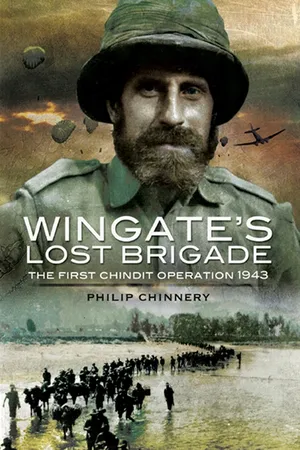
With the Japanese seemingly unbeatable after their conquest of Malaya, Singapore, Thailand and much of Burma, Orde Wingates plans to conduct long range deep penetration operations behind Japanese lines in Burma were audacious to say the least. His Chindit operations (so called after Chindwin River) were hugely demanding on those taking part who suffered terrible deprivation in the harsh climatic and jungle conditions. While costly in terms of lives lost, the operations inflicted damage to the Japanese and raised Allied morale. The author has compiled a fascinating account of Wingates 77 Brigade using the personal accounts of survivors, as well as Wingates own report and post-war interrogation of Japanese generals. A remarkable story emerges of survival, courage and extreme hardship. The author evaluates the successes and failures of the mission.
Information
PART 1 – Operation LONGCLOTH
Chapter 1
Declaration of War
Clouds of wood smoke greeted the author and his guest as they walked into the Cherry Tree public house in Farnham on a wet day in January 2009. The landlady apologized and explained that they had just lit the fire and would we like a menu? The guest opted for Lamb Rogan Josh and the author a Fish Pie; while the cook banged around in the kitchen the guest, an old soldier, began to talk of events that took place sixty-seven years before.
Denis Gudgeon was a young twenty-year-old subaltern – a second lieutenant – with an artillery regiment in London when he saw the recruiting notice. The war had been going badly in the Far East and thousands of officers were required to join the Indian Army. The prospect of extra pay and adventure appealed to Denis and soon he was on a troopship leaving the Clyde. He recalled that the journey was more like a modern-day ‘booze cruise’ and the officers spent most of their time in the bar, hoping that German torpedoes would not come their way out of the darkness.
Denis decided that spending the whole journey in alcoholic oblivion would be counter-productive and chose to learn Urdu instead. A wise choice as it turned out, as he did very well in his Basic Urdu exam after he arrived in India and was sent to join the 3rd Battalion of the 2nd King Edward VII’s Own Goorkha Rifles (The Sirmoor Rifles). He arrived on 16 May 1942, just ten days short of his twenty-first birthday.
Denis found himself second in command of ‘C’ Company, under Captain George Silcock. Training proceeded apace with Denis getting to know his Gurkhas and improving his knowledge of their language and traditions. Suddenly orders arrived, transferring the Battalion to the newly formed 77th Indian Infantry Brigade and they were all packed off by train to Saugor in the Central Indian Provinces. As they pulled in to the station they were met by a smiling, broad-shouldered Major by the name of Mike Calvert. He would become a great influence in the development of the young officer and his life was about to change for ever. Calvert explained that great things lay ahead of them, and by the way did Denis know anything about mules?
The War was going badly in the Far East at that time. For two years Great Britain had been at war with Nazi Germany and most of mainland Europe had fallen to the armies of the Wehrmacht. In the Far East, Japan had already occupied Korea and its troops had been fighting in China for five years. As 1941 came to an end the Japanese had such military might in the area that it was reasonable for the people of the East Indies, Malaya, Thailand and the Philippines to fear attack. On 6 December, President of the United States Franklin D. Roosevelt sent an urgent note to Emperor Hirohito, the ‘Son of God’, in an attempt to dispel the clouds of war gathering on the horizon. It was a futile gesture. Six Japanese aircraft carriers were already steaming across the Pacific Ocean towards the Hawaiian Islands and Pearl Harbour, where the American Pacific Fleet lay at anchor. At 0755 hours on 8 December the first Japanese dive-bombers began their bombing runs against the airfields and the eighty-six ships spread out beneath them. Within two hours, nineteen warships had been damaged or sunk, including four of the seven giant battleships in the fleet; 350 aircraft were damaged or destroyed and 2,403 men killed. It was, as President Roosevelt declared, ‘a day that will live in infamy’. That evening the United States declared war on Japan and the sleeping American giant began to stir.
Great Britain had planned to announce its own declaration of war the same evening, after the United States, but news arrived that Japanese troops had begun landing in Malaya, so the Cabinet approved the declaration at once and it was delivered to the Japanese envoy at 1.00 pm. Within a week, Japanese troops were fighting British, Indian and Australian forces in Malaya and Hong Kong, and Japanese marines were storming ashore on the main Philippine island of Luzon. On 11 December, the British battleships HMS Repulse and Prince of Wales were attacked by waves of Japanese dive-bombers as they headed for the base of Singapore, on the southern tip of Malaya. Within two hours they had been sunk and 840 crew had been killed. On the 15th, troops from the Japanese Fifteenth Army advanced westwards from Thailand into Burma, capturing three key southern airfields. Their objective was to take Rangoon and then cut the main Allied supply line to General Chiang Kai-shek’s Chinese Nationalists already fighting the Japanese in their vast country. The Japanese Army could also make good use of the 12 million acres of rice under cultivation in Burma, together with its natural resources such as oil and manganese. In addition, Burma would provide a springboard for the invasion of India, the largest British possession in the East.
The early months of 1942 saw one defeat after another inflicted upon the Allied forces. On 15 February, Singapore fell and 130,000 British, Indian and Australian troops were taken prisoner. It was the greatest military defeat in the history of the British Empire. In Burma, the airfield and town of Moulmein had fallen and the Japanese continued their advance towards Rangoon. The important Sittang Bridge was blown up too soon by the defenders on 23 February, marooning thousands of British, Indian and Gurkha troops on the east side of the river, in the path of the advancing Japanese. Hundreds died as they tried to swim across. On 8 March, Rangoon was abandoned and the British defenders under General Alexander began their long retreat northwards to India. Two days later the first reports reached the British government of Japanese atrocities in Hong Kong and Malaya, including the cold-blooded murder by bayoneting or beheading of hundreds of prisoners of war, including wounded men, civilians and nurses. The true nature of the enemy was now becoming apparent.
On 19 March, Lieutenant General William Slim took command of the two depleted divisions retreating through Burma, 17th Indian Division and 1st Burma Division. As they made their way up the Irrawaddy valley they destroyed the largest oilfield in the Far East at Yenangyaung, to prevent the wells falling into Japanese hands. On 29 April, the Japanese captured Lashio, cutting the Burma Road to China, and at midnight the next day the men of Burcorps blew up the Ava Bridge across the Irrawaddy River, and turned towards India. They had two weeks of hard marching ahead of them; 13,463 British, Indian, Burmese and Gurkha troops lost their lives during the 900-mile retreat, together with three-quarters of a million refugees. By 20 May, all of Burma was in Japanese hands.
One of the men trying desperately to fight a rearguard action against the seemingly invincible Japanese was Major Mike Calvert, the commander of the Bush Warfare School at Maymyo. Together with instructors from the school and whatever stragglers he could conscript, he had been operating behind the retreat, getting in the Japanese troops’ way whenever possible and picking up anyone left behind. One night in April, he received a message from a loyal Burmese that there were some Gurkhas in the next village who were lost and wanted to be put back on the right road to India. They were in a longhouse that stood on stilts and a faint light shone through cracks in the badly fitting door as Calvert and two of his men approached. ‘They may think we are Japs so we’ll talk loudly in English as we get near the door,’ he told his corporal.
I knocked on the door, lifted the latch and walked in. The house consisted of one long room and in the middle stood a table with nine or ten chairs around it. I already had a smile of greeting on my face, but there were no answering smiles from the occupants of the chairs. They were all Jap officers. I stopped abruptly two paces inside the doorway, but my Corporal and Private, having no idea that anything was wrong, bumped into me and pushed me further into the room before they too came to a halt when they saw the yellow faces. For what seemed like hours we stared at each other. They seemed too stunned to think of shooting. We certainly were. Suddenly I realised that there was only one thing to do. I said quickly, “Excuse me gentlemen. Good night.” Then I turned, grabbed my men by the arms and bundled them out through the door and down the steps. Then we ran like hell for the jungle.
Not long afterwards, Calvert and a dozen of his men reached a tributary of the Chindwin River. They had not seen the enemy for a couple of days and the temptation was too hard to resist – they stripped off for a badly needed bath. Calvert wandered around a little headland and dived in. He was naked except for his boots, one item of clothing never taken off in the jungle. It was fortunate that he stuck to his rule and still wore them. A Japanese officer, who had also decided to bathe in the same small cove, advanced towards Calvert, determined to kill him in hand-to-hand combat. Around the other side of the cove, a party of Japanese soldiers was splashing and shouting. The Japanese officer had heard Calvert’s men, but did not know their strength. If the alarm was raised they might have outnumbered the score of men in his own patrol, so he decided to tackle Calvert with his own bare hands. It was a great mistake. Calvert recalled:
He knew his ju-jitsu and the water on his body made him as slippery as an eel, but I was bigger and stronger. It is extraordinarily difficult to keep balance or move quickly in two or three feet of water. The Jap got more vicious as he jabbed his fingers at my face in an attempt to blind me. He was putting up a tremendous show and I was hard put to it to hold him. I pulled myself together. I had to kill him or he would kill me. I managed to grab the Jap’s wrist and force his arm behind his back. I buried my face in his chest to stop him clawing my eyes out, then as he lashed out with his left arm and both feet, I forced him gradually under water. My boots gave me a firm grip and I shut my eyes and held him under the surface. Eventually he went limp and his body floated away downstream.
There was no time to lose. Calvert staggered around the headland and alerted his men. ‘Japs, in the next cove but one. They don’t know we’re here but they will do in a minute. I killed their officer. Get after them now.’ They grabbed their guns and found about twenty Japanese and killed them all. They only just made it – soon after they reached the cove the body of the officer floated past.
Weeks would pass before Mike Calvert and his men arrived safely in India. On the way he would have plenty of time to recall his first meeting in February 1942 with a man who would change his life for ever. That particular day had not started well. Calvert had been recalled 70 miles to Prome, while in the middle of a successful waterborne raid down the Irrawaddy to Henzada, only to find himself on the receiving end of a sharp rebuke for commandeering a riverboat belonging to the Irrawaddy Flotilla Company and damaging property of the Burmah Oil Company during his demolition operations. The fact that the property would have fallen into the hands of the Japanese anyway was ignored by the stiff-necked staff officer. Pretty fed up, he made his way back to the Bush Warfare School only to find a brigadier sitting in his office, behind his desk.
‘Who are you?’ Calvert glared at the stranger, who was quite calm and composed.
‘Wingate’ he replied. ‘Who are you?’
‘Calvert. Excuse me, but that’s my desk.’
‘I’m sorry,’ said the Brigadier and he moved aside at once to let Calvert sit down. Calvert later recalled:
I was impressed. He showed no resentment at this somewhat disrespectful treatment by a major. He began talking quietly, asking questions about the showboat raid. And to my surprise they were the right sort of questions. Tired as I was, I soon began to realise that this was a man I could work for and follow. Clearly he knew all that I knew about unconventional warfare and a lot more; he was streets ahead of anyone else I had spoken to. Suddenly I no longer felt tired. For even at that first meeting something of the driving inspiration inside Orde Wingate transferred itself to me.
Wingate did indeed know what he was talking about. From 1928 to 1933 he had served with the Sudan Defence Force, during which time he had become fluent in Arabic and gained his profound knowledge of the Middle East. Because of this he was sent for when groups of Arab rebels started raiding Jewish settlements and damaging oil installations in Palestine and Transjordan in 1936. Wingate raised, trained and led a force of what became known as ‘Night Squads’, Jewish volunteers who fought and defeated the Arabs at their own game, using Wingate’s guerrilla tactics. This achievement earned Wingate the DSO and the undying gratitude of the Jews, who would very possibly have chosen him to lead their own army when they fought to establish the state of Israel in 1948. Wingate’s next exploit was to command a force of guerrillas against the Italians in Abyssinia, which gave him more experience and a chance to try out his theories on mobile, free-moving columns of troops, operating behind enemy lines. During some of these exploits, Wingate had served under General Wavell, who was impressed with the man and his methods, and when he was appointed Supreme Commander South-West Pacific, which put him in overall command of Burma, he sent for Wingate and ordered him to take charge of all guerrilla activities there.
It soon became clear in the summer of 1942 that nothing could be done to stop the advance of the Japanese to the Indian border. All Wingate could do was study the land, and the people and the tactics of the Japanese troops. He stayed at Maymyo for a while and he and Calvert walked for miles and talked for hours. ‘My conviction grew that this was a man I could fight for,’ Calvert wrote later. He took Wingate to see General Slim, the commander of Burma Corps, and left them together. On the way back to Maymyo, Wingate said he was very impressed with Slim. ‘Best man, bar Wavell, east of Suez.’ Wingate continued his tour of Burma, using Maymyo as a base, and in March met the Chinese General Chiang Kai-shek, some of whose troops had crossed the border into northern Burma to carry on the fight against the Japanese under the command of American General ‘Vinegar Joe’ Stilwell, who had been appointed Chiang’s chief of staff. He wanted the views of Chiang, experienced as he was in fighting the Japanese, on the idea of a long-range penetration force to be used in the Burmese jungle. Soon Wingate was recalled to Delhi to write a full paper on what he wanted and what he planned to do if he got it. The report was submitted to General Wavell and Wingate was destined to spend weeks waiting in Maidens Hotel, Delhi while it was being considered.
While Wingate cooled his heels in Delhi, Mike Calvert continued to operate behind the Japanese advance. By the time he and the remains of his Bush Warfare School men arrived in India, sick and emaciated, two months had passed and Wingate’s report had finally been accepted. He had been ordered by Wavell to form a long-range penetration brigade and was looking for volunteers to join him. Although Calvert had lost a third of his body weight due to the conditions under which he had been fighting, and his good friend Captain George Dunlop was in hospital suffering from cholera, they both said yes. Instructed to get well again before reporting for duty, Calvert once again had a purpose in life. A full brigade of troops was to be trained to fight the Japanese at their own game and Wingate would lead them.
Chapter 2
A New Way of Fighting
Wingate described his theory of long-range jungle penetration thus: ‘Granted the power to maintain forces by air and direct them by wireless, it is possible to operate regular ground forces for indefinite periods in the heart of enemy-occupied territory to the peril of his war machine.’ It sounded simple enough, but it was a radical concept. The British Army fought its battles with a long logistic lifeline behind it; trucks would bring supplies and reinforcements to the front, and take casualties away to the rear areas. Wingate’s proposal did away with this long-established system and replaced it with an aerial logistic lifeline. Once behind enemy lines, his men would be supplied by air. Their supplies, food and ammunition would be dropped by parachute into clearings in the jungle. The aircraft would be summoned by wireless, instructed which supplies to drop, and told where and when. The men would collect their supplies and melt away into the jungle to continue their task. Wireless could also be used to direct air attacks on targets of opportunity if any were found in the enemy rear areas.
The concept of long-range groups was nothing new – they had already been used in the Western Desert to disrupt Rommel’s lines of communications. The drawback, however, was that the raiders had to carry their supplies with them and when they ran out they had to return home, so their effectiveness was strictly limited. Wingate’s new proposal was much more far-reaching and on a far larger scale.
In 1942 very little was known about air supply and indeed there was very little equipment available in India at that time. Local firms were put to work making parachutes and packings, and the first Indian Parachute Packing Company was formed. There were very few cargo aircraft available and in the beginning Wingate could only count on the support of five planes – three Douglas C-47 Dakotas and two Hudson’s which would later be replaced by C-47s. The problem of directing the aircraft to the right dropping zone at the right time was more difficult to solve. There were no portable radio sets that could be used for the men on the ground to communicate directly with the pilots as they approached. Missions had to be planned well in advance, so the instructions had to be precise. Who better to organize supply drops than the Royal Air Force itself? Wingate decided to form detachments of RAF personnel, including pilots, who understood the difficulties of flying over Burma. The pilots who volunteered for ‘arduous and dangerous duty of a highly secret nature with ground forces’ were extremely enthusiastic and of a very high calibre. They would be invaluable in the months ahead.
The idea was that the requirements of Wingate’s force would be radioed back to the RAF base at Argatala in India, the planes would be loaded and the pilots would take off and head for the area. They would be given a recognizable datum point from which they could follow the instructions given in the signal requesting the supply drop. For instance, the signal might give a river junction as a datum point and direct the pilot to fly at a given altitude, on a given bearing for a certain distance to the dropping zone, which would be marked by a geometrical pattern of fires. Often the signal would instruct the pilot which direction and height to take after each run and he would always be made aware of any flying hazards in the area. Despite the fact that the dropping zones were seldom more than 400 yards by 100 yards the procedure was very successful.
In order to limit the length of the signals, all of which had to be sent in cipher code for security reasons, a method was worked out of compiling ‘shopping lists’. Every man had a set of spare clothes and boots kept in stock at the supply base and a code was worked out for the supply of these items in detail. Items of equipment were similarly coded, alt...
Table of contents
- Title Page
- Copyright Page
- Dedication
- Table of Contents
- Preface
- Acknowledgements
- PART 1 – Operation LONGCLOTH
- PART 2 – March or Die
- PART 3 – Success or Failure
- Appendix 1 - Awards and Decorations – Operation LONGCLOTH
- Appendix 2 - 1 Column Order of Battle
- Appendix 3 - 3 Column Order of Battle
- Appendix 4 - 5 Column Order of Battle
- Appendix 5 - 7 Column Order of Battle
- Appendix 6 - 8 Column Order of Battle
- Appendix 7 - Letter from Wingate to Ken Spurlock’s Father
- Index
Trusted by 375,005 students
Access to over 1.5 million titles for a fair monthly price.
Study more efficiently using our study tools.
Frequently asked questions
Yes, you can cancel anytime from the Subscription tab in your account settings on the Perlego website. Your subscription will stay active until the end of your current billing period. Learn how to cancel your subscription
No, books cannot be downloaded as external files, such as PDFs, for use outside of Perlego. However, you can download books within the Perlego app for offline reading on mobile or tablet. Learn how to download books offline
Perlego offers two plans: Essential and Complete
- Essential is ideal for learners and professionals who enjoy exploring a wide range of subjects. Access the Essential Library with 800,000+ trusted titles and best-sellers across business, personal growth, and the humanities. Includes unlimited reading time and Standard Read Aloud voice.
- Complete: Perfect for advanced learners and researchers needing full, unrestricted access. Unlock 1.5M+ books across hundreds of subjects, including academic and specialized titles. The Complete Plan also includes advanced features like Premium Read Aloud and Research Assistant.
We are an online textbook subscription service, where you can get access to an entire online library for less than the price of a single book per month. With over 1.5 million books across 990+ topics, we’ve got you covered! Learn about our mission
Look out for the read-aloud symbol on your next book to see if you can listen to it. The read-aloud tool reads text aloud for you, highlighting the text as it is being read. You can pause it, speed it up and slow it down. Learn more about Read Aloud
Yes! You can use the Perlego app on both iOS and Android devices to read anytime, anywhere — even offline. Perfect for commutes or when you’re on the go.
Please note we cannot support devices running on iOS 13 and Android 7 or earlier. Learn more about using the app
Please note we cannot support devices running on iOS 13 and Android 7 or earlier. Learn more about using the app
Yes, you can access Wingate's Lost Brigade by Philip D. Chinnery in PDF and/or ePUB format, as well as other popular books in History & Asian History. We have over 1.5 million books available in our catalogue for you to explore.