eBook - ePub
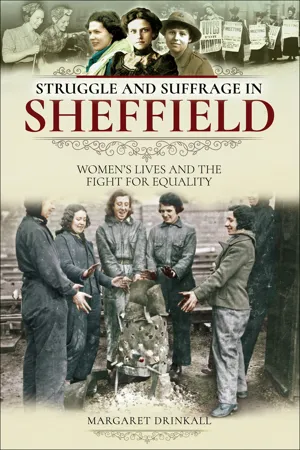
Struggle and Suffrage in Sheffield
Women's Lives and the Fight for Equality
- 192 pages
- English
- ePUB (mobile friendly)
- Available on iOS & Android
eBook - ePub
About this book
A history of the women's movement in Sheffield, England in the twentieth century, examining how women's roles evolved during and between the world wars.
This book looks into the role of women of Sheffield and how it has evolved from the powerlessness of a woman involved in a wife sale, to the achievement of the election of its first female Lord Mayor. Using newspapers of the period, archive material and modern photographs, Struggle and Suffrage in Sheffield examines how the role of women slowly changed in the city. It also highlights the militancy of the Sheffield suffragettes who not only organised demonstrations in Sheffield, but also sent groups to take part in some of the most notorious demonstrations in London. Following these demonstrations several local women were badly manhandled by police before being arrested and sent to Holloway Prison. Adela Pankhurst tried at first to bring the women of the Sheffield WSPU to achieve the vote through peaceful means, only when the Conciliation Bill of June 1910 was dropped, did she then encourage them to take more militant action.
Following the outbreak of both world wars the women of Sheffield worked in the steelworks making munitions. They worked day and night shifts as bombs were falling about them, but when both wars ended they were abruptly dismissed, as the men returned to take up their former jobs. Only following a meeting with PM Gordon Brown and the erection of a bronze statue of Women of Steel in 2016, did Sheffield women truly get the acknowledgment they deserved.
Information
CHAPTER ONE
Love and Marriage

Anyone reading a newspaper in the years from 1850 to 1900 could be forgiven for thinking that in Sheffield, as in other towns and cities throughout Britain, most women were invisible. All the most responsible city positions, the town council, the legal authorities, the guardians of the workhouse or any position of power and authority were all run by men. Women had no say in either the law of the land or the development of the towns and cities in which they lived. Occasionally the names of prominent females were mentioned in the Sheffield newspapers such as the Lady Mayoress, Mistress Cutler or the aristocratic Lady Fitzwilliam, but they were only mentioned when handing out prizes or attending philanthropic events. In the Victorian patriarchal society most women knew their place, and the subjection of the women to men was given validity by the Bible itself. In society’s eyes, as a female child you were under the jurisdiction of your father which continued until you were married, and then it was automatically transferred to your husband. Some women might have thought that freedom could only be obtained through marriage, however, the reality was that marriage held little freedom for women who could be sold like cattle if their husbands so desired. One woman had found out exactly how powerless she was when, on the morning of 12 January 1847, she found herself being sold in the Sheffield market place. Although this act was basically criminal, it underlined the law that a woman was the property of the man, and therefore could be sold by him like a piece of meat.
The disgusting affair came to light when the Mayor of Sheffield, Edward Vickers was on his way to the Town Hall, when he noticed that the market day crowd was much more extensive than usual. He made enquiries into the matter and when he was told that the crowds were there to see a ‘wife sale’, he ordered police officers to bring the pair before him. However, by the time they returned the man had absconded and only the woman was brought into the court room. She showed signs of great distress, sobbing bitterly as she told the bench that her name was Harriet Trotter and she was the wife of Robert Trotter. She explained that although they had been married for only twelve months, during that time her husband had treated her so cruelly that she had been forced to take him before the magistrates. Because of this, her husband informed her that he intended selling her to one of his workmates. Mrs Trotter said that Robert had a gun and had threatened to shoot her if she did not go through with the sale, and so great was her alarm that she had been forced to agree. She did not know the man into whose possession she was to be passed. The mayor asked that a warrant be issued for the husband. The next morning Robert Trotter appeared completely unrepentant when he was brought before the magistrates, who castigated him for his behaviour. However disgusted he felt at the circumstances, the mayor had little option but to order him to find sureties to keep the peace for the next six months and the couple left the court together.
Although we have a very different view today, in the Victorian period domestic violence within a marriage was socially acceptable. The religious ideal that a woman must follow the lead of her husband, appeared to give him a God-given right to punish his wife for her imagined transgressions. By law a man had a right to chastise his wife providing he used an implement no bigger than his thumb, which is where the saying ‘rule of thumb’ came from. As a result of this, numerous husbands were brought before the Sheffield magistrates’ court charged with assault on their wives. One particular violent case of domestic abuse left the court gasping as a wife spoke about her treatment at her husband’s hands. On 20 July 1871 a powerful-looking man named Charles Dent was brought into court, charged with assaulting his wife, Mary Jane Dent. The woman looked pale and emaciated when giving evidence that on the previous Monday she had gone to a neighbours begging for a cup of tea, as she had had nothing to eat for two days. The neighbour made her a drink, but before she could taste it her husband returned home drunk. He ordered her to go home and as soon as he got her into the house he struck her on the side of the head with a poker. Neighbours crowded around the house to try and help her, but the prisoner threatened as to what he would do to them if they did not go away. The police were called and the woman was only then rescued and taken to the workhouse, with her husband’s threats ringing in her ears. Mrs Dent had been examined by one of the medical officers of the workhouse, Dr Kemp, on the previous afternoon, and he told the bench that he found her suffering from the effects of ill usage and want of proper food, indeed food of any kind. He said that because of this she was in a very exhausted and debilitated state. The woman had told him that on the day of the offence, Dent had taken the last 3s in the house and had used it to get drunk. Mrs Dent said that in the past he had tried to get her to prostitute herself or steal for him, but she refused to do it. Neighbours confirmed the woman’s story and said that the couple were living in furnished property, although every piece of furniture in the house had been smashed. In his defence the prisoner tried to maintain that his wife had attacked him on occasions, but the mayor told him that:

Magistrates’ Court Sheffield where cases of domestic abuse were regularly heard.
a poor weak, half-starved woman such as your wife would be hardly likely to attack a brute like you. If you had a dog you would have treated it better than you had done your poor delicate wife. But for the interference of the neighbours you might have murdered her.
Warning Dent that he was lucky he was not before the bench on a much more serious charge, the prisoner was sentenced to six months imprisonment with hard labour at Wakefield Gaol. It was recorded that ‘the decision was received with much satisfaction by the spectators in court’. What happened to such women when the prison sentence had been served and she was once more at her husband’s mercy was left unrecorded. However, domestic abuse was becoming so prevalent that the government was forced to step in and look at ways in which women should be protected, even from their own husbands.
Divorce was expensive and so it was out of the question for ordinary women until the Matrimonial Causes Act of 1878 was introduced, when some Sheffield women were at last able to gain some slight protection from their abusive husbands. One such local case was brought before the Divorce Division of the High Court of Justice, one of the most senior courts in England, in March 1880. It was that of a Mrs Martha Jackson who brought a petition asking for a judicial separation from her husband, Mr Thomas Jackson who had been the proprietor of the Pavilion Music Hall in Sheffield. The court was told that the couple had married on 5 September 1854 and had lived together until May 1878. He was reported to be of ‘very intemperate habits’ and constantly assaulted his wife. Mrs Jackson claimed that he had threatened her so violently that she had been forced to flee the marital home and stay with relatives. She stated that her husband had threatened to break her neck ‘were it not for the law’ and had repeatedly struck her in the face and told her to leave the house. Mr Jackson did not appear at the court, but filed a report claiming that he had lived under extreme provocation from his wife. Witnesses gave statements about several incidents of cruelty, before Sir R.J. Phillimore granted Mrs Jackson a decree of judicial separation.
The same Act meant that working-class women were now able to get a judicial separation from local magistrates such as that of a Sheffield sculptor in September 1881. Theophilus Smith of Thirlwell Road, Heeley was arrested for committing an aggravated assault on his wife Mrs Louisa Smith and his 14-year-old daughter, Ethel. Her solicitor told the court that there was a history of assaults and that Smith had been brought before the bench on several occasions, the last being in May of that year. He had been bound over to keep the peace, which had expired on 25 August when he assaulted his wife again causing her to leave the house overnight. When she returned the next day Smith was lying on the couch in a state of inebriation. Inevitably it was not long before the couple argued once more and he tried to put her out of the house. The little girl Ellen tried to help her mother, but her father twisted her fingers so severely that she too was forced to leave the house. Mrs Smith gave evidence that she was afraid that her husband would kill her when he was drunk, and as a consequence she was staying at her father’s house. Young Ethel Smith and other witnesses were brought to support Mrs Smith’s statement. Mr Smith’s solicitor claimed that the assaults were not aggravated, but that he too had claimed provocation to be the reasons for the beatings. The solicitor assured the magistrates that if they refused her application and she returned back to live with her husband again, her life would not be in danger. The court adjourned for quarter of an hour before the magistrates agreed that Mrs Smith’s life would indeed be in danger if she returned to live with her husband. They fined him £5 and costs for the assaults, and ordered him to pay £1 a week to maintain herself and her four children. Mr Smith was also ordered to keep the peace for three months under sureties of £20. Her solicitor then made an astonishing claim that whilst Mr Smith had been at his office, he had made threats against himself if he continued with his wife’s claim and added that ‘he was himself most afraid of him’. The bench re-considered and increased Mr Smith’s sureties to £50 to keep the peace. Although Mrs Smith might have gained some respite from her cruel husband, she would no doubt have found it very difficult to keep herself and four children under ten years of age on £1 a week. Married women with dependent children had little options for employment, apart from undertaking other women’s domestic chores for a pittance.
As we have seen, even married women had few legal rights, being regarded as the property of their husband, therefore anything she owned automatically belonged to him. He had the right to take any property which his wife had or any earnings that she made. However, after the Married Women’s Property Act of 1870 a man could not take his wife’s earnings, but it was not until the Act of 1882 that married women were given the same rights as unmarried women, to own, buy and sell their own property. More importantly to women was the fact that, at last, their legal identity was seen as being separate to that of their husband. Nevertheless there were still cases of husbands using violence to gain their wives’ inheritance.
A case of a Sheffield woman whose husband had threatened to kick her to death if she did not hand over to him her legacy of £21, was heard before Sheffield magistrates on 14 March 1911. Mrs Emma Blagdon of Sutton Street, Sheffield applied for a separation order on the grounds of her husband’s persistent cruelty. She told the bench that she had been married for twelve years and there were seven children from the marriage, the youngest being only eight months old. Mrs Blagdon stated that although she had been granted a separation order in November last, the allowance which the magistrates had ordered had not been enough, and she had been forced to return to him. She claimed that since then the situation for her had become worse and worse. Her husband had spent £64 in the previous five weeks on horse racing and every time he lost he was most violent to her. If she remonstrated with him, he struck and kicked her and had also struck at the baby who had been sitting on her knee. The £21 had been left to Mrs Blagdon by her recently-deceased husband’s sister who, when told that she was dying, came to live with the family, and the sum was some small recompense for the nursing she had received from her sister-in-law. Mrs Blagdon had given her husband a sovereign, but later the same day he had demanded the rest from her and she was so afraid of him that she left the house. She told the magistrates that she wanted to use the money to train as a midwife, so that she could earn enough money to keep herself and her children. Mr Blagdon was called into court and he told the bench that the sum of money had been a bone of contention between the couple. He denied kicking or threatening her, but admitted that he had struck her once or twice and declared ‘she is always nagging’. However, the magistrates saw the wife’s point of view, and an order was made for the husband to pay 12s a week to his wife and she was to retain the custody of the children.
Throughout the years 1850–1950 many Sheffield working-class couples interpreted the law on marriage and divorce quite flexibly. As we have seen, for financial reasons a woman had little option but to find a man to provide for her, and a father who had lost his wife needed someone to look after his children. This interdependency often resulted in couples tending to ‘live in sin’ rather than divorce. The courts and indeed the community at large took a more lenient view on this subject, but when the couple took it further and the crime of bigamy occurred, then the matter was forced upon the legal authorities and they had to take action.
Such an instance happened in March 1850 when a man called Henry Bayley was brought before the judge, Mr Baron Rolfe, at the assizes in Leeds. He had been charged with marrying another woman whilst his former wife was still alive. The jury was told that he had married his first wife Eliza Bedford in 1843 and they had lived together for two years. Then in 1849 he contracted a second illegal marriage at Sheffield to a woman called Eliza Maxfield. When the second Eliza was informed that he was a married man she refused to believe it, until it was confirmed by her ‘husband’s’ brother. Bayley was quickly found guilty and transported for seven years. A well-used defence in such cases was that the errant party had not seen their previous partner for seven years and therefore assumed they were dead.

The chair from where Mr Baron Rolfe heard the bigamy case against Henry Bayley in March 1850.
As the century rolled on, some sympathy was demonstrated by the legal authorities and more lenient sentences were passed for the crime of bigamy. An illustration of this was when a 32-year-old Sheffield woman was charged with two counts of bigamy at Leeds Assizes on 25 May 1892 when she only received four months imprisonment. Sarah Ann Newboult told the judge that she had married her first husband at Everton near Bawtry in 1881 before marrying again in August 1888 to Henry Blaymires at Sheffield. Newboult obviously enjoyed getting married, as she then went through a third ceremony with a man named Briggs in April 1892 after telling him that she was a widow, her two previous husbands being accidentally killed. Newboult said that her first husband had treated her so badly that she had attempted to poison herself, and had been sent to a criminal lunatic asylum for six months. There she found herself a job as a nurse and supported herself until she met Blaymires with whom she lived for four years before agreeing to marry him. After they were married he too ill-treated her, before leaving her with nothing to eat and she was forced to sell all her furniture to buy food. She told the judge that Briggs, unlike the other two husbands, had always treated her well. Nevertheless the judge castigated her for deceiving this good man before sentencing her to one year’s imprisonment with hard labour.
It was estimated that the displacement of records during the Great War made it easier to commit bigamy. Such a case was heard at Sheffield Police Court on 31 March 1916. James Hillman, a soldier in one of the camps, was arrested and charged with bigamously marrying Ethel Bradley of Fawley Road, Sheffield. She was a widow whose husband had been killed at Neuve Chappelle in March 1915. The woman told the court that the prisoner had told her that he was a single man and that he had been fighting in France for the previous twelve months. They were married on 12 February at the Ecclesall Registry Office. She had no idea that he was married until she went to the barracks for a separation allowance, and it was the army authorities who informed her that he was a married man. His wife also appeared at the court with a baby in her arms and told the bench that the couple had been married at Shelton near Stoke-on-Trent in 1912 and had two children. They had lived together until April 1915 when he enlisted, although he had several times deserted from his regiment. The first Mrs Hillman was complaining that her husband had sold the house over her head, when the prisoner interrupted, and stated that he had only done it because she went with other men. His wife denied this and told the court that she had several times given him money to return back to his regiment, which he had instead spent on drink. The prisoner was sent to take his trial at the assizes, where in May 1916 he received a sentence of twelve months with hard labour.
The years from 1870–1900 gradually allowed Sheffield women, through legislation, the freedom to live their own lives. Although the crime of wife beating still persists into our modern day, we now have more support for abused wives to get away from the men who were violent towards them. It was not until campaigning by women’s groups in the 1970s, resulting in the Domestic Violence and Matrimonial Proceedings Act, that women finally obtained legal protection against abusive husbands. Ordinary women were still powerless, and perhaps nothing epitomises the powerlessness of women under male authority more than that of criminal women caught up in the British legal system.
CHAPTER TWO
Criminal Women and the Justice System
For the years 1850–1950 any woman committing any kind of offence in Sheffield would be taken to the cells underneath the Town Hall, before being brought up before the magistrates the following morning. There she would find that all the arresting officers, as well as the magistrates, solicitors and the clerk of the court were male. It would be a very frightening experience as even on ordinary days the bench would include men of a much higher social rank, with the title of ‘esquire’ as well as the Mayor of Sheffield. If it was a minor offence and the woman was sentenced, she would be sent to prison where again all the prison officers were male. For any c...
Table of contents
- Cover
- Title
- Copyright
- Introduction and Acknowledgements
- Contents
- Chapter One Love and Marriage
- Chapter Two Criminal Women and the Justice System
- Chapter Three Sex, Prostitution and the Contagious Diseases Acts
- Chapter Four Maternity and Motherhood
- Chapter Five The Long March towards Equality Begins
- Chapter Six The Sheffield Suffragettes
- Chapter Seven Sheffield Women and the First World War
- Chapter Eight The Interwar Years
- Chapter Nine Women of Steel
- Bibliography
Trusted by 375,005 students
Access to over 1.5 million titles for a fair monthly price.
Study more efficiently using our study tools.
Frequently asked questions
Yes, you can cancel anytime from the Subscription tab in your account settings on the Perlego website. Your subscription will stay active until the end of your current billing period. Learn how to cancel your subscription
No, books cannot be downloaded as external files, such as PDFs, for use outside of Perlego. However, you can download books within the Perlego app for offline reading on mobile or tablet. Learn how to download books offline
Perlego offers two plans: Essential and Complete
- Essential is ideal for learners and professionals who enjoy exploring a wide range of subjects. Access the Essential Library with 800,000+ trusted titles and best-sellers across business, personal growth, and the humanities. Includes unlimited reading time and Standard Read Aloud voice.
- Complete: Perfect for advanced learners and researchers needing full, unrestricted access. Unlock 1.5M+ books across hundreds of subjects, including academic and specialized titles. The Complete Plan also includes advanced features like Premium Read Aloud and Research Assistant.
We are an online textbook subscription service, where you can get access to an entire online library for less than the price of a single book per month. With over 1.5 million books across 990+ topics, we’ve got you covered! Learn about our mission
Look out for the read-aloud symbol on your next book to see if you can listen to it. The read-aloud tool reads text aloud for you, highlighting the text as it is being read. You can pause it, speed it up and slow it down. Learn more about Read Aloud
Yes! You can use the Perlego app on both iOS and Android devices to read anytime, anywhere — even offline. Perfect for commutes or when you’re on the go.
Please note we cannot support devices running on iOS 13 and Android 7 or earlier. Learn more about using the app
Please note we cannot support devices running on iOS 13 and Android 7 or earlier. Learn more about using the app
Yes, you can access Struggle and Suffrage in Sheffield by Margaret Drinkall in PDF and/or ePUB format, as well as other popular books in History & Modern British History. We have over 1.5 million books available in our catalogue for you to explore.