
- 160 pages
- English
- ePUB (mobile friendly)
- Available on iOS & Android
eBook - ePub
About this book
Cornwall has a rich and diverse history stretching from prehistoric times to the Norman Conquest and beyond, including the turbulent Tudor period, the English Civil War and the First and Second World Wars. Neolithic settlements and Bronze Age dwellings have been found at Carn Brea in Redruth and Rough Tour at Camelford, and many standing stones are scattered across the land. An ancient forest lies beneath the waters between Marazion and the legendary St Michael's Mount, which dates back thousands of years.The area is steeped in legend and Tintagel has mythical connections with King Arthur, although the present castle was probably constructed by Richard, Earl of Cornwall (brother to King Henry III), who owned the site from about 1234. Tales of the Devil, giants, minions and other imps abound in the county.Many of Daphne Du Maurier's books are set in Cornwall including Jamaica Inn and Frenchman's Creek. Virginia Woolf's novel To the Lighthouse was based on holidays at St Ives, Cornwall, where her family took her every summer until 1895. The lighthouse at Godrevy gives inspiration to the title.Various battles and conflicts as well as the diverse and fascinating history of Cornwall are all featured within the pages of this book, which also includes many of the well-known people who have greatly influenced the area over the years.
Trusted by 375,005 students
Access to over 1.5 million titles for a fair monthly price.
Study more efficiently using our study tools.
Information
CHAPTER 1
Saltash to Fowey
Saltash is the first place arrived at in Cornwall after crossing the Tamar by either the Tamar Bridge or the Royal Albert Bridge from Devon.
The area was originally called ‘Ash’ which referred to the many Ash trees that once grew there. The Middle English version of the name Ash was ‘Esse’. The area fell within the manor of Trematon and, when a member of the de Valletort family, who were the Lords of Trematon, built streets on the adjoining hillside in 1175, the waterside area was absorbed into the new borough. The market town flourished and became an important port. Other places in the South West were called Ash, so the town was prefixed with the word, ‘Salt’ to distinguish itself from the other communities in about 1300.
Although outgrown by Plymouth in the 1300s, Saltash continued to prosper and, with its deep-water anchorage, it was able to accommodate ships of all sizes. A small fleet of ships, crewed by local men, were kept by Saltash merchants. These ships were requisitioned for various war service over the centuries. There is a Saltash saying, ‘Saltash was a borough town when Plymouth was a fuzzy down’, which refers to Plymouth not being a seaport when Saltash was already established. Flint arrowheads and skin scrapers dating back from 4,000 to 1,500BC have been found in the fields around Saltash. There was also possibly a Roman settlement on the Saltash side of the ferry crossing.
In the seventh century, Trematon was the Celtic capital and in the ninth century, Anglo Saxons inhabited the area. Saxon rule ended with the Norman conquest of 1066 when Brian of Brittany became the Lord of the Manor. In 1068 William the Conqueror ordered that castles be built in the south-west after a rebellion. One of these castles was built at Trematon and was to become the overseer of the community. Robert, Count of Mortain (William’s half brother) was put in charge of Trematon and soon after founded a market. In 1075, Richard de Valletort, a knight who had fought at the Battle of Hastings, took control of Trematon from Robert and he founded a borough close to the castle. He also had built the parish church of St Stephen.
During Henry II’s reign a port was built at Saltash for the export of tin from local mines. In 1190 a new borough was set up by the de Valletorts near the Tamar foreshore. During this time, the market thrived, as did other activities based around the waterfront, including boat building, fishing and the ferry. This ran between Devon and Cornwall for hundreds of years and was the main route between the two counties before the building of the Royal Albert Bridge in 1859.
The de Valletort family owned the rights to the ferry from the Norman Conquest until 1270. From 1337 the ferry was leased for £10 a year to the Duchy of Cornwall. They continued to hold the lease each year apart from 1357 when it was leased to William Lenche who was the Black Prince’s military porter. This was seen as a reward for Lenche’s service at the Battle of Poitiers, a war fought in 1356 between the English and the French.
The Mayor and Burgesses of Saltash were granted the rights to the ferry in 1385. These rights lasted 200 years and the rent was paid directly to the Duchy of Cornwall. In 1733 the ferry overturned and sank with a loss of twenty lives.
There have been seven ferries since the introduction of the Saltash Floating Bridge Act of 1832 which allowed the Earl of Morley, Sir William Molesworth, Mr A. Edgcumbe and others to purchase the ferry rights and to establish a steam powered ferry. The ferry continued to run until its last journey on 21 October 1961 when the Tamar Bridge opened.
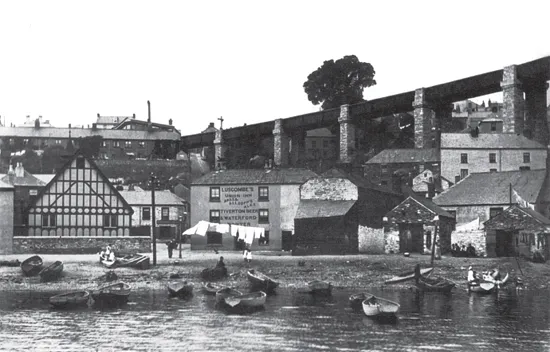
An early scene of the beach at Saltash. During Henry II’s reign,a port was set up at Saltash for the export of tin from local mines. In 1190 a new borough was set up by the de Valletorts near the Tamar foreshore.
Saltash grew up around the area of the waterfront where the ferry service was in operation for hundreds of years. The site of Tamar Street was once home to both fishermen and ferrymen. The area around the water’s edge has changed dramatically over the last 100 years. Once thriving with fishermen and cockle sellers, in 1957 the whole area, much to the dismay of its residents, was declared a slum and it was decided that many of the buildings should be demolished. This was a great shame as some buildings dated back to the 1500s and were as Sir Francis Drake, and many of his compatriots, would have once seen them. Clearing the area, ripped away much of Saltash’s history. At the time, the old industrial buildings were also removed, along with the gasworks which had closed in 1947. Buildings associated with fishing and boat building also disappeared. The three public houses remained although part of the Passage Inn (later renamed the Boatman) was demolished. A small, then modern, housing estate appeared in its place.
Several famous people have had connections with the town including the Hawkins family and of course, Mary Newman, the wife of Francis Drake, who was said to have lived at Culver Road.
When Drake landed at Saltash in 1587, the people helped unload the captured Portuguese ship, San Felipe. Drake had taken the ship on his way back home from a successful attack on the Spanish fleet. The cargo contained jewels, gold and spices which would be worth around the equivalent of £12 million today. The people of Saltash had never seen such treasure. Over £6,000 worth of spices were sold in Saltash while the rest of the treasure was taken back to London to be presented to Queen Elizabeth I. Moored in the River Tamar, the San Felipe caught fire and was destroyed. Parts of the ship were discovered in 1902 when dredging work was carried out.
The ship John Trelawney was equipped by the people of Saltash and proved successful in seeing off the Spanish Armada in 1588.
The property in Culver Road has been known as Mary Newman’s Cottage for many years, but many would dispute that she ever lived there. The cottage itself dates from 1480 and Mary was said to have been born there. It has been suggested that Mary was actually from St Budeaux and that her father was Henry Newman and records of the marriages of his five children, including Mary, are recorded at the church at Higher St Budeaux. Plymouth also lays claim to being Mary’s birthplace and local legend suggests that she was actually born at Agaton Farm and possibly lived, at some time, in the barn that still stands off Normandy Hill. The Newman family were important members of the community. Little is known about Mary Newman, no paintings or drawings exist, and details of her life are sketchy.
What is known, is that she married Francis Drake, then a young sailor, in 1569. They were married for 12 years until Mary died in 1581. Her cause of death is unknown though some suggest that she died of smallpox. Her grave lies where she was married, at the church at Higher St Budeaux in Plymouth although its location has been lost over the years.
While they were married, Francis Drake spent much of his time at sea. During this time, he became wealthy, famous and was knighted by Queen Elizabeth I. Drake was married again in 1585 to Elizabeth Sydenham and they moved to Buckland Abbey. They had no children.
During the English Civil War between 1642 and 1646, it is said that more Roundheads (Parliamentarians) died in the River Tamar from drowning after taking flight from the Battle of Braddock Down than those who died in the battle.
The battle was fought on 19 January 1643 and was a victory for the Royalist Army commanded by Sir Ralph Hopton. Earlier they had been forced to retreat in the face of a superior Parliamentarian army due to lack of powder and arms. However, when three Parliamentarian warships sheltered at Falmouth harbour to escape a storm on 17 January 1643, they were captured by the Royalists who thus replenished their stocks. Hopton then decided to lead an attack against Scotsman Lord Ruthin and his Parliamentarian troops.
The Royalists discovered the Parliamentarians at Braddock Down. Hopton had more infantry than Ruthin, however, the Parliamentarians had more cavalry. Once Hopton decided to attack, after revealing to the Parliamentarians that he had two light canons, Sir Bevil Grenville and his Cornish foot army charged the Parliamentarians with such force that it caused them to flee. They had only fired a single volley which managed to kill two Royalists who were the only casualties on their side. The escaping Parliamentarians reached Liskeard where the men of the town turned on them. The pursuing Royalists succeeded in capturing approximately 1,500 men together with arms and powder and five invaluable guns.
Meanwhile, Saltash had also suffered from heavy bombardment from the river. The fighting resulted in much bloodshed in the town and damage to many buildings. Plymouth was a Roundhead town and most of the damage was done to Saltash as Cromwell’s army tried to get a foothold in Cornwall. This is the reason why many of the Tudor and Jacobean properties that once existed in Saltash are no longer there.
At the end of the Civil War, Saltash declined as Plymouth and Devonport gained importance. The remains of a Royalist Civil War battery can still be found beside the lane leading down to Wearde Quay.
The Regatta was first recorded in 1835, although there had probably been regattas taking place before that year. Families living on Waterside have rowed their boats well before the Normans built Trematon Castle and races probably took place before the first recorded event. One of the most successful and well-known rowers in the Regatta was Ann Glanville. Between 1830 and 1850, she and her all-women crew competed in regattas all over Britain and were rarely beaten.
Born in 1796 in Saltash, she was the daughter of a waterman. She married young and had fourteen children. One of her characteristics was that she stood over 6ft tall. Together with her husband, she ran the ferry between Saltash and St Budeaux. When her husband fell ill and could no longer work, Ann carried on running the ferry so that she could support her family. She also delivered goods by water and would row between Sutton Pool and Budshead Mill, a distance of about 10 miles.
In her spare time, she put together a crew of female rowers from Saltash and they entered the 1833 Plymouth Regatta and took second place. Over the next fifteen years, the crew were the main contenders in many races around Britain. They had financial backers, including a Mr Waterman and Captain Russell who was in charge of the steamer, Brunswick.
They were hardly ever beaten even when they were up against male competitors. When they rowed in a race in Le Havre in 1842, the male competing team withdrew saying that it would be unchivalrous for them to compete against an all-female team. However, in truth, the probable reason for their withdrawal was that they knew they would be beaten. Ann Glanville died in 1878, aged 82, and is buried at St Stephen’s.
The Regatta continued into the early 1900s and 1909 was a highlight when HRH The Prince of Wales presented a cup to the winners. During the First World War, the event stopped but was resumed as soon as the war ended and it continued until the start of the Second World War. After the war the Regatta continued and still runs today, as popular as it ever was.
In the late 1800s, the town was chosen as the crossing place for Brunel’s Royal Albert Bridge and many of the people of Saltash began to commute regularly to Plymouth to work, particularly in the thriving dockyard. The town grew as the population rose sharply. When it was decided to also build the Tamar Road Bridge, 100 years later, Saltash became the main gateway to Cornwall and the population again grew as a result.
Many of the older buildings remain in Saltash although none so old as Mary Newman’s Cottage in Culver Road. Tudor buildings were either destroyed during the Civil War, during the Second World War or by modern redevelopment. Much has disappeared over the years. Gone are the dwellings at Waterside and the thriving community in the area once affectionately called Picklecockle Alley. Also lost are the buildings removed during the construction of the Tamar Road Bridge and the Saltash Tunnel. Many industries have also disappeared in the last hundred years or so including quarrying, ship building and fishing. The limekilns have disappeared, as have the gasworks. Gone too are the tea gardens, the coal merchants, the brass and iron foundries and of course, the ferry.
The Royal Naval Torpedo School, HMS Defiance, was established in 1884. The ninth vessel to be called HMS Defiance was launched in 1861 but it was considered obsolete, because of the new iron clad ships, so it was towed to Plymouth to become part of the reserve fleet. Stripped of machinery, she was moored in the Hamoaze, off Wearde Quay where she became the new Torpedo School training ship.
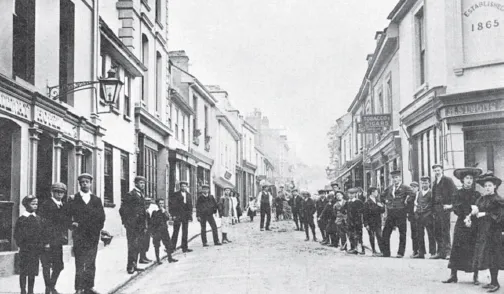
Lower Fore Street, Saltash in Victorian times. Parts of Fore Street have changed considerably over the years although this area is still easy to recognise.
Perseus was moored near to Cambridge and was joined to Defiance by a walkway. The upper deck of Defiance included a lecture room, officers’ rooms and a gymnasium. The lower deck housed the ship’s company. A recreation room included magazines, newspapers and even a billiard table.
When Isambard Kingdom Brunel built the Royal Albert Bridge in 1859, he changed the face of Cornwall forever. The rail link meant that many residents of Saltash began to commute to Plymouth on a regular basis.
The town grew in size as the population rose because of the easy rail access. Perhaps, nowadays, the bridge is seen as a great boon for Saltash but at the time, many residents weren’t happy about the new addition. Some called it ‘an iron monstrosity’ which they felt ruined the look of the once tranquil river. Others disliked the extra visitors to their small town. There was now easy access to Saltash whereas before people would have had to travel across the small ferry. Now, visitors could travel down in great numbers from all over the country and not just to Saltash,...
Table of contents
- Cover
- Title
- Copyright
- Contents
- Introduction
- Chapter 1: Saltash to Fowey
- Chapter 2: The Rame Peninsula
- Chapter 3: St Austell to Falmouth
- Chapter 4: Truro
- Chapter 5: St Keverne to Porthleven
- Chapter 6: Helston to St Ives
- Chapter 7: Hayle to Padstow
- Chapter 8: Rock to Bude
- Acknowledgements
- Bibliography
Frequently asked questions
Yes, you can cancel anytime from the Subscription tab in your account settings on the Perlego website. Your subscription will stay active until the end of your current billing period. Learn how to cancel your subscription
No, books cannot be downloaded as external files, such as PDFs, for use outside of Perlego. However, you can download books within the Perlego app for offline reading on mobile or tablet. Learn how to download books offline
Perlego offers two plans: Essential and Complete
- Essential is ideal for learners and professionals who enjoy exploring a wide range of subjects. Access the Essential Library with 800,000+ trusted titles and best-sellers across business, personal growth, and the humanities. Includes unlimited reading time and Standard Read Aloud voice.
- Complete: Perfect for advanced learners and researchers needing full, unrestricted access. Unlock 1.5M+ books across hundreds of subjects, including academic and specialized titles. The Complete Plan also includes advanced features like Premium Read Aloud and Research Assistant.
We are an online textbook subscription service, where you can get access to an entire online library for less than the price of a single book per month. With over 1.5 million books across 990+ topics, we’ve got you covered! Learn about our mission
Look out for the read-aloud symbol on your next book to see if you can listen to it. The read-aloud tool reads text aloud for you, highlighting the text as it is being read. You can pause it, speed it up and slow it down. Learn more about Read Aloud
Yes! You can use the Perlego app on both iOS and Android devices to read anytime, anywhere — even offline. Perfect for commutes or when you’re on the go.
Please note we cannot support devices running on iOS 13 and Android 7 or earlier. Learn more about using the app
Please note we cannot support devices running on iOS 13 and Android 7 or earlier. Learn more about using the app
Yes, you can access Cornwall by Derek Tait in PDF and/or ePUB format, as well as other popular books in History & British History. We have over 1.5 million books available in our catalogue for you to explore.