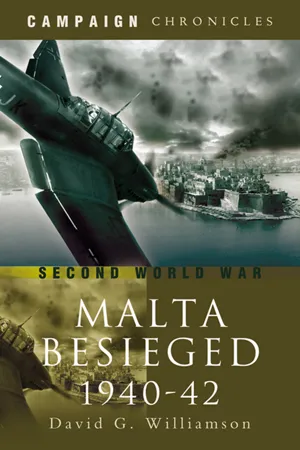
This WWII military study sheds new light on the legendary Siege of Malta, combining a detailed narrative with provocative strategic analysis.
The heroic defense of Malta against the Axis powers is one of the most famous episodes of the Second World War. For more than two years this tiny island was the critical to maintaining control of the Mediterranean and essential to the outcome of the North African campaign. David Williamson, in this thought-provoking reassessment, examines the strategy underpinning British determination to hold on to the island.
Expertly researched and vividly detailed,
Malta Besieged sheds new light on the motives for persisting with such a costly defense against huge odds. he also explores the question of the islanders' loyalty to the British crown. His incisive analysis takes account of the tactics employed by both sides, the political thinking and decision-making at the highest levels and the grim reality of the destruction and suffering on the ground.
- 224 pages
- English
- ePUB (mobile friendly)
- Available on iOS & Android
eBook - ePub
About this book
Trusted by 375,005 students
Access to over 1.5 million titles for a fair monthly price.
Study more efficiently using our study tools.
Information
Print ISBN
9781844154777
Subtopic
Military & Maritime HistoryCampaignChronicle

When the first air raid siren of the war sounded early on 11 June 1940, Malta’s air defences consisted of four obsolescent Gloster Gladiators (with the fall of France the four squadrons of Hurricanes that had been promised back in February were now required to help defend Britain from imminent German invasion). The fact that even this meagre number of four planes existed was a stroke of luck, as they had been crated up in March 1940 for action in Norway, but had been inadvertently left behind by HMS Glorious. They enabled Air Commodore Maynard, in command of Malta’s air defences, to form an operations flight of three with one plane in reserve. A month later he had to use all his formidable powers of persuasion to prevent the Navy from sweeping them away to Alexandria. In the absence of trained fighter pilots, seven men who had been flying sea planes, towing targets for AA guns to practise on, or doing office jobs volunteered to fly them . . .
June 1940: The Italian Blitz
Having declared war on the British Empire on the 10th, Italy launches a series of air strikes on Malta. For the next three weeks the island has only four outdated Gloster Gladiators to repel the raids. To escape the bombing, urban refugees flood into the villages causing chaos, overcrowding and potential health problems. The towns are left deserted and a prey to looters.
The four Gladiators were first scrambled for action at 6.49am on 11 June, but their inadequacies in comparison with the Italian aircraft became all too clear. They attempted to intercept a force of ten Savoia-Marchetti 79 bombers, but it took them so long to gain sufficient height to attack, the Italians were able to drop their bombs on the Grand Harbour and form up to fly back to their bases in Sicily. But Flight Lieutenant Burges, who had been a former flying boat instructor, did manage to get the tail of one of the bombers in his sights and even pepper it with his .303 machine guns. The Savoia, however, soon escaped; and to make matters worse, one of the Gladiators was shot down and destroyed.
To overcome this problem Maynard realized the remaining Gladiators would have to scramble earlier. This meant their pilots would have to divide themselves into watches, and when on duty, they would have to sit strapped into their cockpits, despite the blistering Mediterranean sun, and take off as soon as the air raid alarm was sounded. This would save some sixty seconds and enable the Gladiators to climb an extra 1,000 feet. The six pilots thus took shifts of four hours on and four hours off during the daylight hours from 5am to 8pm.
On 11 June there were eight Italian raids in total. It was during the seventh that the first Italian plane was shot down. Flying Officer W.J. Woods described the event in his combat report:
when climbing again to gain more height, I suddenly heard machine gun fire from behind me. I immediately went into a steep left-hand turn and saw a single-engine fighter diving and firing at me. For quite three minutes I circled as tightly as possible and got the enemy in my sight. I got in a good burst, full deflection shot, and he went down in a steep dive with black smoke pouring from his tail. I could not follow him down, but he appeared to go into the sea. [Source: Air Battle of Malta, p.11]
On 12 June two more enemy planes were shot down, but by 16 June the Italians began developing effective counter techniques. The bomber squadrons flew high, but one bomber in five would deliberately lag behind, acting as a decoy. When the Gladiators attempted to close on the straggler it would lose height, dropping beneath the Italian formation so the other bombers could train their movable guns at the pursuing fighters.
The Royal Italian Air Force (Regia Aeronautica)
In June 1940 the task of neutralizing Malta fell to 2 Squadra Aerea. A Squadra Aerea (Air fleet) consisted of two or more air divisions, which in their turn comprised each of at least two Air Brigades. These were subdivided into Stormi (wings), which usually were made up of two squadrons (Grippi). But the Groupo was the key operating unit and consisted of two Squadrigle (flights of nine aircraft), if these were multi-engine aircraft, and three, if they were single-engine. In December 1940 the Aeronautica della Sicilia (ASIC) assumed overall control of the campaign against Malta.
The Italian air offensive against Malta was badly hit by its poor supply organization and the slow rate in servicing aircraft. Fuel shortages, financial constraints and an alarmingly high accident rate combined to starve Italian pilots of the necessary training before combat. In 1940 a survey conducted for the Chief of the Italian Air Force Staff showed that only 30 per cent of the Regia Aeronautica’s 5,000 or so pilots managed to reach a competent standard. Tactical communications were also poor. The two-way voice radio did not become standard equipment for fighters until 1943. Up to that date pilots still had, for the most part, to rely on hand signals.
In 1940 bombers were the dominant arm in the Regia Aeronautica and their pilots were trained to fight in close defensive formations, which would simultaneously release their bombs on the target. From combat experience in Spain commanders had grasped the importance of fighter escorts and by late 1941 the Air Force was also beginning to practise the synchronization of level bombers, dive bombers and torpedo aircraft. Until they were provided with over 100 Junkers 87s from the autumn of 1941 onwards, the Italians also lacked suitable aircraft for dive bombing.
The Savoia-Marchetti SM79, which had first been tested in Spain, remained ‘by default’ – to quote Macgregor Knox, the expert on the Italian war economy – ‘the Regia Aeronautica’s most effective bomber.’ Its successor, the SM84 had to be withdrawn from service in 1941–42.
The Air Force did develop monoplane prototypes in the period 1939–40, but at the beginning of the war the majority of fighters were still open cockpit biplane fighters. The mass production of the potentially excellent Reggiane Re 2000 was slowed by the Air Force Chief, Francesco Pricolo, because it needed high octane fuel for its most effective performance.
Fiat produced what one historian has called ‘perhaps the worst monoplane fighter of the Second World War’: the open cockpit G50. The ultimate solution was for Alpha Romeo and Fiat to produce under license the Daimler Benz engines, DB601 and DB605. This resulted in creating the ‘adequately powered’ MC202, but production was limited because the Alpha Romeo plant only obtained a mere seventy-four engines from Germany in 1941.
Until 28 June a force of three Gloster Gladiators, whom Flying Officer John Waters nicknamed ‘Faith, Hope and Charity’, were able at any one time to take off – despite crash landings, burst pistons and gun shot damage. To keep them flying the ground crews showed a genius for adaptability. Parts of a Navy Swordfish were grafted on to one Gladiator, while Blenheim bomber engines, discovered in the stores, were fitted into two others.
The defence of Malta rested upon a partnership of guns and fighters, but clearly the success of the fighters would be short-lived unless reinforcements could rapidly be sent. The Acting Governor, Sir William Dobbie, pressed London for a delivery of Hurricanes. The day after the first raid he telegraphed the War Office that the relative success of the raids showed: ‘the importance of fighter aircraft. The four Gladiators here though successful in bringing one plane down are too slow.’ And he requested that a small force of five hurricanes, which were in Tunis en route for Egypt, should be sent to Malta instead. Two days later he returned to the subject and warned that: ‘if fighters are not sent, it will in my opinion, eventually take the form of a dangerous mass demand for surrender, if we are not able to give reasonable protection to the population.’ This message was further strengthened by Dobbie’s Defence Secretary, who was: ‘of the opinion that the next heavy raid will seriously affect public morale, unless a few fast fighters can be lent to us to break up bomber formations’. Finally the Commander-in-Chief of the Mediterranean Fleet, Sir Andrew Cunningham, gave his backing to these requests by stressing that it was: ‘most important to sustain the morale of the Maltese population, who might have to resist attempts at invasion under conditions when immediate naval help was not possible’.
On 18 June the Air Ministry did dispatch a squadron of Hurricanes, but owing to bad weather and mechanical faults only four arrived, and two of those were ordered to fly on to Egypt. However, a further twelve were sent out to the island on 31 July. They were initially shipped to Gibraltar, where they were transferred to a carrier, HMS Argus. The convoy left Gibraltar on 31 July. The subsequent operation set a precedent for the way Malta would be supplied with fighter aircraft. The key to success was to create diversions, which would conceal from the Italians that the Hurricanes were to be flown to Malta. The first was an aerial attack from the Ark Royal on the Cagliari airfields in Sicily, intended to weaken the Italians’ ability to attack the Argus, and the second was to lead the Italians to believe that operations were imminent in the northern part of the western basin of the Mediterranean by broadcasting a series of radio messages from a cruiser stationed off Minorca. On 2 August the Hurricanes flew off from the Argus and were able to reach Malta safely, except for one that crashed as it came down to land.
The first Italian raid of 11 June was made at 7.55am, just as people were setting off to work. According to Colonel Dixon, a British military doctor: ‘The first bombs caused a sort of “primary shock” to the inhabitants, none of whom realized that war was like this.’ Norah Goreing, daughter of the head groundsman of the Royal Naval football pitch at Corrodino, was luckier than most, as her father had already constructed a deep shelter capable of housing the whole family. Later she remembered that when the sirens wailed:
we awoke startled and frantically ran through the back door towards the shelter entrance. At that very moment the Italian bombers dropped the first salvo of bombs to ever hit the island. Five shattering explosions rocked the area as we dived for cover, leaving the glowing sunshine and headed into pitch blackness. [Source: Norah Jane Goreing: Memoir of a Head Groundsman’s Daughter, IWM 92/30/1]
The main attack was directed at the dockyards: consequently it was Valetta and the towns around the waterfront that bore the brunt. The Government had made some progress in converting several tunnels under Valletta into air raid shelters, and a start had been made to tunnel under Senglea and Conspicua. Along the main roads slit trenches had been dug to provide protection for those who were caught out in the open. By 18 June about 19,000 people in Valetta and Floriana were living in tunnels and underground shelters. Elsewhere, where these facilities did not exist to the same extent, the population fled to the countryside. In the first few days about 100,000 refugees fled to what were optimistically called ‘safe areas’. Kathleen Burke, a British teacher in Valetta, later described how: ‘every car in the district was chartered, and motors, donkey carts, and lorries, piled high with furniture filled the narrow streets leaving for comparative safety, until even the milkman stopped coming round and not a shop remained open.’
Inevitably an exodus on this scale put a huge burden on the smaller towns and villages. Not all the evacuees had friends or family in the countryside. Many just turned up in the villages and were accommodated in schools, civic centres and churches. On 15 June the Government announced a system whereby each village appointed an official, who, in cooperation with the District Committee, the police, and the Special Constabulary, would be responsible for organizing the feeding and billeting of the evacuees. These officials were also to ensure that the sanitary system and water supply could adequately cope with the influx. A report from the small village of Lija, which had to cope with a refugee population of 3,000, indicates what this work involved:
preparing schools, rigging screen and partitions in public buildings for families [. . .] making plank beds; collecting furniture, china and clothes [. . .] finding homes for refugees; persuading owners to accept them voluntarily; escorting lorries and buses to stricken areas [to bring over] evacuees and supplies; assisting in opening new shops; keeping order in houses without owners [. . .] organizing and controlling a soup kitchen, a maternity house, and a hospital-room for whooping cough cases. [Source: Joseph Micallef, When Malta Stood Alone]
The Church also played a key role in feeding the refugees by setting up ‘Economical Kitchens’, which were financed by weekly collections on Sunday from congregations throughout Malta, wherever there were gaps in the official provision.
In the meantime the towns were virtually deserted. One visitor to Vittoriosa observed that: ‘I could not see anyone except starving cats and dogs.’ Those who had not fled to the countryside had fled to the tunnels, which were packed with people living in the most unhygienic conditions. The empty shops and houses also attracted looters, and in the three months July–September the number of burglaries doubled compared to the previous year.
By the end of June there had been seventy-five air raids in which eighty civilians were killed and 180 injured. Except for the destruction of the floating dock on 21 June, neither the naval facilities nor the aerodromes suffered serious damage. In the dockyards work had only been interrupted for comparatively short periods. The single most serious incident during the June attacks occurred on the 26th, when a bus full of passengers en route to Valletta was hit by an incendiary bomb at the Marsa Crossroads, resulting in twenty-eight deaths. On 7 July HMS Olympus was hit in No. 3 Dock and over 100 houses in the surrounding area demolished.
By late July the raids became less intense and the refugees began to return to the cities. As Kathleen Burke remarked: ‘when the chief danger had abated, the overcrowding became more irritating and less tolerable than the off chance of being bombed.’
Instead of concentrating on Malta, Mussolini dissipated Italy’s limited military and economic strength on a series of campaigns. Not only did Italian troops advance into the Sudan and British Somalia, but in early September they moved into Egypt and six weeks later attacked Greece through Albania. It was not surprising, therefore, that the overstretched Italian Air Force could launch only a series of sporadic raids on Malta in August and September. Dobbie reported on 20 August that there had been a ‘considerable relaxation from bombing and a return to normality’, but he had already warned London not to crow too loudly over this as:
minimization of the effect from Italian raids on Malta may only produce intensification of these attacks. At present there is reason to suppose that they have deliberately not attacked so fiercely as they would have the world believe, and it is suggested that the Italian dream of intensive damage done should be allowed to continue in view of our meagre defences. [Source: PRO WO 106/3062]
That the Italians could still launch effective raids was shown by their attack on two of Malta’s three aerodromes on the same day, 20 August. This resulted in the damaging of a number of Blenheims, which were passing through en route to Egypt. In early September the Italians began using German Ju 87s, and in raids on 15 and 17 September, for example, delayed action bombs were dropped on Hal Far airfield. However, in the first half of October there was only one air raid. Altogether, in the five months from July to early January 1941, there were 146 alerts and only five civilians were killed and fourteen injured.
The lull in the bombing gave Dobbie the chance to strengthen Malta’s defences and build up her reserves of supplies. The Coordinating Committee of Supplies (COSUP) was set up in Malta, which handed a formidable series...
Table of contents
- Cover
- Contents
- List of Plates
- List of Maps
- Acknowledgements
- Background
- Campaign Chronicle
- Aftermath
- Appendices
Frequently asked questions
Yes, you can cancel anytime from the Subscription tab in your account settings on the Perlego website. Your subscription will stay active until the end of your current billing period. Learn how to cancel your subscription
No, books cannot be downloaded as external files, such as PDFs, for use outside of Perlego. However, you can download books within the Perlego app for offline reading on mobile or tablet. Learn how to download books offline
Perlego offers two plans: Essential and Complete
- Essential is ideal for learners and professionals who enjoy exploring a wide range of subjects. Access the Essential Library with 800,000+ trusted titles and best-sellers across business, personal growth, and the humanities. Includes unlimited reading time and Standard Read Aloud voice.
- Complete: Perfect for advanced learners and researchers needing full, unrestricted access. Unlock 1.5M+ books across hundreds of subjects, including academic and specialized titles. The Complete Plan also includes advanced features like Premium Read Aloud and Research Assistant.
We are an online textbook subscription service, where you can get access to an entire online library for less than the price of a single book per month. With over 1.5 million books across 990+ topics, we’ve got you covered! Learn about our mission
Look out for the read-aloud symbol on your next book to see if you can listen to it. The read-aloud tool reads text aloud for you, highlighting the text as it is being read. You can pause it, speed it up and slow it down. Learn more about Read Aloud
Yes! You can use the Perlego app on both iOS and Android devices to read anytime, anywhere — even offline. Perfect for commutes or when you’re on the go.
Please note we cannot support devices running on iOS 13 and Android 7 or earlier. Learn more about using the app
Please note we cannot support devices running on iOS 13 and Android 7 or earlier. Learn more about using the app
Yes, you can access Malta Besieged, 1940–1942 by David G. Williamson in PDF and/or ePUB format. We have over 1.5 million books available in our catalogue for you to explore.