- 208 pages
- English
- ePUB (mobile friendly)
- Available on iOS & Android
eBook - ePub
About this book
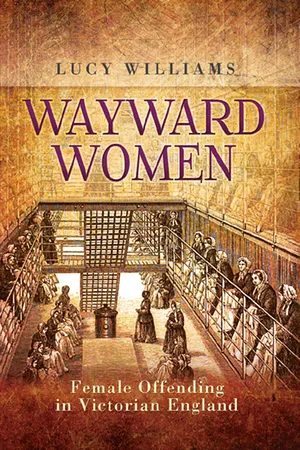
We most often think of the Victorian female offender in her most archetypal and stereotypical roles; the polite lady shoplifter, stowing all manner of valuables beneath her voluminous crinolines, the tragic street waif of Dickensian fiction or the vicious femme fatale who wreaked her terrible revenge with copious poison. Yet the stories in popular novels and the Penny Dreadfuls of the day have passed down to us only half the story of these women and their crimes. From the everyday street scuffles and pocket pickings of crowded slums, to the sensational trials that dominated national headlines; the women of Victorian England were responsible for a diverse and at times completely unexpected level of deviance. This book takes a closer look at women and crime in the Victorian period. With vivid real-life stories, powerful photos, eye-opening cases and wider discussions that give us an insightful illustration of the lives of the women responsible for them. This history of brawlers, thieves, traffickers and sneaks shows individuals navigating a world where life was hard and resources were scarce. Their tales are of poverty, opportunism, violence, hope and despair; but perhaps most importantly, the story of survival in the ruthless world of the past.
Information
Chapter 1
Locked Away, Sent Away, Launched into Eternity
It might have taken decades and countless history books but here in modern Britain we have finally come to the realisation that most things were not better in the past. Putting away the rose-tinted glasses when it comes to thinking about the Victorian stance on marriage and gender, on working hours and fair pay, on healthcare, voting rights and education is long overdue. It turns out that backbreaking manual labour and a world with no old-age pensions was not an easier lot than what we have now. We don’t have to look particularly hard to find evidence that proves Victorian England could be a difficult and unfair place in which to live. However, whether it’s politicians waxing lyrical about ‘new policies’ on the television, or simply snatched pieces of conversation in bus stop lines and supermarket queues, one area in which we refuse to relinquish the belief that our forebears had it right is when it comes to crime and punishment. The very phrase ‘tough on crime, tough on criminals’ brings back to us images of a bygone era when the law ruled with an iron fist and showed no mercy to society’s bad apples – an image that is inescapably Victorian.
If there is one thing no one could accuse the Victorians of it is being soft on crime. The nineteenth century seems to have been a period in which statesmen, judges and philanthropists spent more time debating and devising what to do with criminals than any other time before or since. From the 1830s to the dawn of the twentieth century, three types of penalty dominated the justice system in England: imprisonment, transportation and capital punishment. Before we delve into the world of women and crime in Victorian England it is worth considering the fate that awaited many female offenders.
Locked away
One of the most renowned achievements of the Victorian age is the birth of the modern prison system. Those undergoing imprisonment in twenty-first century England share more in common with their Victorian predecessors than we might imagine. The ideals of punishment, reform and redemption first mooted by the Victorians are still prominent in discussions of prison and prisoners today. The practicalities of prison life are not wholly different either. Prisons today still function on a basic system of privileges and punishments, where inmates are given rights in return for taking on certain responsibilities. What’s more, modern prisoners can even find themselves within the same buildings, treading the same halls, as the Victorian incarcerated. Institutions such as Brixton, Strangeways, Pentonville, Wormwood Scrubs and Holloway are still in use as prisons today and serve as an iconic reminder of Victorian penal innovation. (See plate 2.) The Victorians were responsible for inventing everything from the idea of prison uniforms to the parole system.
The rise of prisons to become the dominant form of punishment in Victorian England was a unique episode in history. The previous centuries had seen a criminal justice system that used a range of corporal and capital punishments. Gaols and ‘lock-ups’ did exist but acted as little more than holding pens for those awaiting trial, whipping, branding or hanging. Offenders could be held in houses of correction in various locations in England as punishment but these cases were relatively uncommon and did not stretch to long terms of incarceration. The most famous pre-Victorian prison was Newgate – a large gaol that held the accused awaiting trial in London, the convicted awaiting transportation and those awaiting the noose at Tyburn. Newgate, like other pre-Victorian prisons, was not intended to punish or reform, but primarily to detain – both men and women of all ages mixed together. Some were already convicted; others were awaiting their turn in the dock. Serious violent offenders were detained alongside the wrongly accused or those guilty only of petty public order infringement. Conditions in such places could be dire. Unequipped for long-term habitation, large cells would hold numerous prisoners without adequate bedding or sanitation. Disease and infection spread easily. Corruption amongst those who ran or were incarcerated within the prison walls was rife. Gaolers could be bribed for access to more food, alcohol and preferential treatment. Some accounts suggest that women too could be bought and sold within the prison walls, or coerced into sex by the gaolers who controlled access to provisions and visits.
The ‘Bloody Code’, as the eighteenth-century justice system is often referred to, began to decline in earnest by the early nineteenth century as transportation to Australia increased and social sensibilities towards violence, gender and age evolved. Theorists and officials began to accept that justice based solely on punitive measures did little to deter others from crime or to reform criminals. A whipped man tended to turn resentful towards his oppressor rather than become repentant. A hanged woman learnt nothing and those who watched her die were only deterred from getting caught. Those responsible for justice in England began to look for other ways to address the problem of crime. Industrialisation and the movement of thousands of workers into towns and cities made finding a solution to tackling and removing criminal elements in society all the more pressing.
The famous convict prisons such as Millbank and Pentonville began life in London in the early part of the nineteenth century and ushered in a fresh penal age. New prisons sought to remove criminals from society and spend years breaking their characters before releasing them back into the world as reformed and productive individuals. By the mid and later decades of the nineteenth century, as transportation came to an end, the prison system began to dominate the experience of punishment. A network of local and national institutions became a repository for the vast majority of law breakers the length and breadth of the country. From 1853, the parole system (based on the somewhat successful ‘ticket of leave’ system operated in Australia) was in place, discharging prisoners who passed their time peacefully and recalling those who reoffended.
Because the Victorians were amongst the first to recognise the social, cultural and developmental significance of childhood, they were the first in English history to legislate specifically for children too. This meant not only putting in place special measures for the protection of children but also providing for their punishment. In previous centuries, children of seven and eight had faced the full force of the adult law. Children of ten years old were transported and it was not unknown for children aged twelve and thirteen to face capital punishment. The Victorians not only put an end to capital punishment for those under the age of sixteen, they also created special institutions to cater for children who committed crime. These institutions allowed for the recognition of childhood as a distinct phase in a person’s development, when their character and sense of morality were assumed to be forged, and kept young offenders from associating with (and learning from) the hardened adult criminals who filled convict and local prisons.
Separate penal institutions for children did not exist until 1902 with the creation of the now world-famous Borstal Prison in Kent, but institutions such as reformatory schools were created to house deviant youths. Coverage across England was sporadic, with some localities having no reformatories for girls and others like Liverpool and Coventry having multiple reformatories for young women. Girls from the age of eight to eighteen, who were convicted of crimes from prostitution to picking pockets or brawling with their neighbours, might receive a sentence of five to fourteen days in an adult prison (where hard labour or harsh conditions might ‘scare them straight’) followed by five or seven years in a reformatory. Young girls convicted of even just one minor offence at eleven might find themselves confined in a reformatory until they reached eighteen. The idea was simple: to catch offenders young and change their characters before they became hardened criminals. Within these institutions, often run by private funds or religious bodies, young female offenders would be given moral correction and religious education. They would be subject to strict routine and discipline and taught practical skills such as laundry work, housework and sewing, which might help them secure employment upon release. This combination of moral reformation and practical preparation was thought to help them avoid the temptation or necessity of turning again to crime.
For adult women a sentence of imprisonment meant one of two things; confinement in a local prison for a period of a few days up to two years where they might undertake corrective ‘hard labour’ such as picking oakum, or penal servitude from three years to life in one of England’s convict prisons. Here, depending on conduct, ability and duration of sentence, they would carry out a range of domestic chores essential to the running of the prison such as laundry and cooking, or other work such as fibre pulling, sewing and knitting. For most female offenders, the end of a spell of penal servitude would entail a stay in a penal refuge. Here, still under tight controls, female convicts would be taught skills to fit them for domestic service positions upon release, although such employment was by no means assured.
The prison system was strictly regimented and highly oppressive. Alongside specialist regimes like the silent system and separate confinement, a generalised system of privileges and punishments controlled everything – what diet offenders were given, what they wore, if they could write letters and receive visitors, and what money, or ‘gratuity’, they could expect upon release. The message of the penal system was clear: those who obeyed would serve less time in prison and be better off when they left; those who did not obey would face physical and mental punishment. However, demanding obedience from those who have already shown nonconformity to the law, and to expect good behaviour from individuals based on the idea of future gratification, was, to put it lightly, flawed.
The time that female offenders spent in prison is often some of the best documented of their lives. The bureaucratic machine that was the Victorian state had paperwork for everything. When a woman was admitted to prison, especially convict prison, a record was taken not only of what she had done and how long she was required to be incarcerated, but also her personal history, physical description, medical history, height and weight. Records kept of the imprisoned tell us how they passed their time, from the labour they were required to carry out to the religion they followed and the prison rules they broke. Guidelines for diet and conduct let us know about prison life down to the last details of what women ate on a daily basis. The limited literacy of the women who passed through English prisons means that first-hand accounts of their experiences often come from rare cases and extraordinary offenders. However, whilst the women who wrote them were far from typical offenders they can still give us some of the most insightful descriptions of life behind bars.
Fifteen lost years
The trial of Florence Maybrick for the murder of her husband James in 1889 was one of the greatest causes célèbres of the Victorian Age. Florence Chandler, a young southern belle from America, had married James Maybrick, a cotton broker two decades her senior, in 1881 (see plate 3). In their unhappy eight-year marriage, the Maybricks had two children and at least two confirmed extramarital affairs. James had kept a long-term mistress for upwards of twenty years. Florence had a short-term dalliance with Alfred Brierley – one of her husband’s business associates. The relationship was to change Florence’s life irrevocably.
After suffering a short gastrointestinal illness in 1889, James Maybrick died in agony at the couple’s home in Liverpool. Knowledge of the Maybricks’ marital strife in the preceding months made James’s brother suspicious of his sudden death. An autopsy on James’s body found traces of the deadly poison arsenic in his body and Florence was immediately suspected of his murder.
Much contradictory evidence was provided at a hastily called trial and to this day, historians and writers remain divided as to whether Florence intentionally administered arsenic to her husband or whether his death was caused by dangerous self-medication, or even as a result of poisoning at all. What is clear to most who study the details of the case is that the evidence presented at the trial had a tendency to present Florence as cold, adulterous, licentious and heartless instead of supporting a case for criminal guilt. The prosecution sought to prove to the jury that Florence Maybrick was a woman of bad character and thus capable of murdering her husband rather than relying on the evidence that proved beyond reasonable doubt that she had, in fact, poisoned him.
The case plunged pro- and anti-Maybrick factions across the country into fierce debate. Did she do it? Could she have done it? What would happen to her now? Despite significant support for Florence both in England and America, at the close of the trial a jury wasted very little time in declaring her guilty. The judge passed the sentence of death, as was the custom in all murder cases. Florence’s supporters mounted a rapid appeal and her death sentence was quickly commuted to life imprisonment. Evidence suggesting her innocence continued to be supplied to the Home Office and even Queen Victoria herself considered that the Maybrick case represented more than the fate of one woman. The imprisonment of Florence Maybrick was used to set an example to unfaithful and dissolute wives across England. The case became an exemplar of the might and power of the British justice system. To release Florence too soon would have raised many uncomfortable questions and so she was to spend the next fifteen years in prison.
Florence Maybrick may have been a far from ordinary convict, but in all likelihood, her experience of prison was very similar to that of all of the women who passed through such institutions. What we know about Florence’s incarceration has left us with almost unequalled insight into a woman’s experience in a Victorian convict prison. Her memoir of this time, My Fifteen Lost Years, was published shortly after she left prison. It gives us a rare, first-hand narrative of the terror and tedium endured by women who served at Her Majesty’s pleasure.
After sentencing, Florence was transferred from Liverpool to Woking Prison, in Surrey. Once there she was placed in a prison uniform, to which, she admitted, ‘the greatest stigma and disgrace is attached’. Her long hair was cut short to her neck by a matron with a pair of scissors. Florence was weighed and measured and left in the infirmary. Here, alone and frightened, her only company came from the ‘raving and weeping’ of an unidentified woman in an adjacent cell. The following morning, she was subjected to a medical examination and was then prepared to enter the main prison. She was taken to her own 7-foot by 4-foot cell, which contained a hammock, three shelves and a small window. Inside this room she spent nine months in solitary confinement. Florence described her daily routine:
It is six o’clock; I rise and dress in the dark; I put up my hammock and wait for breakfast; I hear the ward officer in the gallery outside. I take a tin plate and a tin mug and stand before the cell door. Presently the door opens; a brown, whole-meal, 6-ounce loaf is placed upon the plate; the tin mug is taken, and three-quarters of a pint of gruel is measured in my presence when the mug is handed back in silence and the door is closed and locked. After I have taken a few mouthfuls of bread I begin to scrub my cell. A bell rings and my door is again unlocked. No word is spoken because I know exactly what to do. I leave my cell and fall into single file, three paces in the rear of my nearest fellow convict. All of us are alike in knowing what we have to do, and we march away silently to Devine service. … Chapel over I returned directly to my cell, for I was in solitary confinement and might not enjoy the privilege of working in company with my prison companions. Work I must, but I must work alone. Needlework and knitting fall to my lot. My task for the day is handed to me, and I sit in my cell plying my needle, with the consciousness that I must not indulge in an idle moment, for an unaccomplished task means loss of marks, and loss of marks means loss of letters and visits. As chapel begins at 8.30 I am back in my cell soon after nine, and the requirement is that I shall make one shirt a day – certainly not less than five shirts a week. If I am obstinate or indolent, I shall be reported by the ward officer, and be brought to book with punishment – perhaps a reduced diet of bread and water and total confinement to my cell for twenty-four hours. If I am faint, weak or unwell, I may be excused the full performance of my task; but there must be no doubt of my inability. … Then comes ten o’clock, and with it the governor and his escort. He inspects each cell, and if all is not as it should be the prisoner will hear of it. … The prison ...
Table of contents
- Cover
- Dedication
- Title Page
- Copyright
- Contents
- Acknowledgements
- Introduction: Infamous Creatures
- Chapter 1: Locked Away, Sent Away, Launched into Eternity: Punishment in Victorian England
- Chapter 2: Got to Pick a Pocket or Two?: Crimes of Property
- Photo Gallery
- Chapter 3: The Brutal Side of the Gentle Sex: Violent Women
- Chapter 4: The Demon Drink and the Great Social Evil: Challenging Public Order
- Conclusion
- For the Intrigued Reader
Trusted by 375,005 students
Access to over 1.5 million titles for a fair monthly price.
Study more efficiently using our study tools.
Frequently asked questions
Yes, you can cancel anytime from the Subscription tab in your account settings on the Perlego website. Your subscription will stay active until the end of your current billing period. Learn how to cancel your subscription
No, books cannot be downloaded as external files, such as PDFs, for use outside of Perlego. However, you can download books within the Perlego app for offline reading on mobile or tablet. Learn how to download books offline
Perlego offers two plans: Essential and Complete
- Essential is ideal for learners and professionals who enjoy exploring a wide range of subjects. Access the Essential Library with 800,000+ trusted titles and best-sellers across business, personal growth, and the humanities. Includes unlimited reading time and Standard Read Aloud voice.
- Complete: Perfect for advanced learners and researchers needing full, unrestricted access. Unlock 1.5M+ books across hundreds of subjects, including academic and specialized titles. The Complete Plan also includes advanced features like Premium Read Aloud and Research Assistant.
We are an online textbook subscription service, where you can get access to an entire online library for less than the price of a single book per month. With over 1.5 million books across 990+ topics, we’ve got you covered! Learn about our mission
Look out for the read-aloud symbol on your next book to see if you can listen to it. The read-aloud tool reads text aloud for you, highlighting the text as it is being read. You can pause it, speed it up and slow it down. Learn more about Read Aloud
Yes! You can use the Perlego app on both iOS and Android devices to read anytime, anywhere — even offline. Perfect for commutes or when you’re on the go.
Please note we cannot support devices running on iOS 13 and Android 7 or earlier. Learn more about using the app
Please note we cannot support devices running on iOS 13 and Android 7 or earlier. Learn more about using the app
Yes, you can access Wayward Women by Lucy Williams in PDF and/or ePUB format, as well as other popular books in History & British History. We have over 1.5 million books available in our catalogue for you to explore.