eBook - ePub
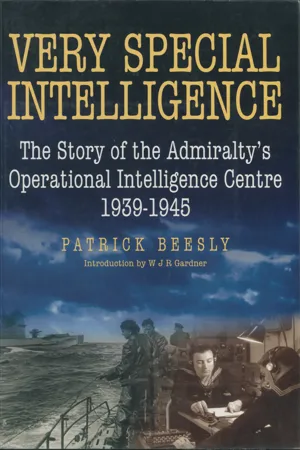
Very Special Intelligence
The Story of the Admiralty's Operational Intelligence Centre, 1939–1945
- 296 pages
- English
- ePUB (mobile friendly)
- Available on iOS & Android
eBook - ePub
Very Special Intelligence
The Story of the Admiralty's Operational Intelligence Centre, 1939–1945
About this book
Operational Intelligence Centre was the nerve centre of the British Admiralty in World War II, dedicated to collecting, analyzing and disseminating information from every possible source which could throw light on the intentions and movements of German naval and maritime forces. OIC labored tirelessly, despite early disappointments, to supply the Navy and RAF with the intelligence that would enable them to defeat Hitler and his admirals. Patrick Beesly, an insider drawing on considerable personal knowledge, reveals, in full, the compelling story of OIC. He throws light on dramatic episodes such as the hunt for the Bismarck; the tragedy of Convoy PQ17; the long war against the U-boats; and on many other significant events critical to the course of the war. Very Special Intelligence, here presented with a new Introduction which sets the work in context and takes account of new research, is the fascinating story of an organization which contributed so much to Allied success.
Information
Subtopic
Military & Maritime HistoryIndex
HistoryCONTENTS
Introduction by W.J.R. Gardner
Author’s Note and Acknowledgments
Preface
1 ASTUTE MEN
2 THE FIRST TWELVE MONTHS.
A LEAN TIME
A LEAN TIME
3 OCTOBER 1940–MAY 1941.
SIGNS OF IMPROVEMENT
SIGNS OF IMPROVEMENT
4 GERMAN NAVAL CIPHERS AND B.P.
5 THE SINKING OF THE BISMARCK
6 JUNE–DECEMBER 1941. SPECIAL
INTELLIGENCE AT LAST
INTELLIGENCE AT LAST
7 JANUARY–JULY 1942. OPERATION
PAUKENSCHLAG AND THE GREAT BLACK-OUT
PAUKENSCHLAG AND THE GREAT BLACK-OUT
8 THE CHANNEL DASH AND PQ.17
9 JULY–DECEMBER 1942. THE INDIAN OCEAN AND TORCH
10 TRITON TO THE RESCUE
11 JANUARY–MAY 1943. CLIMAX OF THE BATTLE OF THE ATLANTIC
12 JUNE–DECEMBER 1943. DÖNITZ TRIES AGAIN
13 THE END OF SCHARNHORST AND TIRPITZ
14 DENNING’S DAMNED BLACK MAGIC
15 U-BOAT WARFARE. D DAY TO VE DAY
Epilogue
Some Personal Views
The Admiralty
Sources
Afterword by Ralph Erskine
Bibliography
Index
ILLUSTRATIONS
Between pages 136 and 137
1 A wartime view of the Citadel
2 Gross Admiral Räder
3 Rear Admiral Denning
4 Gross Admiral Karl Dönitz
5 Rodger Winn
6 Extracts from B. Dienst reports during April and May 1943 to B. d.U. and others stressing Allied H/F D/F activity
7 The telex message from N.S. (Naval Section) B.P. to I.D.8.G. (Denning’s section of O.I.C.) of the decrypt of the German order to Scharnhorst to sail to attack JW.55B
8 The first page of the Submarine Tracking Room’s report to the First Sea Lord for the week ending May 24, 1943
INTRODUCTION
by W.J.R Gardner
THE FIRST edition of Very Special Intelligence was published in 1977 following a series of articles in The Naval Review by Patrick Beesly. It rapidly gained an audience among two main groups of people: those who had participated in World War II, and students of the period who had not necessarily been players in that global drama. A new edition of this book will again capture the attention of those original readers—the former of which are now sadly much diminished—but will also educate a new generation. There are, perhaps, three dimensions we should stress in relation to the original work: the historical ambience into which it fell, the strategic context of the organisation described by Beesly in the book, and the impact of subsequent writing on the subject.
For many years after 1945, historical literature was dominated by two types of book: the official history of events, and the reminiscences of participants. This was particularly true for the Battle of the Atlantic, the shorthand term for the long, complex, sometimes bitter struggle between Grossadmiral Karl Dönitz’s U-boats on one hand and groups of merchant ships and escorts, generally sailing in convoy, on the other. This does not form the entire subject of Beesly’s book, but it does occupy the largest part and it was also incidentally where Beesly himself was employed for much of the war. Some of the other accounts were very good but had obvious limitations. The official naval history, The War at Sea by Captain S. W. Roskill, was broad in scope and generally balanced. However, the intelligence side was barely covered at all and there was one very significant, and quite deliberate, omission: Ultra. As Beesly and others have pointed out, this is not really the correct term for the product of the codebreaking intelligence carried out at Bletchley Park and elsewhere, it was merely a marking applied to some of the decrypted signal-derived intelligence, to indicate their very great sensitivity and the great need for care in their handling. However, Ultra has become, in both popular and scholarly accounts, a short-hand term for codebreaking, and its implied definition will be used throughout this piece.
Roskill’s omission is hardly surprising as his last volume was produced as early as 1961. Tantalisingly, the book contains at least one hint for the initiated that Roskill knew very well about Ultra, as indeed he did. But the gaps also meant that more than one generation of readers grew up with no knowledge of this factor. Stronger hints were given out by Roskill’s contemporaries. Ladislas Farrago’s The Tenth Fleet (1962) sailed pretty close to the wind and Ronald Seth’s The Fiercest Battle (1961) also gave a single indication. But perhaps the closest brush with open acknowledgement of Ultra came with Donald McLachlan’s Room 39: Naval Intelligence in Action (1968). It has to be said that McLachlan, a member like Beesly of the wartime Naval Intelligence Division (NID), did not just content himself with the odd veiled hint but actually discussed such subjects as cryptanalysis and Station X—one of the names for Bletchley Park—at some length. Moreover, McLachlan was granted access to certain official papers denied to Beesly when the latter was writing his biography of Admiral John Godfrey, Very Special Admiral, over ten years later. The strange thing is that McLachlan’s coverage drew very little attention and the truth behind Ultra—he did not use the word itself—remained hidden.
The great breakthrough came in 1974 with the publication of what was an initially successful and later controversial work, F. W. Winterbotham’s The Ultra Secret. Its success came about due to the revelation to the British public, and also to the world, of the scale of British effort and success in the attack on German coded communications during World War II. Winterbotham was not a cryptographic specialist, nor was he involved in all spheres of activity relating to decoding, but this did not stop him from writing about matters about which he understood incompletely then or later. The other difficulty with the work was the fact that it had been written at all. Many of Bletchley Park’s inhabitants, who had faithfully kept its secrets for thirty years or more, experienced an understandable sense of betrayal, not least because Winterbotham—as the author of a great publishing success—was presumably enjoying handsome royalties. Yet in the long term, the importance of The Ultra Secretlay neither in its public impact, nor in its unsympathetic response from participants, nor even in its manifest inaccuracies, but in its very existence; its telling of the achievement of Ultra and the sanction it gave to whole new wave of literature on the subject. Very Special Intelligence, appearing in 1977, was on the leading edge of this.
What Beesly describes is the Operational Intelligence Centre (OIC) of the Naval Intelligence Division of the Admiralty. He wrote from a background of considerable knowledge, having worked in two different capacities in the organisation. In order to appreciate the OIC properly it is useful to consider the place of this entity in both the structure of the Royal Navy in World War II, as well as its part in operations. Much of this is covered in Very Special Intelligence, but not necessarily brought together at the outset. Thus, it can be considered now.
All three British armed services were concerned with the high-level administration of their respective forces but, when it came to operations, there was a fundamental difference between the Admiralty on one hand, and the War Office and Air Ministry on the other. The latter two were not charged with direct operational control of land and air forces; in their cases, these functions were exercised by commanders-in-chief in the appropriate areas. Some naval senior officers outside the Admiralty did likewise, but only to a relatively limited extent. Instead much of the high-level command and control of naval forces, especially for the major units and formations, was carried out by the Admiralty itself. This was a reflection of a number of different elements in combination: the greater mobility of ships at sea, the importance at times of the maintenance of radio silence by ships at sea, and the nature of much of the supporting intelligence material, which made central, rather than devolved, handling very highly desirable, if not essential. Thus, the Admiralty occupied a central position in naval operations in a way that the other services’ head offices never did or could. Such a system necessitates a strong intelligence organisation and this demand was met by the Naval Intelligence Division.
The NID has an interesting history in itself, which is not entirely irrelevant to the present volume. It can be argued that it enjoyed three golden and rather different ages. The first was in the period prior to World War I when it carried out the tasks implied by its name, albeit on a modest scale by comparison with what it was to do in two World Wars. But its greatest claim to fame during several decades was as a precursor of a proper naval staff and just about the only mechanism the Royal Navy had for examining policy other than, and sometimes even instead of, the Board of Admiralty.
The influence, and therefore importance, of the NID was often directly attributable to the calibre and personality of each Director of Naval Intelligence in post. Its second golden age came during World War I when the NID was in the hands of the legendary Reginald—better known as ‘Blinker’—Hall. In many ways, Hall is better known for what he did outside of naval intelligence than inside it. It would be difficult in a short piece to say exactly what he did, so a few examples must suffice. Hall attempted to bribe the Turks into at least neutrality, was instrumental in curbing Irish terrorism, probably supplied sub rosa the evidence that ensured the death penalty for Sir Roger Casement and ran a decoding organisation that foreshadowed Bletchley Park. His greatest hour, however, was being entrusted with the handling of the Zimmermann telegram, the immediate device by which the Americans abandoned neutrality and entered the war on the side of the Entente. Hall’s cryptographers broke the incriminating message, in which the Germans attempted to induce the Mexicans to join the war on their side and reclaim lost territories from the United States. This much was borderline naval intelligence: what followed was not. It was Hall himself who had the delicate double task of persuading the Americans that the intelligence was genuine without the source—codebreaking—being compromised. He did this successfully.
Such were some of the antecedents of the NID and these, to some extent, accounted for its position in the Admiralty as the senior and predominant division by 1939, the eve of its third and final golden age. The NID Director of the time was a more senior officer than most of his nominal peers and, despite some of the problems of filling the posts in the NID—mainly due to extensive mobilisation of people resources in wartime Britain, and the search for relatively rare talent—it did enjoy some priority with recruiting. However, as World War II wore on, as talented officers were casualties of either enemy action or—at senior levels— of becoming persona non grata with Churchill, and as the Navy expanded to its greatest ever size, the NID had to look in other directions for suitable talent. This is one of the important threads of Beesly’s story. The NID was also to experience, for the first half of the war, the leadership of its other great leader after Blinker Hall—John Godfrey. Godfrey was a man of many facets, and was not always well liked by those who served under him. Beesly, himself related by marriage to Godfrey, was to go on and produce the only book-length biography of him in Very Special Admiral Although not all elements of the wartime NID were Godfrey’s creations after 1939—the OIC, for example, was established several years earlier—the admiral did make some important innovations and, most importantly, set and maintained the ethos of the NID.
Besides Godfrey’s leadership, it is also important to understand from the outset something of the NID as an organisation. Some of this emerges from Beesly’s text. More helpful still is the organigram (or wiring diagram) in McLachlan’s work.1 But both of these approaches suffer from limitations and it is necessary to insert a caveat here, and to suggest two possible approaches to looking at the NID. The caveat is that the organisation did not retain an exact form from September 1939 to VE-Day in 1945. It changed greatly both in size and shape, responding to external demands and evolving in the light of internal experience. The two ways of looking at the organisation are in terms of some of its functions, and by considering it as a processing mechanism.
As far as those who would now be called ‘customers’ of the NID were concerned, there were three main types of activity associated with the organisation: country, technical and operational. These were dealt with by separate sections of the NID which did communicate with each other to some...
Table of contents
- Cover
- Halftitle page
- Title page
- Copyright Page
- Table of Contents
Trusted by 375,005 students
Access to over 1.5 million titles for a fair monthly price.
Study more efficiently using our study tools.
Frequently asked questions
Yes, you can cancel anytime from the Subscription tab in your account settings on the Perlego website. Your subscription will stay active until the end of your current billing period. Learn how to cancel your subscription
No, books cannot be downloaded as external files, such as PDFs, for use outside of Perlego. However, you can download books within the Perlego app for offline reading on mobile or tablet. Learn how to download books offline
Perlego offers two plans: Essential and Complete
- Essential is ideal for learners and professionals who enjoy exploring a wide range of subjects. Access the Essential Library with 800,000+ trusted titles and best-sellers across business, personal growth, and the humanities. Includes unlimited reading time and Standard Read Aloud voice.
- Complete: Perfect for advanced learners and researchers needing full, unrestricted access. Unlock 1.5M+ books across hundreds of subjects, including academic and specialized titles. The Complete Plan also includes advanced features like Premium Read Aloud and Research Assistant.
We are an online textbook subscription service, where you can get access to an entire online library for less than the price of a single book per month. With over 1.5 million books across 990+ topics, we’ve got you covered! Learn about our mission
Look out for the read-aloud symbol on your next book to see if you can listen to it. The read-aloud tool reads text aloud for you, highlighting the text as it is being read. You can pause it, speed it up and slow it down. Learn more about Read Aloud
Yes! You can use the Perlego app on both iOS and Android devices to read anytime, anywhere — even offline. Perfect for commutes or when you’re on the go.
Please note we cannot support devices running on iOS 13 and Android 7 or earlier. Learn more about using the app
Please note we cannot support devices running on iOS 13 and Android 7 or earlier. Learn more about using the app
Yes, you can access Very Special Intelligence by Patrick Beesly in PDF and/or ePUB format, as well as other popular books in History & Military & Maritime History. We have over 1.5 million books available in our catalogue for you to explore.