- 224 pages
- English
- ePUB (mobile friendly)
- Available on iOS & Android
eBook - ePub
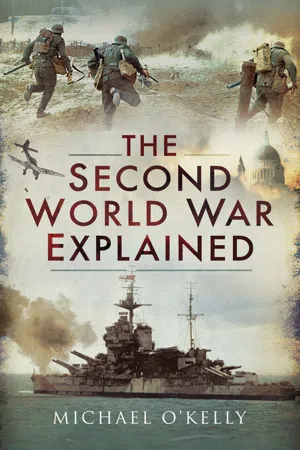
The Second World War Explained
About this book
Over seventy years on the terrible events and outcome of the Second World War remains hugely relevant and important. Far from diminishing interest in this truly global conflict is increasing. The internet has enabled detailed research into ancestors war records to an extent unimaginable a decade or so ago.There have been countless thousands of books on all aspects of the War, both general in scope, of particular subjects, biographies and personal memoirs.The author of The Second World War Explained has identified the need for a concise summary covering the main events and personalities. The result is a compelling, highly readable and informing book which allows an understanding of this most dramatic yet tragic period of history. Will appeal to all age groups.
Trusted by 375,005 students
Access to over 1.5 million titles for a fair monthly price.
Study more efficiently using our study tools.
Information
Chapter 1
Background to War
By the end of the nineteenth century, Germany had been led by Chancellor Bismarck to become a mighty force dominating Europe. It had a large and successful army and enjoyed the close support of the Austro-Hungarian Empire. Kaiser William, Germany’s emperor, was a grandson of Queen Victoria, whom he revered, and a nephew of the King of England, Edward VII. Germany and Great Britain were good friends, albeit under strain in the Boer War and as competitors when Admiral Tirpitz started to develop a rival battleship fleet.
Then came the enormous disaster of the First World War, in which Germany was defeated by the British Empire, France and the United States. In the 1920s, Germany was a broken country, financially ruined, hungry, and with huge unemployment. The German people were bitterly resentful of their defeat and the harsh terms imposed on their country by the Versailles Treaty.
Then a saviour appeared, or so they thought. In 1921, Adolf Hitler became leader of the National Socialist or Nazi Party, dedicated to the rebirth of a great Germany. His autobiography, Mein Kampf, published in the 1920s, set out his ghastly philosophy. Here he announced his hatred of what he believed were the world’s two great evils: Communism and Judaism. He also emphasised that the Germans needed Lebensraum (‘living space’) and openly wrote of the future German expansion in the east. His later invasions of Czechoslovakia, Poland and the Soviet Union followed this claimed need. He believed Germans were a master race and was contemptuous of other nations.
Thus it is even more astonishing that Hitler and Soviet Union leader Joseph Stalin, in apparent friendship, signed a non-aggression pact in August 1939. This pact meant that the Soviet Union, as an ally of Nazi Germany, became a potential enemy of Britain. This position was of course then reversed by Hitler’s invasion of Russia in 1941.
Hitler was clever, utterly ruthless, and stubbornly determined. He was a compelling orator who fired up the masses with his vision. He was also a leader who inspired huge loyalty in his close compatriots. One of his remarkable attributes was a quite phenomenal memory. He retained an encyclopaedic knowledge of the weaponry of other nations’ ships, tanks and aircraft. His greatest flaw was in his often misguided strategic decision making, ignoring the advice of his military leaders.
Initially supported by the right-wing old guard of German politics as well as the army, Hitler’s political manoeuvring eventually outwitted them both. While his thugs intimidated the opposition, the masses flocked to his support. Eventually, in 1933, Hitler was appointed Chancellor, akin to a prime minister. He quickly set about law-making to transform what had been a democracy into a dictatorship. He was supported by his own personal bodyguard, the SS (SchutzStaffel), which subsequently developed into an elite army, the Waffen-SS. When he became president as well as chancellor, he required all the armed forces to take an oath of personal allegiance to ‘their Führer’. All moral considerations, all justice and all freedom were subordinated to the ‘greater good of Germany’. Informers were encouraged by the dreaded secret police, the Gestapo, to report any opposition. Those considered by the Nazis to be ‘enemies of society’ were imprisoned or executed. Many thousands of mentally or physically disabled men, women and children were considered useless and were secretly killed by the SS. The Jews, unfairly held responsible for many of Germany’s ills, were outlawed, ruthlessly persecuted and encouraged to flee the country.
Almost all children in Germany eventually became members of the Hitler Youth while all other youth organisations were banned. Thus Hitler created an enormous reservoir of young people who were brainwashed as Nazi warriors, happy to die for the Führer.
Hitler also introduced conscription and started a major rearmament programme designed to treble the size of the army in defiance of the Versailles Treaty. In his first five years in power he then successively gobbled up the Rhineland and Austria, and threatened Czechoslovakia. In 1938, with war seeming imminent, Neville Chamberlain, the British Prime Minister, paid three visits to Hitler, while the rest of the world voiced their ineffectual disapproval. Chamberlain was an honest and upright man, desperate to avoid or at least delay another terrible conflict only twenty years after the First World War had ended. Eventually, with the reluctant agreement of Czechoslovakia, it was accepted by France and Britain that Germany could occupy Sudetenland, the German-speaking section of that country. In return, Hitler gave a solemn pledge that he had no further territorial ambitions in Europe. Many rejoiced when Chamberlain returned home proclaiming the achievement of ‘Peace in our time’.
However, it was less than a year before Hitler occupied the rest of Czechoslovakia and then later threatened to invade Poland. History has not been kind to Chamberlain. He is portrayed as being simple-minded and easily deceived in accepting the lies and broken promises of Adolf Hitler. But there is another view that suggests he was well aware of Hitler’s duplicity and deceived the dictator into postponing the probably inevitable war. This gave Britain perhaps another year to increase the desperately needed rearmament long demanded by Churchill and others that he had put in train. Amongst many things it gave time to build the Hurricane and Spitfire fighter planes that won the Battle of Britain.
France and Britain tried to warn off Hitler from attacking Poland, but they had no success. In September 1939, Hitler commenced a savage invasion of that country, and so began the catastrophic Second World War. Five years later, between 50 and 60 million people had been killed, Germany destroyed and an exhausted Great Britain physically damaged and financially ruined.
Chapter 2
September 1939 to June 1940
Germany’s strategic position was strengthened by the treaties of support they had made with Japan and Italy. The three powers became known as the Axis. Japan, who for nearly ten years had been fighting China, had a powerful army and navy but stayed out of the war for the first two years. Italy’s fascist dictator, Benito Mussolini, was a particular friend and ally of Hitler. The United Kingdom was supported by the mighty British Empire. The armed forces of Canada, South Africa, India, Australia and New Zealand played a major role in the war.
Eire, although remaining neutral, denied the Royal Navy the use of Irish bases, which had initially been retained by Britain but were handed over as a goodwill gesture in 1938. These bases would have been of inestimable value in the Battle of the Atlantic. Sweden remained neutral but gave important assistance to Germany until near the end. Sweden then finally changed sides to support the winners. Switzerland stayed firmly neutral, as it had done in the First World War.
The UK and France were faced by a highly trained and well-equipped German Army of nearly 3 million men, called the Wehrmacht. Field Marshal Goering, Hitler’s number two, controlled a large modern air force, the Luftwaffe. The navy was called the Kriegsmarine. Here the Germans had made a major strategic error in building big ships rather than the U-boats (submarines) that had proved so successful in the First World War. Their battleships were always a threat and forced Britain to develop major resources to counter them. But otherwise their achievements were small. In the Second World War, the U-boats, at first only a few in number, were an altogether greater threat, as we will see. Germany could easily have built many more. If they had, they might well have starved Britain of the supplies needed for survival and won the war.
For those unfamiliar with warship categories, the battleship was the heavily armoured biggest warship, with a main armament of large 15 or 16 inch calibre guns. It dominated the main navies of the world up until the Second World War. Its vulnerability to submarine attack, and even more to attack by aircraft, then became very evident. At the beginning of the war the major navies had few aircraft carriers. However, their important ability to launch aircraft attacks on ships hundreds of miles away was soon clearly understood. They became the building priority.
Destroyers were the small, fast workhorses, important in their anti-submarine role and also able to threaten large ships with torpedo attack. Cruisers may be seen as long-range ships, halfway in size and armament between the battleship and the destroyer. Frigates and corvettes were smaller and slower than destroyers, and designed primarily for anti-submarine operations.
The Germans also built four ‘pocket’ battleships of reduced size, faster, but with smaller calibre (14 inch) guns. They had some limited success as commerce raiders.
The Royal Navy, together with the major navies of Japan and the United States, had also long relied on the power of big ships and big guns. The importance of aircraft at sea was not appreciated, nor the weak ability of the Royal Navy to counter the submarine threat. Radar equipment suitable for ships had still not yet been developed.
Radar is the well-known system that uses the reflection of radio waves to determine the range and direction of ships and aircraft, or indeed any solid object. It was being secretly developed by many nations in the years before the Second World War, with America and Britain leading the field. It had an important early use in detecting incoming enemy aircraft in the Battle of Britain. Later it became valuable in detecting enemy submarines on the surface. Now of course radar is a system with many uses and fitted to all ships and aircraft.
Britain’s small regular army was only 224,000 strong, although conscription rapidly brought it up to one million. It lacked modern equipment and used out-of-date tactics. It took years to develop into the well-led effective fighting force of 2.9 million men that it eventually became.
As this book frequently mentions various types of army formations, it may be useful to summarise their approximate sizes, although these could vary greatly nation by nation and the circumstances of the time. The basic infantry unit able to operate semi-independently is the battalion, comprising three or four companies, totalling about 500 men. A brigade, containing a number of battalions, might then number 2,000 to 4,000. The division is normally a complete independent fighting formation including a number of supporting units such as artillery, anti-tank unit, signals, medical, engineers etc. Its size could vary greatly, normally from 10,000 to 18,000 soldiers. However, some German divisions in Russia in extremis were reduced to 2,000 men, and some Russian infantry divisions to 5,000. Two or more divisions might form a corps, and two or three of these bring you to an army, from 70,000 to 100,000 strong. Finally, two or three armies together make up an army group.
Britain’s air force was small but expanding fast as modern aeroplanes such as the Spitfire and Hurricane came off the production line. However, Coastal Command was grievously neglected, having only comparatively short-range aircraft. It took years before US long-range Liberators showed how aircraft could be really effective in anti-submarine warfare. Bomber Command also lacked long-range aircraft.
France joined us in declaring war. They had a very large army but it lacked radio communication, and it was cumbersome and over reliant on its eastern fortification, the Maginot Line. France’s air force had not been given enough priority and contained mostly obsolescent aircraft.
With the aid of the Soviet Union’s army, Poland was quickly conquered, with unprecedented savagery. Over 500 towns and villages were burned to the ground. Hundreds of thousands of civilians, particularly Jews, were executed or deported to forced labour or concentration camps. Stalin ordered the arrest and execution of 22,000 prominent Polish leaders and military officers. France had threatened to help Poland by attacking Germany from the west, but in the end did nothing. Britain hurried an expeditionary force (BEF) of about ten divisions over to France, later increasing this to fifteen divisions. They were positioned in the north to defend against an attack through Belgium and Holland.
There was little or no land fighting in the first months of 1940, a period known as the ‘phoney war’. But as the four-year-long Battle of the Atlantic started, the picture at sea was different. Great Britain relied for its existence on importing by sea most of its food, raw materials and oil. If German U-boats could sink enough ships to stop this flow, Great Britain would be defeated. The advantages of a convoy in which large groups of ships sailed in company, protected if possible by a screen of anti-submarine warships, were well known and put into practice. Luckily the German paucity of submarines at first kept our losses low. However, sinkings included HMS Courageous, one of the Royal Navy’s five aircraft carriers, and then the battleship HMS Royal Oak was also torpedoed. The latter was in the Fleet anchorage Scapa Flow, in the Hebrides. This was thought to be impenetrable by submarines but the brave and skilful U-boat ace Günther Prien managed it. Both ships incurred very heavy loss of life.
One victory at sea, in December 1939, cheered the nation. It was called the Battle of the River Plate. The German pocket battleship Graf Spee had sunk ten merchant ships in the Indian Ocean and South Atlantic when she unwisely attacked three light cruisers under Commodore Harwood who were looking for her outside Montevideo. She severely damaged HMS Exeter, but HMS Ajax and the New Zealand HMNZ Achilles were still fighting when Graf Spee, also damaged, broke off to enter neutral Montevideo to effect repairs. Then, deceived into believing a bigger Royal Navy force was arriving, her captain decided defeat was inevitable, and to avoid further loss of life he scuttled his ship in the harbour. Ajax and Achilles, who in fact had no support as yet, knew they were no match for the mighty Graf Spee, and were greatly relieved.
Graf Spee had a supply ship in company called Altmark, who disappeared from the scene with about 350 Merchant Navy prisoners arising from the pocket battleship’s sinkings. When she was detected soon after in a neutral Norway fiord, Churchill gave instructions that she should be boarded by HMS Cossack, commanded by Captain (later Admiral) Vian. The sailors leapt aboard and opened the hold to effect the rescue, shouting, ‘The navy’s here.’ It became a famous war cry.
The ‘phoney war’ ended in April 1940 when Hitler occupied Denmark. Simultaneously, a large German seaborne force invaded neutral Norway. Hitler was keen to safeguard the import of Scandinavian iron ore and also to protect the Baltic Sea. The UK had also decided to invade the north of Norway to deny Germany the precious iron ore, but Germany struck first. Battles raged by air, land and sea for two months. Our operations were badly planned, badly organised, and often characterised by order, counter order, and the enthusiastic but mistaken intervention of Winston Churchill, now the First Lord of the Admiralty. At one stage we captured Narvik, but finally withdrew early in June. The Norwegian Major Quisling sided with the Germans and announced himself as Prime Minister. The word ‘quisling’ entered the English language as a synonym for ‘traitor’.
Perhaps one of many brave naval actions is of particular interest. Lieutenant Commander G.B. Roope commanding the destroyer Glowworm sought out and found the German heavy cruiser Admiral Hipper. He decided to attack and hopefully damage the Hipper before his small ship was destroyed in a completely unequal contest. Having missed with her torpedoes, Glowworm was heavily damaged as she approached and rammed the cruiser before herself capsizing and sinking. The extensive repairs needed to Hipper kept her out of action for much of the war. Roope was awarded a posthumous Victoria Cross (VC), the highest award for gallantry.
British naval forces suffered serious losses with the Luftwaffe demonstrating the importance of air superiority over the sea. German naval losses were greater, but this could not disguise the fact that a great naval power had suffered defeat in a major maritime campaign by a Continental land power with a small navy.
Britain’s perceived operational incompetence and failure to stem the German invasion led in May to Prime Minister Neville Chamberlain being replaced by Winston Churchill, who somehow escaped blame for the Norway disaster. The country was thankfully now in the charge of a great orator and leader with immense experience, energy and determination. The outlook was transformed. Churchill formed a coalition government, with the Cabinet including representatives of all the major political parties. Like Hitler, Churchill had many unwise and mistaken strategic intentions, and was very difficult to work with. But unlike Hitler, in the end, albeit often after much sometimes angry argument, he accepted the decisions of the War Cabinet and his military advisers, the Chiefs of Staff. And again unlike Hitler, he didn’t always sack those who disagreed with him. Wonderfully supported by his wife Clementine, without the drive and inspired leadership of this great man, it is difficult to see how Britain could have won the war.
The day Churchill assumed office, 10 May...
Table of contents
- Cover
- Title
- Copyright
- Contents
- Maps
- Preface
- Chapter 1: Background to War
- Chapter 2: September 1939 to June 1940
- Chapter 3: The Battle of Britain: Summer 1940
- Chapter 4: The Blitz and Wartime Great Britain
- Chapter 5: The Mediterranean Theatre 1941 and 1942
- Chapter 6: Battle of the Atlantic 1941 and 1942
- Chapter 7: Germany Invades the Soviet Union
- Chapter 8: Royal Navy Arctic Convoys 1941–45
- Chapter 9: Japan Enters the War, December 1941 to June 1944
- Chapter 10: The Holocaust
- Chapter 11: UK Bomber Command
- Chapter 12: Soviet Union 1942 and Stalingrad
- Chapter 13: Malta, El Alamein and North Africa 1942–43
- Chapter 14: The Battle of the Atlantic 1943: The Decisive Year
- Chapter 15: Sicily and Italy 1943–44
- Chapter 16: Soviet Union 1943 and 1944
- Chapter 17: Invasion of France 1944
- Chapter 18: The Far East 1944 and 1945
- Chapter 19: Final Defeat of Germany 1945
- Chapter 20: The Atom Bomb
- Appendix 1: Meetings of Great Power Leaders
- Appendix 2: Second World War Timeline
- Plate section
Frequently asked questions
Yes, you can cancel anytime from the Subscription tab in your account settings on the Perlego website. Your subscription will stay active until the end of your current billing period. Learn how to cancel your subscription
No, books cannot be downloaded as external files, such as PDFs, for use outside of Perlego. However, you can download books within the Perlego app for offline reading on mobile or tablet. Learn how to download books offline
Perlego offers two plans: Essential and Complete
- Essential is ideal for learners and professionals who enjoy exploring a wide range of subjects. Access the Essential Library with 800,000+ trusted titles and best-sellers across business, personal growth, and the humanities. Includes unlimited reading time and Standard Read Aloud voice.
- Complete: Perfect for advanced learners and researchers needing full, unrestricted access. Unlock 1.5M+ books across hundreds of subjects, including academic and specialized titles. The Complete Plan also includes advanced features like Premium Read Aloud and Research Assistant.
We are an online textbook subscription service, where you can get access to an entire online library for less than the price of a single book per month. With over 1.5 million books across 990+ topics, we’ve got you covered! Learn about our mission
Look out for the read-aloud symbol on your next book to see if you can listen to it. The read-aloud tool reads text aloud for you, highlighting the text as it is being read. You can pause it, speed it up and slow it down. Learn more about Read Aloud
Yes! You can use the Perlego app on both iOS and Android devices to read anytime, anywhere — even offline. Perfect for commutes or when you’re on the go.
Please note we cannot support devices running on iOS 13 and Android 7 or earlier. Learn more about using the app
Please note we cannot support devices running on iOS 13 and Android 7 or earlier. Learn more about using the app
Yes, you can access The Second World War Explained by Michael O'Kelly in PDF and/or ePUB format, as well as other popular books in History & North American History. We have over 1.5 million books available in our catalogue for you to explore.