- 208 pages
- English
- ePUB (mobile friendly)
- Available on iOS & Android
eBook - ePub
About this book
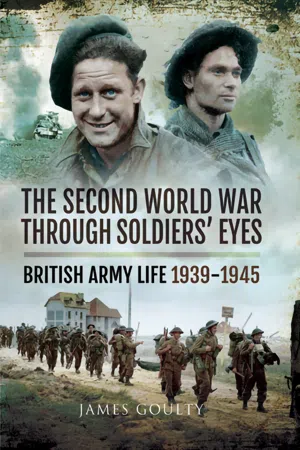
'What was it really like to serve in the British Army during the Second World War?Discover a soldier's view of life in the British Army from recruitment and training to the brutal realities of combat. Using first-hand sources, James Goulty reconstructs the experiences of the men and women who made up the 'citizen's army'. Find out about the weapons and equipment they used; the uniforms they wore; how they adjusted to army discipline and faced the challenges of active service overseas.What happened when things went wrong? What were your chances of survival if you were injured in combat or taken prisoner? While they didn't go into combat, thousands of women also served in the British Army with the ATS or as nurses. What were their wartime lives like? And, when the war had finally ended, how did newly demobilised soldiers and servicewomen cope with returning home?The British Army that emerged victorious in 1945 was vastly different from the poorly funded force of 865,000 men who heard Neville Chamberlain declare war in 1939. With an influx of civilian volunteers and conscripts, the army became a citizens force and its character and size were transformed. By D-Day Britain had a well-equipped, disciplined army of over three million men and women and during the war they served in a diverse range of places across the world. This book uncovers some of their stories and gives a fascinating insight into the realities of army life in wartime.
Information
Chapter 1
Call-Up and Training
All units in wartime required effective training, which is the subject of this chapter. Initially this was difficult to accomplish, as the army was under-prepared for a major war, having spent the inter-war period policing the British Empire and conducting duties at home. John McManners, who enlisted in the Royal Northumberland Fusiliers (RNF) in 1939, stated that ‘it wasn’t the Army as it had been that we came into, but a former organic unity disrupted to function as a vast ramshackle training organisation’. After the evacuation from Dunkirk during the summer of 1940, it was fortunate that sufficient regular personnel remained to form a nucleus around which a mass conscript army could be forged from this ‘ramshackle training organisation’.
Eventually the wartime army expanded to more than three million men and 300,000 women, around three-quarters of whom were conscripts. Forty-eight divisions were formed: thirty-five infantry, eleven armoured and two airborne. There were constant changes to the War Establishment (WE) of divisions, although they were considered the ideal-sized fighting formation because they comprised not only combat units, but all the necessary support personnel as well. At the start of the war the strength of an infantry division was 13,863 all ranks and this rose to 18,347 by the end of the war. The constituent parts of many divisions also altered during the war. For example, over a two-year period seventeen different armoured regiments and nine separate infantry battalions served with 7th Armoured Division, the famous ‘Desert Rats’. Even so, individual soldiers tended to feel an affinity with the division to which they were attached and were proud to wear the relevant cloth insignia on their uniforms, such as the distinctive black cat emblem worn by members of 56th (London) Division, taken from the legend of Dick Whittington.
General Sir David Fraser, who was commissioned into the Grenadier Guards in 1941, observed that by 1945 the soldiers of the British Army had ‘learned their trade and became entirely professional’. As will become apparent, recruits came from a variety of social, economic, educational and occupational backgrounds, and required training to mould them into effective soldiers. Almost all were subjected to the harshness of basic training, before commencing training in a particular trade, such as a signaller or infantryman. During the early 1940s the army also began employing scientific techniques in an effort to improve how it selected personnel for trades, and for training as officers.
Numerous soldiers did not actively seek promotion, preferring the relative anonymity and comradeship of the ranks. Leslie Blackie from Gateshead was posted to India in 1945 with 43rd Royal Tank Regiment (RTR). Writing home he explained that he was happy to remain a trooper (equivalent to a private) because he felt ‘stripes make you disliked rather than liked’. However, as this chapter highlights, several wartime conscripts and volunteers became highly effective leaders at NCO or officer level alongside their Regular Army counterparts.
Many troops eventually served overseas, particularly after D-Day (6 June 1944) when the army became heavily involved in the Allied war effort. Yet, throughout the war large numbers of troops remained stationed in Britain. According to the military historian Jeremy Crang, more than 1.5 million troops, or over half the army, were based in Britain for much of the war, and even after D-Day approximately a million remained at home. These men were involved in home defence, and supporting those army units that were serving overseas. Military training was also one of their primary preoccupations, particularly leading up to the invasion of Normandy in June 1944.
A further part of this chapter outlines the importance of infantry training, with particular reference to the use of battle schools that came to prominence during 1941–44. With their emphasis on using live ammunition, coupled with physically demanding and realistic conditions, battle schools significantly helped transform men into fighting soldiers. Historian Timothy Harrison Place considers that ‘they raised the British Army’s game enormously’.
Recruits who volunteered for the army often proved eager warriors, whereas many conscripts simply longed to survive and pick up the threads of their civilian lives as soon as possible. Similarly, a divide existed between combat personnel and those whose job it was to provide logistical support working on the lines of communication rather than the front line. Historian John Ellis noted that for the latter the war typically comprised ‘foreign travel tempered by excessive regimentation’, whereas front-line troops often endured conditions as torrid as those encountered by their predecessors during the First World War. Often there was also a divide between regular soldiers who had served during the inter-war period, or even the First World War, and conscripts. Alan Wykes, who was called up into the Royal Hampshire Regiment, remembered that his Regimental Sergeant Major (RSM) would routinely berate his draft by stating: ‘You are just a load of flaming amateurs’ in his ‘intimate voice (the one that merely traversed the parade ground at Brookwood, Surrey, as distinct from the one that that must have sounded to the slumbering souls in the nearby Necropolis like the Great Awakening)’.
Conscription for Men
Faced with the prospect of war during the late 1930s the British government began making preparations, including expanding the Territorial Army and re-introducing conscription. The Military Training Act, passed on 26 May 1939, compelled all males aged twenty and twenty-one to complete six months’ service in the armed forces, followed by three and half months in the reserve. By the outbreak of war 35,000 of these conscripts (known as Militiamen) had been called-up into the army and completed their basic training.
Militiamen were notified by a letter from the Ministry of Labour in a buff-coloured envelope, similar to that received by John Elliot, who joined 4th Lincolnshire Regiment in late 1939.
Dear Sir,
In accordance with the Military Training Act, 1939 you will be required to present yourself for military training on Tuesday 17 October 1939 to 16 S/L Militia Depot Royal Artillery. A further confirmation will be sent to you later.
For most Militiamen basic training entailed square-bashing, rifle drill, physical training, and an introduction to infantry weapons, notably the Lee-Enfield rifle and Bren gun. Some men adjusted to this better than others. Ivan Daunt, who had worked on building sites, was conscripted into 4th Royal West Kent Regiment (RWK) in July 1939, and discovered he enjoyed army life, especially physical training. However, Leslie Crouch, who had worked as a carpenter and joined the same battalion, noted Militiamen tended to be more intelligent than the average regular soldier, and consequently proved less good at responding to military discipline. According to Leslie Crouch, you also always felt like ‘a civilian in uniform’ rather than a real soldier.
Another source of angst among Militiamen was that their pay was less than that of regular soldiers. Leslie Crouch recalled initially receiving 1 shilling and sixpence, although this was later increased to 2 shillings per day. However, soldiers of all types tended to be concerned about their pay throughout the war, particularly if they went overseas and had dependants at home. The conscript Leslie Blackie was delighted at having his pay as a trooper in the RTR increased in October 1944 from 3 shillings to 3 shillings and sixpence per day.
Once war was declared against Germany in September 1939, the Military Training Act was superseded by the National Service (Armed Forces) Act that made all males aged eighteen to forty-one liable for military service for the duration of the emergency. The upper age limit for compulsory military service was later raised to fifty-one years, and many older men were deployed on duties in Britain such as in anti-aircraft units.
Anyone liable for military service faced emotional and physical upheaval as they left their pre-war lives behind, and faced an uncertain future in the course of their duty. Citizens could only decline to serve if they were in holy orders, declared unfit under the Lunacy and Mental Treatment Acts, a registered blind person, or worked in a reserved occupation crucial to the war effort such as armaments manufacturing.
Conscientious Objectors had to put their case before a local tribunal, but could still be conscripted to fulfil non-combatant duties with the army, such as working as drivers, in stores, as medical orderlies, or even in bomb disposal. Alternatively they were employed as agricultural labourers, miners or served with the Fire Service or Friends Ambulance Unit run by the Society of Friends (Quakers). Although there was still a great deal of social stigma attached to being a ‘conchie’, in contrast with the First World War men with long-term pacifist sympathies on ethical, religious and political grounds were usually respected and treated less harshly than during the earlier conflict.
Ken Adams was in his early twenties when he received his call-up papers and had been employed by the West Yorkshire Road Car Company. He attended a tribunal in Leeds during January 1940 and announced that, while he was prepared to join the Armed Forces, he ‘wasn’t prepared to kill a man in cold blood and wouldn’t join the infantry’. Consequently, he was posted to the Royal Army Medical Corps (RAMC) and trained as a medical orderly. He still faced some disapproval as other soldiers perceived that he had wangled a comparatively comfortable position by registering as a ‘conchie’. However, medical personnel who supported combat units frequently shared many of the discomforts that were a routine part of front-line life.
Even if the government considered it their patriotic duty to serve King and Country, other soldiers resented conscription, not least because it disrupted their civilian lives. In June 1939 Jack Brunton from Byker, Newcastle upon Tyne, was studying architecture at night school when he was called up. He had no aspirations for promotion and spent the next seven years as a gunner in the Royal Artillery (equivalent to a private in the infantry), bitterly resentful of the way in which the army had uprooted him and thwarted his efforts at obtaining an education. Before being commissioned into the Brigade of Guards, General Fraser served with 8th Royal Berkshire Regiment, and rapidly discovered that many of his fellow soldiers were criminals from Birmingham, who had been advised to join-up by magistrates and ‘were totally uninterested in politics or the war’.
The actor Peter Ustinov became a reluctant infantryman in 1942, and confessed he was fearful of ‘the brutalizing effects of military life’, which he felt threatened to turn him into a ‘robot’. On being called up into the Gordon Highlanders in 1939, Alistair Urquhart observed there was ‘a lot of grumbling at lives turned upside down and becoming regimented, and no gung-ho euphoria’. Many were also wary, due to having grown up hearing unsettling stories from relatives about their experiences during the First World War, and were aware of the high casualty rate in the previous conflict. As Reg Twigg, who enlisted in the Royal Leicestershire Regiment in June 1940, observed, ‘a dark, collective memory sat in the corner of the pub like a ghost’ as ‘depressed eighteen to forty year olds’ waited for the buff envelope.
By contrast, others were more understanding of the need for conscription, and even enthusiastic about what military service might entail. Bill Titchmarsh had served with the Home Guard and was working in an aircraft factory in Wiltshire when he received his call-up papers in December 1942. He could have claimed ‘Reserved Occupation’, but instead chose to join the army. As he recalled ‘I sent them back and a fortnight later received an envelope with a ticket and One shilling postal order for lunch’. This was to cover the tortuous rail journey from his home in war-torn Southampton to Bodmin, where he was to undergo basic training under the aegis of the Duke of Cornwall’s Light Infantry.
Eric de la Torre was called-up in October 1939 and selected for the Royal Army Service Corps (RASC), before later volunteering for the Commandos. He was excited about joining the army, having found his prewar occupation as a desk-bound trainee accountant in London extremely dull. By comparison basic military training with its emphasis on discipline and drill seemed stimulating to him because it was so different from what he had experienced in civilian life.
Many young men were also swayed by the ideological nature of the war. When called-up in October 1939, Richard Phillips was already registered as a ‘Militiaman’, and eventually became the Intelligence Sergeant with 2nd South Wales Borderers seeing active service in Normandy and North-West Europe during 1944–45. As he put it ‘someone had to stop Hitler’s march across Europe’ and as a soldier he was motivated by the need to win the war and defeat Fascism.
Regular Army Soldiers
Unlike conscripts, for regular soldiers the war provided the means, as Rifleman Victor Gregg commented, for them to ‘earn their keep’. Some of these soldiers had seen service policing the British Empire during the interwar years or even during the First World War, whereas as many others had only enlisted in the late 1930s and were still comparatively inexperienced. As professional soldiers it was a chance for them to put their training and skills to the test on the battlefield. In 1939 Platoon Sergeant-Major Martin McLane, aged twenty-eight, was posted to France with the mortar platoon of 2nd Durham Light Infantry (DLI), part of the British Expeditionary Force (BEF). Although he missed his family, particularly his young daughter, he relished the challenge of being able to deploy his unit’s mortars in an active role. The son of a shipyard worker from Tyneside, he was typical of the many young men who had enlisted during the 1930s rather than face unemployment, and who formed the bedrock of the wartime army.
Typically, men enlisted for seven years with the Colours, plus another five in the reserve, or ‘seven and five’ as it was known by regular soldiers. However, there was nothing to stop men signing on for longer terms of engagement if they desired, although as Victor Gregg cautioned men risked becoming institutionalised if they spent several years as a regular soldier, and could find civilian life awkward upon discharge from the army.
The outbreak of war witnessed a rapid readjustment within many regular units from a peace-time footing to mobilisation for active service. Cyril Feebery, who eventually rose to the rank of Regimental Sergeant-Major, enlisted in the Grenadier Guards in May 1937. When war was declared he noted, ‘all the drill and boxing and spit and polish seemed pointless, part of another world’. Rapidly he and other guardsmen were ordered to hand in their highly-polished rifles and ceremonial kit, and re-equip themselves for war as part of 1st Guards Brigade, posted to the Franco-Belgian border.
Additionally, during 1940 ‘Young Soldier’ volunteer battalions were raised and attached to each infantry regiment and given the prefix 70th. These tapped into patriotic enthusiasm and willingness to serve amongst those who were too young to be officially called up and young regular soldiers who had previously served with Home Defence Battalions. To be eligible boys had to be in top physical condition and ardent teenagers from a range of backgrounds flocked to these battalions, including troublemakers advised to join by their local police.
Often these youthful soldiers were highly motivated and several eventually became regular NCOs, were selected for officer training or volunteered for elite units. Eric Sykes from Huddersfield unsuccessfully attempted to join the army several times while under age, but in January 1943 was eventually accepted and posted to 70th DLI. The following September he volunteered for the Parachute Regiment, largely because he was fed up with the routine of guard duties and fatigues, and was eventually promoted sergeant.
As a sixteen-year-old in 1941, Stan Scott, who later joined Number 3 Commando, was posted to ‘D’ Company 70th Suffolk Regiment based in Ipswich. He recalled that they were issued First World War vintage weapons and equipment and conditions were fairly primitive. Their quartermaster provided them with ‘three scratchy blankets, a big white bag and a little white bag. These had to be filled with straw for a palliasse and pillow.’ No transport was available so they marched everywhere, including to a drill hall on the Portman Road near Ipswich Football Club’s ground.
‘Young Soldier’ Battalions were frequently employed on guard duties and assisted in the construction of defence works at a time when the war was progressing badly for Britain. During 1943 they were disbanded, but as General Phillip J. Shears author of The Story of the Border Regiment (1948) opined, most troops from these units had proved keen to do their best and absorbed the spirit of the regiments to which they were posted.
However, not all soldiers serving within these battalions were willing volunteers. When Ernest Harvey was conscripted into the army in late 1942, he was posted to 70th DLI at Barnard Castle, County Durham. He found the ‘NCOs charged you for almost anything’ and was routinely punished by being confined to barracks, or given pack drill each evening after a days’ work with the signal platoon. This entailed being made to run at the double along a river bank in full kit, complete with heavy pack, for lengthy periods.
Territorial Army Soldiers
During the late 1930s with war looming, numerous men aged between eighteen and thirty-eight volunteered for the Territorial Army (TA). Subsequently, many experienced active service during the war when the TA was embodied into the Regular Army under the control of the War Office. Most Territorial units had strong ties with...
Table of contents
- Cover
- Title Page
- Copyright
- Contents
- List of Plates
- Acknowledgments
- Introduction
- Chapter 1: Call-Up and Training
- Chapter 2: Life on Active Service
- Chapter 3: Enduring Active Service
- Chapter 4: Prisoner of War Experiences
- Chapter 5: Casualties and Medical Matters
- The Aftermath, c. 1945–1946
- Bibliography
Trusted by 375,005 students
Access to over 1.5 million titles for a fair monthly price.
Study more efficiently using our study tools.
Frequently asked questions
Yes, you can cancel anytime from the Subscription tab in your account settings on the Perlego website. Your subscription will stay active until the end of your current billing period. Learn how to cancel your subscription
No, books cannot be downloaded as external files, such as PDFs, for use outside of Perlego. However, you can download books within the Perlego app for offline reading on mobile or tablet. Learn how to download books offline
Perlego offers two plans: Essential and Complete
- Essential is ideal for learners and professionals who enjoy exploring a wide range of subjects. Access the Essential Library with 800,000+ trusted titles and best-sellers across business, personal growth, and the humanities. Includes unlimited reading time and Standard Read Aloud voice.
- Complete: Perfect for advanced learners and researchers needing full, unrestricted access. Unlock 1.5M+ books across hundreds of subjects, including academic and specialized titles. The Complete Plan also includes advanced features like Premium Read Aloud and Research Assistant.
We are an online textbook subscription service, where you can get access to an entire online library for less than the price of a single book per month. With over 1.5 million books across 990+ topics, we’ve got you covered! Learn about our mission
Look out for the read-aloud symbol on your next book to see if you can listen to it. The read-aloud tool reads text aloud for you, highlighting the text as it is being read. You can pause it, speed it up and slow it down. Learn more about Read Aloud
Yes! You can use the Perlego app on both iOS and Android devices to read anytime, anywhere — even offline. Perfect for commutes or when you’re on the go.
Please note we cannot support devices running on iOS 13 and Android 7 or earlier. Learn more about using the app
Please note we cannot support devices running on iOS 13 and Android 7 or earlier. Learn more about using the app
Yes, you can access The Second World War Through Soldiers' Eyes by James Goulty in PDF and/or ePUB format, as well as other popular books in History & British History. We have over 1.5 million books available in our catalogue for you to explore.