"An interesting study of the development of military organization and strategy across several millennia, from Bronze Age Mesopotamia to the last days of Rome." —
The Pegasus Archive
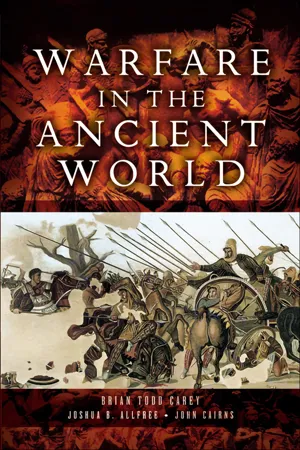
Warfare in the Ancient World explores how civilizations and cultures made war on the battlefields of the Near East and Europe between the rise of civilization in Mesopotamia in the late fourth millennium BC and the fall of Rome.
Through an exploration of twenty-six selected battles, military historian Brian Todd Carey surveys the changing tactical relationships between the four weapon systems—heavy and light infantry and heavy and light cavalry—focusing on how shock and missile combat evolved from tentative beginnings in the Bronze Age to the highly developed military organization created by the Romans.
The art of warfare reached a very sophisticated level of development during this three millennia span. Commanders fully realized the tactical capabilities of shock and missile combat in large battlefield situations. Modern principles of war, like the primacy of the offensive, mass, and economy of force, were understood by pre-modern generals and applied on battlefields throughout the period.
Through the use of dozens of multiphase tactical maps, this fascinating introduction to the art of war during western civilizations ancient and classical periods pulls together the primary and secondary sources and creates a powerful historical narrative. The result is a synthetic work that will be essential reading for students and armchair historians alike.
"An ambitious book that sets out to cover four and a half thousand years of military history, from the rise of the first civilizations in the Near East to the fall of the Western Roman Empire." —
History of War
- 224 pages
- English
- ePUB (mobile friendly)
- Available on iOS & Android
eBook - ePub
Warfare in the Ancient World
About this book
Information
Chapter 1
Warfare in the
Ancient Near East:
The Bronze and Early Iron Ages
Ancient Near East:
The Bronze and Early Iron Ages
Warfare in Ancient Mesopotamia and Egypt: The World’s First Armies
The rise of the world’s first civilizations in southern Mesopotamia and Egypt in the late fourth millennium bce also begins the history of organized warfare in western civilization. The creators of the first Mesopotamian civilization were the Sumerians, a people whose origins still remain unclear. By 3000 bce they had established a number of independent walled city-states in southern Mesopotamia, including the cities of Eridu, Ur, Uruk and Lagash. As the number of Sumerian city-states grew and expanded in the third millennium bce, new conflicts arose as city-states fought each other for control of local natural resources or united against the persistent threat of barbarian raiding and invasion.
With the rise of civilization and organized violence came the experimentation with metal alloys in a search for harder, more lethal materials to make weapons. As early as 6000 bce in Anatolia, Neolithic man experimented with copper tools and weapons. But it was not until the fourth millennium bce that tin was added to copper to produce a superior alloy, beginning the Bronze Age. Roughly contemporary to the rise of civilization in Mesopotamia, the Bronze Age made warfare a much more dangerous activity than it had been before in the neolithic period. From the back of their bronze-gilded war chariots, Mesopotamian kings and, later, Egyptian pharaohs made war and carved empires, bringing civilization to newly conquered regions.
The Sumerians are credited with inventing numerous military technologies, including the war chariot, bronze maces, sickle-swords, socket spears and axes, and the defensive technologies of copper and bronze helmets, armoured cloaks and bronze armour. Many of these weapons, such as the mace, spear and axe, were present in the pre-neolithic and neolithic periods as stone weapons, but the Sumerians improved their lethality by making them out of copper and, later, bronze. In response to the increased lethality of metal weapons, personal body armour was developed, made first out of leather, then copper and, later, bronze. By 2100 bce, bronze scale-armour had been developed, and by 1700 bce was widely used by Mesopotamian and, later, Egyptian armies.
The standard shock weapons in Sumerian armies were the long heavy spear, battleaxe and the dagger. The effectiveness of the heavy thrusting spear on the battlefields of Mesopotamia affected the tactical development of ancient armies more than any other weapon. If soldiers armed with the spear were to fight effectively in groups, they had to arrange themselves in close-order formation, giving rise to the first heavy-infantry battle-square in western civilization. Unfortunately, historians know very little about ancient Mesopotamian military formations and tactics because kings used writing to commemorate significant military victories, not the manner in which the battle was fought. Occasionally, the same events were recorded in pictorial form. The most impressive of these early illustrations of the Sumerian army at war is provided by the Stele of Vultures from the city-state of Lagash, dating from around 2500 bce.
The Stele of Vultures commemorates a victory of King Eannatum of Lagash over the king of Umma and takes its name from a section of the stele depicting a defeated enemy whose abandoned bodies are shown being picked at by vultures and lions. The battle scene shows the army at the moment of victory, marching over the bodies of their defeated and slain enemies. In the upper register the king leads a troop of heavy infantry, while in the lower register the king is shown riding in a four-wheeled battle chariot pulled by four onagers in the van of a troop of light infantry.
The Sumerian light infantryman is depicted without protective equipment and armed with a long spear in the left hand and a battleaxe in the right. It is not known whether these unarmoured light infantry used their spears for shock combat or as throwing weapons. The Sumerian heavy infantry are portrayed in formation, with the unnamed sculptor carving helmeted spearmen, organized six files deep with an eight-man front, with the front rank bearing large rectangular shields. What is interesting is the apparent standardized equipment and number of spears projecting between the shields. The common panoply and close order suggests that these soldiers were well trained, uniformed and equipped to fight as a corps, anticipating later Greek, Macedonian and Roman heavy infantry formations. Still, without corroborating textual evidence it is unknown whether this early battle square was a common battlefield formation, if it was capable of offensive articulation, or if it served primarily as a defensive formation.
Eventually, the Sumerian civilization would fall to the inventor of imperium, Sargon the Great, around 2340 bce (Map 1.1). During his fifty-year rule, the Akkadian king would fight no fewer than thirty-four military campaigns and carve out an empire that would include all of Mesopotamia, as well as lands westward to the Mediterranean, inspiring generations of Near Eastern rulers to emulate his accomplishment.

Map 1.1. The Ancient Near East.
During the Sargonid period (c.2340–c.2100 bce) the Akkadians contributed another major innovation in weaponry: the composite bow. Although it is likely that the Sumerians utilized the simple bow in warfare, no textual or pictorial evidence exists to support this claim. The first evidence of the bow being used in collective warfare is found during the reign of Sargon’s grandson Naram Sin (2254–2218 bce), though it is possible that Sargon himself utilized the weapons in his own campaigns.
The impact of the composite bow on the battlefields of the Near East was significant. While the simple self-bow (a bow made of a single piece of wood) could kill at ranges from 50 to 100 yards, it could not penetrate even simple leather armour at these ranges. The composite bow, with a pull of at least twice that of a self-bow, could easily penetrate leather armour, and perhaps the bronze armour of the day. The reason for this increased performance was the unique construction of the bow. The composite bow was a recurve bow made of wood, horn and tendons from oxen, carefully laminated together to create a bow of superior strength, range and impact power.
Possibly invented on the Eurasian steppes and brought to the Akkadians by mercenary nomads, the composite bow quickly became an important asset on the battlefields of ancient Mesopotamia. Aiming against packed heavy-infantry formations, light infantry archers could fire withering barrages of arrows, causing gaps and tears and eroding the morale of the foot soldiers. Although we have no descriptions of Mesopotamian battles from the Bronze Age, it is safe to assume that the co-ordination of heavy infantry and light infantry archers working together on the battlefield represents a combined-arms tactical synthesis, perhaps the first in the history of western civilization.
Once created, the composite bow spread quickly to other armies over the next 500 years, appearing in Palestine around 1800 bce and introduced to Egypt and the Aegean region by 1600 bce. In New Kingdom Egypt (1567–1085 bce), the improved archer was placed in an improved war chariot, combining for the first time a powerful weapon with increased tactical mobility. Composite bow-wielding light infantry and cavalry would remain a persistent adversary to the heavy-infantry-based armies of western civilization for the next two-and-a half millennia (c.1000 bce–c.1500 ce).
Perhaps no other single military invention is as closely associated with the ancient period as the war chariot. The military application of the wheel came quite early in the development of civilization, with the first chariot integrated into Sumerian battle tactics around 3000 bce. These early chariots were either of the two- or four-wheeled variety, were manned by a crew of two, and were pulled by a team of four onagers. The wheels were constructed of solid wood sections held together by pegs, while the placement of the axle either in front or in the middle of the chariot itself made the Sumerian war chariot heavy and unstable at speed. The absence of a mouth bit made controlling the wild asses very difficult, and it is unlikely that these machines could have moved at more than 10 miles per hour.
Armed with javelins and axes, Sumerian charioteers used their weapons to deliver a shock attack, driving into opposing heavy infantry formations and scattering enemy footmen. The Sumerian machine, pulled by wild asses, was too heavy and cumbersome to offer effective pursuit. Still, the Sumerian chariot served as the prototype for wheeled shock combat for the next thousand years. In the early centuries of the second millennium bce, two different innovations appeared in significant conjuncture to create a superior chariot: the widespread use of the domesticated horse and the new technology of lightweight, bentwood construction.
Although horses were raised as food in central Asia as early as the fourth millennium bce, it was only in the second millennium bce that domesticated equines spread throughout Europe and the Near East. At first too small to be ridden as a cavalry mount, the even-tempered horse was originally used as a replacement for the onager, harnessed to chariots, usually in teams of four. The development of bentwood techniques allowed for the construction of the spoked wheel with a rim of curved felloes and the manufacture of lightweight chariot bodies. At the same time, the appearance of the horse bit improved the control of the animal teams at higher speeds. This lightweight chariot with spoked wheels drawn by teams of horses provided for the first time a fast, manoeuvrable chariot, one that could be used as a firing platform for composite-bow-wielding archers.
By the fifteenth century bce, the Egyptians had modified the chariot into the finest machine in the world. The Egyptian chariot was made entirely of wood and leather and was so light that two men could carry the body over rough terrain. The Egyptians improved the control, manoeuvrability and speed of the chariot by moving the axle to the very rear of the carrying platform. But manufacturing and maintaining a chariot corps was a very expensive endeavour, the prerogative of rich and powerful kingdoms. The chariots’ presence on the battlefield was supported by the complex logistics of horse breeding and training, a small army of wheelwrights and chariot builders, bowyers, metalsmiths and armourers, and the support teams on campaign who managed spare horses and repaired damaged vehicles. Moreover, the chariots’ position as the pre-eminent weapon system in ancient warfare required continued access to strategic materials, specifically the light and heavy woods required for bentwood construction. In the case of Egypt in the late Bronze Age and Assyria in the early Iron Age, this meant access to the famous cedars of Lebanon. It is no wonder why both of these empires expended so much effort main...
Table of contents
- Title Page
- Copyright
- Preface and Acknowledgments
- Key to Maps
- Introduction
- Chapter 1: Warfare in the Ancient Near East
- Chapter 2: Archaic and Hellenic Warfare
- Chapter 3: Warfare in the Hellenic Era
- Chapter 4: Republican Rome at War
- Chapter 5: The Roman Empire at War
- Glossary of Military Terms
- Selected Bibliography
Trusted by 375,005 students
Access to over 1.5 million titles for a fair monthly price.
Study more efficiently using our study tools.
Frequently asked questions
Yes, you can cancel anytime from the Subscription tab in your account settings on the Perlego website. Your subscription will stay active until the end of your current billing period. Learn how to cancel your subscription
No, books cannot be downloaded as external files, such as PDFs, for use outside of Perlego. However, you can download books within the Perlego app for offline reading on mobile or tablet. Learn how to download books offline
Perlego offers two plans: Essential and Complete
- Essential is ideal for learners and professionals who enjoy exploring a wide range of subjects. Access the Essential Library with 800,000+ trusted titles and best-sellers across business, personal growth, and the humanities. Includes unlimited reading time and Standard Read Aloud voice.
- Complete: Perfect for advanced learners and researchers needing full, unrestricted access. Unlock 1.5M+ books across hundreds of subjects, including academic and specialized titles. The Complete Plan also includes advanced features like Premium Read Aloud and Research Assistant.
We are an online textbook subscription service, where you can get access to an entire online library for less than the price of a single book per month. With over 1.5 million books across 990+ topics, we’ve got you covered! Learn about our mission
Look out for the read-aloud symbol on your next book to see if you can listen to it. The read-aloud tool reads text aloud for you, highlighting the text as it is being read. You can pause it, speed it up and slow it down. Learn more about Read Aloud
Yes! You can use the Perlego app on both iOS and Android devices to read anytime, anywhere — even offline. Perfect for commutes or when you’re on the go.
Please note we cannot support devices running on iOS 13 and Android 7 or earlier. Learn more about using the app
Please note we cannot support devices running on iOS 13 and Android 7 or earlier. Learn more about using the app
Yes, you can access Warfare in the Ancient World by Brian Todd Carey,Joshua B. Allfree,John Cairns in PDF and/or ePUB format, as well as other popular books in History & Military & Maritime History. We have over 1.5 million books available in our catalogue for you to explore.