The secret military facilities hidden across Great Britain are revealed and investigated in this fascinating WWII history.
During the Second World War, thousands of facilities across Britain were requisitioned to support the war efforts. Beyond that, countless others were built from scratch. Often the purpose of these locations was a closely guarded secret, even from those living close by.
In
Secret Wartime Britain, Colin Philpott has compiled a fascinating collection of sites that still exist in some form today. They include underground factories, storage sites and headquarters; spy and communication centers; interrogation and POW camps; dummy sites; research facilities such as the sinister Porton Down; treasure stores in stately homes and even royal retreats in the event of invasion, such as Madresfield Court.
Where were these sites and why were they needed? How successfully were they kept secret? What has happened to them since? Were they returned to their owners? Answers to these and other questions make Secret Wartime Britain a riveting and revealing read.
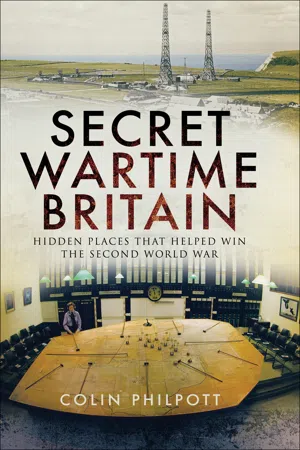
- 264 pages
- English
- ePUB (mobile friendly)
- Available on iOS & Android
eBook - ePub
About this book
Trusted by 375,005 students
Access to over 1.5 million titles for a fair monthly price.
Study more efficiently using our study tools.
Information
Print ISBN
9781526774941
Subtopic
British HistoryChapter One
Factories
Vera Stobbs’ Secret Life at a Royal Ordnance Factory; Ammunition Dumps and Explosions; the Shadow Factories of Coventry; the Camouflaging of Avro Leeds; 1,000s of factories hidden in plain sight; ‘Folly’ Factories Underground
Royal Ordnance Factory, Newton Aycliffe, County Durham
At the age of 94, Vera Stobbs recalled the events of three-quarters of a century ago as though they were yesterday. As an 18 year old, she started work in 1942 at the Royal Ordnance Factory at what was then Aycliffe in County Durham. Vera spoke to me in early 2018, just a few months before her death, about her experiences there. She spoke proudly and fondly of her time there, but it was a tough life which in many ways robbed her of the best years of her youth. A year before starting at the factory her mother had died and it fell to her, given the gender roles of the era, to look after her father who was a miner. Her caring responsibilities meant that she was able to avoid night shifts at the factory. However, she still had to work a relentless six-day-a-week pattern of either early or late shifts, six in the morning until two in the afternoon, or two in the afternoon until ten at night. It was dull, monotonous work and she had to keep the home functioning as well once she had finished.
Vera’s job was to inspect detonators. She had to open boxes, check the detonators and make sure they had been correctly assembled. She did this over and over again throughout her shift with just one half-hour break. She remembers a man she calls ‘The Commander’ coming round each shift to check on their work. Not only was the work boring and repetitive, it was also dangerous. Working with explosive materials brought obvious hazards and one of her friends, Rosie, died in an explosion in the very room where Vera worked, but on a shift when she was off-duty. There were several accidents at the factory during the course of the war. The worst, in May 1945, just days before the end of the conflict, claimed eight lives and an earlier blast, in February 1942, resulted in the deaths of four women.
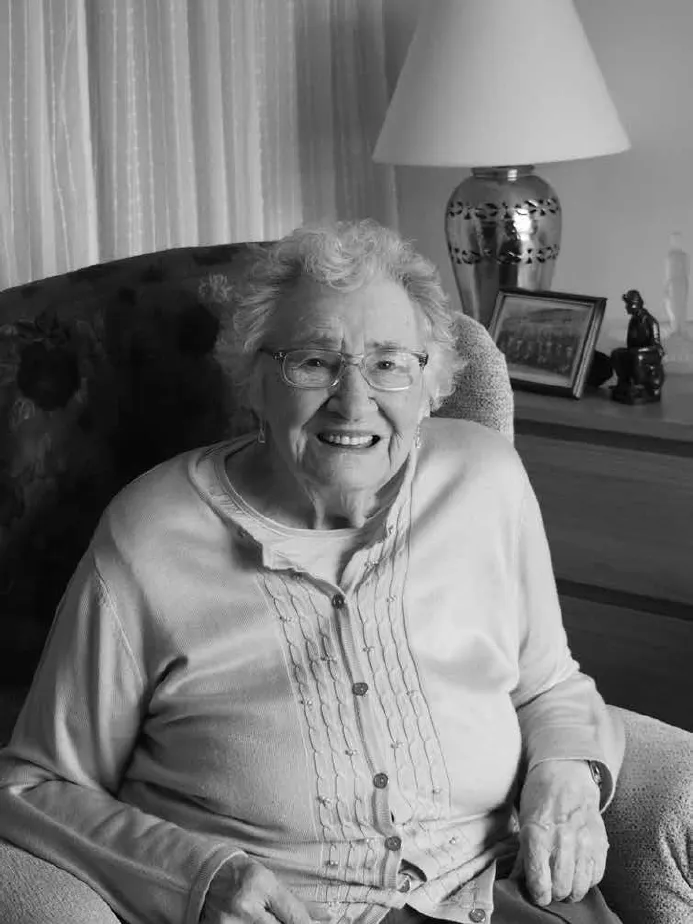
Vera Stobbs, one of the ‘Aycliffe Angels’ who worked at ROF59, the Royal Ordnance Factory at Aycliffe in County Durham from 1942 until the end of the war. (Colin Philpott)
When I spoke to Vera in 2018 at her home in what is now Newton Aycliffe, the new town built after the war near the site of the factory, she told me that she didn’t really appreciate the danger of the work at the time. It was just something in the background and she didn’t think about it all the time. However, there were plenty of warnings in the form of notices and instructions from factory bosses about the risks. Workers were reminded that carelessness could result in explosions in the factory causing injury or death to them and their colleagues, but also mistakes might lead to faulty munitions finding their way to the battlefront with terrible consequences there.
The factory was divided into a ‘clean side’ where the most volatile materials were handled and where restrictions were tightest and a ‘dirty side’ where things were a bit more relaxed. However, as part of the precautions taken to minimise the risk of explosions or chemical incidents, all workers had to wear special shoes and overalls which they put on at the beginning of each shift. They were checked to make sure they didn’t have any flammable items in their possession, like matches and cigarettes, or metal objects like hair grips which might fall into machinery.
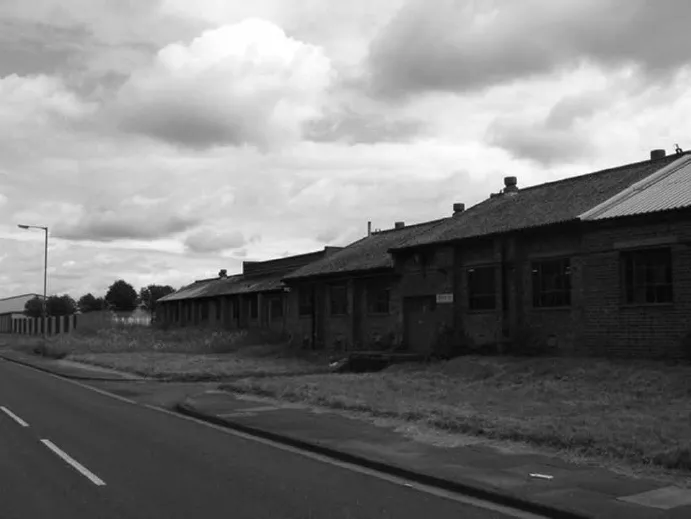
One of the few buildings still remaining from the Royal Ordnance Factory site at Aycliffe in County Durham and which now forms part of the Newton Aycliffe Industrial Estate. (Colin Philpott)
As well as the risk of explosion, there were a variety of dangers to health to those working in munitions factories. The materials involved in the manufacture of armaments often caused skin and hair to turn yellow (munitions workers were referred to as ‘canaries’), caused asthma and breathing problems, sometimes made teeth fall out and even damaged the lining of the stomach. Vera Stobbs was lucky enough to escape these problems, but many of her fellow-workers did suffer significant health issues.
An even greater potential danger came not from within the factory but from the skies above – the risk of German aerial bombardment – and it was against this risk that a range of measures were taken to protect the factory. First of all, its location was deliberately chosen. The Royal Ordnance Factory, Aycliffe, known by its code number of ROF59, was opened in 1941 covering a site of 857 acres and eventually employing over 17,000 people in around 1,000 separate buildings. The site, then in largely open countryside between Darlington and Bishop Auckland, was apparently selected because it was in low-lying ground which was often misty and cloudy. In addition, many wartime factories were built away from main centres of population and away from what was regarded as the more vulnerable south-east of England.
Like many similar factories, ROF59 was camouflaged both by painting and also with the planting of grass on the roofs of the buildings. However, it was a vast site protected by barbed-wire fences and it was impossible to conceal it completely – a characteristic shared with many vital Second World War facilities in Britain.
The site was well-guarded. Most workers arrived either by bike, bus or train at special stations close to the factory. All workers needed a pass and there were armed police at the gate. Vera Stobbs says she has no recollection of having had to sign the Official Secrets Act, nor does she remember any particular instructions about keeping quiet about the work. However, she never spoke to anyone outside the factory about what she did there during the war. She believes that people just knew instinctively that they should keep quiet about it and that the vast majority of her colleagues thought the same. This is a view that I heard many times in the conversations I had on this subject. Vera also pointed out that the site was remote and that, although most of the people who worked there lived in neighbouring large towns like Darlington and Bishop Auckland, it was nevertheless a close-knit community and most of the ROF workers did not meet many other people from outside so opportunities to ‘blab’ were limited, even if workers had been so inclined.
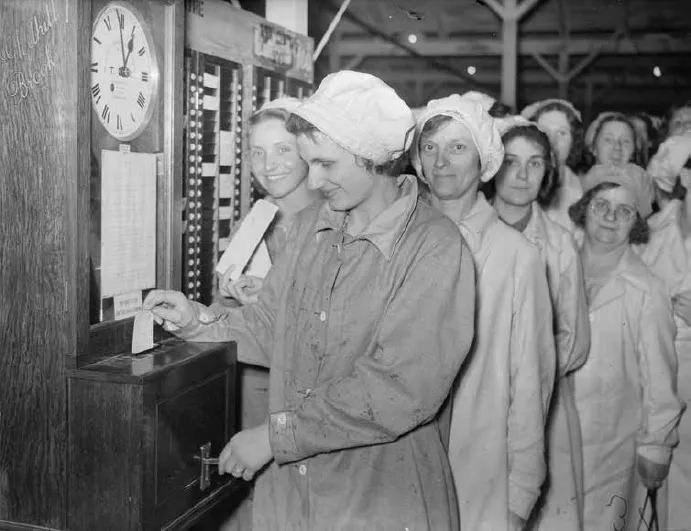
Mrs Skinner clocks on for her shift at a munitions factory, somewhere in Britain, 1940. A large group of her fellow workers are lined up behind her to punch their work card when their turn arrives. (Imperial War Museum)
If there were any breaches of security, their effect was limited. There are claims that German spies infiltrated the factory. William Joyce, the British traitor, who broadcast on an English language radio station from Germany under the name ‘Lord Haw-Haw’, is said to have made reference to the factory in one of his broadcasts. He promised that the factory would be bombed and that ‘those little Angels of Aycliffe won’t get away with it’. But even if, as seems likely, the Germans were aware of the factory, it was never bombed. Vera Stobbs doesn’t recall ever having to go into the factory’s air raid shelters during the day shifts there, although there were air attacks in the area and some bombs did drop nearby. Overall, a combination of its location, its camouflage, its security and the secrecy apparently maintained there meant that it was hidden in plain sight, a characteristic shared by so many of the locations to be encountered on this journey.
The survival of ROF Aycliffe without being bombed, like many other similar factories, was of enormous importance to the war effort. It was what was known as a ‘filling factory’. Its main role was to put powder into shells and bullets and to assemble detonators and fuses. The official history of wartime ordnance factories published at the end of the war estimated that the factory produced seven million bullets during the conflict so it made a major contribution to Britain’s wartime production effort. It was a contribution which was largely down to women who made up 85 per cent of the workforce. Indeed, the epithet ‘Aycliffe Angels’ originating from the Lord Haw-Haw broadcast, was adopted to describe the workforce at Aycliffe.
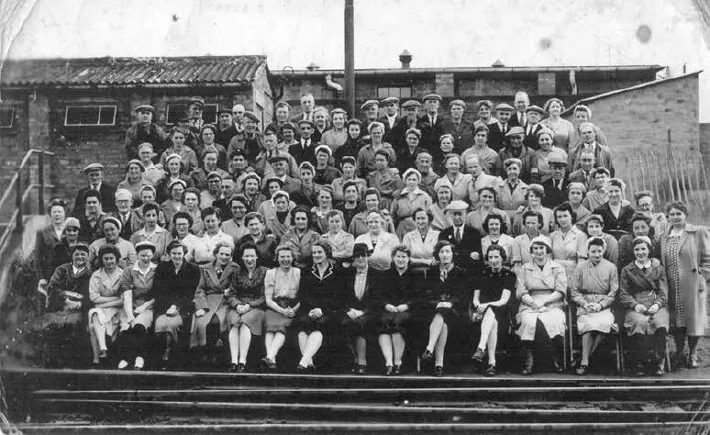
A group photograph of workers at the Royal Ordnance Factory at Aycliffe, County Durham. They became known as the ‘Aycliffe Angels’ after William Joyce, aka ‘Lord Haw-Haw’ referred to them as such during a broadcast threatening to bomb the factory. (Vera Stobbs)
One of the most important aspects of the story of Second World War Britain is the contribution of women on the home front – a contribution which many feel has never received the credit it deserves. Women were encouraged to volunteer from the start of the war and by 1941 more than a million were involved in the Women’s Voluntary Service (WVS) helping with tasks such as evacuation and assistance for victims of bomb damage. However, it soon became clear that women would also be needed in the armed services and in so-called essential occupations – work deemed to be vital to the war effort like factories and farming.
The call-up of women started in 1941. At first it affected just single women aged 20 to 30 but eventually 90 per cent of single women and 80 per cent of married women were involved in the armed forces, factories or on the land. Talking to Vera Stobbs and to others who worked in factories, they were immensely proud of what they did and they enjoyed the companionship and friendships formed during the war years. Although the work was dull and dangerous, the Aycliffe Angels had fun there. Vera told me about the ‘best ankles’ competitions the women organised to relieve the boredom. She recalled the dark humour of playing jokes by getting on stretchers to try to convince the managers that accidents had happened.
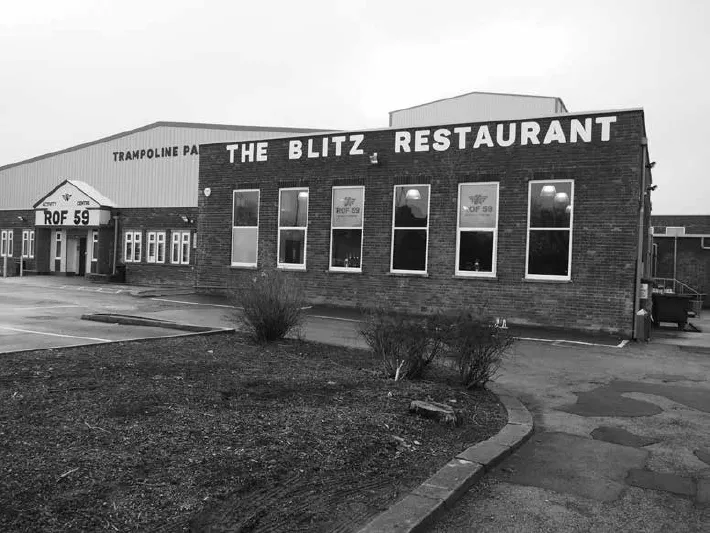
One of the remaining buildings at the former Royal Ordnance Factory at Aycliffe has been turned into a war-themed activity centre known as ROF59 (Colin Philpott)
However, Vera and many of the women who had worked there, and their families, felt that it took far too long for there to be sufficient recognition for their efforts. Winston Churchill made a morale-boosting visit to the factory on 15 May 1942 but in the post-war narrative of the Allies’ victory, it was usually the frontline efforts of Battle of Britain pilots and others which tended to be given most prominence. The contribution of the millions of people, the vast majority of them women, who worked on war production, was often overlooked. In the 1980s and 1990s there was renewed interest in the story of ROF Aycliffe and a campaign started for recognition. Eventually, a memorial plaque was erected in the centre of Newton Aycliffe. Moreover, in 2010 an All Party Parliamentary Group on Recognition of Munitions Workers was set up by a group of British MPs with a view to improving official recognition for the contribution of munitions workers during the war.
Meanwhile, the site of ROF59 had been transformed from 1946 onwards into the Newton Aycliffe Industrial Estate. Many of the factory buildings were redeveloped for peacetime industrial use. One building became the new headquarters of Durham Police. By 2018 most of the original buildings had disappeared to be replaced by new units. However, some remain and, in one of them, a new business – a fitness and indoor climbing centre complete with Blitz Restaurant and Bunker Bar – has opened called ROF 59. It maintains the wartime theme and original notices from the 1940s can be seen on the walls.
Other Munitions Factories
ROF Aycliffe was just one of fifty-one munitions factories across Britain during the Second World War. There were four categories of factories – the engineering factories producing casings for bombs and shells and weapons; small-arms factories making bullet casings; explosive factories manufacturing explosive agents and finally, the filling factories like Aycliffe which filled the bomb and shell casings with explosive substances. Some of these factories were run by private companies that had switched their premises from producing civilian consumer goods to war production; many of the factories were built and run by the Government.
Prior to 1939 Britain’s armaments production had been concentrated mainly on three factories in or near London – the Royal Arsenal at Woolwich, the Royal Gunpowder Factory at Waltham Forest and the Royal Small Arms Factory at Enfield, as well as a small number of factories elsewhere. However, the likelihood of mass aerial bombing necessitated moving munitions production away from the most vulnerable part of the country – London and the south-east. Most munitions factories were therefore built west of a line running roughly from the Bristol Channel to the Tyne. In selecting sites, the key factors were remoteness from areas most vulnerable to bombing, but with reasonable proximity to available supplies of labour and to transport links.
The biggest and the most dangerous were the filling factories like Aycliffe. The factory at Bridgend in South Wales was said to be the largest factory in Britain at the time of its construction in the late thirties. When it was fully operational by March 1940, it covered over 1,000 acres and eventually employed more than 32,000 at its peak during 1942. Officially, seventeen people died in accidents there. Like Aycliffe, it was situated on reclaimed marshland and often shrouded in mist. After the war parts of the site were bulldozed, parts turned into industrial units and others into housing.
ROF Swynnerton near Stone in Staffordshire was another massive site, also a filling factory and, like Aycliffe and Bridgend, chosen partly because it was in an area prone to mist. Started in 1939, the factory was operational the following year and reached peak employment in 1942 with 18,000 working there, mostly women between 18 and 35 years old. The majority of workers were local but Swynnerton, like some other munitions factories, also employed women from all over the country and accommodation hostels were built to house them. The factory had its own railway station which never appeared in any rail timetable.
Swynnerton had more than 2,000 separate buildings. This type of dispersal was typical of the munitions factories in an attempt to reduce the risk of explosions in one area causing damage across the wider facility. After the war many of Swynnerton’s building...
Table of contents
- Cover
- Title
- Copyright
- Dedication
- Contents
- Introduction
- Chapter One Factories
- Chapter Two Command Centres
- Chapter Three Spying and Listening Bases
- Chapter Four Broadcasting and Propaganda
- Chapter Five Decoys, Dummies and D-Day
- Chapter Six Retreats, Reserves and Resistance
- Chapter Seven Interrogation, Internment and Indiscretions
- Chapter Eight Weapons Of Mass Destruction
- Conclusion
- Sources
- Acknowledgements
Frequently asked questions
Yes, you can cancel anytime from the Subscription tab in your account settings on the Perlego website. Your subscription will stay active until the end of your current billing period. Learn how to cancel your subscription
No, books cannot be downloaded as external files, such as PDFs, for use outside of Perlego. However, you can download books within the Perlego app for offline reading on mobile or tablet. Learn how to download books offline
Perlego offers two plans: Essential and Complete
- Essential is ideal for learners and professionals who enjoy exploring a wide range of subjects. Access the Essential Library with 800,000+ trusted titles and best-sellers across business, personal growth, and the humanities. Includes unlimited reading time and Standard Read Aloud voice.
- Complete: Perfect for advanced learners and researchers needing full, unrestricted access. Unlock 1.5M+ books across hundreds of subjects, including academic and specialized titles. The Complete Plan also includes advanced features like Premium Read Aloud and Research Assistant.
We are an online textbook subscription service, where you can get access to an entire online library for less than the price of a single book per month. With over 1.5 million books across 990+ topics, we’ve got you covered! Learn about our mission
Look out for the read-aloud symbol on your next book to see if you can listen to it. The read-aloud tool reads text aloud for you, highlighting the text as it is being read. You can pause it, speed it up and slow it down. Learn more about Read Aloud
Yes! You can use the Perlego app on both iOS and Android devices to read anytime, anywhere — even offline. Perfect for commutes or when you’re on the go.
Please note we cannot support devices running on iOS 13 and Android 7 or earlier. Learn more about using the app
Please note we cannot support devices running on iOS 13 and Android 7 or earlier. Learn more about using the app
Yes, you can access Secret Wartime Britain by Colin Philpott in PDF and/or ePUB format. We have over 1.5 million books available in our catalogue for you to explore.