- 224 pages
- English
- ePUB (mobile friendly)
- Available on iOS & Android
eBook - ePub
The RAF Regiment at War, 1942–1946
About this book
Born out of necessity in the dark days of the War, the RAF Regiment found itself in the thick of the action supporting the vital operations in all theaters. This comprehensive record of their operations gives the clearest indication of the contribution that the Regiment made and includes many first hand accounts of the fighting, including the first shooting-down of a jet aircraft, the Me 262A-2a Sturmvogel in November 1944. As a result of their outstanding contributions to the success of RAF operations in WW2, the Regiment became a permanent part of the RAF. This is the official history of the RAF Regiment from its foundation 60 years ago to the aftermath of hostilities.
Information
CHAPTER ONE
A TIME OF CHANGE
The War of 1914-1918 produced two significant advances in military technology: the combat aircraft and the armoured fighting vehicle. Neither had realized anything approaching their overwhelming influence on the battlefield by the time the war ended, but their appearance in the complex mechanism of warfare cast long shadows which were neither welcomed nor understood by many Service officers and politicians. Indeed, the Chief of the Imperial General Staff was quick to dismiss the newly-formed Royal Air Force as “coming from God knows where, dropping its bombs on God knows what, and going off God knows where”.Those Army officers, such as Fuller and Hobart, who advocated the replacement of cavalry by armoured fighting vehicles were regarded as cranks by their professional colleagues and even the foremost military commentator of the day, Basil Liddell Hart, was ridiculed for his arguments for the “indirect approach” which advocated the use of armoured columns, supported by aircraft, to defeat an enemy army by striking at headquarters, communications and logistic support areas behind the conventional front line. But these theories fell on more fertile ground in the resurgent German General Staff where the blitzkrieg doctrine of fast-moving armoured columns combined with airborne operations and close air support was being developed and refined from Liddell Hart’s pioneering ideas.
Just as Liddell Hart had analysed the future of war on land, another military mind had concentrated on establishing the principles of air power and the means of applying them in war. This was the Italian General Giulio Douhet, who published his treatise The Command of the Air in 1921, soon after the end of the First World War. In his remarkably perceptive study of the aims and methods of air warfare he revealed a principle of fundamental importance when he wrote “The surest and most effective way (of achieving air superiority) is to destroy the enemy air force at its bases” – a statement so obvious in itself that it escaped the attention of many of those in influential positions in the British political and military establishment. However, its significance did not escape the German High Command which was developing the strategy for a new form of warfare, based on modern technology which could effectively destroy any enemy unwise enough to believe that the next war would be won by using the methods which had prevailed in the previous one.
The Maginot Line came to be regarded as the modern answer to the debilitating siege warfare which had been the major feature of the Western Front from 1914 to 1918, and few of those who had experienced that conflict could visualize the developments in strategy and tactics which would make headquarters, airfields and supply depots in the rear areas much more vulnerable to the greater mobility and firepower of ground forces, and to a devastating level of attack from the air, than had been possible even in 1918. From the experience it had gained with the Royal Flying Corps, which was then a part of the Army, between 1914 and 1918 the War Office maintained the principle that, as war on land was the Army’s responsibility, the Army should continue to provide and command the ground and anti-aircraft defences which the Royal Air Force required for the security of its airfields and installations. Despite the RAF’s status as an independent Service, the Air Ministry was content to accept those assurances at their face value, without assessing the implications, in terms of limitations on its own freedom of action, on the conduct of air operations in a future conflict.
In the lean years after the First World War, when the Armed Forces were the poor relations in terms of government expenditure, there were few resources to spare either to develop new technology or to train for a major war. In those locust years both the Army and the RAF were committed to the policy of “imperial policing” in British colonial possessions, which usually took the form of aiding the civil power to restore law and order in urban areas of the Empire, or dealing with incursions and rebellions by lightly-armed tribesmen in the deserts of the Middle East and on the North-West Frontier of India.These activities placed minimal demands on the development of weapons and tactics for a major war and it was hardly surprising that, despite a frantic rearmament programme from 1936 to the outbreak of war in 1939, the British armed forces lagged far behind their enemies in terms of the organization, tactical doctrine, training, weapons and equipment essential for fighting a global war against major European and Asian powers.
In the inter-war years the British Army had struggled to come to terms with the implications of mobility and the employment of armoured fighting vehicles, but it was hampered by a lack of political and strategic direction as well as by inadequate resources. As far as the RAF was concerned, it was required to spread its limited capabilities between defending the United Kingdom against air attack, supporting the operations of the Army and the Royal Navy and in developing an offensive bomber force. In meeting this multiplicity of tasks, the Air Force had been assured that, by operating its aircraft from bases within the Army’s area of responsibility, its airfields would be secure from enemy interference. What neither Service had taken into account was whether the Army would be able to fulfil such a complex and demanding commitment to the Royal Air Force in the yet unrevealed scenario of modern war.
However, as the prospect of another conflict with Germany became more likely, the more thoughtful members of the Air Staff began to appreciate the dangers inherent in relying on another Service, which had different roles and priorities, for the defence of its own airfields and vital installations. Initially, the threat was seen simply as one of low-level air attack by enemy aircraft which had evaded the RAF’s defensive fighter screen and no serious thought was given to the possibility of direct attack on airfields by ground or airborne forces.
To cater for defence against low level air attack, for which neither funding nor new weapons had been provided, searches in the RAF’s supply depots revealed that a number of surplus, First World War vintage, aircraft machine guns still remained in store. These were adapted for use in the defence of airfields and a number of airmen in the trade of Aircrafthand General Duties (ACH/GD) were given cursory training in the handling of these weapons against low-flying aircraft. It was a half-hearted attempt to make bricks without straw and, when put to the test in France and Norway in 1940, it failed miserably.The RAF’s improvised airfield defence measures were swept aside as its forward airfields were strafed by the Luftwaffe and outflanked or overrun by the panzers of the Wehrmacht as the Germans swept through France, the Low Countries and parts of Scandinavia. Despite the gallantry of RAF aircrews, the battle for air superiority was lost as airfields in the forward areas were abandoned and aircraft in the rear areas were destroyed on the ground by a German tactical air force engaged in proving the validity of Douhet’s analysis of the fundamentals of air warfare.
The Luftwaffe was essentially an integrated air arm, with its own infantry, airborne and air defence artillery units, which had little difficulty in achieving air superiority in the early stages of the war by the simple expedient of neutralizing the enemy’s air bases while its own airfields were well protected against attack by its own infantry and antiaircraft units. However, after winning the Battles of Poland, France and Norway by such tactics, the Germans failed to win the Battle of Britain, largely because the English Channel protected the British airfields from ground attack while the elementary radar system on the south and east coasts of England gave adequate warning time for British fighter aircraft to be airborne from their lightly-defended airfields before the waves of attacking aircraft crossed the English Channel. Elsewhere in the United Kingdom, where radar warning and airfield defences were more limited or even non-existent, German air attacks in broad daylight achieved far greater success. RAF airfields, without adequate defences, were attacked with impunity from Wick and Lossiemouth in Scotland through Driffield, Leeming and Dishforth in the North of England to Castle Bromwich and Kirton-in-Lindsey in the Midlands and Kidlington, Mildenhall and Honington in the south and east.
It was at this point that it became all too clear that the RAF’s ability to fight – and win – the air war would depend on the protection provided for its bases against hostile action by enemy ground and air forces. Inevitably, the threat of an imminent invasion after Dunkirk in 1940 caused the Army to give priority to the land battle over the defence of RAF airfields and it became increasingly obvious to the Air Staff that, under the pressures of war, the interests and capabilities of the two Services were diverging to such an extent that the RAF would have to rely on its own resources to ensure that its installations would survive attack and retain the capability for its aircraft to operate effectively against the enemy.
In July 1940, even before the evacuation of British forces from the European mainland was complete, the Air Ministry formed the RAF’s Directorate of Ground Defence to co-ordinate the ground and antiaircraft defence of airfields and installations with the Army’s Inspectorate of Aerodrome Defence. In August 1940, realizing the extent and urgency of the problem, Air Chief Marshal Sir Frederick Bowhill advocated the formation of a ground defence corps, modelled on the Royal Marines, within the RAF and this proposal was strongly supported by the Deputy Chief of Air Staff, Air Marshal Sir Sholto Douglas. There was inevitable opposition to this within the War Office, as well as in some parts of the Royal Air Force, and the pessimistic estimates of the additional manpower which this would require – up to 100,000 men – doomed the project at a time when all three Services were competing for the limited resources of manpower and material which were then available in the UK.
The compromise solution was to continue the patchwork division of responsibility between the Army and the Air Force for the ground and air defence of RAF airfields and installations in the United Kingdom by a mixed force of 17,000 soldiers and 25,000 airmen. The RAF element of this force consisted of NCOs and aircraftmen (remustered in the new trade of Ground Gunner from mid-1940 onwards), officered by the Defence specialization of the Administrative & Special Duties branch. However, although the deployment of the RAF component of this mixed force remained relatively stable, the Army inevitably altered the number, type and strength of its assigned units to meet the recurring changes in the deployment of its anti-invasion forces. This made the planning and direction of airfield defences difficult, if not impossible, particularly as the War Office always insisted that local Army commanders retained the right to redeploy their units elsewhere, without notice, whenever the overall military situation required it and regardless of the level of ground and air threats to the maintenance of aircraft operations. The result was that RAF commanders had to accept that their airfields would be left without the protection of Army units whenever the Army required reinforcements for the land battle, regardless of the threat to airfields and the maintenance of air operations.
Although station defence measures were still at an early stage of development, there were a series of successful anti-aircraft engagements during attacks on RAF airfields in England from July 1940 to the formation of the RAF Regiment in early 1942. During the Battle of Britain, for instance, at RAF Detling Corporal Bruce Jackman continued firing his twin Lewis guns at attacking aircraft until his gun position was demolished by a bomb and he was severely wounded. At RAF Biggin Hill Sergeant Robert Cunningham dismounted a machine gun from an armoured car and engaged three enemy aircraft which were bombing the airfield. At RAF Kenley Corporal John Miller of the Scots Guards shot down a German aircraft with his Lewis gun, while AC2 David Roberts destroyed another enemy aircraft by using the RAF’s newest anti-aircraft weapon for the first time. This was the parachuteand-cable system in which a line of twenty-five rockets was fired in the path of attacking aircraft. The rockets soared to a height of 500 feet, each trailing a steel cable attached to a parachute and the spectacular display of smoke and flames heartened the British defenders on the ground as much as it dismayed the German aircrew as two of the three attacking Dornier 17 bombers were brought down. All three RAF airmen, and the Scots Guards NCO, were awarded Military Medals for their actions. Other awards to RAF Ground Gunners in this period included two George Medals, two more Military Medals, five British Empire Medals for gallantry, seven mentions in dispatches and a King’s Commendation for Brave Conduct.
As training, equipment and organization of airfield defence improved throughout 1941, the Ground Gunner anti-aircraft flights achieved steadily increasing success against those enemy aircraft which attacked RAF airfields and installations at low level. What was universally recognized, however, was that a better and more effective anti-aircraft weapon than the .303˝ machine gun was needed to improve the kill rate – and the deterrent effect – of airfield defences.
Although the effectiveness of anti-aircraft defences on RAF airfields in the UK declined as the emphasis of German strategy changed from daylight raids at low level to high-altitude night bombing attacks, the unabated success of enemy action against RAF airfields in the Middle East revealed the many weaknesses in the policy of dividing the responsibility for airfield defence between two Services with different priorities. The last straw, as far as the War Cabinet was concerned, was the unsuccessful British campaign in Greece in 1941, culminating in the fall of Crete and the loss of most of the British, New Zealand and Greek troops who had been evacuated there from Greece, together with their weapons and equipment. There were three airfields on the northern coast of Crete, at Maleme, near Canae on the west, at Retimo in the centre and at Heraklion in the east, as well as a flying boat base at Suda Bay. Maleme was the closest to the German bases in Greece and had the added advantage of being adjacent to a large town and the port at Suda Bay; it was therefore the enemy’s primary objective. The initial assault by glider-borne and parachute troops was disastrously expensive for the Germans but by concentrating their resources on the single objective of Maleme they were able to capture the airfield within 48 hours. From then onwards a stream of transport aircraft, each carrying forty fully-armed men or an equivalent load of supplies, was landing at the rate of up to twenty an hour and the British garrison, without air support or reinforcement, was overwhelmed.
In the United Kingdom the much greater awareness of the importance of air power directed attention to the security of airfields in concert with the introduction of new aircraft. In Parliament pressure for a speedy resolution of the problem of airfield defence became overwhelming and the government was forced to appoint a distinguished civil servant, Sir Findlater Stewart, to head a committee tasked to examine ways of improving airfield defence and to submit its report to the Chiefs of Staff within the shortest possible time. The committee’s recommendation that the RAF should form its own airfield defence corps of 79,000 officers and airmen, which would release 93,000 soldiers from airfield defence tasks, was accepted by the War Office and the Air Ministry, and approved by the War Cabinet in December 1941. As a result, the War Office agreed to give full support to the new organization by providing instructors, weapons and equipment as well as by seconding officers and NCOs to serve with the RAF Regiment.
HM King George VI gave his formal assent to the formation of this Corps, as an integral part of the Royal Air Force, by a Royal Warrant signed on 6 January 1942 and the Royal Air Force Regiment duly came into existence on 1 February 1942.
By building on the structure of the officers in the defence specialization of the Administrative & Special Duties branch and the NCOs and aircraftmen of the Ground Gunner trade, the new Regiment reached a strength of 50,000 officers and airmen in 240 combatant squadrons, which were deployed alongside the RAF in every theatre of war, within 18 months of its formation.
CHAPTER TWO
THE FORMATION OF THE RAF REGIMENT
In January 1942 there were 150 RAF ground defence squadrons and 335 RAF independent anti-aircraft flights deployed on RAF stations in the British Isles. They had been formed during 1941 in response to the enemy threat to RAF airfields and were officered by those members of the Administrative & Special Duties branch of the RAF who had been trained as Defence Officers, and manned by NCOs and aircraftmen mustered as Ground Gunners, most of whom were drawn from the trade of Aircrafthand General Duties.
Although the ground defence squadrons were based on the model of an Army infantry company, they had only personal weapons and lacked the heavier support weapons with which the infantry units were equipped. The anti-aircraft flights were scaled for between twelve and twenty-four .303˝ machine guns of various types on a variety of mountings, but these did not present a real deterrent, let alone a serious threat, to enemy aircraft attacking at anything other than very low level within a few hundred yards of a static anti-aircraft machine-gun position.
With the formation of the RAF Regiment on 1 February 1942 the Army fulfilled its commitment to provide a cadre of officer and NCO instructors at the newly formed training schools, as well as providing senior officers to fill staff posts in the Air Ministry and at RAF Command and Group headquarters. Although the Vice-Chief of Air Staff had asked for a lieutenant-general to head the new Regiment, the War Office considered that to be an over-ambitious rank for the appointment and seconded Major-General Claude Liardet, who was already the Army’s Inspector of Aerodrome Defence, to take the post of Commandant of the RAF Regiment. A Territorial, not a Regular, Army officer, Liardet had a distinguished record in the 1914-18 war and had been the General Officer Commanding the London TA Division in 1939.
In March 1942 the RAF Regiment Depot was established at Lord Brownlow’s country seat, Belton Park, near Grantham, and a separate RAF Regiment officer cadet training unit was formed there to produce officers with the necessary professional skills. Numerous instructional schools were established to carry out basic and advanced training and several live firing ranges were designated for ground and anti-aircraft weapons. The training task was immense: for a start all the officers and airmen in the existing squadrons and flights had to be retrained as individuals to higher military standards appropriate to their roles and ranks before they could be trained collectively in flights and squadrons for combat tasks.
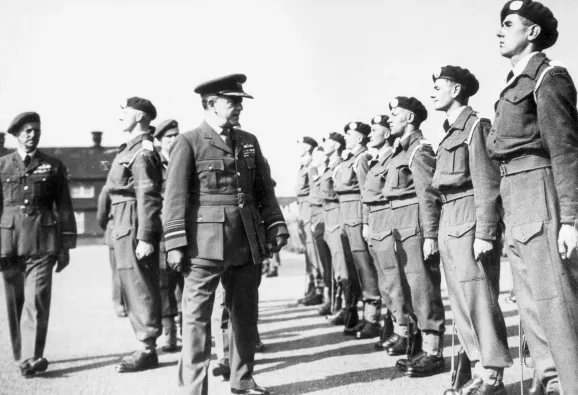
RAF Regiment OCTU, RAF Regiment Depot Belton Park, September 1944. The Commandant of the Depot, Air Commodore Higgins CB CMG, and the reviewing Air Marshal are looking closely at Officer Cadet Roland George (on the extreme right of the picture). (R George)
The overloaded training machine received welcome assistance from the Royal Marines, who undertook much of the task of training the Regiment’s own NCO instructors, while a number of officer and NCO instructors provided by the Brigade of Guards ensured that the initial training of airmen reached a sufficiently high standard. The contribution which instructors from these two elite formations made to the foundation of the RAF Regiment was immense and to this day the RAF Regiment maintains its links with the training establishments of both the Guards Division and the Corps of Royal Marines.
Inevitably, a significant number of officers and airmen were found to be medically unfit or below the standards required for the new Regiment during this phase and had to be replaced by transfers from other RAF trades and by intakes of new recruits. As unit weapons, including anti-tank artillery, mortars and 20mm anti-aircraft guns, and unit equipment such as MT vehicles and armoured cars, were in short supply, improvisation was the order of the day. Nevertheless, by June 1942 there were 148 fully-trained and operational field squadrons available and by June 1943 the formation of new field squadrons and the reorganization of the former AA flights into LAA squadrons had increased the Regiment’s order of battle to some 40,000 officers and airmen in 240 squadrons in the United Kingdom, the Mediterranean, Middle East and Far East. With the addition of staff appo...
Table of contents
- Cover
- Title Page
- Copyright
- Contents
- Acknowledgements
- Preface
- Prologue
- Chapter One: A Time of Change
- Chapter Two: The Formation of the RAF Regiment
- Chapter Three: Events in the United Kingdom 1942-45
- Chapter Four: North Africa 1942-43
- Chapter Five: The Middle East 1942-46
- Chapter Six: The Central Mediterranean
- Chapter Seven: North West Europe 1944-46
- Chapter Eight: South East Asia 1942-46
- Epilogue
- Index
Trusted by 375,005 students
Access to over 1.5 million titles for a fair monthly price.
Study more efficiently using our study tools.
Frequently asked questions
Yes, you can cancel anytime from the Subscription tab in your account settings on the Perlego website. Your subscription will stay active until the end of your current billing period. Learn how to cancel your subscription
No, books cannot be downloaded as external files, such as PDFs, for use outside of Perlego. However, you can download books within the Perlego app for offline reading on mobile or tablet. Learn how to download books offline
Perlego offers two plans: Essential and Complete
- Essential is ideal for learners and professionals who enjoy exploring a wide range of subjects. Access the Essential Library with 800,000+ trusted titles and best-sellers across business, personal growth, and the humanities. Includes unlimited reading time and Standard Read Aloud voice.
- Complete: Perfect for advanced learners and researchers needing full, unrestricted access. Unlock 1.5M+ books across hundreds of subjects, including academic and specialized titles. The Complete Plan also includes advanced features like Premium Read Aloud and Research Assistant.
We are an online textbook subscription service, where you can get access to an entire online library for less than the price of a single book per month. With over 1.5 million books across 990+ topics, we’ve got you covered! Learn about our mission
Look out for the read-aloud symbol on your next book to see if you can listen to it. The read-aloud tool reads text aloud for you, highlighting the text as it is being read. You can pause it, speed it up and slow it down. Learn more about Read Aloud
Yes! You can use the Perlego app on both iOS and Android devices to read anytime, anywhere — even offline. Perfect for commutes or when you’re on the go.
Please note we cannot support devices running on iOS 13 and Android 7 or earlier. Learn more about using the app
Please note we cannot support devices running on iOS 13 and Android 7 or earlier. Learn more about using the app
Yes, you can access The RAF Regiment at War, 1942–1946 by Kingsley M. Oliver in PDF and/or ePUB format, as well as other popular books in History & Military & Maritime History. We have over 1.5 million books available in our catalogue for you to explore.