"Remarkably comprehensive . . . a superb account of a man whose contribution to the political, legal and military legacy of England cannot be understated." —
The Pegasus Archive
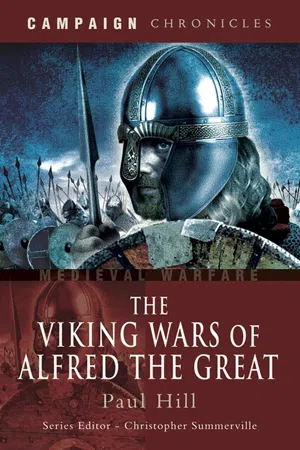
In the spring of 878 at the Battle of Edington the tide of English history turned. Alfred's decisive defeat of Guthrum the Dane freed much of the south and west of England from Danish control and brought to a halt Guthrum's assault on Alfred's Wessex. The battle was the culmination of a long period of preparation by Alfred in the wilderness—a victory snatched from the jaws of catastrophic defeat. As such, this momentous turning point around which an entire nation's future pivoted, has given rise to legends and misconceptions that persist to the present day.
Paul Hill, in this stimulating and meticulously researched study, brings together the evidence of the medieval chronicles and the latest historical and archaeological research to follow the struggle as it swung across southern England in the ninth century. He dispels the myths that have grown up around this critical period in English history, and he looks at Alfred's war against the Vikings with modern eyes.
"This book focuses on Alfred's military campaigns against the Vikings and the strategies he used to defend his kingdom and ultimately defeat his enemies. It also looks at the broader historical context of the Viking invasions and their impact on England." —
Medieval Chronicles
- 224 pages
- English
- ePUB (mobile friendly)
- Available on iOS & Android
eBook - ePub
The Viking Wars of Alfred the Great
About this book
Information
Campaign Chronicle

Nine years without a break he battled with the enemy. Sometimes they deceived him with an uncertain truce. Sometimes he took vengeance on the deceivers. At length he was reduced to such straits that, with scarcely three counties, Hampshire, Wiltshire and Somerset, remaining stubbornly in their allegiance, he was actually forced to take refuge in an island called Athelney, which from its marshy situation was hardly accessible. Years afterwards, when happier times returned, he himself would tell his friends in cheerful intimacy the story of his adventures and how he had survived them by the merits of St Cuthbert–so common is it among mortal men to recall with pleasure experiences that were fearful at the time.
William of Malmesbury
865 The Great Army Arrives in England
The Ravaging of Kent
As men worked near the coast on the fertile fields of the Kentish countryside, they saw something through the autumn haze that shocked them: sail after sail, stretching across the sea–a vision as wide as it was deep. Nothing quite like it had been seen before, but those Kentish men knew what it was. There had been raiding in Kent in the previous year. That fleet had exacted promises of money but had set about plundering the countryside with impunity against the agreement they had made. But now, 300–400 ships, carrying up to 5,000 people, began to infest the Isle of Thanet yet again.
Those who could remember–or who had heard tell–of the great fleet of 851, which had stormed Canterbury and which had been finally caught and defeated by King Æthelwulf and his son Æthelbald at Aclea in Surrey, will have known to expect grim times. Some will have remembered the stories of the sacking of Winchester just five years earlier. But the present fleet was huge, like an entire nation on the move, reminding men of the days of the great wanderings of folk across Europe centuries before, when their own Saxon ancestors had poured into the east of Britannia to change the cultural complexion of the island forever. And now it was happening again. Long ago it had been Hengist and Horsa at the head of a pagan warband, carving their destiny in a Christian land. Now Halfdan, Ubba and Ivarr–the sons of Ragnar–had come to see what they could snatch.
But despite the ravaging, it soon became clear that neither Kent, nor indeed Thanet, were the target. Instead, this Great Heathen Army sailed away. To East Anglia they went, to the land of King Edmund. The East Anglian king, whose place in English history would be confirmed in the most horrible of ways, had reigned over his people many years and was well loved. Edmund’s scouts must have reported what they saw off the East Anglian coast with some trepidation. Nobody knows what Ivarr said to Edmund when they met, but it was likely to have been a one-sided conversation. It must have been very clear to Edmund and his court that the Danes were here to stay. There would be no sporadic raiding, no random devastation. The sons of Ragnar had a different agenda, their ambition driven by cold reason. Money, food, accommodation and horses: these were the bare requirements of the Great Heathen Army.
Edmund was not in a strong enough position to do much about it. The numbers ranged against him were already large and the Danes had pulled off a complete surprise. The news grew worse for the king. Those Vikings who had been active in Francia, and elsewhere on the Continent, had got wind of Ivarr’s foothold in East Anglia and joined him in the spring and summer of 866. The brothers had spent a whole winter in England and as the fields of East Anglia became infested with Viking tents and equipment, Edmund must have wondered how to rid himself of the menace. Recently in Francia, Charles the Bald’s policy of appeasement had made many in Ivarr’s army very rich in terms of portable wealth. They brought to the East Anglian camp large amounts of wine and their share of the 4,000 pounds of silver Charles is known to have paid them. Increasing that wealth was certainly a motivation for the Danes, but the leadership had a political goal, unlike any previous Viking foray on English soil.
The Horsing of the Danes
Asser’s statement that ‘almost the whole army’ was supplied with horses when in East Anglia may reveal a multitude of things. First, it shows that East Anglia was a good breeding ground for horses and presumably held many royal and ecclesiastical studs. Second, it shows the Danes had a military plan. They would campaign on land–many hundreds, if not thousands of them–as a mounted infantry force. Soon the Anglo-Saxon Chronicle would refer to them as ‘radhere’, literally meaning a ‘mounted army’. From the sea, the Danes would support their land counterparts and often sail into the places the mounted forces had secured for them. To modern eyes, the Danish land force from East Anglia, when it was on the move, would have taken on the look of a cavalry army, only preferring to dismount and fight shield to shield as infantrymen when it came to an encounter. Their opponents, the Anglo-Saxons, whose nobility are known to have widely used horses, would have to adopt new strategies to capture this force in the English landscape.
The appearance of a huge mounted army at this time in England may well have acted as a catalyst for the Anglo-Saxons’ horse management techniques. Before the end of the century specific logistical roles were given to the king’s horse thegns, who, like their Carolingian counterparts, were responsible for provisioning the army. It is worth, at this early stage, considering just what kind of logistics would have been involved for both the Danish and Anglo-Saxon mounted forces. Just one horse consumes up to 12 pounds of grain a day and up to 13 pounds of hay. When on campaign, it is likely these mounts were given safe grazing areas. Here, they will have consumed grass amounting to three times the total of hay. This is notwithstanding the many gallons of water required for each animal each day. And so, as they destroyed numerous studs across the ancient kingdom of East Anglia and prepared for a lengthy campaign, the Danes cannot have known that they were changing the way warfare would be waged in England for years to come.
The Breeding of Horses
The Anglo-Saxons loved their horses. As early as the eighth century the Venerable Bede mentioned the gift by King Oswine (644–651) of a ‘royal’ horse to St Aidan. That such a horse could have been given as a gift points to the existence of stud farms. The business of running a stud so expertly carried out by monastic communities as well as by king’s officials was fraught with difficulty. To breed a horse which was to be involved in warfare was a tricky business. Segregating the mares and ensuring the appropriate stallions covered the right mares was also difficult. The Great Heathen Army which landed in East Anglia in its urgency to provide mounts for itself will have destroyed generations of horse breeding across the kingdom. Just one hole in a fence could destroy a breeding programme, let alone an army of marauding Danes.
In Alfredian times a charter of the puppet king Ceolwulf (874–c. 880) dating to 875 gives us a clue as to contemporary horse management. Ceolwulf freed ‘the whole diocese of the Hwicce from feeding the king’s horses and those who lead them’. The Anglo-Saxon Chronicle records the English army as often riding after the Danes and in many cases catching up with them. The Danes themselves valued their horses and are even known to have captured them in one country and shipped them to another, the case of Rochester in 885 being a good example.
866 Descent on York
All Saints Day, 1 November 866
King Burgred of Mercia had come to his throne in 852. Although he headed a family at loggerheads with other Mercian clans, all vying for the throne, Burgred enjoyed a relatively civil relationship with Wessex. He had appealed to Alfred’s father for help in Mercia’s long-standing struggle against the Welsh and Æthelwulf had indeed answered his call. But the time for testing the strength of the marriage of Alfred’s sister to the Mercian king was yet to come.
As it grew in the countryside of East Anglia and provisioned itself, the sheer size of the Great Heathen Army must have terrified those Mercian scouts who rode from Burgred’s kingdom. Which way would it go when the campaigning season started? Burgred, whose military capabilities had already been proved to some extent against the Welsh, knew that this new threat was different. If they came directly for him, could he resist? Was there even enough unity within his court to prevent this colossal enemy from driving apart the nobility of ancient Mercia?
Burgred had every reason to be afraid, but if he had kept a close eye on the build-up of the Danes, then the same could not have been said for the leadership of Northumbria. In fact, this most ancient and one time leading Anglo-Saxon kingdom, had descended into political farce on the eve of the Viking invasion, and it is certainly not beyond the intelligence apparatus available to Ivarr for him to have known almost every detail about the situation in what would now become the first of many strategic targets.
Asser bemoans the situation in the north as having been ‘fomented by the devil’. The Northumbrians, he tells us, had expelled their king Osberht, replacing him with a tyrant called Ælle, a man not of the royal line. This sort of diversion from the royal bloodline was always a contentious issue in Anglo-Saxon society. The alleged usurpation had occurred in 858. Nor did Ælle rule without the prospect of the return of Osberht, who was still at large. It had been Ælle who, according to legend, had killed Ragnar, and it would be he who would pay dearly for it. His war with Osberht reduced the Northumbrian countryside to poverty, particularly in respect of the robbing of the lands of the community of Lindisfarne. Some legends say that Osberht had raped the wife of a man called Bruern Brocard, and that Brocard was so set on revenge that he sailed to Denmark and enlisted the aid of the sons of Ragnar. Whatever the truth behind the story, the leading thegns of the Northumbrian kingdom were divided in their loyalties: on the one side, to a strong-willed and popular incumbent, and on the other, to the one-time occupant of the throne who was entitled to the position by virtue of his blood. What happened next in Northumbria might seem like a tale of vengeance, where saga and reality briefly came together in a colourful northern world.
But summer turned into autumn and still the Danes had not moved. If Burgred’s scouts were surprised at the immobility of a force seemingly ready for campaign and yet going nowhere, then, to the feuding northerners, such news–if it was ever received–might have vindicated their disregard for the danger. Ælle and Osberht should have realised they were mistaken. These two Anglo-Saxon leaders were scorned by the Scandinavian writers and poets of the age. They were the ‘pigs’ who would soon ‘grunt’, so the legend had said.
And the Danish leadership was clever in its approach. Ivarr, whose legendary father had apparently adopted such a stratagem in an Easter time attack on Paris, knew the value of timing. His enemy, after a year of campaigning in its own kingdom against its own kind, would be exhausted by winter. They would also be thinking of other things.
Quite how many thousands went with the brothers to York that winter, and how many were left behind to garrison themselves at their camp in East Anglia, we will never know. We can only guess at the mixture of relief and awe the Mercians felt when they heard that the force was sailing north, over the mouth of the Humber. The Danes had chosen to head not for Burgred’s Mercia but for the crippled and divided patrimony of Ælle.
On Friday, 1 November 866, they came. It was All Saints Day, an important religious festival in the Northumbrian calendar. This was an ideal time to attack, just when folk were putting aside their weapons and turning to matters of faith. The sanctity of the day meant nothing to Ivarr, just as it had meant nothing to Ragnar that day long ago in Paris. If it meant anything, it represented a golden opportunity.
The surprise was total. In fact, Ivarr was almost too successful in his assault on York. Both claimants to the throne were there that day, and they both fled the city in the rout, leaving behind annihilated supporters on both sides. As the Great Heathen Army moved into York, Ivarr must have been delighted with his prize. The jewel of the north, a great trading centre with contacts all over the known world, this ancient city, so beloved by Roman emperors, would become the pride of the Scandinavian north for at least a century. But as he settled his forces in the city for the winter, he knew there was work to do. Preparations must be made. What if the two escapees were to return united with a combined force to push him out of his new possession? It would be a cold and uneasy winter in York for the sons of Ragnar, but it was colder still for the men who, for the time being, had been banished to the barren countryside.
867 An English Disaster
Palm Sunday, 23 March 867
Somehow, against the expectations of many, the two protagonists in Northumbria’s protracted succession crisis called a halt to their war. We cannot know what was said between them, but over those winter months, and into the spring, preparations were made by both parties to launch an assault on occupied York. They would do to Ivarr what he had done to them. Ivarr, if he had indeed been busy preparing York for what was to come, had not done so by repairing the old Roman walls, which still had many gaps in them.
Osberht and Ælle chose Palm Sunday–a major feast day–to attack. Perhaps they had learned from the disaster of 1 November the previous year, or perhaps they thought Ivarr simply would not expect such tactics to be employed on a Christian city by its former Christian rulers. From what we can gather, the first attack successfully pushed those Danes formed up outside the city to the rear. It might have seemed to the allies for a moment that the tables had been turned on their enemy and that surprise had once again won the day. But Osberht and Ælle were forcing their way into a hornet’s nest. Through the broken walls they pushed a retreating enemy into the crowded streets, where thousands of Danes had drawn their swords and readied their spears. It was carnage. Whether it was a ruse to draw the enemy in, or whether it was just their good fortune that they were able to swamp the enemy army in the narrow streets, we cannot tell. Asser says that the defenders were driven on by grief and necessity and so attacked fiercely. This much notwithstanding, the result was a catastrophic defeat for Ælle and Osberht. Along with eight leading Northumbrian ealdormen, the two kings paid with their own lives for the revenge attack on the Danes. The transition of this great northern jewel from the Anglian settlement of Eoforwic to the Viking city of Jorvik had begun. Both inside and outside the town the Danes overthrew their adversaries and those few who survived on the attacking side were forced to make peace with Ivarr. The pigs had grunted.
According to legend, and especially the Tale of the Sons of Ragnar, Ælle did not die immediately. He was brought to Ivarr and the brutal pagan rite of the blood eagle was performed upon him in front of a bloodthirsty audience: his chest ripped open and the lungs ripped out and displayed on his back in the mark of the eagle. And all of this in praise to Odin for the victory. Did it happen? Can the sagas and the reality be reconciled with one another? Perhaps we should hold onto this one thought for now: the ninth century, as we shall see from the relationships which unfold below, was an age where seemingly far-fetched stories of political revenge were almost indistinguishable from reality. It was a dangerous and treacherous world for anyone of importance.
Consolidation and Opportunity
Despite a comprehensive victory, and the removal of Ælle and Osberht, Ivarr decided not to rule Northumbria from his seat in York. The canny Dane knew very well that ancient Northumbria was built on familial ties of kinship, so he installed a puppet king called Ecgberht. Ecgberht is a figure of uncertain background to us, but it is likely he was carefully chosen to suit the politics of the kingdom. The agreement–if later Danish agreements with their English puppets are anything to go by–would have run along the lines of Ecgberht having to keep the kingdom open for the return of the main part of the Great Heathen Army when its leaders had decided they had had enough of campaigning and wished to settle the land and rule it.
Further south, those Mercian scouts would have brought word to Burgred of Ælle’s death (whichever way it came about) and the news must have crippled him. The threat to his kingdom had not passed after all. Now it was stronger than before, as the Danes sat in a menacing position at the heart of Northumbria, turning what had been a conveniently fragmented nation into a new military threat. If he had known where they were headed that winter, his heart would have quickened. Ivarr had chosen to head directly south by land and took his force to Nottingham. Nottingham would become, in the next generation, a major Danish stronghold, and it is easy to see why. It commands a central position in the northern district of Mercia and has a navigable river running through it. From here, if he could establish himself safely and quickly enough in Asser’s ‘city of caves’, Ivarr...
Table of contents
- OTHER TITLES IN THE CAMPAIGN CHRONICLES SERIES
- Title Page
- Copyright Page
- Table of Contents
- List of Maps, Dynastic Chart and Plates
- Epigraph
- Preface
- Background
- Campaign Chronicle
- Aftermath
- Appendix I: Orders of Battle
- Appendix II: Biographical Notes
- Appendix III: Campaign Glossary
- Appendix IV: Regional Lists
- Sources and Bibliography
- Index
Trusted by 375,005 students
Access to over 1.5 million titles for a fair monthly price.
Study more efficiently using our study tools.
Frequently asked questions
Yes, you can cancel anytime from the Subscription tab in your account settings on the Perlego website. Your subscription will stay active until the end of your current billing period. Learn how to cancel your subscription
No, books cannot be downloaded as external files, such as PDFs, for use outside of Perlego. However, you can download books within the Perlego app for offline reading on mobile or tablet. Learn how to download books offline
Perlego offers two plans: Essential and Complete
- Essential is ideal for learners and professionals who enjoy exploring a wide range of subjects. Access the Essential Library with 800,000+ trusted titles and best-sellers across business, personal growth, and the humanities. Includes unlimited reading time and Standard Read Aloud voice.
- Complete: Perfect for advanced learners and researchers needing full, unrestricted access. Unlock 1.5M+ books across hundreds of subjects, including academic and specialized titles. The Complete Plan also includes advanced features like Premium Read Aloud and Research Assistant.
We are an online textbook subscription service, where you can get access to an entire online library for less than the price of a single book per month. With over 1.5 million books across 990+ topics, we’ve got you covered! Learn about our mission
Look out for the read-aloud symbol on your next book to see if you can listen to it. The read-aloud tool reads text aloud for you, highlighting the text as it is being read. You can pause it, speed it up and slow it down. Learn more about Read Aloud
Yes! You can use the Perlego app on both iOS and Android devices to read anytime, anywhere — even offline. Perfect for commutes or when you’re on the go.
Please note we cannot support devices running on iOS 13 and Android 7 or earlier. Learn more about using the app
Please note we cannot support devices running on iOS 13 and Android 7 or earlier. Learn more about using the app
Yes, you can access The Viking Wars of Alfred the Great by Paul Hill, Christopher Summerville in PDF and/or ePUB format, as well as other popular books in History & British History. We have over 1.5 million books available in our catalogue for you to explore.