- 184 pages
- English
- ePUB (mobile friendly)
- Available on iOS & Android
eBook - ePub
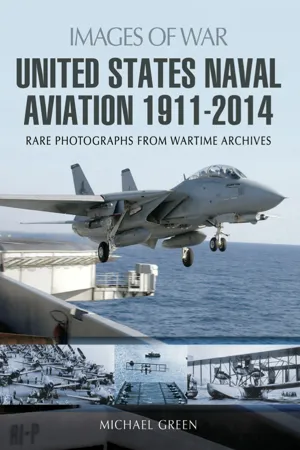
United States Naval Aviation, 1911–2014
About this book
From humble beginnings in 1911 with floatplanes, by the 1930s, the US Navy possessed dirigibles and were introducing fighter planes. By the start of WW2, monoplane fighters were replacing bi-planes and a major aircraft carrier build was underway.Fighters such as the Grumman FLF Hellcat and Vought F4U Corsair were joined by carrier attack aircraft such as the Dauntless, Devastator and Helldriver. As well as carrier-borne aircraft, others operated from shorebases using both wheels and floats.Post WW2, jet aircraft took over from prop driven, and famous early examples were the Shooting Star and McDonnell Phantom, which saw action in Korea. By Vietnam the F4 Phantom II, Skyhawk and Intruder were in service. As well as these fighter attack aircraft were the Lockheed Viking, anti-sub and nuclear capable Douglas Skywarrior.Post Vietnam the F14 Tomcat and Hornet came into service along with the Prowler (Electronic warfare) and Hawkeye (early warning).These aircraft were complemented by a range of helicopters from the massive Super Stallion, through Sea Kings, Seasprites and Seahawks.Today the Super Hornets predominates along with an impressive multi-capable range of aircraft and helicopters.All these and more are described in expert detail and illustrated in this fine book. Future projects are also covered.
Information
Topic
StoriaSubtopic
Storia militare e marittimaChapter One
Pre-Second World War Aircraft
The early years of US naval aviation were marked by rapid changes in technology and extremely limited budgets in the post-First World War era. That meant the US Navy bought small lots of aircraft from numerous manufacturers, always seeking the best in performance while it transitioned from biplane to monoplane, and tested tactics and doctrine for its new aircraft and carriers. Aircraft did not last long in frontline service as they rapidly were superseded by newer, more advanced designs.
The Wright brothers, Orville and Wilbur, made their first powered flight on 17 December 1903, at Kitty Hawk, North Carolina. They did not stand on their laurels and continued to refine the design of their aircraft to improve its performance. The US Navy was not that interested, but did have the foresight to send military observers to aerial demonstrations within the United States and overseas to monitor the progress of aviation technology.
The continuing advancement in aircraft designs following the Wright Brothers’ demonstration in 1903 was becoming harder for the US Navy’s senior leadership to ignore as the years went on. In response, the Secretary of the US Navy (a civilian-appointed position) placed Captain Washington I. Chambers in charge of all aviation matters.
To show off the potential offered by aircraft, Captain Chambers had a short temporary wooden platform built on the bow of the US Navy cruiser USS Birmingham (CL-2). On 14 November 1910, civilian pilot Eugene B. Ely successfully flew off the ship, in a civilian wheeled airplane built by the Curtiss Aeroplane Company, founded by Glen H. Curtiss. Approximately two weeks later, Curtiss offered to train a single US Navy officer how to fly, and was taken up on his offer.
In the meantime, Captain Chambers arranged to have a longer temporary wooden platform constructed on the stern of the US Navy cruiser USS Pennsylvania (ACR-4). It was intended to provide the room needed for Eugene B. Ely to land and then take off from the ship (then moored in San Francisco Bay) a feat that he accomplished on 18 January 1911. It was also the first use of arresting gear, to slow down and stop the aircraft after landing.
Glen H. Curtiss made the first successful floatplane flight, taking off from San Diego Bay on 26 January 1911, in an aircraft he designed and his firm built. The following month, Captain Chambers arranged to have Curtiss taxi his floatplane out to the USS Pennsylvania, now moored in San Diego Bay. Once adjacent to the ship it was hoisted aboard by a crane and then lowered back into the water. This test was conceived by Chambers and Curtiss to prove the ability of floatplanes to operate from US Navy ships.
Development Continues
The publicity tests put together by Chambers and Curtiss had the desired effect on the US Navy’s senior leadership, and on 4 March 1911 the first funds for naval aviation were appropriated. It was at this point in time the Wright Brothers offered to train a single US Navy officer how to fly, if, in exchange, the service would purchase one of their aircraft for the sum of $5,000.
On 8 May 1911, Chambers prepared the necessary paperwork for the US Navy to acquire three aircraft. Of the three planes, the first two to enter service were Curtiss-designed and built aircraft. The first of these two Curtiss airplanes to arrive was nicknamed the A-1. The initial flight of the A-1, in its wheeled configuration, took place on 1 July 1911. The ability of the aircraft to land and take-off from the water as a floatplane was demonstrated ten days later. A few days later the second Curtiss aircraft ordered was delivered to the US Navy and was designated the A-2.
The US Navy also took into service the first of a small number of Wright Brothers-designed and built aircraft in July 1911. The first plane to arrive was designated the B-1. It, and the other airplanes acquired from the Wright Company (formed in 1909 by the Wright Brothers) were eventually configured as training floatplanes.
Pre-First World War Floatplanes and Flying Boats
The US Navy took into service the first of five Curtiss flying boats in 1912, which the company labelled the Model F. They were initially numbered in sequence from C-1 through C-5 by the US Navy. They received a two-letter prefix code of ‘AB’ in March 1914. The ‘A’ stood for heavier-than-air-craft and the ‘B’ for flying boat. AB-2 was the first US Navy aircraft launched by catapult from a ship while underway, an event that took place on 5 November 1915.
In January 1916, the Curtiss Aeroplane Company became the Curtiss Aeroplane and Motor Company. By 1917, Curtiss Model F flying boats had become the US Navy’s standard training aircraft, with 150 built between 1916 and 1917.
Unlike floatplanes that depend on under-fuselage pontoons for buoyancy on the water, flying boats depend on their boat-shaped fuselages for buoyancy. Flying boats often employed outrigger pontoons on the end of their wings for added stability in the water. At the time, flying boats were known as hydro-aeroplanes. Floatplanes and flying boats both fall under the umbrella term of seaplanes.
In October 1913, the US Navy’s second Curtiss-built aircraft, designated the A-2, had its original float pontoon replaced by a flying boat fuselage containing a three-wheeled landing gear. This provided the aircraft the ability to land and takeoff from airfields, or the water. With this added feature, the airplane became an amphibian flying boat. Floatplanes can also be fitted with wheels to become amphibians.
Naval Aviation in Action
The largest contribution made by naval aviation during the First World War proved to be the establishment of a number of shore bases along the French, Irish, and Italian coasts. From these bases, US Navy pilots and air crews primarily flew anti-submarine patrols in flying boats, such as the Curtiss-designed twin engine H-16. The H-16 was eventually superseded in production by the F-5L, a US-modified version of a British-designed flying boat.
When the First World War came to an end on 11 November 1918, naval aviation had 2,107 aircraft, with many of them being floatplanes of foreign design. By 1919, the bulk of the naval aviation assets acquired during the First World War were gone; scrapped or placed into storage. The thousands of men who had manned and serviced these craft were demobilized. As the First World War was also known as ‘The War to End All Wars’, fe...
Table of contents
- Front Cover
- Title Page
- Copyright Page
- Contents
- Dedication
- Acknowledgements
- Foreword
- Notes to the Reader
- Chapter One: Pre-Second World War Aircraft
- Chapter Two: Second World War Aircraft
- Chapter Three: Cold War Aircraft
- Chapter Four: Post-Cold War Aircraft
Trusted by 375,005 students
Access to over 1.5 million titles for a fair monthly price.
Study more efficiently using our study tools.
Frequently asked questions
Yes, you can cancel anytime from the Subscription tab in your account settings on the Perlego website. Your subscription will stay active until the end of your current billing period. Learn how to cancel your subscription
No, books cannot be downloaded as external files, such as PDFs, for use outside of Perlego. However, you can download books within the Perlego app for offline reading on mobile or tablet. Learn how to download books offline
Perlego offers two plans: Essential and Complete
- Essential is ideal for learners and professionals who enjoy exploring a wide range of subjects. Access the Essential Library with 800,000+ trusted titles and best-sellers across business, personal growth, and the humanities. Includes unlimited reading time and Standard Read Aloud voice.
- Complete: Perfect for advanced learners and researchers needing full, unrestricted access. Unlock 1.5M+ books across hundreds of subjects, including academic and specialized titles. The Complete Plan also includes advanced features like Premium Read Aloud and Research Assistant.
We are an online textbook subscription service, where you can get access to an entire online library for less than the price of a single book per month. With over 1.5 million books across 990+ topics, we’ve got you covered! Learn about our mission
Look out for the read-aloud symbol on your next book to see if you can listen to it. The read-aloud tool reads text aloud for you, highlighting the text as it is being read. You can pause it, speed it up and slow it down. Learn more about Read Aloud
Yes! You can use the Perlego app on both iOS and Android devices to read anytime, anywhere — even offline. Perfect for commutes or when you’re on the go.
Please note we cannot support devices running on iOS 13 and Android 7 or earlier. Learn more about using the app
Please note we cannot support devices running on iOS 13 and Android 7 or earlier. Learn more about using the app
Yes, you can access United States Naval Aviation, 1911–2014 by Michael Green in PDF and/or ePUB format, as well as other popular books in Storia & Storia militare e marittima. We have over 1.5 million books available in our catalogue for you to explore.