eBook - ePub
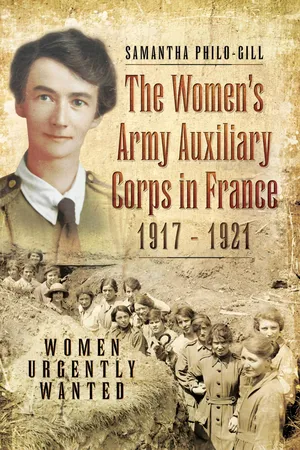
The Women's Army Auxiliary Corps in France, 1917–1921
Women Urgently Wanted
- 208 pages
- English
- ePUB (mobile friendly)
- Available on iOS & Android
eBook - ePub
About this book
In March 1917, the first women to be enrolled into the British Army joined the newly formed Womens Army Auxiliary Corps (WAAC). The women substituted men in roles that the Army considered suitable, thereby freeing men to move up the line. The WAACs served, for example, as cooks, drivers, signallers, clerks, as well as gardeners in the military cemeteries. Due to their exemplary service, Queen Mary gave her name to the Corps in April 1918 and it became Queen Marys Army Auxiliary Corps (QMAAC). By the time the Corps was disbanded in 1921, approximately 57,000 women had served both at home and in France.This book details the establishment of the Corps and subsequently explores the experience of the WAACs who served in France. It follows the women from enrollment to the camps and workplaces overseas, through to their experiences of the Spring Offensive of 1918, the Armistice and demobilization. The final chapter reviews how the women have been remembered in art, literature, museums and memorials. Throughout the book, the author locates the women in a society at war and examines how they were viewed by the Army, the general public and the press. The author draws on a wide range of sources to provide the background and uses the oral and written testimonies of the women themselves to tell their stories. This book will be of interest to social, womens and military historians, as well as family history researchers.
Information
Table of contents
- Cover
- Title
- Copyright
- Contents
- List of Illustrations
- Acknowledgements
- Timeline
- Glossary
- Introduction
- Chapter 1 Establishment
- Chapter 2 Preparation
- Chapter 3 Daily Life
- Chapter 4 Work
- Chapter 5 Controversy
- Chapter 6 Danger
- Chapter 7 Disbandment
- Chapter 8 Memory
- Notes
- Bibliography
- Plate section
Trusted by 375,005 students
Access to over 1.5 million titles for a fair monthly price.
Study more efficiently using our study tools.
Frequently asked questions
Yes, you can cancel anytime from the Subscription tab in your account settings on the Perlego website. Your subscription will stay active until the end of your current billing period. Learn how to cancel your subscription
No, books cannot be downloaded as external files, such as PDFs, for use outside of Perlego. However, you can download books within the Perlego app for offline reading on mobile or tablet. Learn how to download books offline
Perlego offers two plans: Essential and Complete
- Essential is ideal for learners and professionals who enjoy exploring a wide range of subjects. Access the Essential Library with 800,000+ trusted titles and best-sellers across business, personal growth, and the humanities. Includes unlimited reading time and Standard Read Aloud voice.
- Complete: Perfect for advanced learners and researchers needing full, unrestricted access. Unlock 1.5M+ books across hundreds of subjects, including academic and specialized titles. The Complete Plan also includes advanced features like Premium Read Aloud and Research Assistant.
We are an online textbook subscription service, where you can get access to an entire online library for less than the price of a single book per month. With over 1.5 million books across 990+ topics, we’ve got you covered! Learn about our mission
Look out for the read-aloud symbol on your next book to see if you can listen to it. The read-aloud tool reads text aloud for you, highlighting the text as it is being read. You can pause it, speed it up and slow it down. Learn more about Read Aloud
Yes! You can use the Perlego app on both iOS and Android devices to read anytime, anywhere — even offline. Perfect for commutes or when you’re on the go.
Please note we cannot support devices running on iOS 13 and Android 7 or earlier. Learn more about using the app
Please note we cannot support devices running on iOS 13 and Android 7 or earlier. Learn more about using the app
Yes, you can access The Women's Army Auxiliary Corps in France, 1917–1921 by Samantha Philo-Gill in PDF and/or ePUB format, as well as other popular books in History & German History. We have over 1.5 million books available in our catalogue for you to explore.