- 320 pages
- English
- ePUB (mobile friendly)
- Available on iOS & Android
eBook - ePub
About this book
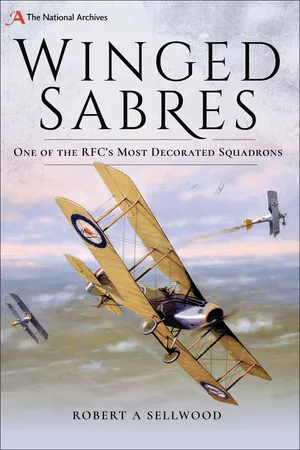
Winged Sabres is the story of a RFC & RAF squadron flying the cumbersome FE2 from February 1916 to September 1917, and then the superlative Bristol Fighter: a two-seater fighter-reconnaissance squadron with an astonishingly high success rate.20 Squadron was possibly the highest scoring squadron of the war and one of the most highly decorated, claiming over 600 combat victories with well over 400 confirmed in RFC & RAF Communiqus. Its members won seventy gallantry decorations including a posthumous Victoria Cross, and included fliers from the U.K. and around the world. Over 40 became aces, including the American Iaccaci brothers and some Canadians and others. But with a casualty rate of around 50% including killed, wounded and POW they paid a high price.Over 15 years research has gone into this book, covering a seldom-explored aspect of WW1 in the air: the two-seater fighter-reconnaissance squadrons. 20 Squadrons motto was Facta Non Verba Deeds Not Words!
Trusted by 375,005 students
Access to over 1.5 million titles for a fair monthly price.
Study more efficiently using our study tools.
Information
Chapter 1
Beginnings – January 1916
When 20 Squadron was first formed in September 1915 at Netheravon, on Salisbury Plain, Wiltshire, it was in order to counter an alarming new threat in the air that nobody could have foreseen. The first year of war had seen the Royal Flying Corps aviators convince all but the most obdurate of the British and French generals of the value of aerial reconnaissance as a means of seeing what the German armies were doing. Firstly, they had spotted and reported the whereabouts of the German armies and allowed the British Expeditionary Force to prepare for the Battle of Mons in late August 1914. Then a couple of weeks later they had spotted the German First Army’s eastwards turn north of Paris that led to the invader being stopped at the Battle of the Marne. The British and French generals quickly came to rely on these early aeronauts for up-to-the-minute intelligence of the enemy’s movements. In 1915 the BEF’s commander, General (later Field Marshal) Sir Douglas Haig, commented that the RFC’s photographic work just before the Battle of Neuve Chapelle had given him a far greater knowledge of the enemy’s defence lines and dispositions than any general had ever known before.
Weather permitting, the RFC had maintained and gradually improved on its reconnaissance abilities throughout the fateful first few months of war but in summer 1915 its work had been rudely interrupted by a new German super-weapon: the single-seat Fokker E-I Eindecker monoplane scout. This was the first aeroplane of any nationality to be fitted with a machine-gun synchronised to fire between the whirling blades of its propeller. Until then, most airmen flying even the latest aeroplanes had been armed only with pistols or rifles. Although a few had experimented with poorly mounted machine-guns with a very limited field of fire, their practical usefulness was almost totally negated by the guns’ extra weight, which seriously impaired those early flying machines’ performance. As a result, meetings with enemy aeroplanes had usually resulted in an exchange of friendly waves rather than bullets and there had been few casualties. With this new German development, the aeroplane itself became a weapon and all the pilot had to do was point its nose at the target. Now adventurous young German flyers such as Oswald Boelke and Max Immelman were busily making themselves famous by shooting down as many British and French aeroplanes as they could find. The British press called it the ‘Fokker Scourge’ and many RFC crews dubbed themselves ‘Fokker Fodder’ as the German pilots took the British and French air strategy by the throat and slowly began to squeeze the life out of it – and of many of its finest men.
The best aeroplane the British could put up against the Fokkers at this time was the two-seat Vickers FB 5, or ‘Gun-bus’, which was already in service. This was a ‘pusher’ type aircraft, the engine and propeller being behind the crew, in which the observer, armed with a drum-fed Lewis gun, sat in the front of the nacelle so that he could fire forwards or sideways. The Gun-bus was slower and less manoeuvrable than the Fokkers, though, and although some of its crews achieved success with the type, it was not good enough to face the up-rated Fokker E-II and E-III variants that soon appeared and quickly began to push the Gun-buses into the ground. Something better was required and, in the absence of a British synchronising gear, the RFC experimented with two more ‘pusher’ types, while the French tried the more conventional tractor-engine layout. One such British ‘pusher’ was the single-seat De Havilland DH2 with a Lewis-gun fixed in front of the pilot to fire straight ahead; while a small French designed single-seat tractor-biplane, the Nieuport 11 ‘Bebe’, carried a Lewis gun on the top wing firing above the propeller-arc. Both proved quite successful against the Fokkers but, being single-seaters, they were not much use for reconnaissance work, which required an observer to take notes and use a camera. For that job, the Royal Aircraft Factory substantially modified the Farman Experimental No.2 (FE2) two-seat ‘pusher’ aircraft and later re-designated it as the ‘Fighting Experimental No.2’. Although superficially similar in appearance to the earlier Gun-bus, the FE2B that went into production was larger, faster, stronger and more manoeuvrable. Armament consisted of a single Lewis gun that the observer could move around his cockpit to any one of six different mountings and the FE2B quickly proved itself against the Fokkers, matching them in speed and having better manoeuvrability. The FE2B was also much stronger and could absorb more damage than the Eindecker. The FE2B began its operational life attached to various squadrons in ones and twos. Then, when its effectiveness became apparent, it was decided to form a new squadron equipped only with FE2Bs to take the fight to the Germans, clear them from its sector of the sky and then carry out its primary role of reconnaissance as the airborne eyes of the BEF.
So 20 Squadron came into being out of grim necessity. The unit was formed on 1 September 1915 from the enlargement of 7 Reserve Aeroplane Squadron at Netheravon under the command of Captain C.W. Wilson MC, whose job was to bring the new squadron up to fighting strength and ability before taking it to France. Captain Wilson had joined the fledgling RFC before the war and, despite receiving a fractured jaw and other minor head injuries in an aeroplane crash in May 1914, he recovered enough to be able to return to duty with 5 Squadron six weeks later. After being appointed a flight commander in September 1914, he was mentioned in despatches by Field Marshal Sir John French in the London Gazette of 9 October that year for his work over France at the start of the German onslaught. Now he faced the even more daunting responsibilities of forming his own fighting squadron, assisted by a small group of officers helped by the skilled tradesmen of the other ranks, led by Acting Warrant Officer (Technical) Bertie Billing. A former turner from Sudbury, Suffolk, Billing had enlisted in the regular army in June 1908, aged nineteen. After transferring to the RFC as an Air Mechanic Second Class in July 1912, he rapidly rose through the ranks, making Corporal in July 1914 and Sergeant just three months later, immediately before being sent to France. A year later, he was posted to 20 Squadron at Netheravon, where his experience, efforts and expertise would come to be recognised by all who served with the squadron. His posting was fortuitous for him on a more personal level too, as it allowed him to marry his sweetheart, Hilda Mary, on 4 November 1915.
The Squadron began to receive the first of its FE2Bs shortly before Christmas 1915 and flying training on them began immediately. Newly promoted Major Wilson busied himself not only with ensuring that his pilots became proficient on the FE2B before they went to France but also with a thousand other matters that had to be dealt with. Stores and supplies had to be requisitioned and sorted for road transport and shipping, including three spare 160 hp Beardmore engines, fifteen Lewis guns and several Sterling Wireless sets in addition to tents, bedding, medical supplies, tools for the mechanics, initial food rations, cooking equipment, other weapons and ammunition. The pilots were to fly out to France in the squadron’s collection of eight FE2Bs and four BE2Cs, while the other officers and men and all the supplies were to travel by road, by ferry and then by road again. Once in France the four BE2Cs were to be exchanged for FE2Bs currently held on the strength of other squadrons. It required considerable feats of organisation but Major Wilson had arranged things so that the road transport would leave more than a day before the aeroplanes were flown out in order to ensure that the mechanics and all their supplies would be ready and waiting at Clairmarais aerodrome, near St. Omer, Pas de Calais.
Things did not turn out quite as planned, however, and when on 24 January 1916 the aeroplanes touched down at Clairmarais as per instructions, the pilots found that the road transport column was still at Rouen. Blocked roads, fuel shortages and all the other confusions of war organisation meant that the main body of personnel did not arrive at Clairmarais until the 26 January and the supplies the following day. Even so, by that date all the aircraft, most of the supplies and 99 NCOs and other ranks were in place – although Warrant Officer Billing was not. He had arrived in France on 26 January as ordered but a sharp-eyed RFC staff officer had recognised him and, realising the need for a man of his talents at the Aircraft Depot at St. Omer, had promptly issued fresh orders. Bertie Billing was transferred to the Aircraft Depot and, despite Major Wilson’s protests, would remain there until August 1917. Two more pilots arrived on January 29, at which time the nominal roll consisted of the following officers:
| Pilots | Observers |
| Capt. J.R. Howett RFC (SR) | Capt. E.W. Forbes (Warwick Reg’t) |
| Capt. E.P. Graves (Royal Field Artillery) | Capt. A.I.F. Duff (Dorset Reg’t) |
| Lt. C.W.E. Cole-Hamilton (2nd Royal Scots) | Lt. F. Billinge (Manchester Reg’t) |
| Lt. R.H. Anderson (12th Rifle Brigade) | 2/Lt. H.F. Champion (Rifle Brigade) |
| 2/Lt. I.R. Heywood (Royal Engineers) | 2/Lt. C.J. Pile (Royal Field Artillery) |
| 2/Lt. L.A. Newbold (Essex Reg’t) | 2/Lt. G.E. Chancellor (W. Surreys) |
| 2/Lt. N.G. McNaughton RFC (SR) | 2/Lt. A.H. Dickinson (N. Cyclist Bn) |
| 2/Lt. P.G. Scott (Gloucester Reg’t) | 2/Lt. D.B. Gayford (W. Surreys) |
| 2/Lt. J.R. Kirton (KOSB) | 2/Lt. G. Exley (Yorkshire Light Inf.) |
| 2/Lt. R.F.S. Morton RFC (SR) | 2/Lt. S. Maller (Royal Dublin Fus.) |
| 2/Lt. C.E.H. James (Welsh Reg’t) | 2/Lt. G.P.S. Reid (Seaforths) |
Also now at Clairmarais was 2/Lt. E. W. Wright, Equipment Officer.
One thing that did go to plan was the exchange of the squadron’s four BE2Cs for FE2Bs, so that the squadron now had twelve FE2Bs and a prototype single-seat Martinsyde Scout, Serial No 4735, for evaluation. The FE2Bs on strength included the following serial numbers: A5202, A5204, A5643, A6328, A6329, A6331, A6332, A6333, A6336 and A6338. Clairmarais aerodrome was situated at the edge of the forest after which it was named, about twenty-six miles from the front lines of the Ypres Salient and was close to the Aircraft Depot at St. Omer and the important rail junction at Hazebrouk. The supplies and the ground crews were all in place, the flyers and flying machines all set to go. The enemy was just over the horizon. And 20 Squadron, attached to 2nd Wing RFC, was ready for war.
******
Chapter 2
Learning to Fight – February 1916
On 3 February 1916, the honour of being the first of 20 Squadron’s flyers to cross the lines on a real mission fell to Lieutenant Robert Hutchison Anderson and Second Lieutenant Chancellor in FE2B A6328, along with Second Lieutenants Newbold and Gayford in A5202 and Second Lieutenants Scott and Exley in A6331. The six men had flown up to 15 Squadron’s base at Droglandt, about ten miles to the northeast, the previous evening, so as to be ready to provide an escort for that unit’s early reconnaissance.
The hard-hit 15 Squadron was equipped with BE2Cs and it was these already obsolete machines that had borne the brunt of the Fokker scourge so far. It might well be said that their crews had been flying something akin to suicide missions because, with a maximum speed of only 72 mph, the BEs could not run away from the Fokkers – and once caught they tended to stay that way. Defensive armament was a single Lewis gun handled by the observer. But as he was seated in front of the pilot and surrounded above and to either side by wings and struts, with the propeller in front of him and the pilot directly behind, his field of fire was extremely limited. However, even that was not the sum of the BE’s liabilities as a fighting machine. It had been designed to be inherently stable, which was ideal for note-taking and photography in a reconnaissance machine that would not meet any opposition but was disastrous in an aeroplane that would have to fight its way to and from the target area. ‘Inherently stable’ is the precise opposite of ‘highly manoeuvrable’ and it was the latter quality that all war pilots were rapidly learning was vital in an aeroplane required to fight its way out of tight corners.
The sight of the three sturdy FE2Bs escorting them must have been somewhat reassuring to the BE2 crews as they worked their way across their lines. The reconnaissance set off at 08.15, and the six young men who sat in their FE2Bs high over the German side of the lines were the first of the many that would fly 20 Squadron’s faithful ‘Fees’, as the FE2Bs were affectionately dubbed, into battle and right now they must have had mixed feelings on their very first foray against the enemy. It can also be supposed that Major Wilson had mixed feelings as he anxiously awaited their safe return. He need not have worried though, for at 10.30 the three FE2Bs hove into sight over Clairmarais and came in to land. They had not met the enemy in the air but they had accomplished their mission.
Half an hour later, three more FEs rose into the sky and headed out towards the lines. Led by Captains Graves and Forbes in A6333, the machines were eastward bound on an offensive patrol (termed an ‘OP’): in other words, looking for trouble. They all returned at 13.20 without having found any, although this might have come as something of a relief to all six men, the remaining four being Second Lieutenant McNaughton and Air Mechanic Second Class Kinder in A6332 and Lieutenant Cole-Hamilton and Captain Duff in A5643. Apart from some more local flying that included new pilot arrival Lieutenant Renton with Corporal May as his observer/aerial gunner, that was the extent of 20 Squadron’s first day of operations. If any of those involved felt a sense of anti-climax at the day’s end they would not have to wait long for it to be dispelled. First contact with the enemy came just two days later.
The German two-seater LVG reconnaissance aircraft had already taken a look at the RFC’s aircraft depot at St. Omer and its pilot now headed north before turning towards the little town of Cassel situated at the top of one of two conical hills that jutted upwards from the otherwise flat and featureless Flanders plains. The town made an excellent landmark for aviators, from which it was easy to locate the rail yards at Hazebrouk after which, his mission completed, the German pilot would then be able to make a straight run for the safety of his own side of the lines. But other eyes were also searching towards Cassel from among the drifting broken clouds, and they belonged to Captain Howett of the RFC.
James Howett was flying the Martinsyde aircraft 20 Squadron was evaluating and, as it had a better speed and ...
Table of contents
- Cover
- Title
- Copyright
- Dedication
- Contents
- Introduction and Acknowledgements
- The British System for Confirming Aerial Combat Victory Claims
- Chapter 1: Beginnings – January 1916
- Chapter 2: Learning to Fight – February 1916
- Chapter 3: Holding the Line – March/April 1916
- Chapter 4: Chivalrous Combats – May/June 1916
- Chapter 5: Triumphs and Tragedies – July 1916
- Chapter 6: First Aces – August/September 1916
- Chapter 7: Eclipse of the Eindeckers – October/December 1916
- Chapter 8: The Way to Glory – January 1917
- Chapter 9: Advantage ‘Albatrii’ – February/March 1917
- Chapter 10: ‘Bloody April’ 1917
- Chapter 11: Towards Messines – May 1917
- Chapter 12: Aces High – June 1917
- Chapter 13: Aces Low – July 1917
- Chapter 14: Third Ypres – August 1917
- Chapter 15: Ugly Duckling Swan-Song – September 1917
- Chapter 16: Passchendaele: October/November 1917
- Chapter 17: Winter War 1 – November/December 1917
- Chapter 18: Winter War 2 – January/February 1918
- Chapter 19: Backs to the Wall – March/April 1918
- Chapter 20: Aerial Combat Crescendo – May 1918
- Chapter 21: A New Fokker – June 1918
- Chapter 22: Turning Point – July 1918
- Chapter 23: Amiens – August 1918
- Chapter 24: The Somme – September 1918
- Chapter 25: To the Bitter End – October/November 1918
- Appendix 1: Nominal Roll Officers and Men Who Flew with 20 Squadron
- Appendix 2: Officers & Men Serving in a Ground Duties Role
- Appendix 3: Decorations and Awards
- Appendix 4: Official Documents
- Appendix 5: Select Bibliography
- Appendix 6: Abbreviations
- Plate section
Frequently asked questions
Yes, you can cancel anytime from the Subscription tab in your account settings on the Perlego website. Your subscription will stay active until the end of your current billing period. Learn how to cancel your subscription
No, books cannot be downloaded as external files, such as PDFs, for use outside of Perlego. However, you can download books within the Perlego app for offline reading on mobile or tablet. Learn how to download books offline
Perlego offers two plans: Essential and Complete
- Essential is ideal for learners and professionals who enjoy exploring a wide range of subjects. Access the Essential Library with 800,000+ trusted titles and best-sellers across business, personal growth, and the humanities. Includes unlimited reading time and Standard Read Aloud voice.
- Complete: Perfect for advanced learners and researchers needing full, unrestricted access. Unlock 1.5M+ books across hundreds of subjects, including academic and specialized titles. The Complete Plan also includes advanced features like Premium Read Aloud and Research Assistant.
We are an online textbook subscription service, where you can get access to an entire online library for less than the price of a single book per month. With over 1.5 million books across 990+ topics, we’ve got you covered! Learn about our mission
Look out for the read-aloud symbol on your next book to see if you can listen to it. The read-aloud tool reads text aloud for you, highlighting the text as it is being read. You can pause it, speed it up and slow it down. Learn more about Read Aloud
Yes! You can use the Perlego app on both iOS and Android devices to read anytime, anywhere — even offline. Perfect for commutes or when you’re on the go.
Please note we cannot support devices running on iOS 13 and Android 7 or earlier. Learn more about using the app
Please note we cannot support devices running on iOS 13 and Android 7 or earlier. Learn more about using the app
Yes, you can access Winged Sabres by Robert A. Sellwood in PDF and/or ePUB format, as well as other popular books in History & Military & Maritime History. We have over 1.5 million books available in our catalogue for you to explore.