The history of an incredibly capable British Royal Navy aircraft, as told by those who flew and maintained it.
In
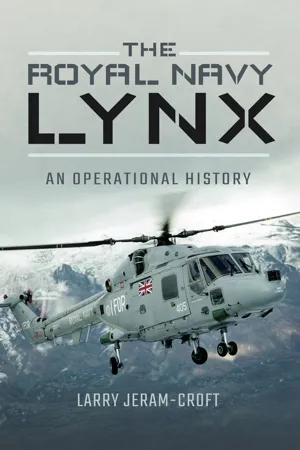
The Royal Navy Lynx: An Operational History, author Larry Jeram-Croft begins with the Lynx's entry into service in 1976. He goes on to discuss its remarkable performance in the Falklands War. Here it was used in both its primary roles of anti-submarine and anti-surface warfare, as well as several others for which it had never been designed, such as Airborne Early Warning and anti-Exocet missile counter measures. The Lynx has been continuously employed in the Gulf from 1980 until the present day. What is not generally known is the fact that these aircraft were responsible for effectively destroying the Iraqi navy, sinking over fifteen warships in a matter of a weeks. All related operational details are included here.
Also included are accounts of operations conducted around the world, including anti-drug interdiction, Arctic deployments, Search and Rescue, hurricane relief, as well as a few notable mishaps. Also described is the development of the aircraft from the Mark 2 to the current Mark 8 (SRU), bringing the narrative fully up to date. Although only a snapshot, the stories narrated here offer the reader a real understanding of the capabilities of an aircraft with a truly remarkable history of service.
"A comprehensive account of the hugely successful service of the Lynx since its entry into service in 1976. All you need to know about a great aircraft, very highly recommended." —Firetrench
- 304 pages
- English
- ePUB (mobile friendly)
- Available on iOS & Android
eBook - ePub
About this book
Information
Chapter 1
The Military Need
After the end of the Second World War, military development continued apace not the least because of the continued threat from the Soviet Union. Submarines continued to increase the range from which they could attack and ships continued to increase the range they could detect the submarines from. It was a technological game of cat and mouse that continues to this day. Unfortunately, for the ships, it was soon realised that although a submarine could be detected, there was now no way of attacking it. One of the solutions was to develop a small helicopter that could operate from the tiny decks of Frigates and Destroyers and carry a weapon out to the target.
The system became known as MATCH, (Manned Anti-Submarine, Torpedo Carrying Helicopter) and the aircraft was known as the Wasp, a development of the Scout that was being built for the Army, it had a single turbine engine and a crew of one pilot. It could also carry a crewman for secondary roles. As a first generation shipborne helicopter it was a great success and it allowed the Royal Navy to take a lead in small ships aviation.
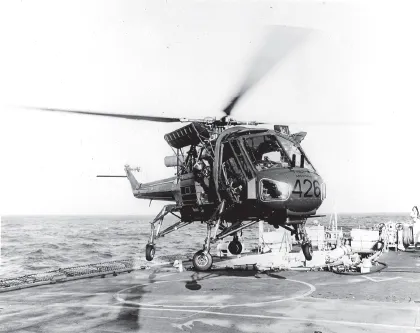
A Wasp landing on a Leander-class frigate. The flight deck is barely bigger than the aircraft. (WHL)
However, the Wasp was limited. With two homing torpedoes slung underneath, it only had a few minutes endurance. Even with no weapons it struggled to fly for more than an hour. One description was that it was on a twelve mile piece of elastic around the ship. It soon became clear that a replacement would be needed. So, in the mid-60s, a replacement was planned. Given the designation WG 13, it would be twin engined and revolutionary in design. Westland helicopters were given the task of designing and developing it as part of a three aircraft production programme with the French. Westland would produce the Lynx, whilst Aerospatiale would produce the smaller Gazelle and larger Puma helicopters.
Then, on 21 October 1967, while the aircraft’s specification was being firmed up and initial contracts were being awarded, the stakes were dramatically increased. Israel and Egypt had just fought the Six Day War and an uneasy truce was in place. The Israeli navy were operating the destroyer Eilat off the coast of Egypt. Eilat was launched in 1942 as the Royal Navy Destroyer HMS Zealous, but had subsequently been sold to Israel. Both sides disagree about what happened next. The ship was off Port Said, and according to Egyptian accounts, well inside their national waters. Whatever the rights and wrongs of the matter, two small patrol boats left the harbour and attacked as soon as they were clear of the breakwater. From a range of about ten miles, the first patrol boat fired two P-15 ‘Termit’ missiles at the Eilat. These weapons were Soviet and known to NATO as ‘Styx’. They were designed as anti-shipping missiles with a range of fifteen miles and could be fitted to any ship from a tiny patrol boat upwards. Despite seeing the incoming missiles, turning away, and increasing speed, the Eilat was hit by both. They hit amidships, one penetrating the engine room, and the ship started to burn and sink. An hour and half later, another patrol boat fired two more missiles. One malfunctioned, but the other hit the sinking ship’s stern and finished her off: fiftyseven men died and ninety-one were wounded.
The incident sent shock waves around the world’s navies. The Eilat may not have been the most modern warship around, but the fact that a tiny patrol boat could inflict so much damage simply by slipping its lines and pointing its nose out of harbour was something to which there was very little defence. The only weapon in the Fleet Air Arm helicopter inventory at the time was the AS12 short-range, wire-guided missile fired from the Wasp and it had neither the range nor the accuracy to take on this sort of threat. Something had to be done. One of the solutions the Royal Navy decided upon was to arm its new helicopter with a credible missile system that would be able to attack up to a Corvette sized target from outside their own defences. The Lynx would get CL 834, later named Sea Skua, a radar homing, sea skimming missile, with a range of over nine miles. Not only would the Lynx be used in the anti-submarine role like the Wasp, it would now have a credible attack role of its own.
Chapter 2
Design and Development

Much of the Lynx design was born out experience with the Wasp. (Steve George)
The Westland Aircraft Works, as a division of Petters Limited, was formed in 1915 to construct aircraft under licence for the First World War, and in 1935 became Westland Aircraft Limited. During the Second World War they took over Spitfire repair and overhaul when the Supermarine facility in Southampton was heavily bombed, and were largely responsible for developing the aircraft into the naval variant, the Seafire. In addition, they produced their own designs. The most successful was the Lysander monoplane, well known for taking agents into wartime France. However, their twin engine Whirlwind fighter might well have made a difference in the early years of the war as it was fast, it would leave a Spitfire standing, and armed with four 20mm cannon which would have outgunned any aircraft during the Battle of Britain. Unfortunately, problems and delays in procurement of the Rolls-Royce Peregrine engines, plus other issues, meant it entered service too late and saw little action. Just after the end of the war, the company produced the Wyvern, a heavy, fast naval fighter with contrarotating propellers powered by an Armstrong Siddeley Python gas turbine. In all, eight naval squadrons operated the aircraft and it saw service during the Suez crisis, but its performance was overshadowed by the introduction of early jets. It also had problems with its technology, particularly the engine, which had an unreliable propeller control system and a habit of flaming out on take-off due to the accelerations of a catapult launch.
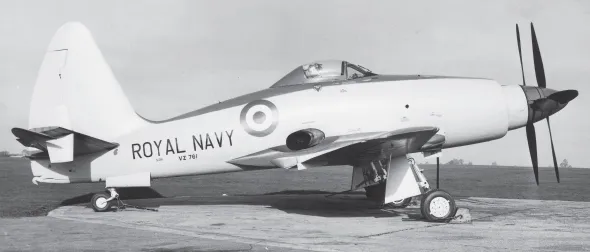
The Turbo Prop Wyvern, the Royal Navy’s last propeller driven fighter. (WHL)
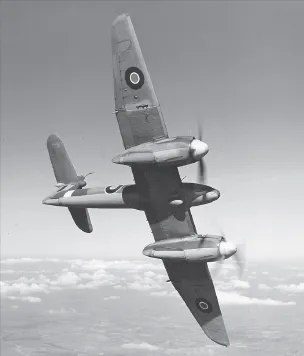
The Westland Whirlwind, nicknamed ‘Crikey’ because of its unusual appearance. (WHL)
Once the Second World War was over, Westland made a decision to concentrate on rotary wing aircraft. It was a brave decision, but not universally approved and the Chief Designer, W. Petter, left to form the aircraft division at English Electric. Amongst his post-war designs were the Canberra, Lightning and Gnat aircraft. Westland made several unsuccessful proposals for new helicopters in various categories, but in the end made an agreement with Sikorsky in the United States to build some of their designs under licence. These included the very successful Wessex and Sea King helicopters, which were heavily re-engineered versions of the originals.
In the fifties, there were a large number of aircraft manufacturers producing everything from long-range bombers to fighters. Because of the growing threat from the USSR, and other conflicts like Korea and Suez, the British Government continued to sponsor new designs. It was a golden age for the British aircraft industry. Many innovative ideas that are still being used today sprang from this time. Britain was a world leader. However, the country was almost bankrupt and by the mid-fifties something had to be done. The government commissioned a White Paper to review the situation. It was led by the then Minister of Defence, Duncan Sandys.
The report was instrumental in forcing fundamental change, although some of its assumptions, for example, that manned aircraft would not be needed in the future as missiles would replace them, were more than a little premature.
On the commercial side, the report concluded that many of the aircraft companies should merge. The incentive to do so was that only these groups would be liable to receive further government contracts. Consequently, by 1960, the British Aircraft Corporation (BAC) was formed out of English Electric, the Bristol Aeroplane Company, Hunting Aircraft and Vickers Armstrong. Hawker Siddeley took over de Havilland, Blackburn and Folland having already taken over Armstrong Whitworth, AVRO, Gloucester and Hawker before the war.
Rotary wing aircraft, although in their infancy, were starting to be developed by several companies. Westland, cash rich from their Sikorsky licence, were seen to be the main lead and so they took over Saunders Roe, Fairy Aviation and the helicopter division of the Bristol Aeroplane Company.
One of the projects that Saunders Roe took with them to the new premises in Yeovil was the Saunders Roe P531, a small single turbine-engined helicopter. It first flew in July 1958, but when Westland re-engineered it, two versions emerged, the Scout for the army and the Wasp for the navy.
The Design
Several years after the industry rationalisation, there was a proliferation of helicopters operating within the services. There was the large twin rotor Belvedere, as well as the Wessex, Sycamore, Wasp, Scout, Whirlwind and Skeeter. Westland proposed they should be rationalised with four replacements:
WG1 – a 35,000lbs All-Up Weight (AUW) machine to carry three crew and thirty-three military personnel, or perform ASW/heavy lift duties.
WG3 – a squad carrier with two crew at 8,000lbs AUW.
WG4 – a Wessex replacement at 17,000lbs AUW to carry twenty-four troops.
WG12 – a four seat light observation helicopter at 2,500lbs AUW.
The WG 3 soon turned into the WG 13 and thence the Lynx. Its original design criteria were:
1. Simple to maintain and reliable.
2. High speed (160 Knots).
3. Easy to manoeuvre on the ground and turn around.
4. Air transportable; particularly in a C130 Hercules.
Armed with these basic criteria, a prolonged debate took place with the MOD. It soon became clear that the aircraft could simply be modified to replace the Wasp with the exception that the rotors were too large. It was also becoming clear that the original intention to fit the T700 engine would not be acceptable, as it did not have the potential to have its power output increased sufficiently. Rolls-Royce then proposed using the more powerful, but untried, BS 360 engine, later to be called the Gem. Despite the risks inherent in mating a new aircraft to a new engine, the decision was taken to go ahead.
By 1966, under political direction, the Lynx was to be developed in conjunction with the French under a three aircraft agreement, where Aerospatiale would develop the Puma and Gazelle, and Westland would lead on the Lynx. It is interesting to note that these three aircraft broadly fall into the categories identified by Westland years earlier (above), with the exception of the large heavy lift aircraft, and of course it wouldn’t be many years before the Chinook was procured for the RAF.
By this time the overall requirement for the naval Lynx had firmed up; so in addition to the original requirement it was to be:
1. Highly manoeuvrable.
2. Be versatile with an all-weather performance.
3. Be capable of operating from a ship with minimal need for the ship to have to change course to recover it.
4. Operate in three primary roles of: ASW or Anti-Submarine Warfare, Surface Search and after the Eilat affair, ASUW or Anti Surface Warfare.
5. Operate in secondary roles of: troop transport, day and night search and rescue and Vertical Replenishment (VERTREP).
About the only one of these requirements that wasn’t fully met in the final RN version was a night SAR capability, as it was never fitted with a sufficiently sophisticated night hover system. However, in order to meet certain of these requirements, some innovative design was going to be needed.
And in the days before email, the internet and mobile phones, there were many in the Royal Navy who saw the primary role of any ship’s aircraft slightly differently.

‘What time you gettin’ the mail Sir?’. (RNFSC)
Highly manoeuvrable
Very early in the WG3/13 programme there had been an aspiration to simplify rotor head design. Up until then there had been two main basic concepts. Bell were using a teetering system using two blades rather like a see saw. It was simple and effective, but had several major disadvantages, not the least an unfortunate tendency, when abused, to part company with the aircraft. Fully articulated rotor systems, where the blades could flap up and down as well as lag around hinges with bearings, were safer and could be used on larger machines, but were complicated, costly to maintain and limited the aircraft’s manoeuvrability.
Westland were not the only company to pursue this goal, but it was not going to be a design solution without its pitfalls. In the United States, Lockheed were developing the Cheyenne attack helicopter, which was revolutionary in design in that not only did it have a rigid rotor, but it also had a pusher propeller at the rear...
Table of contents
- Cover
- About the Author
- Title
- Copyright
- Contents
- Foreword
- Author Profile
- Acknowledgements and Thanks
- Introduction
- Chapter 1 The Military Need
- Chapter 2 Design and Development
- Chapter 3 The Lynx HAS Mark 2 – The Early Days
- Chapter 4 The Falklands War
- Chapter 5 The Lynx HAS Mark 3 – Beefing Things Up
- Chapter 6 The Gulf – 1980 to the Present Day
- Chapter 7 The Lynx HMA Mark 8 – the Final Version
- Chapter 8 There But For the Grace of God Go I …
- Chapter 9 Rescue
- Chapter 10 Around the World
- Chapter 11 The Author’s Story
- Appendix I: Glossary of Terms
- Appendix II: Naval Lynx Variants – Performance Specifications
- Appendix III: A Dummies Guide to Flying a Helicopter
Trusted by 375,005 students
Access to over 1.5 million titles for a fair monthly price.
Study more efficiently using our study tools.
Frequently asked questions
Yes, you can cancel anytime from the Subscription tab in your account settings on the Perlego website. Your subscription will stay active until the end of your current billing period. Learn how to cancel your subscription
No, books cannot be downloaded as external files, such as PDFs, for use outside of Perlego. However, you can download books within the Perlego app for offline reading on mobile or tablet. Learn how to download books offline
Perlego offers two plans: Essential and Complete
- Essential is ideal for learners and professionals who enjoy exploring a wide range of subjects. Access the Essential Library with 800,000+ trusted titles and best-sellers across business, personal growth, and the humanities. Includes unlimited reading time and Standard Read Aloud voice.
- Complete: Perfect for advanced learners and researchers needing full, unrestricted access. Unlock 1.5M+ books across hundreds of subjects, including academic and specialized titles. The Complete Plan also includes advanced features like Premium Read Aloud and Research Assistant.
We are an online textbook subscription service, where you can get access to an entire online library for less than the price of a single book per month. With over 1.5 million books across 990+ topics, we’ve got you covered! Learn about our mission
Look out for the read-aloud symbol on your next book to see if you can listen to it. The read-aloud tool reads text aloud for you, highlighting the text as it is being read. You can pause it, speed it up and slow it down. Learn more about Read Aloud
Yes! You can use the Perlego app on both iOS and Android devices to read anytime, anywhere — even offline. Perfect for commutes or when you’re on the go.
Please note we cannot support devices running on iOS 13 and Android 7 or earlier. Learn more about using the app
Please note we cannot support devices running on iOS 13 and Android 7 or earlier. Learn more about using the app
Yes, you can access The Royal Navy Lynx by Larry Jeram-Croft in PDF and/or ePUB format, as well as other popular books in History & British History. We have over 1.5 million books available in our catalogue for you to explore.