- 64 pages
- English
- ePUB (mobile friendly)
- Available on iOS & Android
eBook - ePub
About this book
The story of the Supermarine Spitfire has been told across many years and the debate about it is enduring, yet the Spitfire remains a true icon. For aviation enthusiasts, for historians, for modellers, the word Spitfire conjures many stories and affections. This book presents the Spitfire enthusiast with an up-to-date history of the Spitfire not just in its design and application in war, but also as a flying memorial and as an aero modellers vital focus.The text examines recently revealed forgotten aspects of the Spitfire story; by combining the elements of design, the story of a weapon of war and a revered scale model, this book frames an essential chapter in aviation history. Packed with original and contemporary images and information, and displaying unique Spitfire model collections, the narrative bridges an important gap and is a worthy addition to the FlightCraft series.
Information
Form & Function
Supermarine started work on its Type 300 in early 1934 and that summer many influences came together to create what was soon named the ‘Spitfire’. Mitchell and his design team would also tour the US that summer and study new aerofoils and the National Advisory Committee for Aeronatuics (NACA) Memorandum technical data – much of which stemmed from German design advances. From NACA came the 2200/49 and 2213 series aerofoils of the Spitfire’s uniquely blended-aerofoil.
Spitfire was also unique in its low frontal area, small tail, ‘gull-wing’ setting and the sculpted panels with underwing concave ‘channels’ – with much work to the shape of the aircraft’s underbelly and, at the radiator mountings, allied to a smoother finish to the fuselage and wings than any competitor. Spitfire’s design was its secret, notably the lift distribution behaviour of its innovative wing shape and aerofoil thinness. Novel too was the light-weight, high-strength nature of its monocoque structural design (with elliptical frames), although this would lead to initial manufacturing difficulties and make the aircraft harder to repair from combat damage.
Elliptical Efficiency?
The Spitfire’s elliptical wing had many advantages in aerodynamic terms – these principally being of lower induced drag (notably at increasing altitude) and improved lift distribution, all via elliptic loading: science lay behind the choice of wing shape.
The creator of the Spitfire wing, Beverley Shenstone stated: ‘The point here is that at great altitudes where the air is thin, the angle of incidence must be increased, resulting in more induced drag. The elliptical wing then becomes important.’
The ellipse gave significant improvements in trailing-edge vortices and at the wingtips where turbulent airflow between the lower and upper surfaces of the wings was better managed by the curved point of the ellipse in comparison to the square or tapered type of wingtips. Knowledge of these elliptical advantages was first discovered in 1894 by the ‘father’ of British aerodynamics, Frederick Lanchester. Similarly, the ‘father’ of German aerodynamics, Ludwig Prandtl, lay behind further elliptical research in the finite wing theory developed by him at Göttingen – the heart of German aerodynamics research 1910–35. Zhukowski in Russia was studying such wing behaviour too. Of note, a remarkable semi-elliptical, high-aspect ratio swept-wing motor glider, the Mayfly, also flew in Germany prior to 1936, a machine that is often forgotten. Hermann Glauert, based in Britain but having visited Göttingen, expanded such lift theories in his 1926 book The Elements of Aerofoil and Airscrew Theory. Shenstone used the book for his academic research and ongoing works.
Where did the advanced and forensic knowledge applied to the Spitfire come from? The answer lies with Prandtl, Zhukowski, Lanchester, Glauert and Beverley Shenstone the young engineer/aerodynamicist who found his way direct from studying advanced wing design in Germany to R. J. Mitchell’s noisy top-floor office above Supermarine’s factory floor in May 1931.
In the elliptical wing and in Shenstone’s modifications to its theories lay the Spitfire’s uniqueness, its advanced aeronautical milestone – one sometimes not even realized by today’s enthusiasts and commentators. Spitfire’s ellipse was not the simple ellipse used on other aircraft but a combination of two semi-ellipses. The front section of the wing is formed from a semi-ellipse having a small minor axis, this being conjoined at a common major point to a rearward section semi-ellipse but one having a larger minor axis. So the ‘rear’ of the wing behind a datum line is larger and more elliptical than the narrower, straighter front section, the rear section seeming to ‘lean’ forward.
By modifying the ellipse like this, an even more efficient lift distribution line along the wing, one that is consistently linear, was achieved. The wing’s main spar and its loading line could be aligned with this lift distribution line, creating ideal efficiencies in terms of aerodynamic and structural implications in a stronger, safer wing. The curves of the ellipse gave more width (chord) for a given wingspan than a straight, tapered wing shape and created depth for guns and wheels even if it was a thin aerofoil.
Shenstone’s role in Germany had a military intelligence link and at one stage Shenstone was arrested by the German authorities. The men who tutored Shenstone and arranged for him to go to Germany were Professor John Parkin and Air Marshal Ernest Stedman RCAF, both with senior national military intelligence roles. Vickers Director Air Commodore Sir John Adrian Chamier was the man who recruited Shenstone in Germany for Vickers-Supermarine and Chamier was a top 1930s British intelligence figure. As the great Rex Pierson, Vickers-Armstrongs chief designer stated to Shenstone in London in 1940: ‘If the Germans had known what you were up to, they would have shot you.’
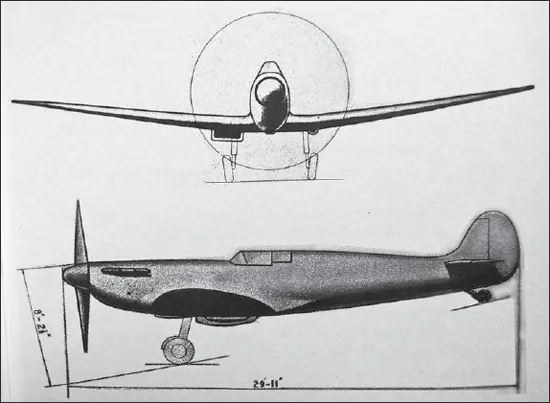
A rarely seen early Spitfire prototype drawing by Shenstone.
These are the circumstances around why the British establishment denied and obscured Shenstone’s work and the use of some part-German technology in the Spitfire’s wing design. After all, the plot hardly fitted with wartime and post-war national propaganda. As a tangent, the reader must be informed that R. J. Mitchell never went to Germany to meet his rival designers, yet the biopic film First of the Few portrayed in its propaganda that he did. In fact, the two men that Supermarine did send to Germany were J. Summers and B. S. Shenstone.
So Shenstone was clearly vital to the plot and the emergence of the Spitfire wing and body design as a history-changing aircraft, yet his role went denied by some for decades. A recent paper, ‘The Spitfire Wing Planform: A Suggestion’ written by J. A. D. Ackroyd, and published by the Royal Aeronautical Society (RAeS) Journal, further frames the facts of the ellipse and its influence upon the Spitfire’s design.
Spitfire’s Secret Science
The Spitfire’s asymmetric, twin-axis elliptical wing shape was the result of thousands of hours of calculus by Beverley Shenstone, and by the forgotten input of Professor Raymond Howland of University College Southampton. Another often ignored contribution came from leading British glider designer and pilot Geoffrey M. Buxton. A close friend of Shenstone, Buxton visited Supermarine and assisted in the wing design challenge and having written a report on airframe skin smoothness, contributed to the Spitfire’s excellence in such criteria. Supermarine S series contributor Arthur Shirvall also worked on the Spitfire’s wing, skin and body sculpting. His role has also rarely been credited: Shirvall later designed the floats for the Spitfire seaplane.
Massive advances in wing shape, skinning, aerofoil blending, ‘washout’ wing twist, boundary layer flow, lift distribution, aileron design, and metallized sculpting defined the Spitfire’s new version of the old elliptical science. Shenstone’s wing was forensically tuned using logarithms and multi-disciplinary methodology applied across every square inch of its lifting surface. New elliptical dual-axis properties were applied. Through the modified ellipse, the blending of local profiles of the shape and of scaling of the conjoined aerofoil sections, a huge step in wing design was achieved; dangerous spanwise flow was tuned out, lift distribution defined, and main wing wake drag to the fuselage and tail lessened (hence the small tail-plane and fin): none of this had been done before. No wonder the wing was hard to build for untrained workers who struggled with its curves and aerofoil profiles until they became practised at the art. Shenstone later said that he thought the wing could have been even thinner, but wisely Mitchell erred on the side of structural caution.
Another advance was the Spitfire’s remarkable general handling at both low and high transonic speeds – all without use of wing fences, slats or stall strips, thus retaining a ‘clean’ wing with high lift coefficient. No other wing of the era (or latterly) flew safely at 65mph/105kph and flew safely at the transonic Mach 0.85 or 500mph/804kph-plus gateway of supersonics.
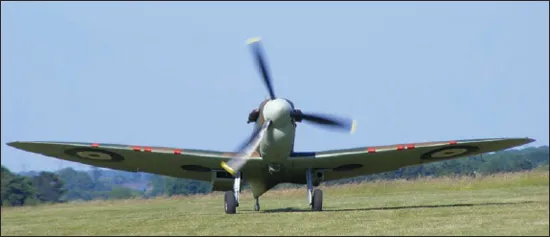
The thin wing and smooth wing-to-fuselage design can best be seen head on.
We must add that as well as adding elliptical forms to his S6, R. J. Mitchell also designed an elliptically influenced flying boat in July 1929 to Air Ministry Specification 20/28, but lacked the knowledge to define a new type of elliptical wing at that time.
Contrary to myth, the Spitfire did not ‘copy’ or mimic the shape of the simple, symmetrical elliptical wing seen on the Heinkel He 70. The He 70’s wing was not the first such shaped wing, and itself mimicked the design of the 1925 Baumer ‘Sausewind’. Neither did the He 70 appear in 1934 just as the Spitfire was being shaped as some commentators have claimed; He 70 first flew in December 1932, entered civilian Lufthansa service in 1933, and was displayed at the Paris Air Show of 1933 (where Supermarine designers first saw it).
There is much supporting evidence that the key discussions and correspondence on the use of the elliptical wing design for the Type 300 (Spitfire) took place in mid-1934, punctuated by drawings 300000/4 to /12 and Mitchell’s and Vickers’ meetings with the Air Ministry and the RAF’s Dowding in the late summer of 1934 – months before subsequent claims of He 70 ‘influence’ in late 1934.
Some aviation commentators have even suggested that Rolls-Royce secured an He 70 and that it was brought to Great Britain and inspected with Mitchell and Supermarine supposedly then cribbing ideas from it for the Spitfire. Again, like so many other claims, this is rubbish yet often repeated as a claimed fact.
The Spitfire prototype was designed and set ‘in-the-metal’ by December 1935, the wing built and finished by January 1936 and awaiting its first flight within weeks, whereas the one-off Rolls-Royce Kestrel-powered He70G was modified with its new engine and nose design at Rostock in Germany from February 1936; it did not appear in Great Britain until the end of March and received its certificate of air-worthiness in April – over a month after the Spitfire’s first flight of 5 March 1936. Ultimately, there was nothing in the He 70’s wing design that could have offered the Spitfire anything: the He 70’s elliptical wing was symmetrical of single axis design, and of one (thicker) aerofoil section designed for use in a high-speed mail plane and transport – not a fighter! Indeed, Heinkel’s unwieldy He 112 fighter that derived from the He 70 was a failure.
The only unusual factor that the He 70 boasted was its smooth all-over skin – to create a ‘smoothness criteria’ to give lower drag. This was achieved by the impractical method of adding hundreds of pounds/kilograms of weight in the form of ‘filler’ to smooth over the aircraft’s skin. Shenstone always openly admitted that this smooth skin did influence him and Supermarine for the Spitfire’s smoothness criteria but that he could never copy such a method to achieve it. Spitfire had to be naturally smooth – in the metal and its flush riveting. An experiment to see if cheaper, protruding domed or ‘mushroom-headed’ rivets could be used, proved that a large increase in drag and a resultant large loss in speed (25mph) resulted. Split-peas were glued in place to resemble the protruding-type rivet for the test; results proved that flush rivets should be retained.
Wing Fillet
Beyond its modified ellipsis and sheer Rolls-Royce Merlin horsepower, the Spitfire had a special ingredient: the science of its wing design allied to an overall ‘aero’ package that gave the Spitfire much lower drag (of all types) in comparison to its rivals, the Hurricane and the Bf 109, which both lacked wing ‘fillets’ – the curved panel that filled in the join between each main wing where it joined to the fuselage. Spitfire boasted such a drag-reducing ‘fillet’ feature and this added greatly to the Spitfire’s wing behaviour and its aerobatic performance. The renowned Sighard Hoerner, stated in his work Fluid Dynamic Drag that 5 per cent of the Bf 109’s total drag stemmed from its wing-to-body drag and that, had it had a wing fillet and been smoother, the Messerschmitt might have been 20mph faster.
B. S. Shenstone added a wing fillet to the Spitfire’s design in April 1935 as a remarkable and again, often unrealized technical advantage to the aircraft’s design. Intriguingly, much of the early development work on the idea of wing fillets was carried out in Germany by A. Lippisch, and by H. Muttray prior to 1934, yet it was the Spitfire that was the first high-speed combat machine to use the device. In the 1930s, American designers embraced the wing fillet. Today, Spitfire restorers know how vital correct setting of the massive concave wing fillet panel is to the aircraft’s performance: modellers must also ensure it is correctly represented.
Everything about the Spitfire was not just ...
Table of contents
- Cover
- Title
- Copyright
- CONTENTS
- Introduction
- Origin of the Species
- Form & Function
- Mk V: The Versatile Spitfire
- Variations on a Theme
- Modellers’ Wings
- Model Showcase: Mission to Model
Trusted by 375,005 students
Access to over 1.5 million titles for a fair monthly price.
Study more efficiently using our study tools.
Frequently asked questions
Yes, you can cancel anytime from the Subscription tab in your account settings on the Perlego website. Your subscription will stay active until the end of your current billing period. Learn how to cancel your subscription
No, books cannot be downloaded as external files, such as PDFs, for use outside of Perlego. However, you can download books within the Perlego app for offline reading on mobile or tablet. Learn how to download books offline
Perlego offers two plans: Essential and Complete
- Essential is ideal for learners and professionals who enjoy exploring a wide range of subjects. Access the Essential Library with 800,000+ trusted titles and best-sellers across business, personal growth, and the humanities. Includes unlimited reading time and Standard Read Aloud voice.
- Complete: Perfect for advanced learners and researchers needing full, unrestricted access. Unlock 1.5M+ books across hundreds of subjects, including academic and specialized titles. The Complete Plan also includes advanced features like Premium Read Aloud and Research Assistant.
We are an online textbook subscription service, where you can get access to an entire online library for less than the price of a single book per month. With over 1.5 million books across 990+ topics, we’ve got you covered! Learn about our mission
Look out for the read-aloud symbol on your next book to see if you can listen to it. The read-aloud tool reads text aloud for you, highlighting the text as it is being read. You can pause it, speed it up and slow it down. Learn more about Read Aloud
Yes! You can use the Perlego app on both iOS and Android devices to read anytime, anywhere — even offline. Perfect for commutes or when you’re on the go.
Please note we cannot support devices running on iOS 13 and Android 7 or earlier. Learn more about using the app
Please note we cannot support devices running on iOS 13 and Android 7 or earlier. Learn more about using the app
Yes, you can access The Supermarine Spitfire MKV by Lance Cole in PDF and/or ePUB format, as well as other popular books in History & Military & Maritime History. We have over 1.5 million books available in our catalogue for you to explore.