A former British Royal Army Veterinary Corps officer recalls his adventures with the Special Forces in Oman during the 1970s in this military memoir.
In 1970 at the height of the Cold War, the young Sandhurst-trained Sultan Qaboes of Oman, with secret British military backing, took on the communist rebels in a fierce but little-known war. Along with regular British Army and 'contract' officers, the SAS played a key role in this bitterly fought but ultimately successful campaign.
The value of winning the 'Hearts and Minds' of the local population was quickly recognized, and this is where a select band of Royal Army Veterinary Corps officers came in. The local economy was a primitive one based on agriculture and the author, freshly qualified and, by his own admission, somewhat naïve particularly in military matters, found himself solely responsible for the veterinary care of a territory the size of Hungary.
Attached to D Squadron, 22 SAS, Andrew Higgins learnt how to respond to the Jebali people's love and concern for their animals who provided their livelihood—goats, camels, sheep, horses, cattle, even bears, hunting birds and pedigree hunting dogs.
His firsthand experiences and anecdotes of life dealing with every level of Omani society from rulers to black slaves and their varied livestock make for wonderfully atmospheric and often amusing reading. In short,
With the SAS and Other Animals is an unusual and potent mix of Special Forces action and veterinary experiences. Readers may well conclude that it really shouldn't have happened to a vet even in a desert war!
Praise for
With the SAS and Other Animals
"In a humorous style reminiscent of the James Herriot stories, Andrew recalls his many adventures dealing not only with the native tribesmen and their animals but also with the Royal Household. . . . This book is very readable. I found it hard to put down. It gives a wonderful insight to local and expatriate life in the Middle East at the time." —Brigadier Paul Jepson QHVS
"It's not only fun to read but also rather good account of another largely forgotten campaign, from a distinctly unusual perspective." —
Country Life Magazine
eBook - ePub
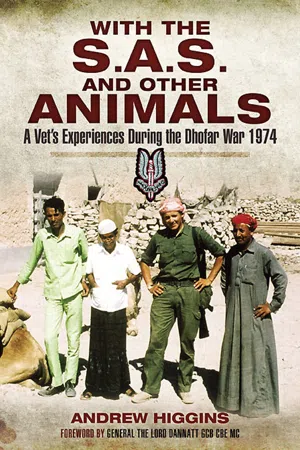
With the S.A.S. and Other Animals
A Vet's Experiences During the Dhofar War, 1974
- 256 pages
- English
- ePUB (mobile friendly)
- Available on iOS & Android
eBook - ePub
About this book
Information
Chapter 1
The Kennel Club
Queasy was not the word for it. Confused. Sozzled. Pissed as a newt. I knew I had drunk too many beers in the boisterous sweltering wooden hut that was the dog-handlers’ Mess, but it had been a very long day and the effects of the alcohol were aggravated by jet-lag and tiredness. I managed to stagger to my feet, sway over to the President of the Mess Committee, a wizened Flight Sergeant, who looked long and hard at me as I slurred out some words of thanks before raising an uncertain hand in farewell and weaving my way out of the door. It seemed a ridiculous introduction to RAF Salalah, that unlikely and bleak outpost of the British military in Arabia.
I leaned against the hut. God, it was hot; a sultry, oppressive Arabian night. The sweat poured down my face and I wondered how I would find my way back to my room in this sprawling, brown, dusty camp. There was a full moon and the stars twinkled with an intense brightness in the cloudless sky. A chorus of frogs croaked and cicadas called shrilly and fitfully to each other across the sandy tracks winding between the silent, blacked-out buildings. I shook my fuddled head.
A gale of laughter sounded from the shack. I noticed a dilapidated sign hanging limply from the sun-bleached timber lintel announcing in faded red letters that this was The Kennel Club. The dog-handlers were NCOs in the RAF Regiment (affectionately known as Rock-apes), which was responsible for guarding this small piece of the United Kingdom. The Kennel Club was their oasis in a war zone where the operational and living conditions were difficult and off-duty drinking was serious. I smiled despite my weariness as I had thoroughly enjoyed my evening sharing dog and vet stories with these professionals. However, the day was drawing rapidly to a close and I aimed myself unsteadily in what I hoped was the general direction of the prefabricated wing where passing British diplomats and oddments like me were housed when no room could be found in the overcrowded Officers’ Mess.
I was lucky to have a room to myself. It was large, but sparsely furnished with a creaking and worryingly wobbly ceiling fan, whichmight once have been white and had several exposed wires that looked as if they would be best avoided. There were also mosquitoes, squadrons of them; they had no difficulty snubbing the torn tin mesh grilles that half-heartedly lined the window and outer door. The bed had been made up with a single pillow and two greyish sheets and I rapidly undressed and lay on it staring nauseously at the slowly revolving fan. This was to be home for the next few days until I took over as Veterinary Officer to the British Army Training Team, and my predecessor had taken his six-month-old suntan back to the RAVC Depot in a wintry Melton Mowbray.
I was surprised to find that my head was gradually clearing, helped by the squirts of adrenaline that periodically shot round my body in response to the unfamiliar deep booms which resonated around the base, as defensive 25-pounders positioned around the RAF Camp fired their warning shells into the hills, collectively known as the jebal, that surrounded Salalah.
Salalah. The garden town, and capital of Dhofar Province, that war-torn region of south-east Arabia bathed by the Indian Ocean and part of the Sultanate of Oman. There had been a sizeable influx of British military assistance into Oman since a coup in July 1970 had overthrown the old Sultan, Said bin Taimur, and his son, the 29-year-old Sandhurst-trained Qaboos bin Said, had assumed power. Up till then insurgents, mainly a revolutionary force called the Popular Front for the Liberation of the Occupied Arabian Gulf, known by the awkward acronym PFLOAG, had almost succeeded in taking over this under-developed but potentially oiland mineral-rich territory. Now, under Qaboos, the country was slowly beginning to emerge from decades of neglect. PFLOAG, which had evolved from a group of Dhofar dissidents, promoted and nurtured by the Russians and Chinese, operated from bases in Oman’s southern neighbour, the communist People’s Democratic Republic of Yemen, or PDRY.
By January 1974, three and a half years after the coup, the well-armed and determined enemy forces had been pushed further back from the plains into the surrounding Qara Mountains, from where they still harried the Sultan’s forces and their British support. Only a few months before, a Katyusha 122mm rocket fired from the jebal had landed outside the RAF Officers’ Mess injuring nine people. So nobody took any chances and the 25-pounders continued to pound into the night.
I was excited. There was no doubt of that. It felt surreal to be lying on a bed in a Foreign Office hut some 5,500 kilometres from home, under a creaking fan and listening to the infuriating high-pitched whine of invisible Omani mosquitoes. Every so often, the room lit up as a Verey light exploded on the jebal, its incandescence penetrating the sun-faded, illfitting, unlined cotton curtains and filling the room eerily with colours.
The sound of the Hercules transporter aircraft in which I had spent sixteen long, cold, hungry and extremely noisy hours still reverberated round my weary brain. More experienced soldiers found a space straight after take-off, got into their sleeping bags, covered their heads and slept until we touched down at RAF Akrotiri in Cyprus. The rest of us on our bum-aching webbed seating along the sides of the rattling dimly-lit drone looked glumly at each other, realising that conversation, sleep and reading were out of the question. The only entertainment was to watch the wires and controls of the aircraft move erratically above our heads until, after several uncomfortable hours, a Loadmaster arrived with a cardboard box containing a few tired sandwiches, a bit of fruit and a bottle of Coke.
Old Oman hands tended to avoid the Brize Norton-Akrotiri-Salalah C-130 route. They booked on the long-haul VC10 service to Singapore, which stopped to refuel at RAF Masirah, an island off the north-east coast of Oman. The VC10 Squadron was also used to ferry Ministers and VIPs and had more conventional passenger comforts. After a good night’s sleep on Masirah, it was possible to catch a shuttle to Salalah. Yet, as so often in life, it’s funny how nobody tells you these little nuggets until it is too late.
The Hercules had eventually bounced into RAF Salalah and I had staggered down the rear ramp into the blinding desert sun to meet the outgoing Veterinary Officer, Scott Moffat, and his chief assistant, Veterinary Dresser Number 1, Saleh bin Hassan Al Yafai. I cannot imagine what Saleh must have thought of this young, sleep-deprived wreck that emerged out of the murky interior of the Herc, stuttering out some words of greeting in Arabic, inadequately learned on a crash course at the Royal Army Education Corps Centre in Beaconsfield the previous week. Still, he was very polite and carried my bag enthusiastically to Scott’s battered grey Land Rover pick-up.
The British Army Training Team, or BATT, had been in Salalah since 1970 and for most of the time its presence was virtually unknown to the British public. The Omanis wanted to focus on modernisation and had no wish to attract world attention to the assistance they were receiving from outsiders. The British government had played a careful balancing act, reflecting the strategic importance of Oman at the entrance to the vital oilfields of the Gulf and the need to avoid any charge of imperialist meddling at a time when Britain was taking positive steps to withdraw from the region. The Special Air Service was ideally suited for such a lowkey role.
I had been briefed at the headquarters of 22 SAS at Bradbury Lines in Hereford by Lieutenant-Colonel Peter de la Billière, a soldier from the Durham Light Infantry who later was to become a household name as Commander-in-Chief of the British forces in the 1990 Gulf War. In 1974 he commanded 22 SAS. When he talked, his vivid and penetrating blue eyes darted constantly and he paced his office like a caged tiger talking with infectious enthusiasm and boundless energy, illustrating his points by jabbing at maps and wall charts. He was dressed in an army pullover and SAS belt and there was a packed Bergen rucksack near the door as if to demonstrate his readiness for any action anywhere and at any time.
Peter de la Billière was friendly and welcoming, and reassuring about the value of the BATT Vet post over the previous four years. It was, he said, one of the four pillars of Operation Storm, the codename for the Dhofar campaign, which he considered to be of such strategic importance that it would go down in history as a significant battle for Western supremacy and the fight against communism. The counter-insurgency effort was being developed hand in hand with psychological warfare designed to demonstrate to the battered population the merits of Sultan Qaboos’ rule and the shortcomings of PFLOAG’s communist alternative. Agricultural development and animal health were a vital strategic part of the civilian reorganisation of Dhofar’s rural economy.
I was handed over to a stocky sergeant, who had completed three tours in Oman. On one tour, he reassuringly told me, he had survived a helicopter crash by rolling himself into a tight ball as the aircraft plummeted to the ground. He explained the province’s geography and climate, and how the fighting was made more difficult by the annual monsoon, which, unusually for Arabia, hit Dhofar between June and September each year with mist and drizzle, known as the khareef, that markedly restricted operations. The war, I learned, was progressing satisfactorily but slowly, painstakingly so at times. Sultan Qaboos was, said the sergeant, remarkably British in many of his cultural attitudes. This wasn’t surprising as his father, who had a great affection for Britain, had read, written and spoken English perfectly. He had, however, brought up his only son in a narrow, traditional and simple style with few privileges. After this repressive childhood, Qaboos had been sent to England in the care of the Reverend Philip Romans, a tutor, who with his wife Laura had endeavoured to educate and prepare him for his future life. He had learned English, studied British local government administration and, finally, gained admission to the Royal Military Academy, Sandhurst.
Qaboos had graduated from Sandhurst in 1962 and was commissioned into the Cameronians (Scottish Rifles). This was followed by a year with the battalion in Germany before his father recalled him to Salalah. When he returned to Oman his freedom was severely restricted, reflecting the old man’s irrational insistence that his son should have no favours or live any better than other Omanis. As a result, the young Qaboos was placed under virtual house arrest in the Old Palace in Salalah, where he must have lived a frustrating and restless existence. However, although he was given no responsibility, he was allowed visits from selected British friends and in this way he was able to plan the eventual overthrow of his father with the help of his contemporary at Sandhurst, Tim Landon, then a junior intelligence officer in Dhofar.
The RAF Regiment and artillery were sent to secure the airfield in Salalah and were soon joined by other British support. The SAS had originally been sent to Oman to protect the new Sultan. Then BATT had been set up to train the tough, battle-scarred tribesmen, known as firqats who had come over to Sultan Qaboos’ side after his accession. Training and taming this local militia was no easy task, but their role would be fundamental in winning the war and overcoming the communist-inspired indoctrination of the jebali or hill people. The firqats knew their enemy, the adoo, better than anyone else, as they had been part of them. They knew the location of the adoo bases and arms caches, their plans, arms sources and command chains, and were a priceless source of intelligence information.
Despite his youth and inexperience, Sultan Qaboos had set to work at once, offering an amnesty and promising much. Some firqats came over immediately; others chose to wait and see how the pendulum might swing. To join the government side, however, did have its dangers. The jebali people of the Qara hills were fiercely tribal and were largely indifferent to life and death. Vengeance could be wreaked in many ways and disloyalty to the tribe or tribal leader could have profound and fatal effects on other family members.
The new Sultan shrewdly went for their hearts and minds to show that he could offer more than guns and atheism to these poor, often confused and deeply religious people. What was needed was action, not words. So Sultan Qaboos started building settlements at strategic points on the hill. Wells were drilled to enormous depths, and at huge expense, to provide clean and pure water. Storage tanks were made available, as were drinking troughs for the nomadic jebalis to bring their cattle, goats and camels.
These settlements allowed the government to interact with the people, but it was made clear that if enemy action resumed, the new lifesupporting water supplies and assistance would be cut off. Under the aegis of the Dhofar Development Department, Civil Aid Teams moved in to supplement the water with essential food requirements, basic schooling and medical services. A mosque (often a prefabricated hut) was put up and a programme of agricultural improvement started. Because the new settlements were vulnerable to attack, BATT detachments had been posted at key locations to train the firqats how to guard their new-found rewards.
Nomadic people’s wealth is often vested in their animals. The Qara people’s lives were centred on their cattle and a man with thirty or forty cows was rich. To put it into perspective, the dowry for a beautiful young wife might be fifty cows. In 1974, a jebali goat might have been worth £80 (perhaps five or six times as much in today’s terms), a cow £250 and a good camel £500 or more. It was an enormous investment and so it was not surprising that a sick animal was sometimes viewed with greater concern even than a sick child. Sultan Qaboos’ decision to include a veterinarian in the Hearts and Minds campaign was a clever way of demonstrating in practical terms that he really understood his jebali people and was doing what he could to help address their practical needs.
In the longer term, it had been planned that the DDD would take over the veterinary responsibilities and employ civilian veterinarians to do the job. Scott Moffat was supposed to be the last British army Veterinary Officer in Oman, but it was not yet safe enough for a civilian to work on the jebal where the success of the Hearts and Minds drive was crucial. So the decision was made to have just one more military vet. Me.
The Verey lights continued to shine, the artillery continued to pound, the squeaking fan continued to turn and the effects of my exhausting journey finally sent me to sleep on my little bed in Salalah. The mosquitoes sharpened their fangs and prepared for dinner.
Chapter 2
Bir Bint Ahmed
At 7.30 the next morning I was awakened by a swarthy unshaven Pakistani Mess attendant bearing a mug of British army tea, made with condensed milk and half a pound of sugar. This was Mohammed. He was wearing a none-too-clean shirt, pyjama-type trousers and blue flip-flops. Mohammed muttered a few deferential words in some language halfway between Urdu and English, as I blearily watched him open the thin cotton curtains and politely pick up and remove my travel-worn clothes, which had been flung haphazardly into a dusty corner the previous evening.
Twenty minutes later, Scott collected me for breakfast. Over a hundred British serving officers and Sultan’s Armed Forces (SAF) mercenary or contract officers from a variety of countries, but mainly the UK, lived in the Mess and ate together in the large dining room. Breakfast was as silent as an enclosed convent, with the quiet broken only by a gentle rustling of tatty, dog-eared pages of week-old newspapers. The food was pretty awful. Reconstituted milk did not taste good on stale cornflakes. The vintage eggs from Lebanon were served without any bacon out of respect for the country’s religion. The bread was impressive only for the number of dead weevils per slice. Scott warned me off the coffee and suggested lemon tea, with generous spoonfuls of sugar, which was good advice. The atmosphere dampened my excitement so I sat down and flicked unenthusiastically through an ancient Sunday Times magazine and absently scratched my mosquito bites as I pondered the day ahead.
After breakfast we made a brief courtesy call on the RAF Camp Commander, aWing Commander who clearly relished his position. He proudly surveyed his territory through his office window and explained that the immediate protection of the airfield was provided by the RAF Regiment with artillery support from Cracker Battery, home to the 25-pounders that had greeted me the previous night. There were also things called Hedgehogs, which were observation posts on the Camp’s perimeter; defensive trenches made of lumps of concrete, oil-drums, ammunition boxes, sandbags and razor wire. Outside the window the Camp was a hive of activity and in addition to the usual airfield bustle and noise, aircraft were beginning to warm up and take off.
Courtesies over, and with Scott at the wheel of the Vet Land Rover, we careered out of the Camp and along the road towards the Dhofar Development Department’s Farm Project at Bir Bint Ahmed, literally Ahmed’s well, a couple of kilometres or so to the west of the town, where the Veterinary Officer had his office and pharmacy.
Tarmac roads were a fairly new introduction to Oman. The previous Sultan had been apprehensive of modern ways and the threat he felt that roads and cars posed to the traditional, Islamic way of life meant that he had successfully kept the country’s transport system in an almost medieval time warp. The same applied to social services. There had been virtually no schools and no higher education. Apart from one American missionary hospital at Ruwi, just outside Muscat, run by a few dedicated nonconformists, there were only a handful of medical dispensaries scattered around the country. The first hospital in Dhofar, with just twenty-two beds, had opened in 1961. There had been very little mains electricity, or sewage disposal or mains water, no television and hardly any telephones. Jeans were prohibited as was cigarette-smoking, and of course alcohol was banned. Outside visitors were rare and it was said that the old Sultan personally issued all visas for foreigners entering Oman. Nobody was allowed to move about the country without permission.
Sultan Qaboos was slowly and progressively reversing his father’s obsessions and was intent on liberating his people. The Omanis responded well to this new permissiveness, as health and education began to leap the centuries in giant steps. A few roads had been built, including a loop around Salalah town and a road to the port, Raysut, about 20 kilometres to the west beyond Bir Bint Ahmed. The new Ruler moved at a pace he could control and finance. Oil revenue was increasing and offered considerable opportunity, but the reserves in Oman were nothing like those of its oilrich neighbours in Saudi Arabia or the United Arab Emirates.
Bir Bint Ahmed was part of the Dhofar Development Department’s Agriculture Branch, which was run by an ex-cavalry officer called Mike Butler. Mike was responsible to the Director of DDD, a British mandarin called Robin Young who steered the overall development of the Province and worked closely with the local Governor, or Wali, Sheikh Braik bin Hamoud, Sultan Qaboos’ personal representative in Dhofar. Braik had played a key role in helping Qaboos to overthrow his father, who was quietly retired to the Dorchester Hotel in London’s Park Lane where he had died in 1972.
The people of Oman considered themselves...
Table of contents
- Cover
- Dedication
- Title
- Copyright
- Contents
- Preface
- Foreword
- Maps
- Prologue – From UlsterWith Love
- 1. TheKennelClub
- 2. Bir Bint Ahmed
- 3. BATTman
- 4. The Wali of Sudh
- 5. The Flying Scotsman
- 6. Flotsam and Jetsam
- 7. A Good Audience
- 8. An Iron in the Fire
- 9. Up the Hill
- 10. The Royal Connection
- 11. The Winged Dagger
- 12. The Muscateer
- 13. A Close Run Thing
- 14. His Majesty’s Zoo
- 15. White City
- 16. Court and Social
- 17. The Animals Come First
- 18. The Coming of the Irish
- 19. A Load of Bull
- 20. A Sleepless Night
- 21. Ma’a as-salaama
- Glossary and Abbreviations
- Further Reading
- Index
Trusted by 375,005 students
Access to over 1.5 million titles for a fair monthly price.
Study more efficiently using our study tools.
Frequently asked questions
Yes, you can cancel anytime from the Subscription tab in your account settings on the Perlego website. Your subscription will stay active until the end of your current billing period. Learn how to cancel your subscription
No, books cannot be downloaded as external files, such as PDFs, for use outside of Perlego. However, you can download books within the Perlego app for offline reading on mobile or tablet. Learn how to download books offline
Perlego offers two plans: Essential and Complete
- Essential is ideal for learners and professionals who enjoy exploring a wide range of subjects. Access the Essential Library with 800,000+ trusted titles and best-sellers across business, personal growth, and the humanities. Includes unlimited reading time and Standard Read Aloud voice.
- Complete: Perfect for advanced learners and researchers needing full, unrestricted access. Unlock 1.5M+ books across hundreds of subjects, including academic and specialized titles. The Complete Plan also includes advanced features like Premium Read Aloud and Research Assistant.
We are an online textbook subscription service, where you can get access to an entire online library for less than the price of a single book per month. With over 1.5 million books across 990+ topics, we’ve got you covered! Learn about our mission
Look out for the read-aloud symbol on your next book to see if you can listen to it. The read-aloud tool reads text aloud for you, highlighting the text as it is being read. You can pause it, speed it up and slow it down. Learn more about Read Aloud
Yes! You can use the Perlego app on both iOS and Android devices to read anytime, anywhere — even offline. Perfect for commutes or when you’re on the go.
Please note we cannot support devices running on iOS 13 and Android 7 or earlier. Learn more about using the app
Please note we cannot support devices running on iOS 13 and Android 7 or earlier. Learn more about using the app
Yes, you can access With the S.A.S. and Other Animals by Andrew Higgins in PDF and/or ePUB format, as well as other popular books in History & Military Biographies. We have over 1.5 million books available in our catalogue for you to explore.