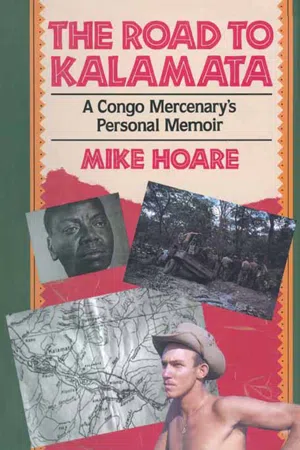
The famous adventurer and mercenary recounts his exploits during the Congo Crisis in this Cold War military memoir.
At the close of 1960, the newly formed Independent State of Katanga in central Africa recruited Thomas "Mad Mike" Hoare and his 4 Commando team of mercenary soldiers to suppress a rebellion by Baluba warriors known to torture the enemy soldiers they captured. In
The Road to Kalamata, Hoare tells the story of 4 Commando and its evolution from a loose assembly of individuals into a highly organized professional fighting unit.
Hoare's memoir presents a compelling portrait of the men who sell their military skills for money. They are, in his words, "a breed of men which has almost vanished from the face of the earth." Originally published in 1989, this edition of
The Road to Kalamata features a new foreword by the 20th century's most famous mercenary and one of its most eloquent storytellers.
- 256 pages
- English
- ePUB (mobile friendly)
- Available on iOS & Android
eBook - ePub
About this book
Information
Contents
Preface
1. 4 Commando Musters
2. The Frightful Ones
3. The Nyunzu Column
4. The Melody Lingers On
5. Katanga Mai
6. Breakout from Nyunzu
7. The Fighting Patrol
8. The Road to Kalamata
9. Mr. Donaldson Senior
10. A Punitive Expedition
11. The Solution
About the Author
Preface
TOWARD the end of 1960 and the beginning of 1961, Mr. Moise Tshombe, the president of the newly formed Independent State of Katanga, recruited a force of mercenary soldiers to help his fledgling army suppress a rebellion by the Baluba, one of the two great tribes in Katanga. While this was not the first time mercenary soldiers had been recruited for service in Africa in this century, it was nevertheless an event that was to cause considerable agitation at United Nations Headquarters and reams of comment in the world press.
In due course this initiative gave rise to an astonishing crop of highly imaginative stories about mercenary soldiering and mercenary soldiers, which were so far removed from the truth as to be laughable. I mention this in order that the reader may not be disappointed with this story, which sets out to be nothing more than an accurate if prosaic account of a tragic incident that took place during the Katanga campaign of 1961. If in the telling it robs mercenary soldiering of a little of its unexplained mystique, no great harm will be done.
Ten years after the Belgian Congo had become the Democratic Republic of the Congo, and later the Republic of Zaire, a large number of place names were altered in order to depict more accurately those places’ indigenous origins. Leopoldville became Kinshasa, Elizabethville became Lubumbashi, Stanleyville became Kisangani, and so on. As the events in this story take place in the period just after independence I have retained the original colonial place names, which were then in use. The story is true and all the characters real live people. Here and there I have altered a name where it will save someone embarrassment.
1
4 Commando Musters
THE column had bogged down in the heart of enemy territory. The track had collapsed after days of torrential rains and more than twenty trucks had sunk into the mud up to their axles. We were surrounded by an army of unseen Baluba warriors, a tough and merciless foe. That day we had lost one of my men from a wound inflicted by a poisoned arrow. He had lasted less than sixty minutes and was our first casualty. Morale among my Katangese drivers was at rock bottom. My unit, 4 Commando, which was escorting the column, was on edge, several of the men down with malaria, the remainder near exhaustion from lack of sleep.
I often think back to that evening in that smoky, wet Baluba hut in an unnamed Baluba village in northern Katanga, with the rain pelting down and night falling fast, when I warned my officers of what might lie ahead. Our modern weapons and efficient logistical supply, I told them, did not of themselves ensure victory over a primitive, badly armed enemy. There were other potent factors to be taken into account. The harshness of the terrain and the tropical climate were among them. Then there was the abnormal character of our enemy. The fact that he tortured his prisoners ritually before killing them, that he used poisoned arrows and practiced cannibalism—these were tactical considerations they might not have encountered as soldiers elsewhere in the world. This was central Africa, not Europe. There was no Geneva convention here. Little did any of them think they would experience every one of the things I warned them about in the course of their service with 4 Commando.
I lay on the floor of the mud hut that night covered by a mosquito net and listened to the drumming of the incessant rain. Before dropping off to sleep, I thought back to that other world in which it had all begun.
A shabby Skymaster waited for us in a remote corner of the airfield as though glad to be out of the public eye. It looked tired and beat up. As we got nearer I could see traces of previous liveries on its tail plane, a sure sign it had changed hands more than a few times in the last twelve years. Just as I was beginning to feel a little uneasy I recognized the skipper, Captain Jack Malloch, a legendary figure in central African aviation. If he was the pilot I had nothing to worry about. Take Jack out of his blue serge uniform and his cap with the gold braid, put him in a white surplice and black cassock, and he would remind you of the most angelic bishop you had ever seen. He waved a hand in the direction of the sixty-three men who had sauntered across the tarmac with me to board the well-used DC 4.
“You in charge of this lot, Mike?” he asked with a smile.
“You could say that, Jack. How far is it anyway?”
“Just under a thousand miles. We overfly Bulawayo, Lake Kariba, and Lusaka.”
“ETA Elizabethville?”
“Sixteen hundred hours—all being well.”
“Any stops?”
“None scheduled.” He laughed. “But you never know.”
“Any weather?”
“Nothing we can’t handle or go round. Box lunches on the back seat and brown paper bags for everyone.” He grinned. “I think you may need them. Get ’em on board as quickly as you can, will you?” He clapped his hands. “OK boys, andiamo.”
Jack was not noted for his small talk. Two or three plain clothes security officials waved us good-bye in a friendly way, the doors were slammed, and the engines burst into life setting up that high-pitched vibration that always gets me worried. Jack nursed the old crate off the ground and then shaped a course due north for what used to be called darkest Africa. In places it still is, with good reason; but that was something I was going to find out for myself in the course of the next six months.
In the early stages of the flight I went round to introduce myself to the men and checked their names against the manifest Jack had given me. About twenty of them were South Africans, fifteen from the U.K., and the rest Italians, Portuguese, and Rhodesians. The flight was uneventful as it turned out, but punctuated by moments of mild terror when we dropped heavily through thick black clouds. I noticed with some alarm that the wings of the DC 4 really did flap. I had often been told that Skymasters were famous for that engaging characteristic, but never really believed it until then.
Five hours later we were approaching the high plateau of Katanga, the watershed for two of the longest rivers in Africa, the Congo and the Zambezi. It was the time of the heavy summer rains and the land looked green, virile, and unruly. Below us unfolded a beautiful ranch-type country, unbelievably rich in mineral wealth of every description, but spectacularly so in copper. Five minutes from Elizabethville, the capital of Katanga, a single seater Fouga Magister jet-fighter screamed round us by way of formal inspection, just to remind us that the Independent State of Katanga was at war—internally with a recalcitrant tribe called the Baluba, and externally with the Democratic Republic of the Congo, from which Katanga had broken away, unilaterally, some nine months ago. We knew it already. After all, that was why we were here.
Some months prior to this Mr. Moise Tshombe, the president of the Independent State of Katanga, had decided to bolster up his newly raised defense forces by the recruitment of about seven hundred mercenary soldiers, the majority of whom would be Belgians and Frenchmen. By the end of February 1961 he had recruited five hundred men in Brussels and Paris and flown them out to Katanga. This recruitment in Europe rather than in Africa was a logical step to take as Belgium had been the former colonial power and French was the principal official language spoken throughout the Congo. The remaining two hundred men would come from Rhodesia and South Africa. The sixty-three men now arriving with me were the last of this intake.
At that time the new Katangese Army consisted of fifteen thousand recruits, plus about six hundred officers loaned by the Belgian Army for this special duty. The Belgians formed the staff, with their general headquarters, known as Etat Major, in Elizabethville. They had moved fast and in a few short weeks had established regimental depots and instructional cadres throughout the country. Within three months they were turning out officers, noncommisioned officers, and men for the new army at a reasonable standard. The proposed mercenary force recruited in South Africa and Rhodesia was not intended at this stage to be part of the Katangese Army proper but to serve as a form of gendarmerie whose duties would be of a paramilitary nature, in support of both the army and the police.
We taxied to a remote corner of the field and disembarked to be greeted by the Minister of Defense, Monsieur David Yav, and his Belgian Chef de Cabinet, Carlos Huyghe, a tall handsome man in his early thirties, the son of a former Governor General of the Belgian Congo. Immigration formalities were waived. We were hurried on to small buses driven by Belgian sous-officiers and whisked away in the direction of Jadotville, an important mining center about a hundred and fifty kilometers westward, and then a further thirty-five kilometers southwest of that to another mining center called Shinkolobwe. Shinko is famous for the copper mine that produced the uranium for the Los Alamos experiments, better known in history as the Manhattan Project, which resulted in the production of the world’s first atom bombs back in 1945. We drew up at the cantonment, which appeared to be unoccupied. We were allotted villas previously lived in by Belgian technicians and their families, the majority of whom had left the Congo soon after it had been given its independence some nine months previously, or during the recent tribal fighting in Katanga.
The Belgian staff work was superb. In an hour we were fed and kitted out in the uniform of the Katangese Army. The only item of clothing that distinguished us from them and labeled us as gendarmerie was the bush hat, Australian type, which, while imparting a suitably romantic air, was to prove less than practical in the field. We listened to a short lecture by a Belgian officer on the military situation, embellished by some bloodcurdling comment on the nature of the enemy. This was designed, I felt sure, to disabuse the minds of some of us who might have thought we were going to be paid to lounge around in barracks. After a few drinks in the Mining Club canteen we got to know one another briefly and found our beds at a reasonable hour.
The following morning I examined the nominal roll. It showed a total strength of 121 officers and men. We were to be organized in two half companies, one of them to be led by Alistair Wicks, an ex-British Army officer, and the other by myself. I was to have overall command. This unit was not to be confused with a mercenary unit of about thirty men that had been raised a little earlier and called itself the White Legion, and sometimes the Compagnie Internationale when banded together with other Belgian mercenary units. Regrettably, at this moment the whole of the White Legion was languishing in a United Nations jail in Leopoldville, having been taken prisoner by Ethiopian troops of the U.N. peacekeeping force at Kabalo, a town in northern Katanga. But before their capture the Compagnie Internationale had distinguished itself in a fierce and decisive action against the Baluba at an important tin mining town named Manono, also toward the north of the country.
From the look of the names on the nominal roll it appeared the unit would be made up from about fifteen nationalities, the majority being Britons and South Africans. There were no Americans although a large number of Americans were sympathetic to Tshombe’s cause and had made inquiries about enlistment in his forces. It was rumored at this time that Americans who enlisted for military service under a foreign flag would be committing an offense against the U.S. legal code punishable by confiscation of their U.S. passport. The belief in this draconian measure persisted for some years thereafter and deprived me of some excellent men later on when I commanded a unit of mercenary soldiers in the Congo known as 5 Commando. Later still it was found that there was no foundation in the law of the United States to substantiate that rumor.
At a glance I could see that we were going to have some problems with the organization. For a start there were far too many officers for a unit of 121 men. Officer rank had been conferred by Carlos Huyghe on an arbitrary basis grossly in excess of the fixed establishment for an independent company.
Most of the difficulty arose from a clause in our contract of engagement which stated that the volunteer was entitled to a rank one above that which he had held in his previous military service, full documentary proof being required to establish that, of course. A corporal would become a sergeant, a lieutenant a captain, and so on. A reasonable idea in theory, but there was no possibility of it working in practice. Alistair had been a captain. Was he now to be a commandant, the rank between captain and major equivalent to senior captain in the Katangese Army? I had been a major. Was I now to be a lieutenant colonel? Malheureusement non, they said. There was only one lieutenant colonel in the entire Katangese Army and he was the commander in chief, Lt. Col. Crèvecoeur, a Belgian. It did not worry any of us overmuch, and for my part I was quite content to accept the rank of captain provided only that I receive the appointment of commander of the unit now in formation. Rank, I thought in these circumstances, was not very important; one’s appointment was the thing that mattered.
Another cause for concern was the stipulation made by the recruiting officer, one Captain Roddy Cargill, lately an officer in the British South African Police, that as there would be no time or facilities for any basic training all volunteers must be old soldiers who had been in action. This requirement, while highly desirable, was in fact impossible to fulfill, and led in due course to the ostentatious display of World War II and Korean War medal ribbons, bogus in many cases you may be sure, by all and sundry in an attempt to bolster their claims to previous military service.
But when you really get down to it, men who have actually been in action are much rarer than you might imagine. A travelogue of medal ribbons is no indication that their wearer has ever come under fire from the enemy. Vast numbers of soldiers serve their entire service honorably without ever hearing a shot fired in anger. It cannot be otherwise, and it is to some extent a question of proportion. During World War II it had taken twelve men to support one man in the firing line. In Korea this had risen to twenty-two, presumably the result of the advance in military technology and the advent of more sophisticated equipment. So by that reckoning men who had actually been in action were going to be quite hard to find.
To add to the general confusion on this point there was also some uncertainty as to what precisely was meant by “action.” The terms “on active service” and “in action” are distinctive and not interchangeable, but nevertheless frequently confused in the civilian mind. “In action” in the military context means to be physically engaged in combat with the enemy; “on active service” means to be mobilized, ready to fight, serving under the colors but not actually fighting. In the present case it would be fair to say the majority of the volunteers had certainly been on active service, and all were certainly trained soldiers, but not very many of them had been in action.
A story from World War II illu...
Table of contents
- Cover
- Font1
- Half Title
- Font2
- Title
- Copyright
- Dedication
- Font3
- Contents
Trusted by 375,005 students
Access to over 1.5 million titles for a fair monthly price.
Study more efficiently using our study tools.
Frequently asked questions
Yes, you can cancel anytime from the Subscription tab in your account settings on the Perlego website. Your subscription will stay active until the end of your current billing period. Learn how to cancel your subscription
No, books cannot be downloaded as external files, such as PDFs, for use outside of Perlego. However, you can download books within the Perlego app for offline reading on mobile or tablet. Learn how to download books offline
Perlego offers two plans: Essential and Complete
- Essential is ideal for learners and professionals who enjoy exploring a wide range of subjects. Access the Essential Library with 800,000+ trusted titles and best-sellers across business, personal growth, and the humanities. Includes unlimited reading time and Standard Read Aloud voice.
- Complete: Perfect for advanced learners and researchers needing full, unrestricted access. Unlock 1.5M+ books across hundreds of subjects, including academic and specialized titles. The Complete Plan also includes advanced features like Premium Read Aloud and Research Assistant.
We are an online textbook subscription service, where you can get access to an entire online library for less than the price of a single book per month. With over 1.5 million books across 990+ topics, we’ve got you covered! Learn about our mission
Look out for the read-aloud symbol on your next book to see if you can listen to it. The read-aloud tool reads text aloud for you, highlighting the text as it is being read. You can pause it, speed it up and slow it down. Learn more about Read Aloud
Yes! You can use the Perlego app on both iOS and Android devices to read anytime, anywhere — even offline. Perfect for commutes or when you’re on the go.
Please note we cannot support devices running on iOS 13 and Android 7 or earlier. Learn more about using the app
Please note we cannot support devices running on iOS 13 and Android 7 or earlier. Learn more about using the app
Yes, you can access The Road to Kalamata by Mike Hoare in PDF and/or ePUB format, as well as other popular books in History & Military Biographies. We have over 1.5 million books available in our catalogue for you to explore.