- 320 pages
- English
- ePUB (mobile friendly)
- Available on iOS & Android
eBook - ePub
Visiting the Fallen: Arras South
About this book
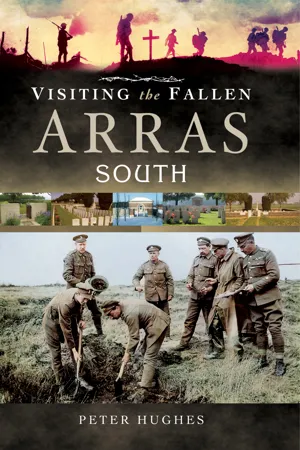
This companion volume to Visiting the Fallen: Arras North provides in-depth information of the WWI battlefield, its significance, and its cemeteries.
Arras, France, was a frontline town throughout the Great War. In 1916, it became home to the British Army and it remained so until the Advance to Victory. The area around Arras is as rich in Commonwealth War Graves Commission cemeteries as anywhere on the Western Front, yet they remain largely unvisited. This book explores those cemeteries, and tells the story of the men who are buried there.
Visiting the Front: Arras-South contains comprehensive coverage of over 60 Commonwealth War Graves Commission cemeteries to be found in Arras and to the south of the town. It has a wealth of gallantry awards, including their citations, and features hundreds of officers and other ranks who fell during the war.
Many small actions, raids and operations are described in a book that tells the story of warfare on the Western Front through the lives of those who fought and died on the battlefields of Arras. This is an essential reference guide for anyone visiting Arras and its battlefields.
Trusted by 375,005 students
Access to over 1.5 million titles for a fair monthly price.
Study more efficiently using our study tools.
Information
Chapter One
Two Male Models – A Highland Tune for the Major – A Dip in the Canche
Faubourg d’Amiens Cemetery, Arras
Private Leonard Albert BYWATER, 16th Royal Warwickshire Regiment, was 19 years old when he was killed by a sniper’s bullet on 3 April 1916 (Plot I.A.12). Although he was born in Stroud, Gloucestershire, the family lived in the Aston district of Birmingham. Leonard’s elder brother, Private Arthur Harold BYWATER, served in the same battalion and was also killed by a sniper a few months later on 16 June (Plot I.D.52). Not only did they share a similar fate, but both are now buried here in Plot I just a short distance from each other.
Company Serjeant Major Frederick John CROSSLEY DCM, 1st Queen’s Own (Royal West Kent Regiment), was killed in action on 9 April 1916, aged 41. His DCM, gazetted on 17 December 1914, was awarded for conspicuous and gallant service over a period of ten days in the trenches at Neuve Chapelle. (Plot I.A.24)
Lieutenant Colonel Henry Norrington PACKARD DSO, 46 Brigade, Royal Field Artillery, was 46 years old when he was killed in action on 12 April 1916. He was commissioned in the Royal Artillery in July 1890 and was mentioned in despatches in October 1914. In February the following year he received his DSO in connection with operations in the field. (Plot I.A.41)
Private Ernest Henry ALLEN, 1st East Surrey Regiment, died of wounds on 21 April 1916 (Plot I.A.48). His brother, Private Edward Allen, was killed in action a few months later, on 1 July 1916 near Redan Ridge on the Somme, serving with the 1st Somerset Light Infantry. He is buried at Sucrerie Military Cemetery, Colincamps.
Lieutenant Colonel Henry Thomas CANTAN CMG, 1st Duke of Cornwall’s Light Infantry, was killed in action on 16 April 1916, aged 47. The London Gazette dated 17 May 1892 shows his promotion from colour sergeant with the King’s Royal Rifle Corps to second lieutenant with the Duke of Cornwall’s Light Infantry. He served with the regiment in the South African War and the London Gazette of 20 July 1900 refers not only to his promotion to captain, but also notes that he had been recovered as a prisoner of war. In December that year he was seconded to the South African Constabulary, but by 1908 he was again serving with his regiment. This career soldier was promoted to temporary lieutenant colonel in October 1915. His CMG was awarded soon after that, as there is a reference to it in the London Gazette in December. (Plot I.A.49)
Second Lieutenant Alex John REID DCM, 1st East Surrey Regiment, was killed in action on 26 April 1916. He had won his DCM a year earlier at Hill 60, near Ypres, while serving as a company serjeant major with the battalion and the award was gazetted on 3 June 1915. The citation refers to conspicuous gallantry and valuable service performed by him on 20 April 1915 when he went out of his trench across the open and brought up ammunition and reinforcements on three separate occasions. The fighting there was extremely fierce and the ground that he had to cross was constantly swept by severe machine-gun and shell fire. (Plot I.B.11)
Major Richard Archibald JONES, 15th Royal Warwickshire, the son of a clergyman from Wandsworth, London, was killed just after midnight on 21 May 1916 by a rifle grenade as he was supervising work to consolidate a mine crater that had been blown by the Germans on 19 May. JONES had been the principal of Birmingham University College and had commanded the university OTC there. He held a Master’s degree and was 34 years old when he died. (Plot I.B.46)
Killed with him was Lance Corporal William HUNDY (Plot I.B.47) whose body was recovered by his brother, Hubert, a stretcher-bearer. Three other wounded men were also brought in. A glance at William’s army number – 15/1 – shows that he was the first man to enlist with the 15th Battalion in Birmingham.
Private Sidney CLINCH had served with the 8th Royal Fusiliers before being posted to the 5th Entrenching Battalion. He died of wounds on 2 June 1916, aged 17. He is one of several soldiers buried here who fell aged 17. (Plot I.C.15)
Private Charles Douglas WORDINGHAM, 1st Norfolk Regiment, was killed in action on 4 June 1916, aged 21, almost certainly a casualty of the same bombardment that obliterated trenches of the 15th Royal Warwickshire Regiment that day (Plot I.C.17). His brother, Private James Reginald John Wordingham, also fell during the war whilst serving with the 9th Essex Regiment, aged 24. He died of wounds on 23 March 1918 and is buried at Merville Communal Cemetery Extension.
Lance Corporal Leslie Frank BROMWICH, 15th Royal Warwickshire Regiment, was killed in action on 4June 1916, aged 19 (Plot I.C.62). His brother, Private Edgar John BROMWICH, served in the same battalion and was killed on the same day, aged 26 (Plot I.D.14). Their parents had two other sons who served during the war. The cemetery register states that the brothers are buried near to one another, and initially it might seem odd that they are not buried next to one another. The most likely explanation lies in the fact that Edgar was originally reported as missing in action. His body was not immediately found, although it was recovered soon after. His burial would probably have taken place a short while after his brother’s interment.
On 4 June the Germans heavily shelled the trenches held by the battalion before firing three mines. Two of these were poorly aligned and were detonated adjacent to, but not directly beneath our trenches. The third one, however, exploded directly under the section held by ‘C’ Company and caused several casualties. The Germans then followed this up by sending across a large raiding party, which in places penetrated as far back as the British support lines before it was finally driven back.
Lieutenant John Onslow MADDOCKS, 15th Royal Warwickshire Regiment, was killed in action on 4 June 1916, aged 19. He was the son of Sir Henry Maddocks, Conservative MP for Nuneaton. (Plot I.D.29)
Captain Archibald Henry TATLOW, 15th Royal Warwickshire Regiment, was killed in action on 4 June 1916, aged 31, during the same incident in which the Bromwich brothers died. (Plot I.D.36)
Second Lieutenant Edgar George Butlin MILLSON, 4th Bedfordshire Regiment, attached 1st Battalion, was killed in action on 18 June 1916 when he was shot dead by a sniper. He was a railway engineer working in Colombia when the war broke out and returned to England in order to enlist. His father was a specialist medical psychologist and was awarded the OBE for services in that field. (Plot I.D.54)
Serjeant Frank Cyril RICHARDSON, 8th King’s Royal Rifle Corps, was killed in action on 2 July 1916 (Plot I.E.26). He and Serjeant Alfred Whitfield Harrison STONE MM (Plot I.E.29) were originally reported missing in action after the Germans had detonated a mine beneath the battalion’s trenches late on the night of 1 July 1916. The mine was accompanied by a heavy barrage, and although a few Germans succeeded in entering one of the battalion’s trenches close to the newly-formed crater, they were repulsed by bombers under Second Lieutenant Cooke who managed to occupy the front lip of the crater, which was then quickly consolidated.
Private John RICHARDSON, 16th Cheshire Regiment, was killed in action on 21 October 1916 (Plot I.H.3). The information in the CWGC register suggests that both he and Frank Cyril RICHARDSON were related, probably cousins. Both men came from Calverton, Nottinghamshire.
Company Serjeant Major John BEECH, ‘B’ Company, 15th Cheshire Regiment, was killed in action on 4 October 1916, aged 42. The 15th Cheshire Regiment was a Bantam battalion which, along with the 16th Battalion, went to France at the beginning of 1916. Both battalions served with the 35th (Bantam) Division. (Plot I.G.29)
Captain Arthur Beadon COLTHURST, 14th Gloucestershire Regiment, was killed in action on 25 October 1916 (Plot I.H.14). His third son, Flying Officer John Buller COLTHURST, served as a bomb aimer with 115 Squadron, Royal Air Force, during the Second World War and was killed in action on 24 February 1944 during a bombing raid over Schweinfurt. His Lancaster bomber was shot down, almost certainly by enemy flak, resulting in the loss of the entire crew. His body was never recovered and he is now commemorated on the Air Forces Memorial, Runnymede. The target of the raid had been the ball-bearing works producing this vital component for the German armaments industry.
Captain James Percival HODGKINSON, 15th Sherwood Foresters, was killed in action on 2 November 1916, aged 24. He is referred to in the battalion history, The Blast of War, published in 1986, but there is no account of his death, which strikes me as an unusual omission. (Plot I.H.31)
Captain John TILLEY, 7th Norfolk Regiment, was killed in action on 28 November 1916, aged 21. Though a relatively quiet period for the battalion, it was required to provide working parties, including wiring parties, during the latter part of November. The battalion war diary notes that Captain TILLEY was fatally wounded while inspecting the wire under the cover of mist. The sergeant with him was also wounded. The party that went out to rescue them presumed that they had been hit by stray bullets, but the rescue party was also fired on, suggesting that a sniper could have been responsible for his death rather than random or routine fire. (Plot I.J.30)
Private John MITCHELL, Private George CUTHBERT and Private Thomas JACKSON, all of whom served with the 10th Argyll & Sutherland Highlanders, died on 6 January 1917. They were part of a platoon preparing to carry out a raid on German positions opposite them with a party from the 8th Black Watch. The raid was due to begin at 3.08pm, but at 1.00pm an accident occurred as the men of the 10th Argyll & Sutherland Highlanders were being briefed by one of their sergeants inside a cellar. A Mills bomb exploded in their midst, presumably after the pin had come loose. Two men were killed instantly and fourteen others wounded. The raiding party was quickly brought back up to strength using men from another platoon and at 2.00pm the party of two officers, nine NCOs and seventy-seven men filed up the trench known as Imperial Street and into final positions for the raid.
The raid itself lasted only twenty minutes and the unusual timing appears to have taken the Germans by surprise. Stokes bombs were used to destroy dug-outs, which in some cases lifted the roofs off. Estimates put the German dead at around a hundred, while casualties for the 10th Argyll & Sutherland Highlanders amounted to one man killed and one other man wounded. The wounded man was carried in by Second Lieutenant Robertson.
MITCHELL, CUTHBERT and JACKSON are buried together (Plot II.B.11, 12 and 13). Nearby are the graves of Lance Corporal David CRAIG and Private William KINLOCK (Plot II.B.24 and 25). It is possible that these two men either died of wounds as a result of the incident in the cellar, or that one of them was the wounded man rescued by Second Lieutenant Robertson. Both men died of wounds on 9 January 1917.
The Reverend Edward Francis DUNCAN MC, Chaplain 4th Class, was killed in action on 11 March 1917, aged 32, while going to the assistance of a man wounded by a shell. He won his MC in similar circumstances after going to help an officer who had been wounded during a raid, an act which he carried out even though he himself had been wounded. He was attached to 103 Brigade, 34th Division. His MC was gazetted on 27 November 1916. (Plot II.F.8)
Lieutenant Thomas William JONES MD Ch.B. D.Ph, Royal Army Medical Corps, was killed in action on 11 March 1917, aged 31, while attached to the 27th Northumberland Fusiliers (4th Tyneside Irish). (Plot II.F.9)
Major Royston Swire GRIFFITHS, 123rd Siege Battery, Royal Garrison Artillery, is shown in Officers Died in the Great War as having died on 17 March 1917, aged 31. He enlisted in 1914 with the Royal Marines, but soon switched to the Royal Marine Engineers. He was commissioned in January 1915 and then served in France with the above battery from the end of July 1916 until his death. Unfortunately he became ill and developed a blood clot that killed him. (Plot II.H.3)
Bombardier Ernest George HUMPHRIES, 260th Siege Battery, Royal Garrison Artillery, was killed in action on 22 March 1917, aged 29. The CWGC register notes that he had been headmaster of Englishcombe School, Bath, before the outbreak of war. (Plot II.J.18)
Second Lieutenant Edward Rodney Hasluck GRANTHAM, 1st Northumberland Fusiliers, died of wounds on 31 March 1917, aged 20. He was educated at Rugby School and Trinity College, Cambridge (Plot II.M.22). His elder brother, Second Lieutenant Richard Aubray Fuge Grantham, was killed in action a few weeks earlier on 4 March serving with the 2nd Lincolnshire Regiment. He is buried at Fins New British Cemetery, Sorel-le-Grand. Like his brother, Richard was educated at Rugby School, but went on to study at Corpus Christi College, Oxford. The family lived in Hampstead, London.
Private Arthur Andrew PLANK, ‘C’ Company, 1st South African Regiment, was wounded at Delville Wood on 18 July 1916. He was killed in action on 5 April 1917 in the run up to the opening of the Arras offensive (Plot II.O.23). Next to him is Private N.M. MAGENNIS of the same regiment. He was killed in action the previous day. (Plot II.O.22)
Company Quartermaster Serjeant Thomas S. KING, 24th Northumberland Fusiliers (1st Tyneside Irish), aged 45, was killed in action on 7 April 1917. Soldiers Died in the Great War shows his death occurring the following day. (Plot II.P.2)
Among the sixty soldiers of the South African Brigade buried here are three who were killed in action on Christmas Day 1916. All three are from the 2nd Battalion, South African Regiment: Private Leslie Frederick DORE (Plot III.A.9), Second Lieutenant M.F. BURLEY (Plot III.A.11), and Private John Jacob BELLARDI (Plot III.A.13).
Buried among them are two other casualties from that day: Gunner Henry Stone ELLIOT, 123rd Battery, Royal Garrison Artillery, shown in Soldiers Died in the Great War as having died on active service (Plot III.A.10), and Corporal John BRODIE, 6th King’s Own Scottish Borderers, shown as being killed in action (Plot III.A.12).
Second Lieutenant Harold DAWS, 10th Durham Light Infantry, was killed in action on 26 December 1916. The CWGC register informs us that he returned from Brazil in 1914 in order to enlist and that he originally served with the Artists’ Rifles OTC. (Plot III.A.14)
Private Murray Stewart LE MARE, 3rd South African Regiment, was another veteran of the fighting at Delville Wood; he was wounded there on 16 July 1916. He was killed in action on 12 January the following year (Plot III.B.7). A little way along the same row is Private Arthur Douglas GRANT, 4th South African Regiment, who was also wounded at Delville Wood. He was killed in action a few days later on 18 January 1917. (Plot III.B.21)
Major John Stanley SHARP, 5th Royal Berkshire Regiment, was killed in action on 17 March 1917, aged 34. He was educated at Wellington College, then Trinity Hall, Cambridge. He was a very good sportsman and was awarded colours for rugby, cricket and hockey while at university. In 1914 he joined one of the Public Schools Battalions of the Royal Fusiliers and was then commissioned in the 5th Royal Berkshire Regiment. He went to France with his new battalion in May 1915.
On 17 March 1917 he led around 200 of his battalion in a raid on German trenches just south of Blangy. The raid was of short duration, lasting just twenty-five minutes. Most of the casualties, thirty-six in total, occurred as the party was returning to its own trenches when it was caught by retaliatory German shell fire. Eight other ranks were killed in the action and Major SHARP was one of two officer casualties. The other officer was Second Lieutenant Basil Hamilton Abdy Fellowes. He died of wounds five days later, aged 19, at a casualty clearing station at Avesnes-le-Comte and was buried there in the Communal Cemetery Extension. SHARP’s body was recovered easily owing to the fact that he fell just yards from reaching the comparative safety of the British trenches. He was mentioned in despatches in May that year in recognition of his leadership. (Plot III.G.31)
Major James Robert WALKER MC, ‘B’ Battery, 62 Brigade, Royal Field Artillery, was killed in action on 20 March 1917, aged 40. He had previously served for twenty years with ‘C’ Battery, Royal Horse Artillery. His MC was gazetted on 17 January 1917, but it appears to be without a citation. (Plot III.H.30)
Private James O’NEILL, 9th Cameronians, was killed in action on 22 March 1917, aged 22 (Plot III.J.15). His younger brother, Patrick O’Neill, fell in action on 3 May that year whilst serving as a lance corporal with the Household Battalion, aged 20. He has no known grave and is commemorated on the Arras Memorial. The family came from Motherwell.
Serjeant Thomas DOYLE, 10th Argyll & Sutherland Highlanders, was 44 years old when he was killed in action on 3 April 1917. He had spent nearly half of his life as a soldier, having served in the army for twenty-one years. (Plot III.M.29)
Captain Thomas Hesketh ROSS MC, 4th Battalion, South African Regiment, was one of only four officers from that battalion to emerge from Delville Wood unhurt. His gallantry and leadership during those desperate few days in July 1916 earned him the MC. He was subsequently wounded by a bullet to the head during a raid on the night of 18/19 October 1916 near the Butte de Warlencourt. The raid, led by ROSS himself, comprised a force of 200 men, including bombers, signallers and Lewis gunners. ROSS was wounded when the Germans launched a counter-attack on Snag Trench around 5.00am using flame-throwers and bombs. They drove him and his men back to their original positions with heavy casualties, along with a party under Captain Langdale. Sadly, ROSS was killed the following year at Arras on 3 April 1917, though there is some dispute as to whether he was killed by a sniper or by shrapnel.
In 1903 he joined the Transvaal Scottish and was commissioned the following year. In 1906 he served with the Transvaal Scottish Volunteer Company during the Zulu Rebellion and later went on to command the Transvaal Scottish ...
Table of contents
- Cover
- Title Page
- Copyright
- Dedication
- Contents
- List of Plates
- Acknowledgements
- Introduction
- Chapter 1: Two Male Models – A Highland Tune for the Major – A Dip in the Canche
- Chapter 2: Captain Murray’s Pluck – A Man who knew all about Tanks – My Family and other Eagles
- Chapter 3: Goings on at Monchy – A Chapel and a Windmill – Port for the Duke’s Table
- Chapter 4: A Father and Son meet for the Last Time – ‘Awly Magawly’ and some Cavalrymen – We also fell on 1 July 1916
- Chapter 5: Rooks, Cuckoos and Calvaires – Fighting a lost Cause – A Childbirth ends in Tragedy
- Chapter 6: Dinner with Sassoon – A Middle Name of Murray – Last Confessions in a Barn
- Chapter 7: A Mill and a Crucifix – From the Scarpe to the Piave – A Gallant Cheesemaker
- Chapter 8: ‘A Gallant English Officer’ – Sewing Machines and a Portuguese Count – A Mysterious Death in the Woods
- Chapter 9: Two Deaths in a Dublin Park – The Mammoth of Morchies – A Swiss Imbroglio
- Chapter 10: An Unusual Revelation on Good Friday – Early Days with Fabian Ware – Two Trees, a Sunken Road and a Railway Cutting
- Chapter 11: A Mystery off the Cornish Coast – Coffee and Small Comforts – Orchids and Orchards
- Bibliography
Frequently asked questions
Yes, you can cancel anytime from the Subscription tab in your account settings on the Perlego website. Your subscription will stay active until the end of your current billing period. Learn how to cancel your subscription
No, books cannot be downloaded as external files, such as PDFs, for use outside of Perlego. However, you can download books within the Perlego app for offline reading on mobile or tablet. Learn how to download books offline
Perlego offers two plans: Essential and Complete
- Essential is ideal for learners and professionals who enjoy exploring a wide range of subjects. Access the Essential Library with 800,000+ trusted titles and best-sellers across business, personal growth, and the humanities. Includes unlimited reading time and Standard Read Aloud voice.
- Complete: Perfect for advanced learners and researchers needing full, unrestricted access. Unlock 1.5M+ books across hundreds of subjects, including academic and specialized titles. The Complete Plan also includes advanced features like Premium Read Aloud and Research Assistant.
We are an online textbook subscription service, where you can get access to an entire online library for less than the price of a single book per month. With over 1.5 million books across 990+ topics, we’ve got you covered! Learn about our mission
Look out for the read-aloud symbol on your next book to see if you can listen to it. The read-aloud tool reads text aloud for you, highlighting the text as it is being read. You can pause it, speed it up and slow it down. Learn more about Read Aloud
Yes! You can use the Perlego app on both iOS and Android devices to read anytime, anywhere — even offline. Perfect for commutes or when you’re on the go.
Please note we cannot support devices running on iOS 13 and Android 7 or earlier. Learn more about using the app
Please note we cannot support devices running on iOS 13 and Android 7 or earlier. Learn more about using the app
Yes, you can access Visiting the Fallen: Arras South by Peter Hughes in PDF and/or ePUB format, as well as other popular books in History & Military Biographies. We have over 1.5 million books available in our catalogue for you to explore.