"An excellent account of the political battles and the commercial skulduggery . . . and its outstanding service as a transport and tanker with the RAF." —Firetrench
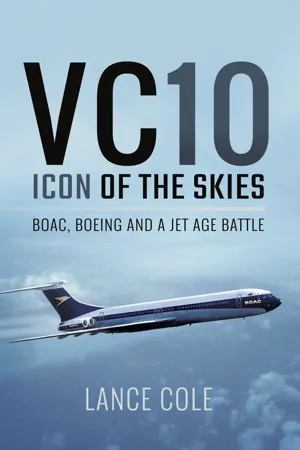
The VC10 was the nation's biggest jet airliner of its age and regarded as the world's best-looking airliner. It was safe, fast, and designed to take off from short runways in Africa and Asia, at the request of its main operator BOAC—the airline that would later go on to become today's British Airways.
The VC10 and the larger Super VC10 were beloved by pilots and passengers alike and became icons of the 1960s. They were hugely popular all over the world.
Yet the VC10 was eclipsed by Boeing's 707 which sold by the hundreds, despite the fact that the 707 was less capable and could not initially operate from the runways of the Commonwealth and old British Empire routes, as the VC10 undoubtedly could. This book blends the story of VC10 development with a well-researched tale of corporate and political power play. It asks; just what lay behind the sales failure of the VC1O?
Politics played an important part of course, as did BOACs tactics, and a whodunnit cast of politico-corporate events and machinations at the highest level of society during the dying days of Empire in 1960s Britain. Key players in the story, from Tony Benn to famous test pilot Brian Trubshaw (Concorde), are cited and quoted.
By exploring this historical period in depth and highlighting all the various impediments that stood in the way of success for the VC10, Lance Cole adds an important layer to our understanding of twentieth century history.
- 256 pages
- English
- ePUB (mobile friendly)
- Available on iOS & Android
eBook - ePub
About this book
Information
Chapter 1
Icon of the Skies: The VC10 Legend
“BOAC got what it had asked for.”
Brian Trubshaw, MVO, CBE, FRAeS,
in conversation with the author
in conversation with the author
I conic is an overused word, all too easily applied to too many objects, but the VC10 was (and remains) a true icon of not just industrial design, but also of airline life, and of world travel as it opened up the mass market. People loved, truly loved, the VC10 as an icon of the air. Pilots, passengers, and small boys and girls the world over, adored the sight and the sound of the VC10 and its enlarged variant the Super VC10 – which really was super in every respect.
To many, the VC10’s most important customer was the RAF, and the VC10’s military transport and flight refuelling story is one that, although not intimately linked to civil operations, cannot be ignored in the story. The RAF’s transport needs were, like BOAC’s, also wrapped up in the end of Empire, yet then lasted into the second decade of the new millennium. The story of the RAF and its own Transport Command and Tanker squadron VC10 deployments spanned fifty years.
There is no over-sentimentalised gushing in saying that the VC10 was utterly, devastatingly, beautiful (perhaps in pure engineering terms, unnecessarily so), and remained stunning in the metal and in the mind long after it had passed by. Every line of the VC10 ‘works’, it is as though the thing was styled – like a great car design from Pininfarina, Bertone or Michelotti, or more appositely, Sir William Lyons, Malcolm Sayer, or a Sir Nigel Gresley locomotive.
The VC10 was shaped not by Italian sculptors, but British engineers – men not given to artistic or emotional over excitement, but just as with aircraft, even Concorde, the engineers and designers behind such great shapes, would hate to be associated with a suggestion of ‘styling’. But have you ever met anyone who is not moved by the shape of the VC10?
So the VC10 was a supreme piece of industrial engineering design. In its lines, it was wonderfully sculpted, but not ‘over-designed’, or a fashion victim.
Even the shape of the VC10’s cockpit windows has a distinct form as a design motif that sets a mood, a face, one that seamlessly draws the eye into the lean fuselage that itself then arcs back into that great, swept ‘whale tail’ of a fin. The VC10’s nose-to-tail Saville Row tailored style simply reeks of great design that has never dated. Unlike certain ‘exotics’ underneath that stylish skin, lay great engineering integrity.
The VC10, in the sum of all its parts, was a perfect blend of form and function; it was indeed a marker to the beauty of Concorde – upon which many of Sir George Edwards VC10 engineers and designers worked, and which many ex-VC10 pilots flew as a supersonic elite. It was the sleek, sweptback aerodynamic sculpture of the 1960s, instantly recognisable anywhere in the world – as was the BOAC blue and gold livery and the ‘Speedbird’ emblem. The VC10 seemed to gel with James Bond and his sharply tailored suits, elegant watches, lean women, fashion couture and an impression of style and speed, above all – speed – in a quintessential 1960s design evocation that lived long beyond that decade and never aged. Sean Connery’s James Bond would look good in a VC10, but so too would that more contemporary Bond, Daniel Craig; somehow, VC10 sits amid the design names of the 1960s and still looks fresh and perfect over fifty years later. We might say the same of the original Cunard liner the Queen Elizabeth II, the Supermarine Spitfire, Concorde, or the Blackburn Buccaneer and the Avro Vulcan. Making an automotive analogy, the Aston Martin DB6, Porsche 911, Jaguar E-Type, Ferrari 365 Daytona, all are similarly timeless. In fact, if you park an Aston Martin DB6 next to a VC10, the view is wonderful, although Sir George Edwards might have preferred to equate the VC10 with a Bentley – his personal car of choice – but now, it would have to be a Bentley Continental GT.
Perhaps ultimately eclipsed in sculptural terms by Concorde, the VC10 was and remains a massive statement of British industrial design brilliance. There are other VC10 emotional ingredients – such as that haunting sound of Rolls-Royce Conways howling as they decelerate as the VC10 taxies past, the engine pods, the raked main undercarriage, the upswept elevators, the wing shape, the slight nosedown stance upon the wheels. Surely, none of this elegance was by accident.
The BOAC VC10 interior design and the revised Super VC10 cabin design, created a new standard of style, safety and comfort for all airliners. An ‘architectural’ look was used for the cabin wall and ceiling mouldings. New materials and patterns were used to trim the cabin. The 707 and DC-8 had reiterated old prop-liner style designs for their cabins, the VC10 created a new interior design fashion for airliners.
The Economy Class seats were the strongest made, had a forward support spar keeping it away from the legs of occupants seated behind, and achieved a 13.6g impact rating, much safer than the old 9g rating. Special cushions and webbing made the seat the most comfortable standard-class airline seat in the world. Concealed cabin lighting was a first in the VC10. The Super VC10 saw revised colours and panels in a more contemporary look. Overall, for both machines, better comfort, fresher air and more room amid new colours, all set new international standards in Economy Class and interior designs.1
‘Ah but,’ say the Boeing men, ‘it only sold a few, whereas Boeing’s seven-ohseven warhorse sold into four-figures. So what did exquisite design, inside and out, achieve?’
The answer to that is not a simple response. As the acclaimed Scottish industrial designer Dawson Sellar, always opined, ‘what on earth was the point of bad or boring design when good design cost no more, and made things sell and achieve a place in peoples’ affections? Good design earned money and more, in marketing terms. So, an often ignored tangent of the VC10 is that of its place in the annals of global industrial design.’ ‘Old school’ engineering purists of course, might be horrified at such words, but earning a place in peoples affections is what the VC10 design did.
The VC10 influenced airliner design and brought new techniques and standards that are now commonplace. So the advance of design was the VC10 achievement beyond its airline service.
Even if it was a subconscious act, the VC10 design team and aerodynamicists, surely also created a piece of stunning engineering design. For the conservative British to turn out something so ‘designed’ as the VC10, was in fact, quite a shock in a drab, grey and beige austerity world of post-war Britain. The men of British ‘safe’ design might have expected the French to go all arty with their sexy-looking Caravelle jet liner, but an English design should surely be staid, square, redoubtable and upright in its angles – like a Morris Minor or a Vickers Vanguard! Nothing flashy (like a Caravelle or a Citroën DS) would be allowed – surely? Well, not until the VC10 and the Malcolm Sayer-styled Jaguar E-Type, both arrived in a blast of 1960s British style that was beyond even the Italian stylists. Britain, however conservative, however stifled, could turn out the best designers and engineers in the world.
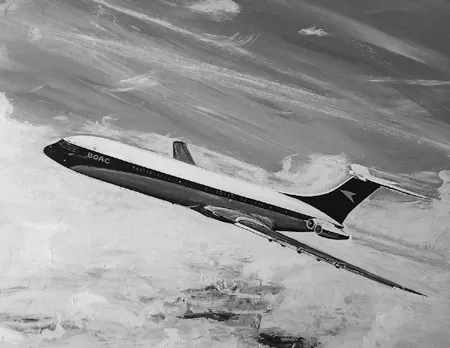
VC10 Climb Out.
Beige gave way to blue and gold.
The VC10 was the epitome of expensive-looking, designer-stylist couture in alloy, yet it was made and shaped by men immersed in old-school engineering. Yet their attitude was different – outward looking – and they gave us the perfect lines of the Viscount and the V1000, and finally, Concorde itself. They imagined beyond the constraints of the old, British conservative design psychology.
The State’s Carriage: Imperial to BOAC
Inherent within the VC10’s airline life, was the whole theatre of British civil aviation, its history, and the BOAC story. BOAC was born from Imperial Airways, which itself was birthed from the strands of early British privately owned airlines; Imperial and its successor, BOAC, were both State funded organs, not just of national transport, but also of colonial will.
BOAC then straddled that old world, and the new world of social change and end-of-empire, yet it was the child of many attitudes that were decidedly ‘imperial’ in outlook. Both airlines were subject to the vagaries of government, the Civil Service, overseeing boards, and the personal issues and egos of various leaders, MPs, ministers and transient political figures. Transient political appointees perhaps being the most lethal and potentially toxic risk of all to any business, especially a nationalised airline – or Britain’s railways. In matters of transport and defence, the arrival of a clueless new minister of such a department of responsibility can cause great concerns and harms to airlines, air forces, or to armies and navies. Experts in their respective fields make much better appointees. Advising civil servants might also have their own agendas. All the themes of politics and corporate game playing contributed not just to Imperial Airways and BOAC, but to the ethos and practices that resulted in BOAC’s route network and its airliner procurement. The VC10 was a child of such circumstances, yet few authors have investigated such influencing genesis.
A factor so often overlooked by aviation enthusiasts and purists, were the social science issues – after the Second World War, British society changed. Previously stuck in a perceived wisdom of class, social hierarchy, deference to royalty, and defined social rules, Britain was a society ripe for social revolution – if not actual revolution. Imperial Airways had been the instrument of a ruling class and an Empire administration. All that was to change and BOAC was cast between the two differing worlds of old and new. As British society changed in the 1960s, so too did travel, notably air travel upon the wings of the national airline that was BOAC. Such ingredients provide a sub-plot to the story and, in the political and corporate machinations that affected BOAC we see certain evidence of the issues suggested herein.
Britannia Rules the Air?
Britain had previously dominated the seas and the building of the ships that traversed the seas. Britannia ruled the waves, and it assumed it would rule the skies, which was an assumptive error of costly arrogance. Somehow, despite the engineering and design brilliance of British boffins, the British threw away the chance to rule the skies and the airliner market of the mid-late twentieth century. The reasons for the failure lie deep within the psychology of the British elite who ran affairs at the time. As the high flying Douglas DC-2 and DC-3 came into being in their modernistic monoplane, alloy monocoque streamlined design, the British were turning out wire-braced, wood and steel-built aerial yachts of biplane configuration and achieving stately progress in the lower airs. Devices such as the Handley Page HP42 and the Short S-17 Kent Class (generically known as the ‘Scipio’), sailed the foetid lower altitudes of the Empire’s airways as the new world rushed ahead in cooler airs many thousands of feet above. It really was a bizarre set of circumstances. We have to wonder, how on earth it transpired.
Looked at from the hindsight of today, we can suggest that aspects of BOAC and of Imperial Airways were very messy indeed, with a great deal of questions hanging over certain decisions and policies – and they are truly a crucial part of the VC10 and BOAC story. A very large amount of money has been swallowed up across the decades.
After over four decades of flying, the RAF’s VC10 story has only just ended, and left many hardened military men in tears when it closed that final chapter. The VC10 flew for just over fifty-one years – a significant achievement.
Before that occurred, there were the decades of a very British story.
Chapter 2
Empires in the Sky: From Comet to V1000
‘The slaughter of that beautiful babe in the bulrushes was an act of defeatism that will come home to roost’
Aviation writer, Stanley H. Evans, on the termination of the Vickers V1000/VC7.
(Private correspondence to B.S. Shenstone in 1956)
‘One of the most disgraceful, most disheartening and most unfortunate decisions that has been taken in relation to the British aircraft industry in recent years …
‘From a national point of view that will be a tragedy when here, in almost completed form, we have a potential world-beater.’
Mr Paul Williams, MP (Sunderland South), the House of Commons. 8.51pm, 8 December 1955, speaking on the cancellation of V1000. (Hansard, Vol 547, cc665–670)
Despite the travails of the Second World War, British and American minds took time out from military strategy to consider the world in a more peaceful, post-war environment. Paramount amongst such considerations, were the expected airline transport needs of the world powers and their peoples, notably of the west. The Brabazon Committee, under John Moore-Brabazon, who had flown with Geoffrey de Havilland at the dawn of aviation, was the 1940s British body that performed the act of soothsaying to the future of British civil aviation; uppermost in its mind were the needs of the Empire, of mail, and of elite passengers travelling to their positions of colonial authority and importance. Mass travel was not what things were about.
The Americans had a wider vision of the new world order, and that vision served them well.
The Atlantic axis and the rising need for fast travel to Asia and Africa to serve old and new worlds, would be the key driving factors in years to come, yet there would be paradoxes and contradictions inherent within the debates and the application of the instrument of national policy via Britain’s airline – Imperial – and then its offshoot as the British Overseas Airways Corporation (BOAC). Some of the British failed to grasp that the war would end their Empire, they thought that there would be a return to flying boats and First Class travel. Such people, locked into their insular certainties, did not envisage mass travel, the tourist-class market, and an emerging world that would desire jet airliners and new airways.
While – circa 1943–1945 – the British toyed with their wartime Brabazon Committee looking at military and civil airframes for a post-war future, America developed, often-superior, military aircraft that could very easily be re-purposed as airliners for the new era and the new world market. Urgent wartime developments in airframe and powerplant technology soon gave us the DC4, DC6, DC7, Lockheed Constellation range, and Boeing’s bomber-derived airliner such as the Stratocruiser – all based upon wartime airframes. Military budgets had ‘free’ knock-on effects for civil airliner design and development, but the British were slower than the Americans to make the most of the opportunity. Converted British types like the Argonaut, Hermes, and Lancaster bombers were stumbling steps – ineffective anachronisms all.
However, a huge leap forwards in piston and turbin...
Table of contents
- Cover
- Title
- Copyright
- Contents
- Acknowledgements
- Introduction
- Chapter 1 Icon of the Skies: The VC10 Legend
- Chapter 2 Empires in the Sky: From Comet to V1000
- Chapter 3 An Imperial Affair: Biplanes to Big Flying Boats
- Chapter 4 A Great Corporation: BOAC and the Politics of Power
- Chapter 5 Vanjet: Design for the Future – Valiant to VC Series
- Chapter 6 Highly Detailed Reality: VC10 and the Realisation of a Dream
- Chapter 7 BOAC, Parliament and Planes: Politics, Passengers, Guthrie, and the VC10 affair
- Chapter 8 Boeing’s Big Beast: Deltas, B-52s and Stratotanker to Stratoliner
- Chapter 9 VC10 Beyond BOAC: Other Operators
- Chapter 10 Full Flap: What Might Have Been and What Was
- Notes
- Bibliography & Sources
- Appendix 1
- Plate section
Trusted by 375,005 students
Access to over 1.5 million titles for a fair monthly price.
Study more efficiently using our study tools.
Frequently asked questions
Yes, you can cancel anytime from the Subscription tab in your account settings on the Perlego website. Your subscription will stay active until the end of your current billing period. Learn how to cancel your subscription
No, books cannot be downloaded as external files, such as PDFs, for use outside of Perlego. However, you can download books within the Perlego app for offline reading on mobile or tablet. Learn how to download books offline
Perlego offers two plans: Essential and Complete
- Essential is ideal for learners and professionals who enjoy exploring a wide range of subjects. Access the Essential Library with 800,000+ trusted titles and best-sellers across business, personal growth, and the humanities. Includes unlimited reading time and Standard Read Aloud voice.
- Complete: Perfect for advanced learners and researchers needing full, unrestricted access. Unlock 1.5M+ books across hundreds of subjects, including academic and specialized titles. The Complete Plan also includes advanced features like Premium Read Aloud and Research Assistant.
We are an online textbook subscription service, where you can get access to an entire online library for less than the price of a single book per month. With over 1.5 million books across 990+ topics, we’ve got you covered! Learn about our mission
Look out for the read-aloud symbol on your next book to see if you can listen to it. The read-aloud tool reads text aloud for you, highlighting the text as it is being read. You can pause it, speed it up and slow it down. Learn more about Read Aloud
Yes! You can use the Perlego app on both iOS and Android devices to read anytime, anywhere — even offline. Perfect for commutes or when you’re on the go.
Please note we cannot support devices running on iOS 13 and Android 7 or earlier. Learn more about using the app
Please note we cannot support devices running on iOS 13 and Android 7 or earlier. Learn more about using the app
Yes, you can access VC10: Icon of the Skies by Lance Cole in PDF and/or ePUB format, as well as other popular books in Technology & Engineering & British History. We have over 1.5 million books available in our catalogue for you to explore.