"An interesting introduction to Victorian crimes, the people who committed them, and how effective rehabilitation may have been." —Ripperologist Magazine
What was life like in the Victorian underworld—who were the criminals, what crimes did they commit, how did they come to a criminal career, and what happened to them after they were released from prison?
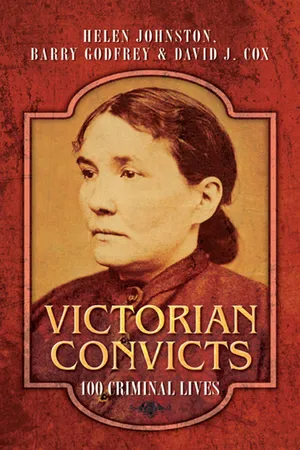
Victorian Convicts, by telling the stories of a hundred criminal men and women, gives the reader an insight into their families and social background, the conditions in which they lived, their relationships and working lives, and their offences. They reveal how these individuals were treated by the justice and penal system of 150 years ago, and how they were regarded by the wider world around them. Such a rare and authentic insight into life in and out of prison will be fascinating reading for anyone who is interested in the history of crime and criminals, in legal and prison history and in British society in the nineteenth century.
"A fascinating, informative and educational read providing the history of these one hundred individuals who lived so long ago but who can teach us today the practices of the Victorian penal system and the struggles of the era." —
Crime Traveller
"It is intriguing and very readable opening a window into lives of so many unfortunates. If you have an interest in police history this work, particularly details of numerous convictions and what followed after the court case was concluded, will be of interest." —Surrey Constabulary History Journal
- 224 pages
- English
- ePUB (mobile friendly)
- Available on iOS & Android
eBook - ePub
About this book
Information
Print ISBN
9781473823730
Subtopic
Storia britannicaThe Convict Licensing System
Background
The licensing system introduced for convicts in 1853 had its origins in the development of the ‘ticket-of-leave’ system by Sir Philip Gidley King, third Governor of New South Wales (1800-06). This system allowed well-behaved transported convicts to either work for themselves or for a designated employer within a proscribed district of the colony before their sentence expired or they gained a pardon. The system was designed to act as an incentive to encourage good behaviour amongst transportees and many thousands received such tickets.
In 1853, following the introduction of the convict prison system as a result of the 1853 Penal Servitude Act, which replaced sentences of more than seven years’ transportation with penal servitude, it was decided to introduce a similar system in Britain. The system, known officially as licensing (but popularly retaining the term ‘ticket-of-leave’ throughout the nineteenth century) was championed by Lieutenant Colonel Joshua Jebb CB, Surveyor-General of Prisons and later Chairman of the Directors of Convict Prisons. He was of the opinion that such a system would be more regulated and reformatory in nature (by means of convicts actively having to modify and maintain their good behaviour in order to gain a licence) than the previous indiscriminate use of pardons to free prisoners after serving about half of their sentences.
This view was endorsed by Captain Whitty, Governor of Portland Prison, who stated that:
The system of wearing conduct-badges on the dress, by which the monthly progress of each convict towards the attainment of his ticket-of-leave is publicly marked, works very satisfactorily, as is evinced by the anxiety of even the ill-conducted prisoners to regain a lost good-conduct mark and the efforts to keep subsequently clear of the misconduct book.1
Some prisons took this system of rewarding good behaviour a step further; Dartmoor Prison introduced an internal ‘ticket-of-leave’ system, by which different colour uniforms enabled well-behaved convicts to join a special class of prisoner who were either let out of the prison during the day to perform outside work (normally clearing unproductive land in order to bring it into cultivation), or to work inside the prison on easier tasks, e.g. feeding and looking after the farm animals.2
Jebb also stated in the Report that with regard to the release of convicts on such licences, ‘it may be confidently stated that the majority will do well’, since the strictly regulated system replaced the ‘free and easy, lax and demoralising system which formerly prevailed in the hulks’.3 He anticipated that, based on the contemporary prison population, the introduction of a licensing system would affect between 1,800 and 2,000 convicts per year. His estimate was broadly correct. Between 8 October 1853 and 27 June 1854 nearly 1,000 men were released on licence.4 Anticipating criticism or fears that the influx of such a large number of offenders back into the community would adversely affect crime rates, he stated that men serving time on hulks had previously been released about halfway through their sentence – and that this had not caused any great problems with recidivism.5 Jebb was being somewhat optimistic here; numerous newspaper reports of offences carried out by ‘ticket-of-leave men’ fuelled public suspicion of the system throughout the 1850s and 1860s.
How did the system work?
In general, well-behaved convicts serving seven years would be released on licence after serving three years of their sentence, those sentenced to ten years being released on licence after serving four years. Jebb explained the preparations for the release of such convicts in considerable detail, but the main points were that:
• Each convict could be credited with a small amount of money on a daily basis, which was to be accrued as a result of his industry and good-behaviour. This would be credited to an account which would be given the convict on the day of his release. Jebb stated that the average amount was between £5 and £6 for the first 800 convicts who had been released on licence.6 This money was held in a Post Office account at the stated destination of the licence-holder. Half was given to the licence-holder upon demand, but the other half could only be reclaimed upon the licence-holder providing subsequent proof of his continued good behaviour.
• Each man released on licence to be given a suit of clothes and a pair of shoes upon his release, together with a Bible and Prayer Book.
• Each man to be accompanied to the nearest railway station by a prison officer, who then gives the former convict a railway ticket to his stated destination, together with a small amount of money advanced out of their future earnings for necessary expenses.
• The licence and a certificate of good conduct to be given to the licence-holder by the prison officer at the railway station prior to departure.
Considerable endeavours to procure employment for the licence-holder were also made; prior to release the prison chaplain would draft a standard letter to prospective employers about a month prior to the convict’s release, enquiring about the possibility of the convict’s future employment:
Sir,
The Secretary of State being anxious to ascertain the prospect of employment of convicts who from time to time become eligible for release on licence, and with a view to assist them in entering upon a career of honest industry, has requested me to refer to any one likely to afford information, or to promote these objects. I therefore take the liberty of addressing you in the case of ----------- now a prisoner under sentence of ------------- in --------------- to make inquiry as to his prospects of obtaining employment, or the means of support, if liberated on licence. He is in -------- state of health and his conduct during imprisonment has been ------------------. I enclose a form which should be filled up by any one inclined to find employment for the man, or to support him, if an invalid. A certificate of such person’s respectability, and power to fulfil his promise should be duly signed by a magistrate, or the minister of the parish. Whether the inquiries you may be good enough to make may prove successful, or otherwise, I request the favour of your returning the enclosed paper filled up, addressed to the Chaplain of the prison in which the man referred to is confined. The prisoner states that ----------- of ----------- will give him employment or support him, as the case may be.7
Conditions for holding a licence
The licence-holder was free so long as they met certain conditions. They would lose the licence if they committed another offence; they were also expressly forbidden from associating with ‘notoriously bad characters’, leading ‘an idle or dissolute life’, or having no visible means of support’ (and this applied to those licence-holders who were infirm or elderly – they had to prove that someone was willing to support them financially). Any breach of the above conditions meant that the individual would be taken before a magistrate and subsequently returned to his former place of incarceration in order to serve out the remainder of his sentence.
Between 1864 and 1869 all male convicts on licence also had to report on a weekly basis to a police station in his residential district. Following the passing of the 1869 Habitual Criminals Act, any police constable (with the written permission of his Chief Constable) could take into custody (without the need for a warrant) a holder of a licence who was thought to be earning a living through dishonest means. This was repealed by the 1871 Prevention of Crimes Act as it proved impracticable. This Act also made provision that any licence holder who breached his licence in a minor manner (i.e. a misdemeanour) could be imprisoned for up to three months without his licence being forfeited. Any licence holder was also to report his or her address to the Chief Constable of the district in which they were residing. Any male licence holder also had to report to his district police on a monthly basis (this could be by letter rather than in person at the discretion of the Chief Constable). Licence-holders were also to notify any change of residency to both old and new police forces within 48 hours of their change of address, with a penalty of up to one year’s imprisonment for failing so to do.
Female licence-holders (who were first released on a conditional licence to Female Refuges, where they stayed for nine months before being released on a full licence) were meant to report once to the police force in the residential district of their respective Refuge, as well as to the Lady Superintendent of the Refuge. They were then under no further obligation to report, but the Lady Superintendent was encouraged to keep an eye on them post-release from the Refuge.
Problems with the system
However, all of the above was how the system was supposed to operate; in practice it was rarely administered as smoothly as the regulations and rules suggested. In 1878, Sir Edmund Henderson, Commissioner of the Metropolitan Police, admitted failure with regard to the requirement of male licence-holders to report monthly. He stated baldly that ‘we cannot enforce that proviso of the Act and it has become more or less a dead letter with regard to the men reporting themselves’.8
There were other problems concerning the investigations of the police into the lives of licence-holders and their habits; although rule 372 of the Metropolitan Police handbook stated that ‘when the divisional police are directed to make enquiries respecting licence-holders or supervisees, the greatest care must be taken not to injure them directly or indirectly either with their employers or landlords’, it was clear that this rule was not always followed. A former convict gave evidence to the Gladstone Committee (which was commissioned to look into the workings of the convict prison system in 1894) that police officers rarely took the trouble to hide the fact that the person of whom they were making enquiries was on a ‘ticket-of-leave’, thereby causing them considerable problems if the landlord or employer had not previously known their convict status.9
A record was kept each year of those whose licences were revoked as a result of their continued offending, and the results published in annual Judicial Statistics. The number of revoked licences remained low, but the extent to which this was due to licence-holders’ good behaviour is debatable; it is clear that once an offender had left prison, it was relatively easy for them to disappear from official oversight if they so desired, especially if they moved to large conurbations such as London. The introduction of photography in prisons (upon entry and release) obviously made it easier to keep track of former convicts, as did the invention of fingerprints in the early twentieth century, but licence-holders could (and did) disappear from the system. However, the system was generally considered to be successful and continues to this day, albeit it in a modified form.
Use of licence folders for genealogists and historians
The licence folders which were created to contain details of the licensees are an invaluable source of family and social history; almost 50,000 such folders of male and female licence holders are available for inspection at The National Archives (TNA) in Kew. At The National Archives, over 45,000 male licence folders for the years 1853-87 are held under the catalogue reference PCOM 3, whilst over 4,000 female licence folders for the same years (with considerable gaps) are held under catalogue reference PCOM 4. Further details of licences issued (for both males and females) can be found in PCOM 6. Many other criminal records can also be found at The National Archives – it is well worth looking at their website www.nationalarchives.gov.uk for further details.
The National Archives, in partnership with various commercial genealogy websites, plan to make all PCOM 3 and PCOM 4 records (together with many other related documents) available online. At the time of writing, over 4,000 folders of female licence holders dating between 1853 and 1871 have been digitised and are now available on Ancestry.co.uk, whilst over 35,000 folders of male licence holders dating between 1853 and 1887 have also been digitised and are now available on findmypast.co.uk.
A wealth of information can be found within the licence folders. Apart from the date and details of offences for which the individual was sentenced to penal servitude, many personal and family details are shown. These can include:
• Age
• Religion
• Education (i.e. degree of literacy)
• Marital Status
• Number of Children
• Next of Kin (including addresses)
• Height
• Weight
• Medical History (including any illnesses suffered or diagnosed whilst in prison)
• Colour of Eyes and Hair
• Distinguishing marks including tattoos and scars, loss of digits or limbs etc.
• Occupation
• Photographs (from late-1860s onward)
As well as the above information, much more can be gleaned from looking into the folders in greater depth; for example, further addresses of family and friends can be found from the record of correspondence both sent and received by the convict, whilst many of their previous offences are often listed, giving important information as to their ...
Table of contents
- Cover
- Title Page
- Copyright
- Contents
- Introduction to the Convict Prison System
- The Convict Licensing System
- Conclusion
- Select Bibliography
- Notes
Trusted by 375,005 students
Access to over 1.5 million titles for a fair monthly price.
Study more efficiently using our study tools.
Frequently asked questions
Yes, you can cancel anytime from the Subscription tab in your account settings on the Perlego website. Your subscription will stay active until the end of your current billing period. Learn how to cancel your subscription
No, books cannot be downloaded as external files, such as PDFs, for use outside of Perlego. However, you can download books within the Perlego app for offline reading on mobile or tablet. Learn how to download books offline
Perlego offers two plans: Essential and Complete
- Essential is ideal for learners and professionals who enjoy exploring a wide range of subjects. Access the Essential Library with 800,000+ trusted titles and best-sellers across business, personal growth, and the humanities. Includes unlimited reading time and Standard Read Aloud voice.
- Complete: Perfect for advanced learners and researchers needing full, unrestricted access. Unlock 1.5M+ books across hundreds of subjects, including academic and specialized titles. The Complete Plan also includes advanced features like Premium Read Aloud and Research Assistant.
We are an online textbook subscription service, where you can get access to an entire online library for less than the price of a single book per month. With over 1.5 million books across 990+ topics, we’ve got you covered! Learn about our mission
Look out for the read-aloud symbol on your next book to see if you can listen to it. The read-aloud tool reads text aloud for you, highlighting the text as it is being read. You can pause it, speed it up and slow it down. Learn more about Read Aloud
Yes! You can use the Perlego app on both iOS and Android devices to read anytime, anywhere — even offline. Perfect for commutes or when you’re on the go.
Please note we cannot support devices running on iOS 13 and Android 7 or earlier. Learn more about using the app
Please note we cannot support devices running on iOS 13 and Android 7 or earlier. Learn more about using the app
Yes, you can access Victorian Convicts by Helen Johnston,Barry Godfrey,David J. Cox in PDF and/or ePUB format. We have over 1.5 million books available in our catalogue for you to explore.