A fully illustrated guide to the German Tiger I tank and its operations in the field by the renowned expert on WWII armored vehicles.
At Hitler's insistence, the first Tiger I tanks drove into action in Tunisia in December 1942. Despite their lack of reliability and the small number deployed, they quickly gained a fierce reputation. With its heavy armor and 88mm gun, the Tiger I outclassed all the Allied tanks then in service. Beyond their deployment in North Africa, they also operated in Sicily and Italy between 1943 and 1945.
In his second volume in the TankCraft series on the Tiger, Dennis Oliver uses archive photos and extensively researched color illustrations to examine the Tiger tank and the German army units that first took them into combat.
Perfect for model enthusiasts,
Tiger I showcases available model kits and aftermarket products. It also includes a gallery of beautifully constructed and painted models in various scales. Technical details, as well as modifications introduced during production and in the field, are also examined providing everything the modeler needs to recreate an accurate representation of the tanks.
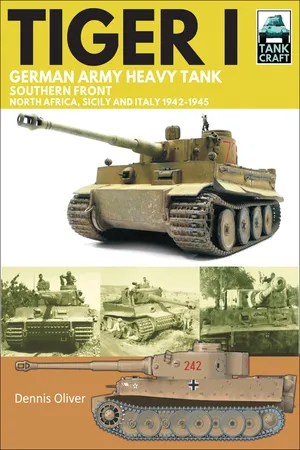
eBook - ePub
Tiger I
German Army Heavy Tank, Southern Front, North Africa, Sicily and Italy, 1942–1945
- 64 pages
- English
- ePUB (mobile friendly)
- Available on iOS & Android
eBook - ePub
Tiger I
German Army Heavy Tank, Southern Front, North Africa, Sicily and Italy, 1942–1945
About this book
Trusted by 375,005 students
Access to over 1.5 million titles for a fair monthly price.
Study more efficiently using our study tools.
Information
THE ITALIAN CAMPAIGN
THE ITALIAN CAMPAIGN. 1943-1945.

The main map shows Italy north of Salerno, which was the site of the joint British and American assault of 9 September 1943. The successive defensive lines, beginning with the Volturno Line north of Naples, are shown as semi-broken lines and in most cases they are referred to by their anglicised names. Note that the Gothic Line, the scene of some of the bitterest fighting of the campaign, is actually made up of two distinct defensive lines named Green I and Green II. The smaller map at left shows the area south of Salerno and the Calabrian coast where the British and Canadian landings took place from 3 September 1943. In northern Italy the OZAK (Operationszone Adriatisches Kustenland) and OZAV (Operationszone Alpenvorland) were German military zones set up after the Italian surrender. The Italian Social Republic (RSI) was created on 23 September 1943 with Mussolini at its head and was nominally in control of the area north of Cassino. Its troops, however, fought under German command and from late November 1943 the defence of Italy was coordinated by the commander of Heeresgruppe C under the newly-created Oberbefehlshaber Sudwest with Generalfeldmarschall Kesselring filling both roles.
When the Allies crossed the Straits of Messina and landed along the Calabrian coast on 3 September 1943, German units stationed in Italy were technically under the command of the Commando Supremo, the Italian high command, as they had been at the beginning of the fighting in Sicily. Any confusion was, however, laid to rest when the Italian government announced its surrender on 8 September and the Germans quickly moved to disarm their former allies. The main purpose of the landings in Calabria had been to distract the attention of the German commanders while another landing took place further north. However, they were not to be so easily deceived and Generalfeldmarschall Kesselring, who had been appointed to command all German military units in the Mediterranean, held back LXXVI.Panzerkorps, his mobile reserve, correctly predicting that the main Allied effort would come further north, at Salerno or Naples. The British and Canadians in Calabria would be held up by a single regiment, battling their way north as the Germans destroyed the roads and bridges behind them, falling back to the next defensive position. The struggle in Italy would conform to this pattern until the end of the war.
3 September 1943. British and Canadian troops land at Reggio Calabria against almost no opposition as the new Italian government signs a secret armistice with the Allies. Generalfeldmarschall Kesselring correctly predicts that the main landing will be made at Salerno, south of Naples.
5 September 1943. British units advance inland and capture Santo Stefano.
6 September 1943. German units of LXXVI. Panzerkorps begin falling back toward Castrovillari in anticipation of a landing at Salerno.
7 September 1943. Kampfgruppe Kruger, made up from Panzergrenadier-Regiment 71 and parts of Panzer-Aufklärungs-Abteilung 129, both from 29.Panzergrenadler-Division, holds up the British and Canadian advance.
8 September 1943. The Italian governmentformally announces the country’s unconditional surrender. German units move immediately to take control of the Italian occupation zones in the Balkans and southern France and to disarm Italian forces in Italy.
9 September 1943. Allied troops land at Salerno south of Naples. Within hours the tanks of 16. Panzer-Division conduct a counterattack which is only beaten back by naval gunfire. A number of clashes take place between Italian civilians and German troops, most notably in Naples.
10 September 1943. German Fallschirmjäger, supported by the armour of 26. Panzer-Division and 3.Panzergrenadler-Division, complete the occupation of Rome and the surrounding area.
11 September 1943. To the south the British secure Brindisi and Bari.
12 September 1943. Inexplicably the British advance is halted for 48 hours. At Salerno the Germans continue their counterattacks against the Allied position, pushing US units back toward the beach and re-capturing Altavilla on the northern edge of the perimeter. Fearing the worse. Allied commanders begin to prepare evacuation plans.
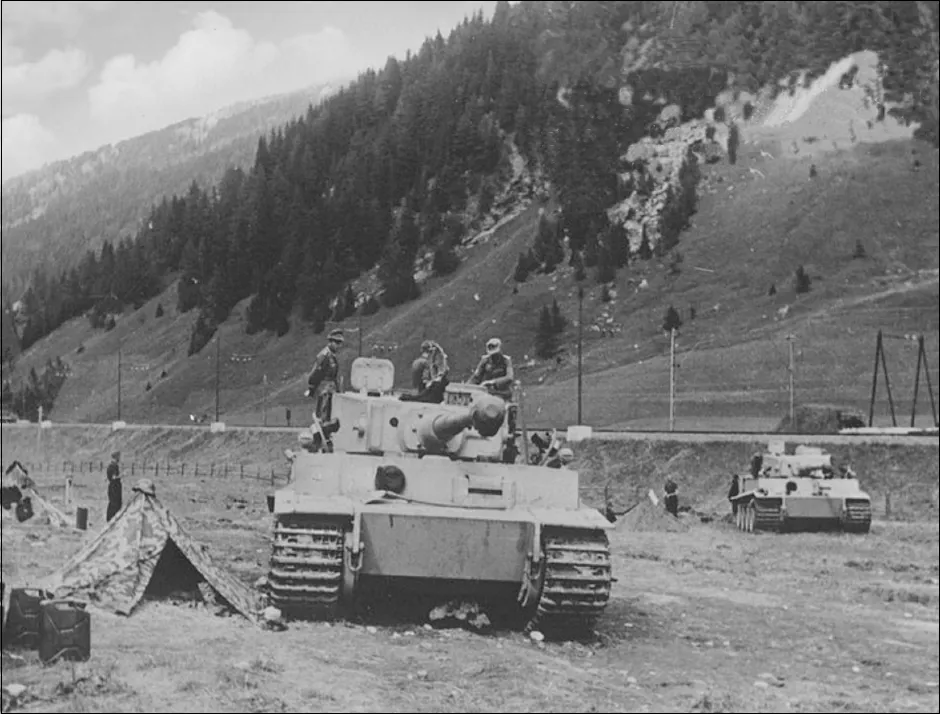
Photographed just north of the village of Brenner in Austria near the Italian border these early production Tigers are two of the tanks of schwere Panzer-Kompanie Meyer. These vehicles travelled as far 05 Innsbruck by rail, some 30 kilometres north of Brenner, suggesting that this image may have been taken on 1 August 1943. The tank in the foreground is almost certainly the Tiger commanded by Leutnant Meyer.
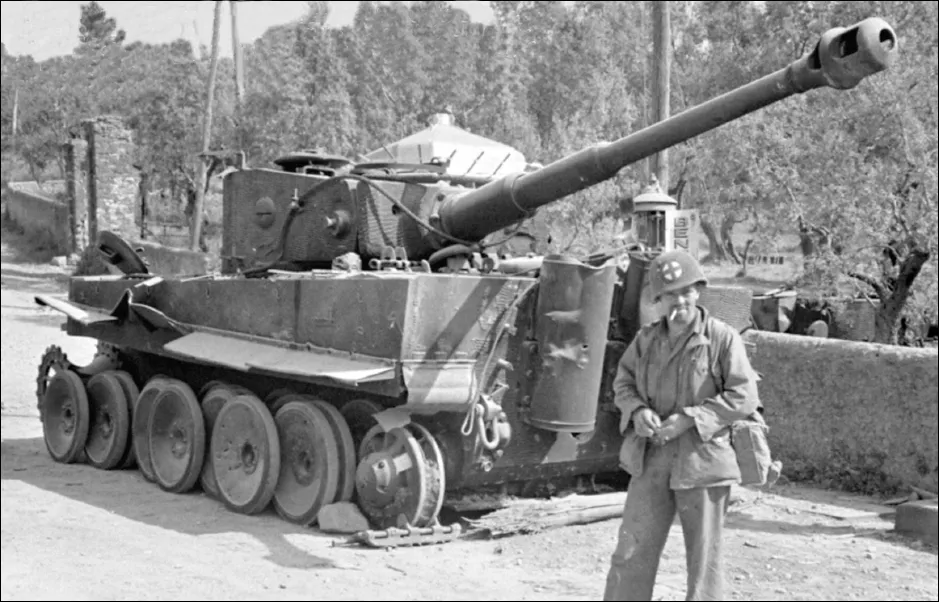
Photographed at Cori, a small town east of Rome, on 31 May 1944 this tank is oneof seven Tigers destroyed here by their own crews due to a lack of fuel. Just visible is the insulator for the radio aerial on the turret side towards the front identifying this as one of the 3.Kompanie tanks equipped to control the Borgward BIV demolition vehicles.
13 September 1943. An assault by elements of 16.Panzer-Division and 29.Panzergrenadier-Division at Salerno almost reaches the Invasion beaches.
14 September 1943. American paratroopers are dropped behind the German lines In an attempt to relieve the pressure on Salerno. Although the Germans continue to attack the beachheads, naval gunfire and aerial bombardment give the Allies a decisive advantage.
17 September 1943. British units link up with US troops near Salerno. Generalfeldmarschall Kesselring orders the units around Salerno to break off the counteroffensive and form a defensive line. Hitler, influenced by Rommel, informs Kesselring that the real defence of Italy will take place north of Rome.
23 September 1943. The area commander of Naples, Oberst Walter Scholl, orders the complete evacuation of the city, sparking widespread demonstrations which quickly develop into armed insurrection.
27 September 1943. British units capture the large airfield complex near Foggia on the east coast.
28 September 1943. US Army troops capture Avellino as the fighting within Naples intensifies.
29 September 1943. As Allied troops enter Pompeii, less than 20 kilometres from Naples, Oberst Scholl enters into negotiations with the Italian resistance fighters.
30 September 1943. German troops begin evacuating Naples while the fighting continues.
1 October 1943. The first Allied troops enter Naples to find Italian resistance fighters in control of the city. The city’s port facilities, and hence its strategic importance, have been comprehensively destroyed by the Germans.
3 October 1943. British troops cross the Biferno River near Termoli and set up defensive positions. Within 24 hours the bridgehead is under attack by the tanks of 16. Panzer-Division.
5 October 1943. A further assault by 16.Panzer-Division at the Biferno bridgehead is only repulsed by the timely arrival of Canadian and British tanks.
6 October 1943. The Americans capture Capua and Caserta as another unsuccessful attempt is made by 16.Panzer-Division to destroy the Biferno bridgehead.
7 October 1943. American troops reach the Volturno River but come up against the strong German defensive position there.
12 October 1943. A second American assault along the Volturno convinces Generalfeldmarschall Kesselring to withdraw his forces to the fortifications of the Barbara Line which run from the mouth of the Trigno River on the east coast to the area around Mondragone in the west.
13 October 1943. As the Americans cross the Volturno, Italy declares war on Germany.
5 November 1943. The British reach the entrance to the Liri valley and begin an assault on the German positions on Monte Camino.
15 November 1943. With the British stalled at Monte Camino the American advance is also brought to a halt. The German military commander in Milan declares a state of emergency in ...
Table of contents
- Cover
- Title
- Copyright
- Contents
- Introduction
- The Tunisian Bridgehead
- The Defence of Sicily
- The Italian Campaign
- Camouflage & Markings
- Model Showcase
- Modelling Products
- The Tiger Units
- Technical Details and Modifications
- Panzer Colours
- Product Contact Details
Frequently asked questions
Yes, you can cancel anytime from the Subscription tab in your account settings on the Perlego website. Your subscription will stay active until the end of your current billing period. Learn how to cancel your subscription
No, books cannot be downloaded as external files, such as PDFs, for use outside of Perlego. However, you can download books within the Perlego app for offline reading on mobile or tablet. Learn how to download books offline
Perlego offers two plans: Essential and Complete
- Essential is ideal for learners and professionals who enjoy exploring a wide range of subjects. Access the Essential Library with 800,000+ trusted titles and best-sellers across business, personal growth, and the humanities. Includes unlimited reading time and Standard Read Aloud voice.
- Complete: Perfect for advanced learners and researchers needing full, unrestricted access. Unlock 1.5M+ books across hundreds of subjects, including academic and specialized titles. The Complete Plan also includes advanced features like Premium Read Aloud and Research Assistant.
We are an online textbook subscription service, where you can get access to an entire online library for less than the price of a single book per month. With over 1.5 million books across 990+ topics, we’ve got you covered! Learn about our mission
Look out for the read-aloud symbol on your next book to see if you can listen to it. The read-aloud tool reads text aloud for you, highlighting the text as it is being read. You can pause it, speed it up and slow it down. Learn more about Read Aloud
Yes! You can use the Perlego app on both iOS and Android devices to read anytime, anywhere — even offline. Perfect for commutes or when you’re on the go.
Please note we cannot support devices running on iOS 13 and Android 7 or earlier. Learn more about using the app
Please note we cannot support devices running on iOS 13 and Android 7 or earlier. Learn more about using the app
Yes, you can access Tiger I by Dennis Oliver in PDF and/or ePUB format, as well as other popular books in History & World War II. We have over 1.5 million books available in our catalogue for you to explore.