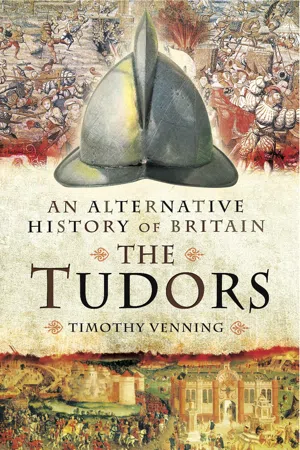
A renowned historian examines some of the most crucial junctions of fifteenth- and sixteenth-century Britain—and how they could have gone differently.
Timothy Venning's series of alternative histories explores the pathways of British events from the Anglo-Saxon Age to the English Civil War. In this volume, he presents an in-depth analysis of the Tudor period. As always, Venning discusses the fateful moments at which History could easily have taken a different turn.
In a fascinating series of "what if" scenarios, Venning presens a detailed look at the possible and likely results. While necessarily speculative, the scenarios are all highly plausible and rooted in a firm understanding of actually events and their context. In so doing, Venning gives the reader a clearer understanding of the factors at play and why things happened the way they did, as well as a tantalizing view of what might have been.
Key questions discussed in this volume include:
Did the pretenders Lambert Simnel and Perkin Warbeck ever have a realistic chance of a successful invasion/coup?
If Henry Fitzroy, Henry VIIIs illegitimate son, had not died young, might he have been a suitable King?
What if Edward VI had not died at fifteen but reigned into the 1560s and 70s?
How might the Spanish Armada have succeeded in landing an army in England, and with what likely outcome?
- 234 pages
- English
- ePUB (mobile friendly)
- Available on iOS & Android
eBook - ePub
About this book
Information
Chapter One
What if the early Tudors had not had such dynastic bad luck?
Politics, biology, and chance from 1485 to 1547
Prince Arthur, 1502: the second loss of a potential ‘King Arthur II’
Amultitude of healthy, competing adult royal sons had its own political problems for a dynasty, as seen by the struggles among Edward III’s sons and grandsons in the latter years of his reign and after his death. Edward IV’s two brothers were a perennial problem once they were adult, one assisting his overthrow and both threatening the rights of his sons to succeed. Henry VII’s relatively small family did not immediately present problems for the succession. He and Elizabeth of York had had three sons, of whom one (Edmund, born 1499) died as an infant – as had Edward IV’s third son, George. But his eldest son, Arthur, died young at fifteen in April 1502, a few months after his marriage to Catherine of Aragon. The Prince of Wales was apparently delicate, and was less robust-looking than his surviving brother, Henry; it is uncertain if his health was the real reason for the delay in his marriage or in his being kept at court and not sent off to preside over the Council of the Marches at Ludlow as early as his predecessor Edward V had been.1 Edward had left court at three; Arthur left at six; the next Prince(ss), Mary, left for Ludlow at eleven.
Arthur’s sudden death – whether or not of the tubercular tendency that threatened generations of Tudors and accounted for both Henry VIII’s sons in their teens – was unexpected and followed within months of his marriage, leaving the King with one son. (Even if the King’s third son, Edmund, born in 1499, had lived he would have been too young to be of use for many years.) The obscure ‘sweating sickness’ that accounted for Arthur, involving a high temperature and kidney failure, may have been fatally exacerbated by a weak constitution and his decline took weeks;2 straightforward epidemics’ victims usually died quicker. It had possibly been spread from the town of Ludlow into the adjacent castle, and as such the King’s decision to place Arthur’s household there and not in a more isolated location may have made contagion easier. (His other main residence in the region was a hunting-lodge at Tickhill outside Bewdley by the Severn, which was possibly safer.) But a traveller from an infected location could put any household at risk; a prince’s household would necessarily interact with local employees and travellers, and the heir would be expected to show himself to his people and attend public occasions. (Arthur’s brother Henry VIII would keep moving from house to house to try to stay ahead of infection in other epidemics, e.g. that of 1528.) But for the Prince’s demise, the putative ‘Arthur II’ – the second heir called Arthur to die young, the first having been Richard I’s superseded and murdered nephew in 1203 – would have succeeded at the age of twenty-two in April 1509, with no legal question about his marriage to Catherine of Aragon. A less dominant personality than his younger brother, who even aged eight was impressing the visiting scholar Erasmus in the royal nursery,3 he was likelier to have ruled in the more cautious mould of his father. This need not have led to avoidance of bold foreign policy-decisions such as the French war of 1512–13, where the vigorous Henry VIII was apparently restless to emulate Henry V in conquering France and led his troops in person, and his health might have permitted a French expedition on the cautious lines of his father’s invasion of France in 1492. The circumstances of Franco-Spanish/Habsburg rivalry in the 1510s would have been the same for Arthur as for Henry. But Henry was to be well-known for handing the minutiae of political and administrative business over to his ministers in the first two decades of his reign, in which Thomas Wolsey proved to be his indispensable man of business. Henry was more conscientious than has been allowed for in myth, and Wolsey anticipated rather than pre-empted his decisions; his skill lay in relieving the King of tedious business without seeming to encroach on his prerogative. Henry VII’s leading clerical adviser, Bishop Fox, was ageing by 1509, and Fox’s protégé Wolsey might well have made himself indispensible to Arthur too. But Arthur would probably have spent less time and energy on physical sports, with there being no evidence that (health aside) he was at all interested in hunting or the tournament by the age of fifteen. A more sedentary and bookish ruler was more likely to have been involved in Council work in his twenties to a degree that Henry was not, with a lesser chance that quantities of business would be delegated to one minister. Certainly Arthur is unlikely to have been as shameless as Henry, already an idiosyncratic and ruthless personality, in sacrificing his father’s ministers Empson and Dudley to the wrath of the ‘higher-born’ peers from whom they had been extorting money on Henry VII’s behalf.
It is still possible that Arthur would have died young and Henry succeeded to the throne in his twenties, probably with a wife provided for him by the Habsburg/Spanish alliance of 1506–13 (perhaps one of Charles V’s sisters). Arthur and Catherine might have had a son after 1502, when Catherine was seventeen; by the time she was married off to Henry in real life she was nearly twenty-four and had been harming her health with religious austerities as a widow,4 living on reduced expenses while Henry VII and her father, Ferdinand, haggled over her dowry. Would years of satisfactory marriage to Arthur instead of widowhood cooped up at Durham House made her more fertile? Henry could then have been regent for an under-age nephew or niece, born in the 1500s, if Arthur died relatively young in c.1510–25. Alternatively, Henry VII (born in 1457) could have outlived Arthur and reached something like the age of his uncle Jasper Tudor, who died in his early sixties in 1495.5
Henry’s decline in health does not seem to have been noticeable until 1508, except for one serious illness in 1503; however it seems that he was withdrawing more into his ‘inner chambers’ and access to him was controlled by men such as Empson and Dudley, which may imply that he was losing his confidence.6 But if Henry had had a semi-adult and serious Arthur available for support, not the (five years) younger and joust-loving Prince Henry, could he have started to induct his heir into administration by the mid-late 1500s? Or would the emergence of the Prince have led to courtiers opposed to the ‘low-born’ favourites turning to him to try to influence the King?
The trend in international politics by 1509 was for the consolidation of the Tudor alliance with Ferdinand of Aragon (regent of Castile) and Emperor Maximilian against Louis XII of France, with the two rulers’ joint heir Charles (Emperor Charles V) as destined husband of Henry VII’s daughter, Mary; this was likely to have continued whether Henry VII or Arthur was king in the years after 1509. In that case, the marriage of Prince Henry to a Habsburg princess was the next logical dynastic move. Assuming Henry VIII and his Habsburg wife to have been less unlucky in childbirth than Catherine of Aragon, who would have stayed as Arthur’s queen, and Catherine to have had no luck by Arthur either, Henry VIII might still have been king after Arthur c.1515–20 and had no difficulties over the lack of a male heir in the 1520s.
The rocky road to the marriage of Henry VIII and Catherine of Aragon: could it have been abandoned?
The marriage of Henry VIII to a wife six years his senior was ultimately the result of the political situation of England after 1485, where his father had been courting the alliance of her parents Ferdinand and Isabella. What were the alternative sources of a wife for his brother Arthur – and thus him – in the 1490s? No English alliance with their long-term foe France was secure, given the competition between the two mistrustful powers over the lost English domains in France and the surviving claim of the English sovereigns to the throne of France, which Henry V had successfully revived in 1415–22. Charles VIII’s regency had backed Henry Tudor against Richard III in 1484–5, giving him sanctuary and troops when he had to flee from Brittany; but it was normal French policy to stir up trouble against a strong and militaristic English king who might invade. Louis XI had backed the refugee Queen Margaret of Anjou (a Frenchwoman, and Louis’ cousin) against Edward IV in the 1460s, and Richard III was a threat to France as he had strongly opposed Edward’s abandonment of the invasion of France when Louis bought him off at Picquigny in 1475.
Once Henry was king, he was as much of a threat to France as Edward and Richard had been and in 1488 the Anglo-French détente collapsed over Henry unsuccessfully endeavouring to save the independence of Brittany from a French invasion; in 1492 Henry invaded France like Edward had done. In any case, after peace was insecurely restored between the two countries the young French King (born 1470 and just married to the Breton heiress Anne) had no children and had no available sisters of the right age to marry Henry’s sons. An Anglo-Habsburg alliance was also out of the question, as in the 1490s the new Emperor Maximilian was backing the claim of ‘Perkin Warbeck’ to the English throne – and the pretender was induced to name Maximilian as his heir in return. The new Emperor’s stepmother-in-law, Margaret, Duchess of Burgundy, was Richard III’s sister and thus supported both ‘Simnel’ and ‘Warbeck’. In any case, England was seen as of marginal importance by the Empire and Maximilian was to betroth the only available princess of the 1490s, his daughter Margaret (born 1480), to Ferdinand and Isabella’s son Juan. Closer to home, the end of the Anglo-Scottish confrontation of 1496 (when James IV invaded England on behalf of ‘Warbeck’) led to James’ marriage in 1503 to Henry’s eldest daughter, Margaret, but there were no princesses available to marry Princes Arthur or Henry in return. The Anglo-Spanish match was thus the only logical and prestigious alliance with a ‘Great Power’ available in the 1490s, and even so was long delayed – probably due to Catherine’s parents’ doubts over Henry’s ability to survive as king, given the chronic instability in England, which showed no signs of subsiding. Catherine was only sent to England in 1501, and even then Henry had insecurities over the reason for her escort insisting on her remaining secluded from view during her journey across England – was she offputtingly ugly? – and insisted on being able to view her for himself in a confrontation with her courtiers at Dogmersfield Park, Hampshire.7
When Henry VIII finally married Catherine in his brother’s place time was against the production of a large family, given that she was already nearly twenty-four and six years his senior. It was the delicate state of international relations, with Henry VII needing to keep up his prestigious alliance with Catherine’s parents Ferdinand and Isabella, which meant that once Arthur was dead the idea was floated that the new Prince of Wales should marry his brother’s widow rather than Henry sending her home. The possible legal excuse to invalidate the potential marriage to a brother’s widow under canon law did not stand in the way of the new marriage-treaty for their union of June 1503 – possibly the lure of a second dowry encouraged the avaricious Henry VII to agree. Crucially, Catherine had no younger sisters nearer Prince Henry’s age who could have married him – thus preserving the hard-won Anglo-Spanish alliance – and remained fertile for longer than Catherine did. This would have been a legally safer course, had it been available. But marrying the Prince to his brother’s widow required complex legal manoeuvres, and the evidence of Catherine’s lady-in-waiting Dona Elvira that her marriage to Arthur had not been consummated – thus making the first marriage legally questionable and the second easier – was not accepted.8 This would also have meant that Catherine was not legally Princess of Wales and so saved Henry VII from paying her an appropriately large allowance. Nevertheless, despite accepting the legality of the Arthur–Catherine union he tried to save himself the money anyway at one point – out of miserliness or as a legal manoeuvre?
The form of legal application to the Pope for a dispensation for the Henry/Catherine union was that which accepted that a forbidden relationship already existed between them. The reason for Henry VII and the Spanish ambassador De Puebla, acting for Ferdinand and Isabella, taking this course instead of presenting evidence that Arthur and Catherine had never consummated the marriage is unclear. Catherine was to claim in 1527 that the marriage had never been consummated, as did her lady-in-waiting Dona Elvira, and they were the likeliest to know; and in 1533 Henry was supposed to have told imperial ambassador Chapuys that his wife had been a virgin. (He later claimed it had been a joke.9) The probability is that both parties knew that the marriage might have been consummated. But in 1505 – the point at which the 1503 treaty provided for Prince Henry, now fourteen, to marry Catherine – he was required to formally announce his opposition to marrying her. This was presumably part of his father’s complex international diplomacy and a means of putting pressure on Ferdinand, and this and the resulting four-year delay in the marriage provided the Prince with a valid excuse to back out of the contract once he succeeded to the throne and could do as he wished.
In October 1505 Pope Julius granted legal backing to the Prince so he could restrain his ‘wife’ from excessive religious practices – probably obsessive fasting – that were potentially damaging to her health; this must have resulted from a formal request made by the Prince at his father’s behest and implies that at this point they considered the union of Henry and Catherine as valid and worth preserving.10 If they were not going to marry, why worry over her potential fertility? Even if the device of a formal appeal to the Pope – accepting that Catherine was the Prince’s wife, as without that he and his father had no right to interfere with her behaviour – was necessary to secure the devout Catherine’s submission, it shows that the King valued her (politically) as his son’s potential queen and cared to save her health.
But the King and the latter’s ministers meanwhile considered an alternative candidate for the Prince’s hand, a Habsburg offer of either Maximilian’s eldest grand-daughter Eleanor – which would require a delay as she was younger than Prince Henry – or a Bavarian princess. (Eleanor would thus have been a prime candidate to marry Henry in the later 1500s had Arthur survived.) Catherine remained isolated, short of money, and in ill-health at her ‘dower’ residence in London, Durham House, through 1503–9 and in 1507 the new Spanish ambassador Fuensalida reckoned her chances of marrying Henry minimal and sought to extricate her with as much of her dowry as he could prise back from Henry VII.11 The King even arranged for his son to read out a formal renunciation of his desire for the marriage to chosen councillors on 27 June 1505, the eve of his fourteenth birthday when he would be eligible to marry her. This was done in private at Richmond Palace and witness (and probable organizer) Bishop Fox, a skilled canon lawyer, told the 1527–8 divorce proceedings that it had been done as the King was furious with Catherine’s father for not paying the dowry.12 It was not acted upon, but was obviously arranged so that the marriage could thenceforth be cancelled at short notice citing this document as evidence for the bridegroom being unwilling – and the latter could have used it himself to call off the marriage in 1509 if he had so desired.
The picture of an indifferent if not hostile Henry VII holding up the marriage indefinitely was strengthened by Catherine’s own panicky letters to Ferdinand about her desperate situation, which have been cited as ‘prima facie’ evidence. By 1507 she was allegedly short of adequate clothing for her servants, forced to sell off her silver plate to pay them and keep up a semblance of dignity, and had not seen her betrothed for months, although they lived in the same royal household. The King treated her with polite lack of interest, though he was willing to wait patiently for Ferdinand to pay up.13 She even wrote to her sister Juana to encourage her to stop vowing never to marry again and to marry Henry VII, hoping to win the King’s goodwill that way.14 (Her pleas were practically irrelevant, as even if the emotionally unbalanced Juana had changed her mind Ferdinand is highly unlikely to have let her do so.) By early 1509 Henry was even refusing to admit Catherine to his sickbed and her complaints about lack of money and royal indifference led her to think that she might have to give up and leave England after all15 – but this situation may have been due to the new problem of the King’s steepening physical decline.
Arguably, given Henry VII’s cool attitude towards the marriage by 1505–7 and the rising eligibility of Princess Eleanor as she grew older the King’s better health in 1505–9 and survival after April 1509 would have increased the chances of marrying off the Prince to the Habsburg alternative. Anger at Ferdinand’s refusal to let him marry Juana, a solution on which he was keen in 1507,16 could have pushed him into action. This would have been a viable diplomatic alternative to securing a Spanish alliance for a new war with France, and would have tied in with the December 1508 (abortive) betrothal of Henry VII’s younger surviving daughter Mary Tudor to Maximilian’s grandson and heir Charles.17 (The latter was five years Mary’s junior, and was in fact to marry into the Portuguese royal family as his Castilian forebears often had done.) Had this marriage been followed through Mary would have been Charles’ Queen of Spain as of 1516 and Empress as of 1519, and Henry VIII would have been left with two sisters married out of the realm instead of one when he came to draw up his will in 1543. Mary’s children by the Emperor, like Margaret Tudor’s children by her Scots husbands, would not have been born in England and thus unquestionably eligible for the English throne. The Tudor succession-problems of the 1540s–1550s would have been even more complicated, unless Henry VII’s youngest daughter, Catherine (born 1503) had survived infancy and been given an English husband. But would a son of Mary Tudor and Charles of Habsburg been a potential candidate to marry his first cousin, Henry VIII’s daughter Mary, instead of her actual husband Philip (born 1527), the real-life son of Charles and his Portuguese wife Isabella? If Mary and Charles had two sons, the younger could marry the Princess without the danger (in 1554) of unifying England and Spain.
Fuensalida did not see any signs of pro-Spanish advice among the King’s ministers as of 1507 and was apparently very surprised to be informed that Henry VIII would marry Catherine after all on the new sovereign’s accession.18 What had been going on in the new King’s mind as he waited for his father to make his mind up in 1505–9 is unknowable, but perhaps he was genuinely attracted to Catherine as a ‘princess in distress’ awaiting rescue by him. It would have fitted in with the Arthurian romances that were...
Table of contents
- Cover
- Title Page
- Copyright
- Contents
- Chapter 1: What if the early Tudors had not had such dynastic bad luck?
- Chapter 2: Early Tudor dynastic bad luck
- Chapter 3: What if Henry VIII had been killed in the near-fatal tiltyard accident of January 1536?
- Chapter 4: Other possibilities to be considered for Henry VIII’s reign – three queens survive for longer, or a different queen in 1538/40
- Chapter 5: What if Edward VI had not died at fifteen in 1553, and the ‘Edwardian Reformation’ was not halted by Mary I?
- Chapter 6: What if Jane Grey had been successfully installed in power in July 1553?
- Chapter 7: Late Tudor ‘what ifs’
- Chapter 8: 1588: a close-run thing? The Spanish Armada – could it have landed successfully, and what then?
- Notes
- Bibliography
Trusted by 375,005 students
Access to over 1.5 million titles for a fair monthly price.
Study more efficiently using our study tools.
Frequently asked questions
Yes, you can cancel anytime from the Subscription tab in your account settings on the Perlego website. Your subscription will stay active until the end of your current billing period. Learn how to cancel your subscription
No, books cannot be downloaded as external files, such as PDFs, for use outside of Perlego. However, you can download books within the Perlego app for offline reading on mobile or tablet. Learn how to download books offline
Perlego offers two plans: Essential and Complete
- Essential is ideal for learners and professionals who enjoy exploring a wide range of subjects. Access the Essential Library with 800,000+ trusted titles and best-sellers across business, personal growth, and the humanities. Includes unlimited reading time and Standard Read Aloud voice.
- Complete: Perfect for advanced learners and researchers needing full, unrestricted access. Unlock 1.5M+ books across hundreds of subjects, including academic and specialized titles. The Complete Plan also includes advanced features like Premium Read Aloud and Research Assistant.
We are an online textbook subscription service, where you can get access to an entire online library for less than the price of a single book per month. With over 1.5 million books across 990+ topics, we’ve got you covered! Learn about our mission
Look out for the read-aloud symbol on your next book to see if you can listen to it. The read-aloud tool reads text aloud for you, highlighting the text as it is being read. You can pause it, speed it up and slow it down. Learn more about Read Aloud
Yes! You can use the Perlego app on both iOS and Android devices to read anytime, anywhere — even offline. Perfect for commutes or when you’re on the go.
Please note we cannot support devices running on iOS 13 and Android 7 or earlier. Learn more about using the app
Please note we cannot support devices running on iOS 13 and Android 7 or earlier. Learn more about using the app
Yes, you can access The Tudors by Timothy Venning in PDF and/or ePUB format, as well as other popular books in History & Ancient History. We have over 1.5 million books available in our catalogue for you to explore.