- 120 pages
- English
- ePUB (mobile friendly)
- Available on iOS & Android
eBook - ePub
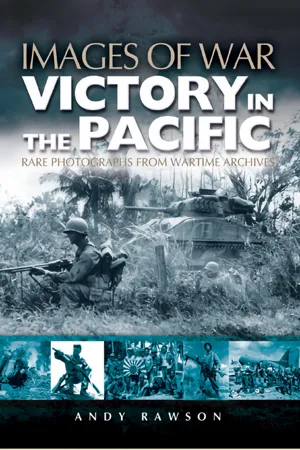
Victory in the Pacific
About this book
"By Spring 1945, while the war in Europe was coming to a close, in the Pacific there was no end to hostilities in sight. The Japanese, albeit retreating, defended every outpost and island with fanatical determination and all the indications were that Japan would have to be invaded at a terrible cost. The two atomic bombs at Hiroshima and Nagasaki changed this and the world forever.Victory in the Pacific tells the story of the last six months of the war against Japan in the Pacific, the Philippines, Burma and China in words and pictures, culminating in the Atom Bomb raids and the occupation of Japan."
Information
Chapter One
Burma and China
The Japanese attempt to take Imphal, the gateway to India, had stalled at Kohima in the spring monsoons of 1944. General William Slim’s Burma Corps, composed of British and Indian troops, held back General Mutaguchi’s divisions in fierce fighting and by July the Japanese had to fall back starving and low on ammunition.
British Fourteenth Army followed through the rain soaked jungle and crossed the Chindwin at the end of November but Vice-Admiral Lord Louis Mountbatten, the commanding officer of South East Asia, was forced to divert troops and supplies elsewhere, allowing the Japanese to withdraw across the Shwebo Plain and behind the Irrawaddy River under their new commander General Hyotaro Kimura.
With only four infantry divisions, two tank brigades and a minimum of air support under his command, Slim opted to make a feint crossing near Mandalay while IV Corps attacked at Nyaungu, 100 miles downstream. During the early hours of 14 February the Japanese were alerted as the leading wave sailed across the wide river and the British and Ghurkha troops suffered heavy losses. Tanks gave covering fire at first light and Indian troops crossed to secure a slender hold on the far bank. With a bridgehead secured, IV Corps could advance across the Burma Plain to Meiktila, the Japanese communications centre in Burma.
Fighting side-by-side, the British and Indian soldiers encountered fanatical, and at times suicidal, resistance but still entered the town on 6 March, forcing the majority of the garrison to retire while a rearguard held on, at the ancient Fort Dufferin until the 21st, and only surrendered after bombers had blasted holes in the fortifications. With the monsoon season about to begin, Slim ordered XXXIII Corps to focus the Japanese attention along the Irrawaddy River as IV Corps advanced on a narrow front down the Sittang River. It was a risky operation but the gamble paid off and by 23 April they had advanced over 300 miles, capturing Toungoo as Tokyo ordered a general withdrawal to the coast in response to American successes in the Pacific.
While IV Corps struck deep into the heart of Burma, XV Corps had progressed with Operation DRACULA, a series of amphibious landings along the west coast. An attack on the Arakan area in December 1944 had been followed by the capture of the port facilities at Akyab and the airfields on Ramree Island a month later. By the end of April Slim was ready to launch the final attack against Rangoon, and on 2 May, Indian paratroopers landed south of the city while 26th Indian Division came ashore on both sides of the Rangoon River. The city was deserted; the Japanese had withdrawn and the local population turned out in force to cheer the Indian troops as they moved into the heart of the city.
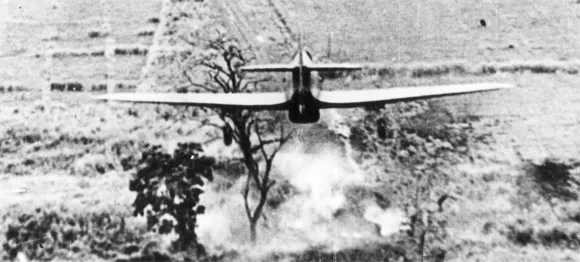
The Allied Air Forces relentlessly pounded the Japanese supply lines, targeting bridges, roads and camps as they fell back towards the Chinwin River. This RAF Hurri-bomber is making a low level bombing run against a bridge on the Tiddim Road.
600,000 men of General Kimura’s army had withdrawn across the Sittang River into the flooded paddy fields and grasslands along the Thailand border. Starving and low on ammunition they fought on until they were killed or died from malnutrition or disease. Finally, on 4 August, Mountbatten was able to announce that Japanese resistance had ended, drawing to a close the bitter campaign in the mountains and jungles of Burma.
While General Slim fought with the Fifteenth Army in Burma, Generalissimo Chiang Kai-shek and his American adviser, General Vinegar Joe Stilwell, were trying to stem Japanese ambitions in China. Despite Stilwell’s advice and American aid, the Chinese divisions were poorly trained and the Japanese spring offensive of 1944, Operation ICHI-GO, had easily overrun the Peking-Canton railway. Only the monsoons saved General Chiang’s men and by the autumn the Japanese had exhausted their supplies near their final objective, the American airfields around Chungking.
In China’s Yunnan province, twelve inadequately equipped divisions of China’s Y-Force had been on the counter-offensive since May but had made little headway against the organised Japanese. Although disorganized, Chinese troops supported, by the Fourteenth US Air Force, engaged a million Japanese soldiers, losing over 700,000 casualties as they halted their offensives at Lungchow and along the Canton-Hengchow railway.
When General Albert Wedemeyer replaced Stilwell in October 1944, American and Chinese relations started to improve and Chiang Kai-shek agreed to stop relying on the American bombers and rebuild his army so he could start to fight back. The new alliance worked and as Y-Force advanced beyond Tengyueh and Lungling, the Chinese conscripts began to drive back the Japanese.
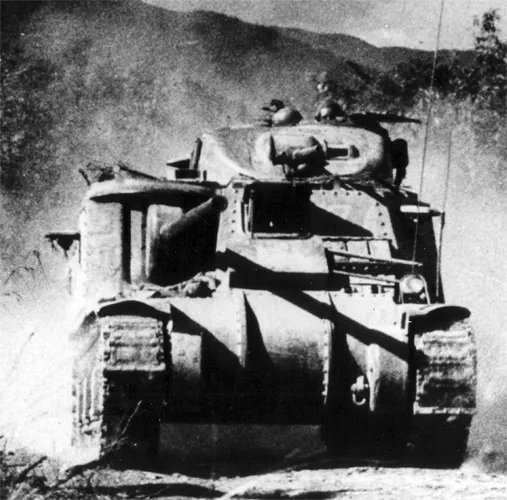
After being on the defensive for over three years, at long last the British Fourteenth Army could go on the offensive. This Lee-Grant tank assisted 5th Indian Division during the attack on the Japanese positions around Tiddim.
January 1945 was an important turning point in China as Chiang’s two Armies met and the first convoy drove along the Ledo Road. Work had started on the supply route as early as December 1942 and for two years 80,000 American engineers and Chinese labourers battled the weather and terrain to push a single-track road over mountains, through jungles and along narrow gorges. The British thought it was a folly as the lorries would consume vital fuel to carry the supplies but General Stilwell was anxious to appease the Chinese and a 1,800-mile long fuel pipeline connecting Calcutta and Kunming alleviated the problem. The material effect might have been questionable but the boost to Chinese morale was incalculable. Although Chiang had never seen eye-to-eye with Stilwell, he named the road in honour of his vitriolic advisor.
A final Japanese attack in March 1945 captured the American air base at Laohokow but an attempt to capture the air base at Chihkiang failed: it was the first Japanese setback. The Chinese struck back, driving their exhausted and starving enemy before them. On 9 May, as the Soviet Union prepared to declare war,Tokyo withdrew troops to defend Manchuria, bringing the fighting in south China to an end.
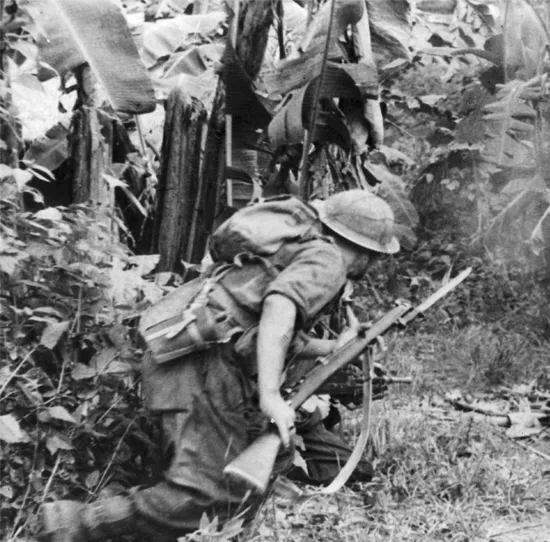
Although starving and low on ammunition, the Japanese soldiers fought on in the swamps and jungles of Northern Burma. This British patrol is taking no chances as it moves cautiously through a banana grove on the look out for snipers.
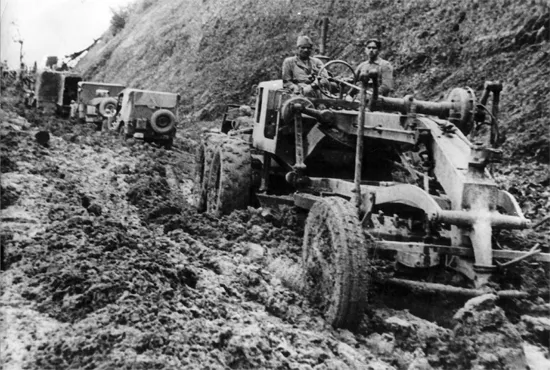
The monsoons turned the jungle tracks into quagmires, strangling Lieutenant-General Slim’s supply lines as his men tried to follow up the Japanese retreat across Burma. These Bengali engineers are struggling to keep traffic moving along the Palel-Tamu road.
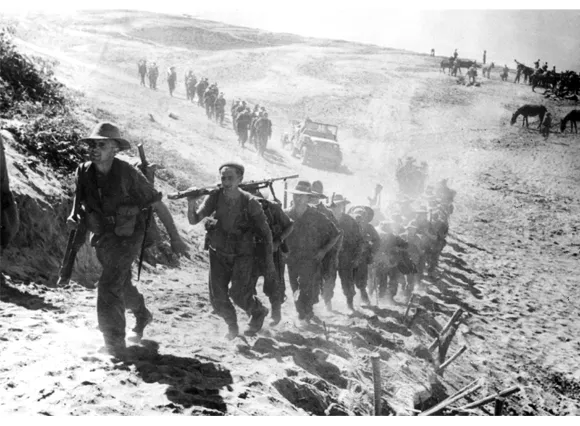
IV Corps finally crossed the Chindwin R...
Table of contents
- Cover Page
- Title Page
- Copyright Page
- Contents
- Introduction
- Chapter One : Burma and China
- Chapter Two : S-Day on Luzon and the Drive to Manila
- Chapter Three : The Campaigns against Shimbu Group and Shobu Group
- Chapter Four : Clearing the Southern Philippines
- Chapter Five : D-Day on Iwo Jima and the Battle for Mount Suribachi
- Chapter Six : Fighting to the Bitter End on Iwo Jima
- Chapter Seven : L-Day on Okinawa and the Capture of Motobu Peninsula
- Chapter Eight : The Battle for the Shuri Line
- Chapter Nine : The Surrender of Japan
Trusted by 375,005 students
Access to over 1.5 million titles for a fair monthly price.
Study more efficiently using our study tools.
Frequently asked questions
Yes, you can cancel anytime from the Subscription tab in your account settings on the Perlego website. Your subscription will stay active until the end of your current billing period. Learn how to cancel your subscription
No, books cannot be downloaded as external files, such as PDFs, for use outside of Perlego. However, you can download books within the Perlego app for offline reading on mobile or tablet. Learn how to download books offline
Perlego offers two plans: Essential and Complete
- Essential is ideal for learners and professionals who enjoy exploring a wide range of subjects. Access the Essential Library with 800,000+ trusted titles and best-sellers across business, personal growth, and the humanities. Includes unlimited reading time and Standard Read Aloud voice.
- Complete: Perfect for advanced learners and researchers needing full, unrestricted access. Unlock 1.5M+ books across hundreds of subjects, including academic and specialized titles. The Complete Plan also includes advanced features like Premium Read Aloud and Research Assistant.
We are an online textbook subscription service, where you can get access to an entire online library for less than the price of a single book per month. With over 1.5 million books across 990+ topics, we’ve got you covered! Learn about our mission
Look out for the read-aloud symbol on your next book to see if you can listen to it. The read-aloud tool reads text aloud for you, highlighting the text as it is being read. You can pause it, speed it up and slow it down. Learn more about Read Aloud
Yes! You can use the Perlego app on both iOS and Android devices to read anytime, anywhere — even offline. Perfect for commutes or when you’re on the go.
Please note we cannot support devices running on iOS 13 and Android 7 or earlier. Learn more about using the app
Please note we cannot support devices running on iOS 13 and Android 7 or earlier. Learn more about using the app
Yes, you can access Victory in the Pacific by Andy Rawson in PDF and/or ePUB format, as well as other popular books in History & Asian History. We have over 1.5 million books available in our catalogue for you to explore.