- 288 pages
- English
- ePUB (mobile friendly)
- Available on iOS & Android
eBook - ePub
About this book
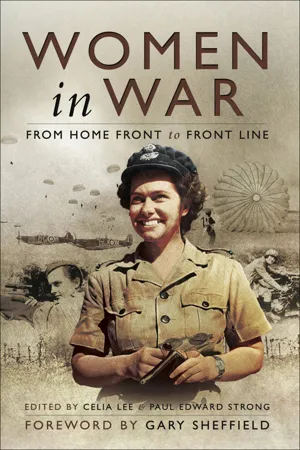
The changing role of women in warfare, a neglected aspect of military history, is the subject of this collection of perceptive, thought-provoking essays. By looking at the wide range of ways in which women have become involved in all the aspects of war, the authors open up this fascinating topic to wider understanding and debate. The discuss how, particularly in the two world wars, women have been increasingly mobilized in all the armed services, originally as support staff, then in defensive combat roles. They also consider the tragic story of women as victims of male violence, and how women have often put up a heroic resistance, and examine how women have been drawn into direct combat roles on an unprecedented level, a trend that is still controversial in the present day. The collection brings together the work of noted academics and historians with the wartime experiences of women who have remarkable personal stories to tell. The book will be a milestone in the study of the recent history of the parts women have played in the history of warfare.AuthorsDr Juliette Pattinson, Professor Mark Connelly, Georgina Natzio, Christine Halsall, Jonathan Walker, Major Imogen Corrigan, Dr. Halik Kochanski, Dr T.A. Heathcote, Elspeth Johnstone, Mike Ryan, Grace Filby, Dr George Bailey, Tatiana Roshupkina, Leicester Chilton, Paul Edward Strong, Celia Lee, John Lee
Trusted by 375,005 students
Access to over 1.5 million titles for a fair monthly price.
Study more efficiently using our study tools.
Information
THE SECOND WORLD WAR: THE EASTERN FRONT
Chapter 14
Women in the Siege of Leningrad
It seemed that nothing could spoil a long anticipated holiday, when a 9-year-old girl who lived with her parents in a flat in Leningrad arrived one hot summer’s day, accompanied by her mother, at the former Finnish resort, Terijoki, on the Gulf of Finland, 50 km from Leningrad (now St Petersburg). This beautiful spa area known as the Northern Riviera with its sandy beaches, cedar forests, and wooden cottages, had belonged to Finland prior to 1939. A town on the border with the Soviet Union, it once rose to glory as the capital of the short-lived Finnish Democratic Republic (December 1939 to March 1940), to be later ceded under the Moscow Peace Treaty to the Soviet Union, together with about 9 per cent of the pre-Winter War Finnish territory, and eventually, in 1948, losing its original name to the Russian-sounding Zelenogorsk.
It was June 1941, and the little girl on vacation was my mother, Tatiana (who is today Mrs Chernysheva). She came with her mother, Varvara Sysoenkova (née Schedrina) to spend the summer at her uncle’s cottage. Uncle Nikolai Schedrin, Varvara’s brother, was a military man, who stayed in Terijoki with a small military unit. Like many of his comrades-in-arms, he had a beautiful carved wooden cottage facing the Gulf of Finland.
Despite the Blitzkrieg and crushing advance of the Germans into Western Europe, the Russians, having been lulled into a false sense of security by the Hitler-Stalin Non-Aggression Pact of 1939, known as the Molotov-Ribbentrop Pact,1 were enjoying the first summer month of 1941. All rumours of the deployment of German divisions along the Soviet Union frontier were dismissed by the media, and branded as absurd propaganda.
The country did not expect to be attacked, and was not prepared for war. For this reason, a prolonged, distant noise at dawn, on the 22 June 1941, was mistaken for a heavy thunderstorm by the unsuspecting Varvara and Tatiana. But seeing the Gulf of Finland in the morning, full of stunned fish, floating with their silvery bellies up, revealed the grim truth; the country had been attacked, and war had broken out. The noise they heard was the heavy bombing of Kronstadt, a Russian seaport town on Kotlin Island, 30 km west of Leningrad, near the head of the Gulf of Finland. It was the early start of Hitler’s battle plan, Operation Barbarossa, aimed at the rapid conquest of the European part of the Soviet Union.
The plan envisaged launching offensives in three major directions, using dedicated German army groups: Leningrad (Army Group North) Smolensk-Moscow (Army Group Centre) and Kiev (Army Group South).2 The overall objective of the plan was to destroy Soviet forces in the area up to the Urals by the autumn of 1941, with the help of 183 divisions, 3,350 tanks, 7,184 guns and 1,945 aircraft.3 Leningrad’s fate was clearly defined in this plan. This city was the main strategic goal of Army Group North under the command of Field Marshal Wilhelm Ritter von Leeb, and it was intended to be wiped off the map, together with about 3,000,000 of its citizens. Army Group North had twenty-one divisions at its disposal, five of which were mobile, and was thought to be able to carry out its task well without the help of other groups, and later even to help Army Group Centre in a push to Moscow.4 So sure was Hitler of his victory over the legendary city, and indeed the whole of Russia, wrongly believed by the Germans to be ‘a colossus with feet of clay’,5 that he had sent out invitations to celebrate Christmas 1941 in vanquished Leningrad. Little did he know that a planned ninety-day operation would turn into one of the longest sieges in history, lasting 900 days, and resulting in the defeat of the German troops.
For Varvara Sysoenkova and her daughter Tatiana, remaining on former Finnish territory, with Finland fighting on the side of Germany, was much too dangerous. Nikolai was a commissar, a military-political Army officer, and using his influence was able to secure Varvara and Tatiana standing room on a heavily overcrowded train in a stampede of people who were eager to reach Leningrad.
Today, Tatiana still remembers that Leningrad greeted them with chaos at the railway station. Those called to the colours, and volunteers, surrounded by sobbing relatives, were getting on military trains heading to the fighting at the front. Screams filled the air, panic engulfing the ones who stayed. What would the future hold?
Varvara took Tatiana back to their home which was house 15/17, Flat 6, Steklyannaya Ulitsa (Street), Leningrad. Tatiana’s father, Fyodor Sysoenkov, had been drafted into the army in the early days of war, and was tragically killed in the battle of Smolensk in the autumn 1941.
With the men away at war the remaining population, who were mostly women, were immediately mobilised for constructing fortifications along the northern and southern city borders. Up to 500,000 people worked on fortifications every day–women, teenagers and the elderly. Time was at a premium and, following the order from the Supreme High Command General Headquarters, the armed forces from the Northern Front were enlisted to help civilians in building a fortification belt in the Southwestern part of Leningrad.
No one complained of the hard working conditions. People were united in their fervent desire to save their beloved city. Apart from fortifications along the perimeter of Leningrad, citizens built a large number of air raid shelters (over 4,600 of which were ready by 20 August 1941); anti-tank entrenchments, ditches covered with steel ‘hedgehogs’, and barbed wire entanglements were placed at the approach routes to the city. In all 190 km of timber barricades, 635 km of wire entanglements, 700 km of anti-tank ditches, 5,000 earth-and-timber emplacements, and reinforced concrete weapon emplacements, and 25,000km of open trenches, were built by civilians.6
Varvara was among the first women to work on defence line fortifications. She worked a ten-day shift, followed by one evening off. She was allowed a short time off to see her young daughter Tatiana, who was at home with an elderly grandmother, Ekaterina Schedrina. Families with only one child were not permitted to leave the city, so evacuation was out of the question.
Women’s tasks were to dig trenches with shovels, carry heavy timber beams and stones (several women at one time) and perform other heavy manual labour. Every finished stretch of entrenchment was greeted with relief. Those working on fortifications were provided with basic meals. They slept in the shelter tents put up on the site where they were working. Rest time was reduced to a minimum, and they worked up to twenty hours a day. With the enemy fast approaching Leningrad, all effort was consolidated to ensure the required defence of the city.
With the first casualties arriving, Varvara was sent to work in a field hospital. She was a petite woman of delicate build, and it was considered that she could be of more help nursing wounded soldiers and civilians who, even at the height of fighting at the city borders, continued to work on fortifications.
From the start of the war the women of Leningrad had to learn how to become snipers, communications operators and reconnaissance scouts. They took up posts in Air Raid Patrol (ARP), the militia and the Navy. They worked in hospitals and factories, and in public transport, driving trams through the city under heavy shelling, risking their lives. Industrial plants were converted to military production to make ammunition, tanks and ships for the Navy, and women constituted nearly 75 per cent of the workforce.
For Tatiana, the autumn of 1941 began with a return to school. Classes took place in the basement, which also served as a shelter where children could remain during the air raids. They were issued with gas masks, and asked to help the city by being vigilant, and report any suspicious activity, like seeing someone sending signals to guide the enemy to the right targets for air attacks.
Many places in Leningrad were camouflaged. For example some bridges looked like innocent rows of wooden houses, and the spires of major cathedrals were covered with sackcloth and sand bags. Thanks to these measures, nearly all the bridges in Leningrad remained intact during the war, but some of the historic buildings were not so lucky. The famous Palace of Empress Catherine the Great (1729–96) at Tsarskoye Selo, and the Peterhoff Palace were destroyed. The beautiful Amber Room in Catherine’s Palace, which had been a present to Peter the Great from the King of Prussia in 1716, was stolen by the Nazis. After the war, both palaces were painstakingly restored, and the Amber Room reconstructed in 2003, with the financial help of the German company, Ruhrgas.
In early September 1941, the Leningrad Zoo was hit by a bomb, killing many animals. For several days, Tatiana was haunted by the blood-curdling screams of a mortally wounded elephant. Chaos and fear settled in her mind. She was confused and frightened by the whole situation. Her parents were away; she felt lonely and anxious; and her daily trips to school were far from being safe.
By 8 September, Leningrad and its suburbs were completely surrounded by German forces. It was the start of a 900-day siege, ‘the iron ring of Hitler had closed’.7 All ground supply routes were cut off, and the remaining air supply route was constantly under attack by the Germans. The city authorities faced an acute problem of providing the citizens with food. The population of Leningrad had increased considerably due to the influx of refugees. The stocks of food for the city could barely stretch for just over a month. All food stores were emptied within a short period of time, and many were closed completely. The people themselves stored as much food as they could but that would last only for a limited period of time.
Food rationing seemed to be the only equitable option, and although it was introduced as early as July 1941, initially the amount of food and its variety, however basic, could help people stave off hunger. Many families still had some stocks of cereals, sugar and even butter in their homes. An average Leningrad citizen was entitled at that time to 600 grams of bread a day, if in employment, and their dependants were rationed to 400 grams a day.8 Citizens were also given small quantities of meat, 400 grams a month for their dependants, cereals, fats and sugar. However, by 20 November, the fo...
Table of contents
- Title Page
- Copyright Page
- Table of Contents
- List of Contributors
- Foreword
- Editors’ Note
- Dedication
- Introduction - Paul Edward Strong and Celia Lee
- THE NINETEENTH CENTURY
- THE FIRST WORLD WAR
- THE SECOND WORLD WAR
- THE SECOND WORLD WAR: THE BRITISH FIGHTING SERVICES
- THE SECOND WORLD WAR: SECRET SERVICE WORK
- THE SECOND WORLD WAR: THE EASTERN FRONT
- Index
Frequently asked questions
Yes, you can cancel anytime from the Subscription tab in your account settings on the Perlego website. Your subscription will stay active until the end of your current billing period. Learn how to cancel your subscription
No, books cannot be downloaded as external files, such as PDFs, for use outside of Perlego. However, you can download books within the Perlego app for offline reading on mobile or tablet. Learn how to download books offline
Perlego offers two plans: Essential and Complete
- Essential is ideal for learners and professionals who enjoy exploring a wide range of subjects. Access the Essential Library with 800,000+ trusted titles and best-sellers across business, personal growth, and the humanities. Includes unlimited reading time and Standard Read Aloud voice.
- Complete: Perfect for advanced learners and researchers needing full, unrestricted access. Unlock 1.5M+ books across hundreds of subjects, including academic and specialized titles. The Complete Plan also includes advanced features like Premium Read Aloud and Research Assistant.
We are an online textbook subscription service, where you can get access to an entire online library for less than the price of a single book per month. With over 1.5 million books across 990+ topics, we’ve got you covered! Learn about our mission
Look out for the read-aloud symbol on your next book to see if you can listen to it. The read-aloud tool reads text aloud for you, highlighting the text as it is being read. You can pause it, speed it up and slow it down. Learn more about Read Aloud
Yes! You can use the Perlego app on both iOS and Android devices to read anytime, anywhere — even offline. Perfect for commutes or when you’re on the go.
Please note we cannot support devices running on iOS 13 and Android 7 or earlier. Learn more about using the app
Please note we cannot support devices running on iOS 13 and Android 7 or earlier. Learn more about using the app
Yes, you can access Women in War by Celia Lee,Paul Edward Strong in PDF and/or ePUB format, as well as other popular books in History & Military Biographies. We have over 1.5 million books available in our catalogue for you to explore.