"One of the classic first-hand pilot accounts of World War II . . . covers . . . the siege and the Axis aerial onslaught on the island."—
The Spitfire Site
Malta Spitfire Pilot is the journal of Flight Lieutenant Denis Barnham. Having joined the RAF at the outbreak of war, Denis grew from an inexperienced young pilot into a battle-hardened Spitfire ace—most of which occurred in the 200 grueling operational hours that followed his arrival on the embattled island of Malta, in a period of just ten weeks in the spring and summer of 1942.
Malta was of great strategic importance to the Allies and was pivotal to their success in North Africa as it provided the perfect launching pad for aircraft to attack Axis supply ships in the Mediterranean. As a direct result, the island, in turn, suffered intensive aerial bombardment by the Luftwaffe and Regia Aeronautica. This memoir was written by the author as he and his fellow pilots battled against terrible odds and under constant attack. It is one man's dramatic and moving account of the air battle to save Malta.
"Much has been written on this subject, but the author records his experiences in a personal way, rather than strategy . . . It is well worth reading his comments on action in one of the most bombed islands of the war."—Aeromilitaria
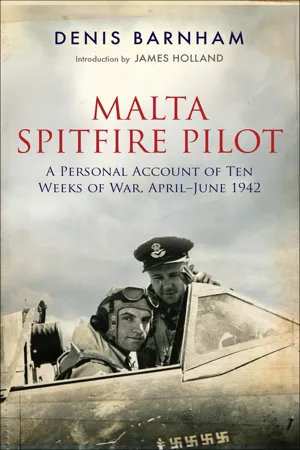
eBook - ePub
Malta Spitfire Pilot
A Personal Account of Ten Weeks of War, April–June 1942
- 224 pages
- English
- ePUB (mobile friendly)
- Available on iOS & Android
eBook - ePub
About this book
Information
Topic
StoriaSubtopic
Storia militare e marittimaPART ONE
BACKGROUND
CHAPTER 1
THE GIRDERED CAVERN
“WILL Flight Lieutenant Barnham report to the R.T.O. immediately—Flight Lieutenant Barnham report to the R.T.O. immediately.”
They’re calling my name over the Station Tannoy, and my train, which has just pulled in four hours late, hasn’t even coasted to the end of the platform. I’m running, trotting, half-staggering as fast as I can go towards the distant exit gate at Glasgow Central Station. My bulky parachute bag is banging and lurching against my knees; inside, all the precious equipment which may soon be in use, my parachute, my emergency dinghy, in case I bale out into the sea, my yellow Mae West life-saving jacket, my flying-helmet, goggles and steel helmet make the bag heavy.
I’m just approaching the engine, but I still have a long way to go. This great swollen cylinder of steel is oily and hot, it’s relaxing with a gush of steam, while the driver, in dirty blue overalls, stands with indolent satisfaction on the footplate. To my mind the engine hasn’t even exerted itself: it not only stopped three times along the length of Preston station when I was saying goodbye to my wife, but it has stopped repeatedly since then. The three hours* margin which I allowed myself to get from Glasgow to Abbotsinch aerodrome has been used up and overrun.
The end of the platform at last.
“Where’s the R.T.O.’s office?”
“Over the far side, chum.”
Why was the train late? There was no air raid—goods trains had priority, I suppose—but my mission’s vital too. Yes, there’s the office: R.T.O. in bold letters.
“You’re Tannoying for me?”
“You’re Barnham? You were expected hours ago. Come on then— as quick as you can—down these stairs.”
I’m bundled into the back of a dark blue Austin Ten with all my kit. Glasgow streets, tall black buildings, tram lines and impatient halts at red traffic lights. Suburbs, with buildings thinning out a bit.
What’s my Squadron Commander going to say to me? Orders came through so suddenly that there was no time for official embarkation leave—on his own initiative the C.O. gave us all forty-eight hours; a precious gift, for Diana and I have only been married a few weeks. He particularly asked us not to let him down—and that’s just what I’ve done.
So this must be the aerodrome: low-lying grass, wide and flat, supporting two ancient black hangars under a heavy grey sky. No aeroplanes of any kind, just a few huts.
The C.O., broad and tall, with the blue and white diagonal stripes of the D.F.C. that he won in the Battle of Britain looking brilliant and clean under his R.A.F. wings—particularly brilliant against the blue-grey of his large but well-filled uniform—how ashamed he makes me feel. It’s no good making excuses to him. Everything he says is quite true, and I nod my head in silence. That a brand new Flight Commander should have let the Squadron down—he need not rub it in.
All the pilots are now streaming past us, taking their seats in the bus. They are very discreet—I think they guess that I’m in trouble. I am so bewildered by the crazy rush from the station that they all stream past in a blur of R.A.F. blue. Now, beyond the C.O., I notice the Rhodesian shoulder flashes on the “Dreaded Hugh’s” uniform as he hurries along with Ken, his wide English friend. Ken is the oldest man in the Squadron. I notice the large American eagle flashes on the handsome Tilley’s jacket and I notice his Clark Gable moustache. “Pancho”, from the Argentine, must have passed us already; and Pip from “B” Flight, and probably slender Cyril with his unusual South African Air Force wings—but there’s “Baby Face”, the other South African pilot: his smart khaki uniform is very conspicuous. Last of all come Max and Scotty, one tall figure, one very short, in their dark blue of the Royal Australian Air Force, together as usual. I smile to myself as I watch these two buddies walking closely side by side, for they share a kind of conspiracy, a mutual reaction to everything.
We have taken our places. The other pilots are laughing together. I have a window seat; the C.O. is just in front of me; I’m still in disgrace. In silence I look out at the landscape that slides past: I watch it hungrily, for it may be my last chance. Cobbled streets, more tram lines, drab yellow and soot-red walls, corrugated-iron roofs stained and rusty, slate roofs chipped and damp, neglected fields and a few trees whose Springtime has been delayed by breathing smoke. All too soon great cranes and masts finger the skyline as we turn off the main road. Before us is a gigantic ship, an aircraft carrier; it towers up above us like the side of a flat grey mountain, its complex of turrets and radar masts receding towards the clouds. The bus squeaks to a standstill: climbing out and staggering with our luggage, we pick our way over the rusty railway lines, past three grimy trucks, and over cinders from which a few blackened weeds struggle gallantly to life. Just a brief impression of the ship’s carefully painted sides as we file up the gangway.
We are sailing almost at once, so, finding a hole through which I can look back at the derelict landscape, I watch the ropes that bind us to the shore being cast off one by one. As the last rope, the last link with home, splashes into the sea, trails in the water, and finally hangs limp and vertical from the overhanging catwalk, seven labourers with their hands rumpling their trouser pockets stare down into the increasing space between us and the dock.
Deep in the ship the engines are now throbbing and shuddering. The shores of the Clyde slide by more and more rapidly. Next comes the open sea, darkly overcast. As we plough our way into it not only does a screen of destroyers take up protective stations around us but a battleship moves into position. It’s good to see such an imposing array because last month, March 1942, had the worst shipping losses of the war: over eighty merchant ships, totalling almost five hundred thousand tons, were sunk by enemy submarines. As it grows darker I watch the battleship Renown on our starboard bow dip slowly into the black waves; she rises majestically up again; the reflected light from the churned water races along her camouflaged sides and a plume of white streams out behind her.
It was with a mounting sense of adventure that I followed two of my American hosts through a labyrinth of corridors into the ship. I know the corridors fairly well now, having been several days on board, but in that first impression I quickly lost my sense of direction. Twisting and turning we passed through the openings of watertight doors and ascended clanging ladders. We were in artificial light all the time: predominantly orange, but sometimes blue. These lights played over the uniforms of the two American officers, changing the immaculate Naval Air Arm green into unusual hues. At first the two officers looked like twins, for they both had long legs, tightly pinched waists, broad square shoulders and their hair was so short that it bristled from their skulls, but, as they walked in front of me, I soon became aware of their differences: the first one went solidly on, always presenting a rounded back view, while the second was all angles, all arms and legs, contorting himself against the corridor wall, continually turning to speak with me.
He talked and asked questions all the time. He talked in the wardroom, where I learnt that ships of the American Navy are “dry” ships, serving soft drinks, mostly Coca-Cola, where we each had an excellent cup of coffee served by a negro barman and where I first heard the characteristic Tannoy message “The smoking lamp is out throughout the ship, gasoline system in operation”, that I have heard repeatedly since. After coffee the Americans led me down the corridors past the hum of dynamos, through the hangar deck filled with aircraft and smelling of dope, into other creaking passages where cigar smoke lingered outside half-opened doors. They told me that our carrier is the U.S.S. Wasp—or as they rolled their tongues so delightfully around it—the “Wa~aasp”, the first ship of the U.S. Navy to be sent into action in “The European Thee-at-er of Operations”.
“What’s the Messerschmitt 109 like to fight against?” they asked me.
“It’s very fast,” I replied. “It’s generally been higher than us when we’ve encountered it. In combat, of course, the Spitfire can turn much better—that’s the best advantage to have.”
“And this new pursuit ship of theirs, the F.W.190, how does she compare?”
So I told them.
“And how many sorties have you done?” they asked.
I was listening to their soft round accent—the questionable innuendo in their voices took me by surprise. I thought the enquiry blunt.
“A few convoy patrols,” I replied, “and about sixty-four trips over France.”
“And how many Germans have you destroyed?”
The question was embarrassing because I’ve only shot down one enemy plane. I’ve always felt ashamed that I’ve not done better—indeed I still dream of the combats in which I’ve bungled wonderful opportunities, manoeuvred the wrong way due to some false alarm or other, or simply missed through bad shooting.
We had by then stopped outside my cabin door. I wondered if I should tell them the whole story of my F.W. 190, or not? I had been chased in a state of terror all the way across the Channel by three of these formidable machines. They were so very much faster than my Spitfire that I couldn’t get away from them. Close to the cliffs at Folkestone I made one last desperate turn. The Spitfire was very much more manoeuvrable than they were and as I turned inside them, I took careful aim at the leader before giving him all that I’d got with cannon and machine-guns: to my astonishment the second plane fell into the sea with a great splash!
“I’ve destroyed one, a F.W.190,” I replied, hoping that I would be able to go in and unpack—but they lingered.
“Why is it,” they asked me, “that with all those sorties you don’t wear any medals?”
That was almost too much. I had to explain that thousands of R.A.F. pilots had very much more experience than I had, and that very few of them had been given decorations. I added that if there really were going to be campaign medals for this war, then the British would only make up their minds about it years afterwards. I looked at the many coloured ribbons that the Americans sported on their green jackets, learning that one was for prowess at shooting and another for being on the western seaboard of America when certain parts of it were shelled by a Japanese submarine; I wanted to say the C.O.’s D.F.C. really is a medal—but I didn’t dare. After all the Americans, who have only been at war a few months, will soon have their equivalent,
“Well,” they said, “here’s your cabin, your kit’s been put in there; we live three doors up; we’ve got a library, and, if you like music, we’ve got lots of recads, Bach, Mozart, Beethoven, Schubert—make yourself at home, any time. Here, have a cigar.”
I have seen the Americans since and I like them more and more, but when they left me that first evening I stood outside my cabin door, staring at it. I think I was afraid of finding a dormitory packed with people. I was remembering my last trip abroad: it was early in 1940, in a liner converted to a troopship sailing to Capetown—I was on my way to Rhodesia for my flying training. Together with a lot of ground-crew airmen, we were herded into a small gymnasium, but so great was the overcrowding, with all of us interlocked on the floor in the tropical heat, that no one could sleep. The airmen were in high spirits—their songs were shouted into my ears—I hadn’t been long in the Air Force—I was new to the sexual barbarity of military songs—in my inexperience I found the three weeks’ voyage a taste of hell.
Opening the door I found my cabin on this aircraft carrier was a small, quiet room for two people. On the opposite side of the cabin, smoothing the creases from the tropical uniform that he’d just unpacked, stood the “Dreaded Hugh”. He’s the other Flight Commander; he has a ginger moustache, rather sparse in its texture, filling his upper lip, straight sandy hair brushed back over his head, while his face and thick-set neck are salmon pink in colour—odd for a Rhodesian. We call him the “Dreaded Hugh” because he prefixes the word “dreaded” to all our names. I am the “Dreaded Denis”, and his close friend is the “Dreaded Ken”. Although he had made himself thoroughly at home, he had made no claim on either of the two bunks that fitted into an alcove on the right-hand wall. I guessed he would be playing cards or dice with Ken for most of the voyage, and I didn’t want his great feet in my face in the early hours of the morning, so I took the top bunk; soon after this Hugh seized a pack of cards and was gone.
I had a good long look around me. I realised at once that with such a comfortable home I would spend a lot of my time here, and that’s just what I’ve done. It’s as good as having a cabin to myself, for I only see Hugh in the morning. I watch him from my bunk. He staggers in a sleepy condition up and down the tilting floor, shaves, dresses, then disappears for another twenty-four hours.
It’s pleasantly warm in here—in fact I can control the cabin to any heat by re-setting the thermostat. I can also make it deliciously fresh by lifting a small eyelid vent and letting cool air rush in. There are two deep, friendly armchairs on the carpeted floor, and two metal writing- desks, each with its own shaded reading-lamp. Across the end wall a celadon green curtain is drawn, but behind it the side of the ship leans outwards, no doubt to support the^flight deck above. There’s a port-hole there, but at the moment there’s a steel blackout panel fitted across it, out of sight, of course, behind the curtain.
I have written long letters to all my family and many of my friends. I have read a little, while at times, as now for instance, I look about me: I find such a luxurious cabin a strangely incongruous thing in war. A U-boat may have its sights upon us, and a torpedo may be approaching— now—at this very moment. Apprehensively I wait for the bang. There would be a rush of water. I would grab the life-jacket that hangs on the back of the closed door and race for life to the rendezvous point on the flight deck above. But suppose the door was buckled in the explosion— jammed tight? I would be trapped: but there is no bang; there’s a long creak every few moments, there’s the beat of engines and there’s a rhythm of movement in the way our carrier rides the waves.
All around us, thousands of yards out across the dark water, the destroyers and the battleship must be forging ahead in their allotted stations. Thousands of men must be alert. Look-out men must be straining their eyes watching the water, while deep inside the ships men on duty behind complicated asdic instruments must be listening and watching for the blip that would betray a submarine’s imminent attack. We are taking reinforcement aircraft to the besieged island of Malta and it is vital that we get through.
This is the blackest moment of the war so far—we have had strategic withdrawal after withdrawal, then a new wave of reverses started last December when the Japanese hit the Americans in the back—with the might of America in with us it looked as if the war would be quickly over—but no: Germany, Italy and Japan appear to have consorted together. Japan, cutting the world in half longitudinally, has swept southwards across the Pacific Islands and will undoubtedly invade Australia next; simultaneously she has struck westwards towards India. In her invasion of Malaya our great battleships, the Prince of Wales and Repulse, were quickly sunk; Singapore fell next and now two attacks are converging on India itself: one Japanese army is sweeping through Burma in the north, while in the south we have just learned that a Japanese fleet, with troopships, is attacking Ceylon. At this same moment the Germans and Italians are making an all-out offensive south-eastwards across the Mediterranean towards the Middle East—no doubt they expect to join up with the Japanese forces in India. Although the Balkans have been overrun, Crete captured by an airborne invasion, and although Rommel is advancing along the North African coast towards Egypt, the island of Malta still stands behind enemy lines, a constant menace to Rommel’s supply routes. Malta is vital and the enemy realise that they must not only neutralise the island but capture it. Malta is cut off from effective Allied succour by almost a thousand miles of sea from Gibraltar on one hand and by another thousand miles of water from Cairo on the other. She is brooded upon by the underside of Italy and Sicily, a bare sixty miles away. The Germans have assembled a bombing fleet of five hundred planes on the Sicilian airfields; for months they have been hammering and hammering at the tiny island. The island’s R.A.F. bomber force has been wiped out. The dwindling number of fighter planes are battling against odds of forty or fifty to one. Will we be in time before the German invasion? Will the fifty Spitfires we are taking be enough?
A few minutes ago I was in the hangar deck looking at our cargo of Spitfires. The hangar is a vast girdered cavern stretching away into the distance like the inside of a whale; in it our fighters are lashed into position, parasites to Leviathan. It is impossible to cross the deck without ducking under wings and tails, all tucked into one another. The Spitfires’ wheels are steadied by wooden blocks, their wing tips lashed to the deck by ropes and cables, but more Spitfires are suspended from the roof girders, slung there by canvas loops—they sway gently as our carrier rolls. Staring at these planes I could not help wondering how many of them and, indeed, how many of our pilots will be left in a week’s time.
In order to get into the Mediterranean without being seen by enemy agents on the shores of Spain or North Africa, our fleet is going to pass through the Straits of Gibraltar in the dead of night. Once inside, the Navy, who have precious few heavy ships left, dare not take us very far— we will have to take off and fly about seven hundred miles to our destination. I hope we are taken far enough: of the last formation that left a carrier in this way, only four reached the island—nine others ran out of petrol: the machines were lost and the pilots drowned.
Even the take-off will be an ordeal—in order to avoid a similar disaster we will be carrying an extra ninety gallons of fuel in larger long-range tanks attached under the belly of each plane: but a new problem arises— weight. We have each been limited to ten pounds of personal luggage in order to keep our machines as light as possible—but the planes themselves, with an extra powerful armament of four cannons and four machine-guns, are unusually heavy. Is the deck going to be long enough for us to take off and climb into the air? It looked awfully short when we came aboard and none of us have ever taken off from an aircraft carrier before.
Thus we face the octopus future that draws us steadily towards it. As a fighter pilot I know I have little chance of coming out of such a battle alive, so it is with sorrow that I look back on what I have done with my life so far and on what I hoped I might achieve.
CHAPTER 2
OPERATIONAL TOUR
THE last time I was in an aircraft carrier I was eight years old, for my mother had taken me to a Navy Week at Portsmouth. It was the scale of the airc...
Table of contents
- Cover
- Details
- Title
- Copyright
- Contents
- List of Illustrations
- Foreword
- Introduction
- Part One: Background
- Part Two: Middle Distance
- Part Three: Foreground
- Authors note
- Plate section
Trusted by 375,005 students
Access to over 1.5 million titles for a fair monthly price.
Study more efficiently using our study tools.
Frequently asked questions
Yes, you can cancel anytime from the Subscription tab in your account settings on the Perlego website. Your subscription will stay active until the end of your current billing period. Learn how to cancel your subscription
No, books cannot be downloaded as external files, such as PDFs, for use outside of Perlego. However, you can download books within the Perlego app for offline reading on mobile or tablet. Learn how to download books offline
Perlego offers two plans: Essential and Complete
- Essential is ideal for learners and professionals who enjoy exploring a wide range of subjects. Access the Essential Library with 800,000+ trusted titles and best-sellers across business, personal growth, and the humanities. Includes unlimited reading time and Standard Read Aloud voice.
- Complete: Perfect for advanced learners and researchers needing full, unrestricted access. Unlock 1.5M+ books across hundreds of subjects, including academic and specialized titles. The Complete Plan also includes advanced features like Premium Read Aloud and Research Assistant.
We are an online textbook subscription service, where you can get access to an entire online library for less than the price of a single book per month. With over 1.5 million books across 990+ topics, we’ve got you covered! Learn about our mission
Look out for the read-aloud symbol on your next book to see if you can listen to it. The read-aloud tool reads text aloud for you, highlighting the text as it is being read. You can pause it, speed it up and slow it down. Learn more about Read Aloud
Yes! You can use the Perlego app on both iOS and Android devices to read anytime, anywhere — even offline. Perfect for commutes or when you’re on the go.
Please note we cannot support devices running on iOS 13 and Android 7 or earlier. Learn more about using the app
Please note we cannot support devices running on iOS 13 and Android 7 or earlier. Learn more about using the app
Yes, you can access Malta Spitfire Pilot by Denis Barnham in PDF and/or ePUB format, as well as other popular books in Storia & Storia militare e marittima. We have over 1.5 million books available in our catalogue for you to explore.