eBook - ePub
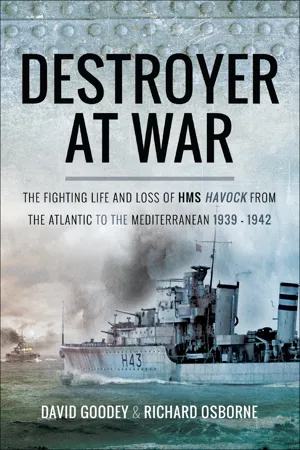
Destroyer at War
The Fighting Life and Loss of HMS Havock from the Atlantic to the Mediterranean 1939–42
- 320 pages
- English
- ePUB (mobile friendly)
- Available on iOS & Android
eBook - ePub
Destroyer at War
The Fighting Life and Loss of HMS Havock from the Atlantic to the Mediterranean 1939–42
About this book
It was headline news on 8 April 1942: One of the Navys most famous destroyers, a ship which survived bombs, torpedoes and full scale battles, has been wrecked. That destroyer was HMS Havock, described in another newspaper as Britains No 2 Destroyer of this war second only in fame and glory to the Cossack.Havock had earned her reputation guarding the convoys across the Atlantic in 1939 and at Narvik in the abortive bid to stave off the German occupation of Norway in 1940. Havock was then transferred to the Mediterranean, fighting at the Battle of Cape Spada in 1940 and in 1941 at the Battle of Matapan and in the evacuations of Greece and Crete.Havocks duties in the Med continued, escorting the convoys to the besieged island of Malta and the equally beleaguered garrison at Tobruk. Then in the Battle of Sirte in 1942 Havock was badly damaged and she limped into Malta for repairs. There she was heavy bombed and when Havock made a bid to reach Gibraltar, she was wrecked off Cape Bon. Her crew was captured and imprisoned in the infamous Laghouat internment camp.The authors have tracked down fifty of the surviving crew and from interviews have been able to compile one of the most detailed, and certainly one of the most dramatic, histories of a destroyer during the Second World War. Destroyer at War tells the story of the battles and operations of a famous ship, and its sad destruction, through newspaper reports, official documents, and the words of the men who sailed and fought in HMS Havock as she earned an astonishing eleven battle honors in her brief but glorious career.
Information
Chapter 1
A Ship is Born
HMS Havock was a destroyer of the H or Hero class whose construction was foreshadowed in the autumn of 1933 when the First Lord of the Admiralty1 circulated his construction proposals2 for 1934. These included the aircraft carrier Ark Royal, three Town class and one Arethusa class cruisers and another flotilla of destroyers, the H class. The latter was the penultimate class of a series of seventy-seven destroyers constructed to a largely standardised design derived from that of the V and W class destroyers and Scott and Shakespeare class flotilla leaders which were beginning to enter service shortly before the Armistice on 11 November 1918.
British destroyer development 1908-16
The early British destroyers were designed to protect the battlefleet from attack by enemy torpedo boats and consequently were known as Torpedo Boat Destroyers (TBD). In order to be effective, the latter had to be faster, more seaworthy and have a heavier gun armament than contemporary torpedo boats. The TBDs were also equipped with torpedoes and consequently could also be employed offensively against an enemy battlefleet but this was considered to be very much a secondary function. However, developments in torpedo technology led to a reappraisal of TBD capabilities and functions.
Thus, compared to earlier TBDs, the vessels of the G or Beagle class of the 1908-09 programme displaced 950 tons with a top speed of twenty-seven knots and had a much-improved armament consisting of one 4-inch and three 12-pounder guns plus two tubes for 21-inch torpedoes. The latter weapon was not only considerably more destructive than earlier torpedoes but also had a range of 12,000 yards at thirty knots which equated to the effective gun range of battleships of the period. The introduction of the 21-inch torpedo meant that one fleet could fire torpedoes into the centre of an oncoming opposing fleet which was six miles away. It was argued3 that, although these so-called ‘browning’4 shots were unlikely to hit specific ships, they had a good chance of hitting some of the closely spaced ships in the enemy battlefleet and thereby could force the latter to fight at longer ranges which would favour the British with their superior gunnery control.
The incremental improvements in subsequent classes were shown to good effect in the L class of 1912 which had a full load displacement in excess of 1,000 tons and carried three 4-inch guns as well as four 21-inch torpedo tubes. The Ls set the pattern for subsequent 235 M, R and S class destroyers built during the First World War. Completed with either two or three funnels, their bridge was no more than sixty feet from the bow and consequently was very wet in a seaway. Furthermore, the bridge was so far forward that personnel manning this flimsy structure were subjected to violent movements in quite moderate weather and their performance declined as the sea state increased.
The larger Kempenfelt class flotilla leaders, which were armed with four 4-inch guns and entered service in 1915-16, fared no better and the desirability of the bridge positions being as far aft as practicable caused this design to be reviewed again at the Admiralty in March 1916. A new design was prepared in which the bridge moved aft by about thirteen feet, the first and second funnels were combined and the forecastle deck extended aft. No. 2 gun, formerly on a platform between the first two funnels, was moved to a position on the forecastle on a deckhouse, a blast screen being provided to protect the crew of No. 1 gun. The deckhouse was utilised to provide further accommodation for officers. Right-ahead fire for two guns was thus secured, and the upper gun became capable of being manned in weather which would preclude the fighting of No. 1 gun5. These modifications were effected in the six-strong Grenville class which had been ordered in 1915 and entered service in 1917.
Enter the V class
Probably the most innovative and iconic destroyer design of the period owes its existence to the adoption of geared turbines in the R Class destroyers then building. Because the latter were likely to be significantly faster than the Kempenfelt class leaders, this led to the design, in April 1916, of a new flotilla leader utilising the same machinery as the R Class TBDs so as to expedite construction6. The smaller machinery power enabled the Kempenfelt class armament to be carried on a vessel 15 feet shorter. Furthermore, the V class leaders were faster than the Kempenfelts because the saving in weight obtained by having a shorter vessel with lower-powered machinery coupled with the increase in machinery and propeller efficiency due to the adoption of geared turbines. Compared with the Grenville class, the bridge in these new leaders was fifteen feet further aft, accommodation was increased and they were £50,000 cheaper to build. The V leaders carried the same number of guns as the Kempenfelt and Grenville classes but they had higher velocity and increased range, namely four 4-inch QF Mark V on C.P. II mountings with 30° elevation. Two 4-inch guns were superimposed forward in ‘A’ and ‘B’ positions two 4-inch superimposed aft in ‘X’ and ‘Y’ positions. One 3-inch 20-cwt Mark III high-angle gun was mounted on a platform aft of the funnels for anti-aircraft purposes. Two pairs of 21-inch double revolving torpedo tubes and four torpedoes were carried, except in Vampire, which had two sets of triple 21-inch torpedo tubes and six torpedoes.
Five vessels, Valkyrie, Valorous, Valentine, Valhalla and Vampire were ordered during April to July 1916 with delivery scheduled to begin from June 1917. The new leaders were a great improvement over earlier designs, with good seakeeping and a powerful gun armament, with their superimposed guns in ‘B’ and ‘X’ positions being able to fight in very heavy weather. They had a distinctive appearance with a tall thin fore funnel and a shorter fatter second funnel.
In response to reports that the Germans were building large destroyers the Admiralty Board decided in June 1916 that it was necessary to have destroyers of greater gun power than the R Class. Compared with the latter, the enhanced gun power was to be obtained by adding a fourth 4-inch gun as well superimposing two of the four guns. In order to obtain such destroyers within the minimum time of construction, twenty-five vessels were ordered to be of the same dimensions, form and arrangement as the V Class flotilla leaders already designed but with modification to their bridge and accommodation to render them more suitable for destroyer work7. Decks were strengthened to take triple 21-inch torpedo tubes, and bridges were strengthened with canvas screens being replaced by steel plating. The first of the class entered service in August 1917 and the last in June of the following year. In December 1916 orders were placed for twenty-three repeat V class but equipped with the triple 21-inch torpedo tubes which had not been available earlier. Known as the W class, two ships were cancelled in April 1917 and remainder were completed between November 1917 and October 1918.
The proven superiority of the V and W classes of destroyers at sea over the R class together with a perceived need for a longer-range gun armament for these vessels, led to the placing of the orders in January and April 1918 for a further fifty-four vessels to the V Class design. It was decided that the 4-inch QF Mark V guns of the V and W Classes should be replaced by 4.7-inch guns as mounted in the Scott and Shakespeare class flotilla leaders. The armament therefore consisted of four 4.7-inch BL guns, one 3-inch HA gun and two sets of triple tubes for 21-inch torpedoes8. Only sixteen of these ships were completed, mostly between April 1919 and June 1920, with the thirty-eight being cancelled after the Armistice between November 1918 and September of the following year.
Scott and Shakespeare class flotilla leaders
In early 1916, at the time the V class leaders were being designed, Admiral Jellicoe indicated the need for a flotilla leader of greater size and displacement in order to combat the severe weather conditions experienced in the North Sea. At about the same time there were also reports that German destroyers mounting 5-inch guns were being constructed and consequently the DNC was instructed to design ships capable of meeting this new challenge. Fortuitously, Thornycroft had submitted a design for a new flotilla leader and the DNC reported that, if fitted with 5-inch guns, it would meet this new requirement. Because the Navy did not have a 5-inch gun in its inventory the Army’s 4.7-inch gun was utilised instead in the new Admiralty design which was to become the Scott class. The result was an armament consisting of five 4.7-inch BL Mk I guns on C.P. VI mountings arranged as in the V Class but with an extra gun on top of fan intakes between funnels plus two sets of 21-inch triple torpedo tubes9. This made them the most heavily armed destroyers in the world which together with the addition of a nine-foot rangefinder as well as torpedo sights on the bridge resulted in a massive improvement in fighting efficiency.
One vessel only, Scott, was ordered to this design in April 1916, but two similar vessels, Shakespeare and Spenser, were ordered about the same date from Thornycroft to their form, the general arrangement being similar to the Admiralty design. The large flatsided funnels of the Thornycroft vessels made them appear larger than those completed to the Admiralty design. Subsequently, repeat Scotts were ordered in December 1916 (Bruce & Douglas) and April 1917 (Campbell, Mackay, Malcolm, Montrose and Stuart). One repeat Shakespeare (Wallace) was ordered in April 1917, followed by six more in April 1918 (Barrington, Hughes, Keppel, Rooke, Saunders and Spragge). After the Armistice Rooke was renamed Broke while Barrington, Hughes, Saunders and Spragge were cancelled.
Thus it was that the Royal Navy ended the First World War with the finest destroyers afloat as represented by the 1,325 ton V /W and Modified V/W classes and the 1,500 ton Leaders of the Shakespeare and Scott classes all of which had an endurance of 3,200-3,500 nautical miles at fifteen knots. Unsurprisingly, these ships set the style of the destroyers in service with many navies in the 1920s and early 1930s.
Post War Destroyer Construction
The huge number of destroyers built during the conflict meant that there was no urgency to recommence destroyer construction in the early 1920s. Great War experience showed that fleet destroyers required a large fuel capacity and endurance for screening purposes while a heavy torpedo armament was considered to be of primary importance for fleet action. The Admiralty envisaged that the next generation of destroyers would be about the same size as the Scott class leaders, armed with four 4.7-inch and two 2pdr guns and at least six 21-inch torpedoes and equipped with Asdic and depth charges. Endurance was expected to be about 5,000 nautical miles at twelve knots. However, the designs offered to the Admiralty in November 1923 specified ships which were 300-600 tons greater than the Scott class leaders with an endurance of 4,500-5,000 nautical miles at twelve knots.
In the event, the Admiralty felt that these proposed destroyers would be too large and when the prototypes were ordered in 1924 the Admiralty specified ships similar to the most recent design available, namely Thornycroft’s Modified W class. The two foremost destroyer builders, Thornycroft and Yarrow, were selected and given a free hand within the Admiralty’s broad specifications to evolve a standard type. Consequently, the prototypes Amazon and Ambuscade were generally similar to the Modified W class but with two knots more speed, all-steel bridges, improved habitability and a wider radius of action. From them stemmed the seventy-nine ships of A to I classes which formed eight full flotillas of nine vessels, a half flotilla of five vessels plus two additional vessels for the RCN.
The central British destroyer tactical concept of the inter-war period remained the long-range browning shot. Consequently, in July 1926, during discussion of the requirements for a class of destroyers to be built under the 1927 Estimates, it was agreed that emphasis should be placed on torpedo attack. This requirement, which dominated British destroyer design into the Second World War and beyond, seems strange in light of the lack of success of ship-launched torpedoes during the Great War. However, it can be argued that fear of torpedo attack may have had an effect out of all proportion to the results actually achieved10.
At about this time the Royal Navy believed that the antidote to the submarine was an Asdic-equipped destroyer armed with depth charges while the antidote to mines laid in the path on the oncoming fleet was the Two-Speed Destroyer Sweep (TSDS). The latter could be used as a search sweep ahead of the fleet, as a protective sweep, or as a clearance sweep and was effective against simple moored mines at twelve knots and above. However, it was felt that a destroyer equipped with both would suffer from a congested quarterdeck and therefore it was envisaged that flotillas of destroyers would be alternately equipped with Asdic or TSDS. In 1928 it was decided that all destroyers would be built with trunks and offices so that Asdic could be installed even if completed as TSDS ships. Turning to the 4.7-inch gun armament of these new destroyers, it was decided that their mountings had to be hand-operated because loss of power would cause their inactivation. In comparison, hand-worked guns could remain in action as long as there was a man alive to load them.
A major factor influencing British naval policy and construction programmes was budgetary economy which, of course, accorded with the contemporary Government policy of orthodox and deflationary finance. Another factor that further reduced naval construction was the notorious ‘Ten Year Rule’ which was instituted in 1919 and assumed that there would be no major war for ten years from that date. Unfortunately, in June 1928 the Chancellor of the Exchequer, Winston Churchill, made this rule self-perpetuating. Add to that baleful influence of the politically naïve naval treaties of the period and one can well imagine why, with the limited funds at their disposal, the Admiralty deliberately built medium-sized destroyers which showed only minimal improvement over the Scott class leaders.
The A – ...
Table of contents
- Cover
- Title
- Copyright
- Contents
- Foreword by David Goodey
- Foreword by Richard Osborne
- Acknowledgements
- Glossary of Technical Terms and Abbreviations
- Chapter 1 A Ship is Born
- Chapter 2 Spanish Civil War (January 1937 – March 1939)
- Chapter 3 Run up to War (March 1939 – March 1940)
- Chapter 4 The Battle for Narvik (April 1940)
- Chapter 5 The Invasion of Holland (May 1940)
- Chapter 6 Mediterranean Maelstrom (May 1940 – February 1941)
- Chapter 7 The Battle of Matapan (27 – 30 March 1941)
- Chapter 8 Convoys and the Tripoli Bombardment (April – May 1941)
- Chapter 9 Evacuation of Greece and Crete (April – June 1941)
- Chapter 10 No Rest for the Wicked: Syria, Tobruk, Groundings and More Convoys (June 1941 – March 1942)
- Chapter 11 The Slow Death of HMS Havock: The Second Battle of Sirte and Beyond (March – April 1942)
- Chapter 12 Prisoners of War in Laghouat (April – November 1942)
- Chapter 13 Court Martial
- Appendices
- Notes and References
- Bibliography
- Plate section
Trusted by 375,005 students
Access to over 1.5 million titles for a fair monthly price.
Study more efficiently using our study tools.
Frequently asked questions
Yes, you can cancel anytime from the Subscription tab in your account settings on the Perlego website. Your subscription will stay active until the end of your current billing period. Learn how to cancel your subscription
No, books cannot be downloaded as external files, such as PDFs, for use outside of Perlego. However, you can download books within the Perlego app for offline reading on mobile or tablet. Learn how to download books offline
Perlego offers two plans: Essential and Complete
- Essential is ideal for learners and professionals who enjoy exploring a wide range of subjects. Access the Essential Library with 800,000+ trusted titles and best-sellers across business, personal growth, and the humanities. Includes unlimited reading time and Standard Read Aloud voice.
- Complete: Perfect for advanced learners and researchers needing full, unrestricted access. Unlock 1.5M+ books across hundreds of subjects, including academic and specialized titles. The Complete Plan also includes advanced features like Premium Read Aloud and Research Assistant.
We are an online textbook subscription service, where you can get access to an entire online library for less than the price of a single book per month. With over 1.5 million books across 990+ topics, we’ve got you covered! Learn about our mission
Look out for the read-aloud symbol on your next book to see if you can listen to it. The read-aloud tool reads text aloud for you, highlighting the text as it is being read. You can pause it, speed it up and slow it down. Learn more about Read Aloud
Yes! You can use the Perlego app on both iOS and Android devices to read anytime, anywhere — even offline. Perfect for commutes or when you’re on the go.
Please note we cannot support devices running on iOS 13 and Android 7 or earlier. Learn more about using the app
Please note we cannot support devices running on iOS 13 and Android 7 or earlier. Learn more about using the app
Yes, you can access Destroyer at War by David Goodey,Richard Osborne in PDF and/or ePUB format, as well as other popular books in History & Military & Maritime History. We have over 1.5 million books available in our catalogue for you to explore.