- 231 pages
- English
- ePUB (mobile friendly)
- Available on iOS & Android
eBook - ePub
Wimbledon, Merton & Morden at War, 1939–45
About this book
More than 350 bombs fell on Wimbledon during the Second World War, killing 150 residents and injuring a further 1,071. Around 12,000 houses were damaged and 810 destroyed.Notable people discussed in this fascinating book include Ernest Leonard Harvey, who was onboard HMS Suffolk on the night Bismarck was spotted; Peter Walley, who died when he steered his crashing aircraft away from housing in the area; Pat Reid, Colditz Castle escapee; PoW Ernest Colman's "Wimbledon Variation"; casualties of the Burma-Thailand railway; and the members of the Mitcham Home Guard who were killed when a German parachute mine hit the Tower Creameries site on Wednesday, 16 April 1941 (after a relatively quiet couple of weeks).This well-researched book also includes a list of the lost hospitals of Wimbledon, as well as war memorials in the London Borough of Merton findings which have since been added to the Imperial War Museum's website, www.iwm.org.uk. It also provides an insight into factory worker jobs that have long-since bitten the dust. Tri-ang in South Wimbledon was a national by-word for toys until it started making munitions for real. And, with the outbreak of war, Vortexion of The Broadway, Wimbledon - a manufacturer of public address amplifiers - found itself under the direction of the Government for war work.Overall, this is a poignant testimony to the momentous efforts, bravery, self-sacrifice and determination of the people of Wimbledon during the Second World War, who sought to find normality in a reality so far removed from anything they had ever known.
Trusted by 375,005 students
Access to over 1.5 million titles for a fair monthly price.
Study more efficiently using our study tools.
Information
CHAPTER ONE
Be Prepared, Germany is Arming
‘All the while, across the North Sea, a terrible process is astir. Germany is arming,’ Winston Churchill, July 1934.
The 1934 Wimbledon Championships took place at the All England Tennis Club (Church Road, Wimbledon) from 25 June until 6 July. By August 1934 Adolf Hitler, a wounded, decorated soldier of the First World War, had declared himself Fuhrer – the leader of Germany. In British history, rearmament covers the period between 1934 and 1939. Churchill’s demands for rearmament were not intended towards war (RAF Museum). He felt that the carnage of the First World War was terrible and should not be repeated.
On 1 August 1936, Hitler opened the 11th Summer Olympic Games, held in Berlin; the Hindenburg, a large German commercial-carrying rigid airship, flew over the opening carrying the Olympic flag behind her. According to the International Olympic Committee, the Berlin Games are best remembered for Hitler’s failed attempt to use them to prove his theories of Aryan racial superiority. As it turned out, African-American sprinter and long jumper Jesse Owens (1913–1980) won four gold medals. There were 208 participants for Great Britain: 171 men and 37 women. Barbara Burke (1917–1998), Kathleen Margaret Tiffen (1912–1986), born in Croydon, and Dorothy Odam-Tyler were affiliated to Mitcham Ladies’ Athletic Club. James Ginty (1908–1999) was affiliated to Belgrave Harriers athletics club, Wimbledon. Burke won the silver medal in the 4x100 metres with her team mates Eileen Hiscock (1909–1958), Violet Olney (1911–1999), and Audrey Brown MBE (1913–2005). Tiffen qualified for the hurdles semi-finals but finished fifth out of six. Tyler won silver medals in the 1936 and 1948 Olympic Games high jump. Ginty competed in the men’s 3,000 metres steeplechase in the 1936 Olympics.
The first Air Raid Precautions (ARP) Act came into force in January 1938, compelling local authorities to appoint ARP Wardens, set up emergency ambulance services, first aid posts, rescue, repair and demolition services, and expand their local fire services by forming and equipping an Auxiliary Fire Service (AFS). The AFS’s role was to supplement the work of brigades at local level.
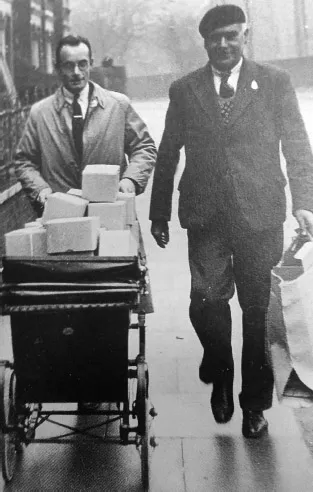
Two Wimbledon ARP Wardens delivering gas masks in September 1938 use a pram to speed up their work. (Merton Archives)
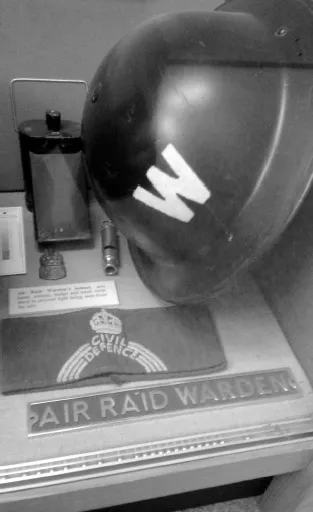
An ARP Warden’s helmet, armband, whistle, badge and torch with hood to prevent light being seen from the air. (Wimbledon Museum, 2017)
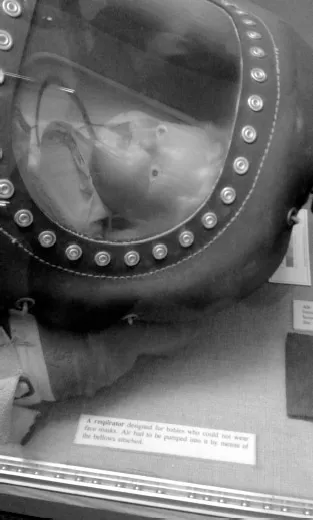
A gas mask designed for babies who could not wear face masks. Air had to be pumped into it by means of the bellows attached. (Wimbledon Museum, 2017)
A small percentage of ARP Wardens were full-time and were paid a salary, but most were part-time volunteers who carried out their ARP duties as well as full-time jobs. One in six were women, and among the men there was a significant number of veterans of the First World War. At the beginning of the war, ARP Wardens had no uniform. They wore their own clothes, with the addition of a steel helmet, wellington boots and an armband. In May 1941, full-time and regular part-time wardens were issued with blue serge uniforms.
The ARP Wardens were responsible for the handing out of gas masks, including gas masks for babies, and pre-fabricated air raid shelters such as Anderson shelters. The Controller of the ARP/Civil Defence (in 1941, the use of Civil Defence replaced the existing ARP) was normally the Town Clerk. At the beginning of the war, the Clerk to the Town Council of Wimbledon was Herbert Emerson Smith, born in 1897, appointed in 1919, a lawyer and dairyman’s son of Worple Road, Wimbledon, but he was forced to retire due to ill health. Until his successor Edwin Marrat Neave (1894–1978) of Birmingham was appointed, the task of organising Civil Defence fell to the Deputy Town Clerk, Arthur Rolt (1893–1972), who, in 1939, lived in Coombe Lane.
Rolt was assisted by the Borough Engineer and Surveyor, Thomas Webster, who was also responsible for the Rescue Service and Communications throughout the war. F.H. Neville was ARP Shelter Superintendent (Merton and Morden News, 8 January 1943). Neave was later awarded an OBE for his work as Controller.
Webster established a system of observation posts on the roofs of both the Town Hall and seventeenth-century property Eagle House on High Street, Wimbledon Village, from which almost every part of Wimbledon could be seen. Later, when the bombing started, compass bearings could be taken from these posts, which enabled the location of an incident to be established within a few minutes. (Eagle House has been converted into eight apartments, ready for occupation from Autumn 2017).
The Council’s ARP Control Centre was established in the basement of the Town Hall (now the Old Town Hall and next to Centre Court Shopping Centre) at the Queens Road end of the building. More than 2,000 men and women staffed the ARP Control Centre, the thirty-eight ARP Wardens Posts, the First Aid Posts, the Auxiliary Fire Stations, and the Mobile Services Depots (mertonhistoricalsociety.org.uk). Wimbledon Air Cadets helped to take messages between different ARP Posts. And young people worked as fire watchers, warning the ARP Wardens if they saw fires started by enemy bombing.
A frequent visitor to the Control Centre in the basement of the Town Hall was Alderman Augustus William Hickmott (1877–1972), Mayor of Wimbledon from 1926 to 1928, who retired from the Council in 1960 after forty years unbroken service. Whenever reports of damage or casualties came in, he would go out on foot to offer aid and advice to those who had suffered in any part of the borough. Hickmott, born in Kent, was a grocer who lived at 52 Merton Road with his wife, Marion Elizabeth Hickmott.
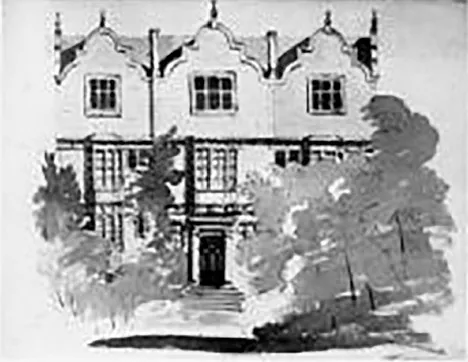
A watercolour sketch (1810) of Eagle House. Credit Museum of Wimbledon
I have found references to the following ARP Posts in what is now the London Borough of Merton:
•Corner of Adela Avenue and Douglas Avenue KT3
•All England Tennis Club SW19
•Old Raynes Park library building in Aston Road SW20. Open-air billiards provided a popular pastime for Aston Road ARP workers (Raynes Park library has been housed in four different buildings all on the same site in Aston Road)
•Corporation Depot, Queens Road, near Queen’s Road School SW19. This ARP post had been proposed on 6 December 1938 by Regional Inspector Captain Toyne of the Home Office in correspondence to the chief inspector. (This chief inspector may have been Colonel Pickering). On 3 July 1939, 161 personnel were proposed at this depot.
•Fort Bailey, 56 Mitcham Park CR4. An image, taken on 31 January 1940, can be found on merton.gov.uk
•Lingfield Road Village Hall SW19. Captain Toyne proposed to adapt the village hall into an ARP depot, but this had been earmarked by the military.
•London Road, Morden, an ARP training centre.
•Sewage Works, Durnsford Road SW19. This ARP post had been proposed on 6 December 1938 by Regional Inspector Captain Toyne in correspondence to the chief inspector. On 3 July 1939, forty-nine personnel were proposed at this depot.
•Hall attached to Raynes Park Methodist Church, 195–205 Worple Road SW20. On 3 September 1939, eighty-three personnel were proposed at the Worple Road depot.
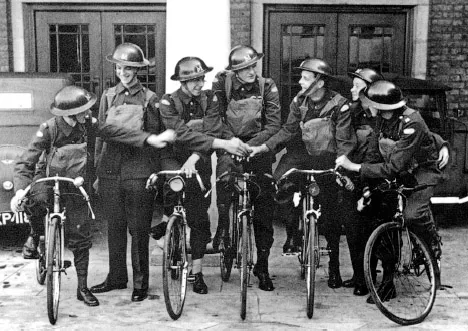
Wimbledon Air Cadets serving as cycle messengers.
The ARP Mobile Services comprised the Stretcher Parties with fifteen ambulances and ten cars, the sixteen Light and three Heavy Rescue Teams, and the Decontamination Parties. The Heavy Rescue Teams were based at the Council Highways Depot in Garth Road, Lower Morden, and the Decontamination Parties at the Control Centre (with some of their equipment stored behind the fire station next door). The Stretcher Parties were at the pavilion in Morden Recreation Ground, at Morden Farm school in Aragon Road and at the old Library building in Aston Road, Raynes Park. The Light Rescue Parties were based at these three and also at Garth Road. (Merton Historical Society, Bulletin No 167, September 2008). The Garth Road site was a Merton and Morden Urban District Depot, and not used by Wimbledon Borough.
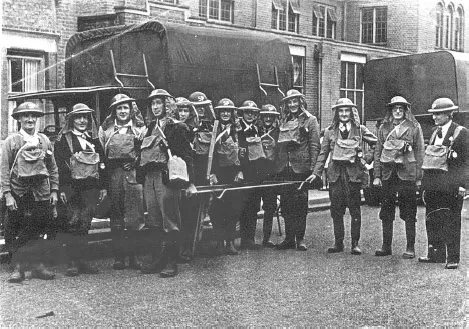
Medics and stretcher-bearers at an ARP post in Worple Road, 1942. (Museum of Wimbledon)
The Merton and Morden Urban District Auxiliary Fire Service (AFS) station was based in the grounds of Joseph Hood School in Whatley Avenue, Raynes Park. The swimming pool at Wimbledon College, Edge Hill was a valuable source of water for the local fire brigade. The long-established District Fire Service, based at its station on Kingston Road, was integrated with ARP emergency procedures, but was still expected to deal with ‘civilian’ fires as well. This AFS brigade tackled the fires during the Blitz in central London.
Dr Harold Ellis, Medical Officer of Health (MOH) for Wimbledon, headed First Aid and was assisted by Dr Patrick Doody, later to be MOH for the London Borough of Merton. Dr Doody was called to the armed forces in November 1940; his duties were taken over by Dr Cecil Stedman Cloake, who, in 1939, lived in Queen’s Road, Wimbledon. His son John Cecil Cloake (1924–2014), born in Wimbledon, where he attended King’s College School, served in the Royal Engineers in India and Japan during and after World War Two. After the war, he read History at Cambridge University. In 1948, he commenced a career in the UK’s Diplomatic Service, within the Foreign Office. He was appointed Third Secretary in Baghdad in 1949. His final post was in Sofia as Ambassador of the UK to Bulgaria where he was in charge of the UK’s diplomatic mission between 1976 and 1980.
First Aid Posts were established at the following locations:
•All England Tennis Club SW19, which also served as a mortuary, under Sister Rutter.
•Blakesley House by the Nelson Hospital SW20. In 1944, Blakesley House was converted to accommodate night nurses and a physiotherapy department.
•Cottenham Park SW20, under the direction of Margaret Roney (a Margaret Roney was Mayoress of Wimbledon from 1941 to 1943).
•Lindisfarne Road SW20, under Sister Wadey.
•Council Highways depot in Garth Road.
•Oberon Sports Pavillion SW2O.
•Pelham School SW19. This was under Sister Rosie.
•Queen’s Road depot SW19.
•Southey Road SW19.
•Beside South Wimbledon (Merton) tube station, on the corner of Merton High Street and Morden Road SW19.
•Wimbledon College, Edge Hill SW19.
The main ambulance stations were at Cottenham Park, where one of their first ambulances was adapted from a newsagent’s delivery van, and at Queens Road School (currently The Priory C of E primary school). At the beginning of the war, there were a number of men in the ambulance service, but most of these were called up and the service became staffed almost entirely by women.
Wimbledon Borough was also responsible for the provision of ARP Rest Centres, o...
Table of contents
- Cover
- Title
- Copyright
- Contents
- Dedication
- Introduction
- Chapter One Be Prepared, Germany is Arming
- Chapter Two Evacuation
- Chapter Three Early Stages of the Second World War
- Chapter Four Air Raid Precautions
- Chapter Five Home Guard Operational from May 1940
- Chapter Six When Toys Gave Way to Real Munitions
- Chapter Seven Captain William Schermuly
- Chapter Eight Calling All Workers
- Chapter Nine The First Bombing of Wimbledon, 1940
- Chapter Ten Peter Kenneth Walley
- Chapter Eleven The Blitz
- Chapter Twelve The Single Worst Night of Bombing
- Chapter Thirteen The Tower Creameries, 1941
- Chapter Fourteen The Sinking of HMS Hood
- Chapter Fifteen Life Became Grim
- Chapter Sixteen 1942 and 1943
- Chapter Seventeen 1944 and the First Flying Bomb
- Chapter Eighteen Happier Times with Brighter Prospects
- Chapter Nineteen Lost Hospitals of the Second World War
- Chapter Twenty We Will Not Go to War
- Chapter Twenty-one Military Deception
- Chapter Twenty-two Women Remembered
- Chapter Twenty-three VC Winners
- Chapter Twenty-four Lord Dowding, the Airman who Saved Britain
- Chapter Twenty-five Major Malcolm Munthe
- Appendix
- Bibliography
Frequently asked questions
Yes, you can cancel anytime from the Subscription tab in your account settings on the Perlego website. Your subscription will stay active until the end of your current billing period. Learn how to cancel your subscription
No, books cannot be downloaded as external files, such as PDFs, for use outside of Perlego. However, you can download books within the Perlego app for offline reading on mobile or tablet. Learn how to download books offline
Perlego offers two plans: Essential and Complete
- Essential is ideal for learners and professionals who enjoy exploring a wide range of subjects. Access the Essential Library with 800,000+ trusted titles and best-sellers across business, personal growth, and the humanities. Includes unlimited reading time and Standard Read Aloud voice.
- Complete: Perfect for advanced learners and researchers needing full, unrestricted access. Unlock 1.5M+ books across hundreds of subjects, including academic and specialized titles. The Complete Plan also includes advanced features like Premium Read Aloud and Research Assistant.
We are an online textbook subscription service, where you can get access to an entire online library for less than the price of a single book per month. With over 1.5 million books across 990+ topics, we’ve got you covered! Learn about our mission
Look out for the read-aloud symbol on your next book to see if you can listen to it. The read-aloud tool reads text aloud for you, highlighting the text as it is being read. You can pause it, speed it up and slow it down. Learn more about Read Aloud
Yes! You can use the Perlego app on both iOS and Android devices to read anytime, anywhere — even offline. Perfect for commutes or when you’re on the go.
Please note we cannot support devices running on iOS 13 and Android 7 or earlier. Learn more about using the app
Please note we cannot support devices running on iOS 13 and Android 7 or earlier. Learn more about using the app
Yes, you can access Wimbledon, Merton & Morden at War, 1939–45 by Ruth Mansergh in PDF and/or ePUB format, as well as other popular books in History & British History. We have over 1.5 million books available in our catalogue for you to explore.