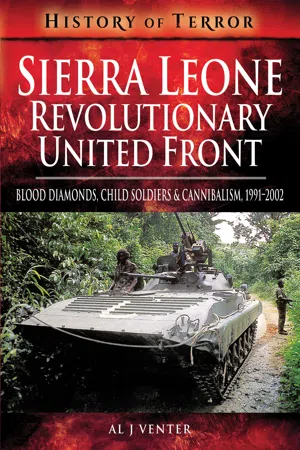
eBook - ePub
Sierra Leone: Revolutionary United Front
Blood Diamonds, Child Soldiers and Cannibalism, 1991–2002
- 128 pages
- English
- ePUB (mobile friendly)
- Available on iOS & Android
eBook - ePub
Sierra Leone: Revolutionary United Front
Blood Diamonds, Child Soldiers and Cannibalism, 1991–2002
About this book
Sierra Leones eleven-year guerrilla war that left 200,000 people dead was brief, bloody and mindlessly brutal. It was also the second African war in which mercenaries were hired to counter some of the worst atrocities that Africa had on offer. By the time it ended in 2002, several groups of mercenaries including an air wing equipped with a pair of ageing Mi-24 helicopter gunships and backed by the British Army and the Royal Navy played significant roles in quelling the bush rebellion.It was an idiosyncratic war, which started with the Foday Sankohs Revolutionary United Front (RUF) chanting the slogan No more slaves, no more masters, power and wealth to the people and ended with a series of battles for control for Sierra Leones diamond mines in the interior. By then the Liberian tyrant Charles Taylor and Libyas Muammar Gadaffi were the prime movers for the rebel cause, one of the reasons why anyone deemed to be the enemy doctors, journalists, civil servants, missionaries, nuns and teachers was slaughtered.The war gradually deteriorated into some of the most barbaric violence seen in any African struggle and which sometimes included cannibalism, with an army of 11,000 child soldiers some as young as nine or ten high on drugs rounding up entire neighbourhoods to machine-gun them en masse or burn them alive in their homes. Amputations of limbs of women, the very young and the very old were commonplace.
Information
1. GUNSHIP FOR HIRE
Newsman Mark Corcoran, a television producer for Australian Broadcasting Corporation (ABC) has covered a lifetime of wars, coups, insurrections, revolts, uprisings and the rest. In August 2000 he ran the West African gauntlet and made his way to Sierra Leone, a country then caught up in the kind of civil war that had not only morphed into a grotesque human-rights issue that had international implications but threatened to rip the former British colony apart.
Nobody in the country was left unaffected; just about everybody knew somebody who had been killed, wounded, abducted, abused or had themselves been brutalized. It had been that was for almost a decade: a cruel, bloody rebellion led by a disgraced former Sierra Leonean army NCO who made the murder of innocents and the cutting off of arms and legs of the young and old one of his several signature traits. Another was arriving at a village in the middle of the night and abducting all the young men whom he believed might serve his purpose. Either that or he slaughtered them. His instrument of torture was an army of child soldiers whom he kept permanently drugged or doped. It did not take long for his Revolutionary United Front—more commonly, the RUF—to drive fear into the hearts of the entire nation.
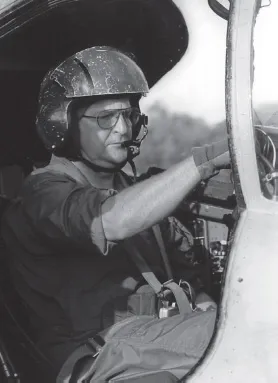
Neall Ellis in the cockpit of his Hind.
A seasoned war correspondent with solid experience in Asia, the Middle East and Africa, Corcoran was determined to cover this conflict and in the process befriended Neall Ellis, a South African mercenary helicopter pilot who, single-handed, flew Sierra Leone’s only operational Mi-24 Hind helicopter gunship. The result was a fairly graphic report, rather prosaically headlined ‘Gunship for Hire’. Corcoran’s kicks off with a no-holds-barred: “If we ever catch you, we’ll cut out your heart and eat it!” That was a very real threat made by some of Sierra Leone’s Revolutionary United Front who, everybody was aware, literally devoured the hearts of their adversaries whom they regarded as bold or intrepid. They had done exactly that with former American Vietnam veteran and mercenary freebooter Colonel Bob MacKenzie. He had barely been appointed head of one of the Sierra Leonean army units tasked with countering a specifically active rebel unit in the Malal Hills, a few hours’ drive out of Freetown, the capital. In his very first action against the RUF he was wounded, captured, tortured until he died and his heart cut out, sliced up and eaten raw by his killers. We know this because there were several captured Roman Catholic nuns in the village where all this happened, underscored later by the boasts of some of the rebels at local bars in days after the attack. They admitted to those prepared to listen that they only did this to those whom they regarded as unusually brave and Bob MacKenzie apparently fitted the bill.
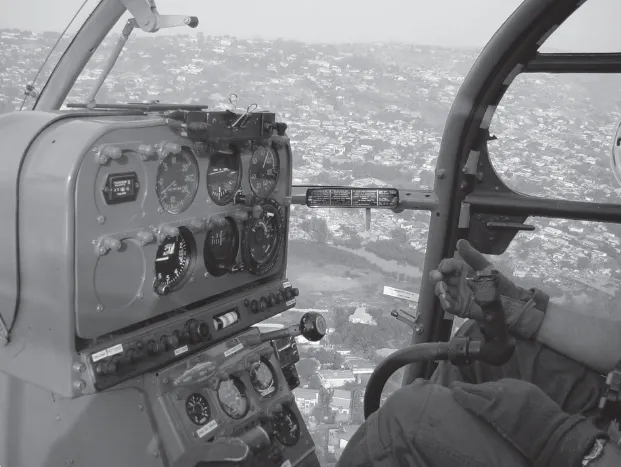
Ellis at the controls of his Hind, over Freeetown.
Then, not long afterward, several RUF commanders again made the threat. This time, the intended victim was the mercenary aviator Neall Ellis. The message was graphic: “If we catch you white man, you will die and we will eat your heart.”
By the time that Mark Corcoran met Neall Ellis for the first time, the pilot had been living with the threat of what the rebels would do to him if they could lay hands on him for roughly five years. As the newsman said the first time they made contact, “He did didn’t look too worried as we met for a beer in Paddy’s Bar, in Freetown.” He went on to explain that Paddy’s was the watering hole of choice for mercenaries, spooks, peacekeepers and aid workers, all the usual suspects who seemingly materialize at every Third World conflict, now spilling out of this noisy, sweaty, open-sided shed, perched above the appropriately named Pirate Bay on Freetown harbour.
Corcoran takes up the story: It is a typical Paddy’s night, reverberating to dance music, war stories and bar girls on the make … all the clichés of airport fiction, straight from the pages of the Fredrick Forsyth’s novel, The Dogs of War. Except here, it is all very real, and the patrons of Paddy’s are doing their best to intoxicate themselves against the horrifying reality that lies outside.
This port city was founded in the eighteenth century by freed slaves from America. The mood and look of the streets seem more Caribbean than African.
Nursing a large beer, Ellis explains that his opponents in this latest dirty war are best described as Africa’s Khmer Rouge—without the ideology. The RUF’s only clear objective seems to be controlling the country’s fabulously rich diamond fields.
Even by the brutal standards of African civil wars, this conflict is terrifying. The RUF’s trademark punishment is mindless violence. Out in the darkness that night, just beyond the bright lights of Paddy’s Bar, are the camps and slums, home to thousands of men, women and children who’ve had arms, legs and even lips and ears hacked off by teenage rebels.
Ellis talks about it all in a dispassionate tone—much the same way he reflects on the country’s unpredictable tropical weather—which can be just as deadly to a helicopter pilot.
This bespectacled, fifty-something South African is totally unassuming. He displays none of the ‘hard-man’ qualities that make him a legend in mercenary circles. Short and heavy set, he has, like so many South African mercenaries, the air of a social rugby player on tour, perhaps a Johannesburg dentist, cutting loose for a couple of weeks away with the boys.
But his reality is quite different. Ellis is a former South African colonel. One of the world’s most experienced combat helicopter pilots, he fought in apartheid South Africa’s toughest and dirtiest battles, flying gunship missions in support of a variety of feared Special Forces units at the forefront of Pretoria’s secret war against Black Africa’s frontline states, which included 32 Battalion, the police anti-terror force Koevoet, the Parabats as well as South Africa’s crack long-range-penetration Recce Commandos.
In Angola, reputedly, he was the only helicopter pilot to survive being targeted, simultaneously, by three surface to air missiles—fired by Cubans—and who lived to fly another day. Thereafter, he single-handedly at the controls of the Mi-24 gunship, forced major rebel concentrations away from the gates of Freetown. Twice!
When apartheid ended, most of these military specialists quit the army, effectively privatizing to form the nucleus of ‘Executive Outcomes’ which quickly established a reputation as perhaps the most ruthlessly efficient private army in the world. Ellis also resigned, at first trying his hand at farming and commercial fishing, before being lured back to ‘the job’, signing on as a soldier of fortune in Bosnia and the Congo. He was then lured to Sierra Leone by an offer from ‘Executive Outcomes’ and, afterward, by the similarly minded British outfit ‘Sandline’—all big names in the mercenary world. These days they prefer to be called private military companies, or in the argot, PMCs, though some operators prefer the moniker private security companies. To paraphrase one mercenary executive, “The dogs of war now live in a corporate kennel.”
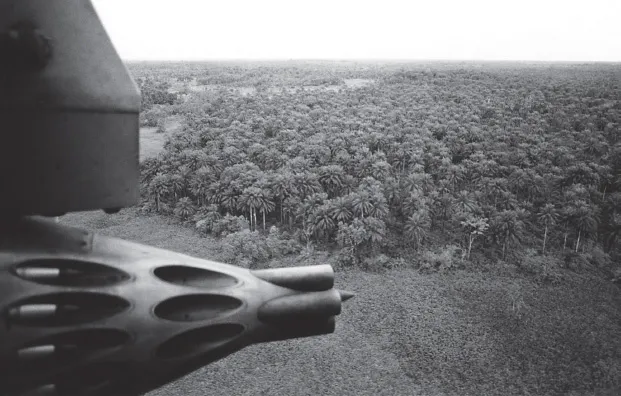
From the rear of the Hind, one of the two rocket pods on the gunship.
Ellis agrees: “The job, I think, is the same, but the image has changed. Now it’s suits and briefcases. You are more professional. I think the days of Congo and Angola when you had the image of mercenaries as drunken guys going around shooting up the place, you know, having a fine time, has gone—the people you find now, generally speaking, are well-trained, professional soldiers, Special Forces trained.”
Ellis is keen to display the ‘new professionalism’ of his calling. A few days after our drink at Paddy’s, we’re on the helipad at Cockerill Barracks, the Freetown HQ of the Sierra Leone Army at Aberdeen, on the eastern fringe of the capital. Cameraman Geoff Lye and I have been invited on a combat mission.
In the course of a nine-year civil war the rebels of the RUF have defeated the national army and confounded two peacekeeping forces. Now, the guerrillas fear only one thing—what Neall Ellis calls his office—a Russian built Mi-24 Hind helicopter gunship, which he flies under contract to the Sierra Leonean army.
With flying helmet in one hand and assault rifle in the other, Ellis strides toward the Hind helicopter which squats on the tarmac not dissimilar to a large menacing camouflaged bullfrog. Ellis boasts: “The RUF call this aircraft Wor-Wor Boy.” Wor-Wor, he explains is a Mende word, which means ugly. “So it’s ugly boy to them … they fear it, they are very frightened of this aircraft. Whenever we get overhead—they used to shoot at us quite a bit, small-arms fire—but now they duck for cover … they run, they scatter all over the place.”
His nine-member team was recruited from around the world—a veritable United Nations of mercenaries. The mechanics scrambling over the helicopter making last-minute checks are Ethiopian. Loading a machine gun is Fijian Fred Marafano, a grim hulk of a man in his late fifties, who served in the British SAS and won an MBE in London’s Iranian Embassy hostage drama of the 1970s. The other door gunner stacking ammunition is Christophe, a short, wiry Frenchman who insists that he’s holidaying in Sierra Leone. Everyone wears flying suits, except Christophe. Determined to maintain his vacationer alibi, he fights in jeans and T-shirt.
They’ve run out of ammunition for the big nose-mounted cannon, so there’s no need for a co-pilot gunner on this mission. Ellis gestures that this vacant front seat should be occupied by Geoff and his camera. I’m to ride in the back with the door gunners.
Fuelled, armed and strapped in, we lurch off the helipad for a heart-stopping 270 kilometre-anhour ride, just metres above the jungle canopy. “It makes it harder for them to hit us with a missile or rocket,” offers one of the crew as reassurance. The rebels have just overrun an army-held village. Ellis has been called in ‘to sort it out’.
Rice paddies and coconut trees flash by—so close that I flinch—to the amusement of the door gunners. The margin for error is zero. Our lives are in the hands of pilot Ellis. If he flinches, it will be all over in an instant.
The rear of the helicopter is stacked with rifles and grenades. If we are forced down in a rebel area, there will be no prisoners, the crew will fight their way out, or die. Elllis’s view: “If you do this job and worry about dying then you should stay at home and do an eight- to-five job back in the first world.”
“Five minutes to target,” warns Ellis on the intercom. Time enough to briefly ponder the ethical issues. If I survive a crash landing, should I pick up a weapon in self-defence, sure in the knowledge that as a European, the rebels will assume me to be a mercenary? Or will I maintain my non-combatant status to the end, hoping that some drugged and dreadlocked teenage rebel, going by the name Commander Superhero, will make the distinction between media and mercenary?
I need not have worried. Later, Ellis reveals that if Geoff and I were facing imminent capture—he’d given orders for the crew to shoot us. He smiles when he says this—I’m still not sure he was joking.
Smoke from burning houses marks the target village. “Are you going to fire?” asks Fred on the intercom.
Ellis: “I see them—I’m not sure if they are civilians or not—there are not supposed to be any civilians here—it’s all supposed to be a rebel area.”
Seconds later he unleashes hell. A volley of 80-millimetre rockets shreds a row of houses. “These rockets were used very effectively in Chechnya,” says Ellis. Now they very effectively shred a row of houses and anyone hiding inside. “You can tell the difference between a rebel and a civilian, you get the feeling, you can tell the difference,” Ellis insists.
The door gunners open up, picking their targets with slow, deliberate aim, the tracer rounds arching toward the ground like a deadly garden hose. There’s no Hollywood bravado, just a cold clinical efficiency to it all. This is the business of contract killing.
To many it’s morally reprehensible. Human Rights Watch accuses the crew of indiscriminately killing civilians by targeting marketplaces. Ellis says the RUF use villagers as human shields. If he’s fired at, he shoots back. “Rebels are carrying guns. Civilians aren’t carrying guns. If a civilian is carrying a gun he is a rebel, so he is a target.”
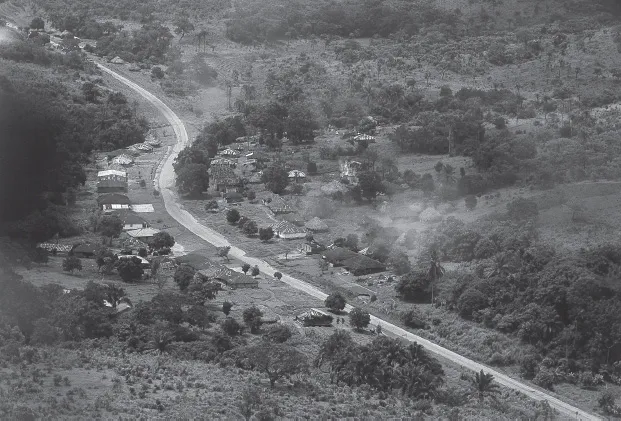
Early morning helicopter strike on a rebel village near the Guinean border.
But the rebels are also armed with shoulder-fired missiles. Ellis takes no chances, throwing the aircraft around the sky. The floor is awash with hundreds of expended machine-gun shells, a sea of brass, rolling from side to side as the gunship lurches at high speed.
The crew spots figures huddling under a river bridge. The cabin shudders as another deafening rocket salvo is fired, the barrage sending sheets of water high into the air. “The rebels are terrified of this aircraft—when they see it they just run,” says Ellis. From my position in the back of the gunship, it’s impossible to determine what they’re shooting at. All I see is the occasional flash of movement through the tree canopy below.
Then it’s all over, and we’re tree hopping back to base, over villages where the people don’t run away. They recognize Wor Wor Boy—smiling, waving and cheering for the unlikely saviours of Sierra Leone.
Fijian Fred, hunched over a still-smoking machine, is transformed. Minutes ago he was wild-eyed with controlled aggression. Now, he’s a laughing, grandfatherly figure waving to the kids below. The other door gunner, Christophe, remains expressionless. He stares blankly at the passing scenery. I wonder what these men dream about at night.
In one sense this is a mission of redemption for men more accustomed to being vilified. In other parts of Africa mercenaries are, with considerable justification, accused of perpetuating rather than ending conflicts. But here in Sierra Leone, they are for many, heroes who stood and fought when everyone else had fled.
Ellis and his crew first landed in Sierra Leone in 1995. Like so many other mercenaries, he came for the money. Hired by Executive Outcomes, his crew joined a force that in just a few weeks, drove the RUF out of the diamond fields and to the brink of defeat.
Then the soldiers of fortune were forced out of the country themselves a...
Table of contents
- Cover
- Title
- Copyright
- Contents
- Introduction
- 1. Gunship for Hire
- 2. The Colonial Epoch
- 3. The Popular Revolution
- 4. Foreign Elements Rally to the Cause
- 5. Executive Outcomes Moves In
- 6. The Mercenaries Make Gains
- 7. The Air War
- 8. Enter the British
- 9. The UN’s West African Débâcle
- 10. The Mercenary Syndrome
- Epilogue
- Bibliography
- About the Author
Trusted by 375,005 students
Access to over 1.5 million titles for a fair monthly price.
Study more efficiently using our study tools.
Frequently asked questions
Yes, you can cancel anytime from the Subscription tab in your account settings on the Perlego website. Your subscription will stay active until the end of your current billing period. Learn how to cancel your subscription
No, books cannot be downloaded as external files, such as PDFs, for use outside of Perlego. However, you can download books within the Perlego app for offline reading on mobile or tablet. Learn how to download books offline
Perlego offers two plans: Essential and Complete
- Essential is ideal for learners and professionals who enjoy exploring a wide range of subjects. Access the Essential Library with 800,000+ trusted titles and best-sellers across business, personal growth, and the humanities. Includes unlimited reading time and Standard Read Aloud voice.
- Complete: Perfect for advanced learners and researchers needing full, unrestricted access. Unlock 1.5M+ books across hundreds of subjects, including academic and specialized titles. The Complete Plan also includes advanced features like Premium Read Aloud and Research Assistant.
We are an online textbook subscription service, where you can get access to an entire online library for less than the price of a single book per month. With over 1.5 million books across 990+ topics, we’ve got you covered! Learn about our mission
Look out for the read-aloud symbol on your next book to see if you can listen to it. The read-aloud tool reads text aloud for you, highlighting the text as it is being read. You can pause it, speed it up and slow it down. Learn more about Read Aloud
Yes! You can use the Perlego app on both iOS and Android devices to read anytime, anywhere — even offline. Perfect for commutes or when you’re on the go.
Please note we cannot support devices running on iOS 13 and Android 7 or earlier. Learn more about using the app
Please note we cannot support devices running on iOS 13 and Android 7 or earlier. Learn more about using the app
Yes, you can access Sierra Leone: Revolutionary United Front by Al J. Venter in PDF and/or ePUB format, as well as other popular books in History & 20th Century History. We have over 1.5 million books available in our catalogue for you to explore.