A pictorial history of the major WWII battle in which American Navy and Marine forces took the island of Iwo Jima from the Japanese Army.
Just eight square miles in size, the Japanese island of Iwo Jima lies some 750 miles due south of Tokyo. Following a preparatory air and naval bombardment which lasted for many weeks, it was there, on the morning of Monday, 19 February 1945, that U.S. Marines launched Operation Detachment, their aim being the capture of the entire island and the three airfields that had been constructed on it.
The Japanese defenders, however, were prepared. The enemy garrison had heavily fortified Iwo Jima with a network of bunkers, caves and dugouts, hidden artillery positions and more than ten miles of underground tunnels that proved difficult to locate and destroy.
The following thirty-six days saw some of the bloodiest fighting of the Pacific campaign, resulting in more than 26,000 American casualties, including 6,800 dead. Of the 21,000 Japanese soldiers on Iwo Jima at the beginning of the assault, only 216 were taken prisoner during the battle.
The capture of Iwo Jima, revealed here through a remarkable collection of archive images, was declared complete on the morning of 26 March 1945. The battle also resulted in one of the most iconic images to emerge from World War II—the raising of the American flag on the summit of Mount Suribachi.
The Battle of Iwo Jima features images from the initial landings through the bitter fighting that followed for each yard of the island.
- 208 pages
- English
- ePUB (mobile friendly)
- Available on iOS & Android
eBook - ePub
About this book
Information
Subtopic
Military & Maritime HistoryChapter One
The Island
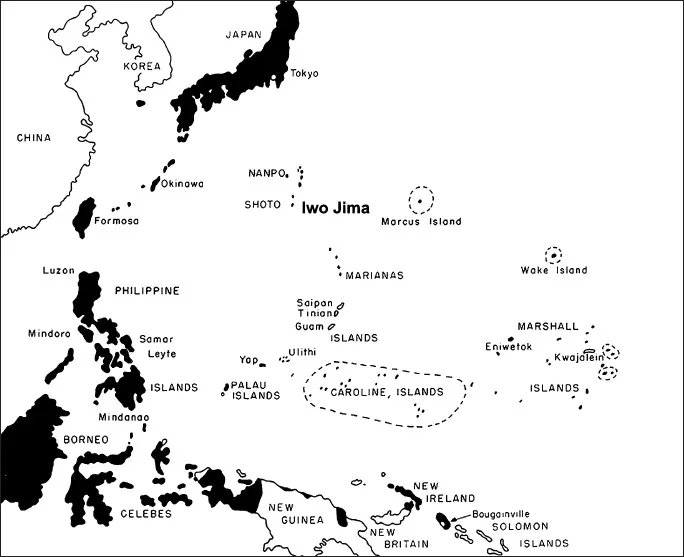
The Bonin Islands were colonized by Japan in the mid-nineteenth century. However, seafarers from Spain, Great Britain, Russia and Japan had sailed past and noted the islands from as early as the mid-sixteenth century.
The civilian population, who were all of Japanese descent, lived mostly on the central and northern part of the island. Government signs were erected around the island in 1937 warning visitors that trespassing, surveying, photographing, sketching, modeling, etc, without previous official permission was prohibited under Japanese military secrets law and that any offender would be punished. In 1943 the population on Iwo Jima numbered 1,091. Many were engaged in working at a sugar processing plant and a sulphur refinery. Others worked as fishermen and farmers. Rice, the staple diet of the Japanese, could not be grown and had to be imported. Drinking water was obtained by catching rain water in concrete cisterns. The civilian population was evacuated in June 1944 when preparations to defend the island commenced. Some of the male population remained, however, as a result of being conscripted to work on the island’s defences. It was to become a fortress with no escape for most of the Japanese defenders.
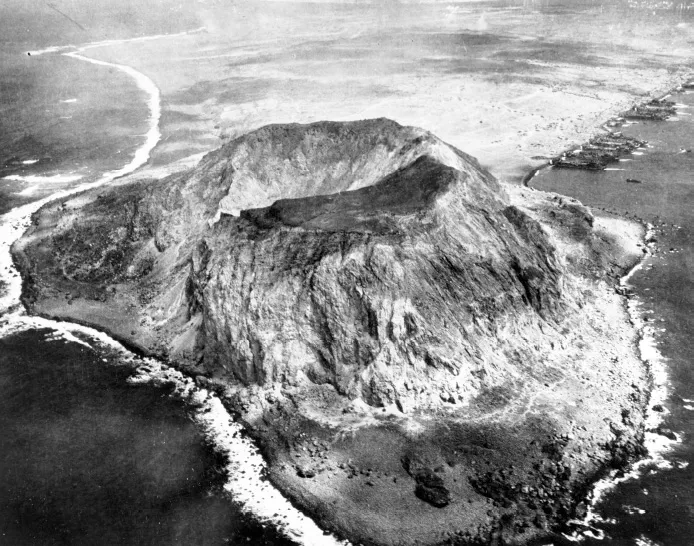
Iwo Jima seen from the southern part of the island. The dormant volcano known as Mount Suribachi can be seen in the foreground. Rising to approximately 550ft, it dominates the island. The summit of the volcano is approximately the same height as the Washington Monument or the Post Office Tower in London. (USN)
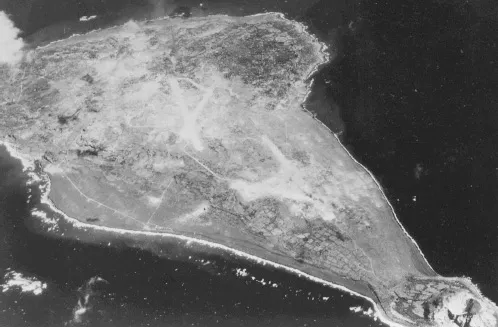
The island viewed from the south-west. Taken before the invasion began, the Japanese’ two airfields in the centre of the island can be seen. A patchwork of fields can also be made out around the southern tip of the island. These would be destroyed by the massive preliminary bombardment by air and sea, which started in June 1944 and ended with the intensive three-day period prior to the assault and subsequent bombardment supporting the assault on the island. (USN)
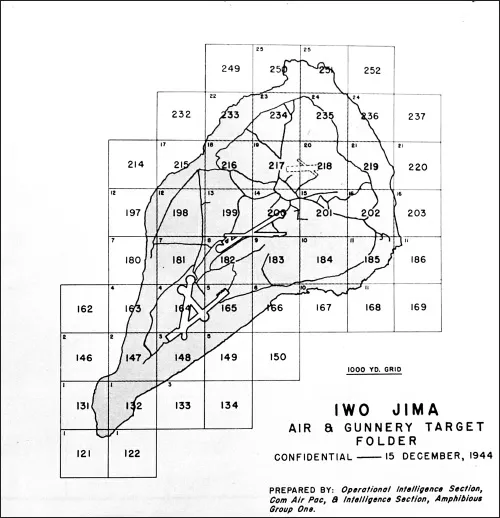
An important part of the preliminary assault preparations was intelligence work to identify the defences on Iwo Jima. This was carried out using air photography and air photography interpretation. The island was divided into grid squares to define the location of defences and to allow these to be destroyed by bombardment from the sea and the air. This map shows the main grid square locations. Each of these squares were broken down into twenty-five smaller squares identified by an A–Y suffix.
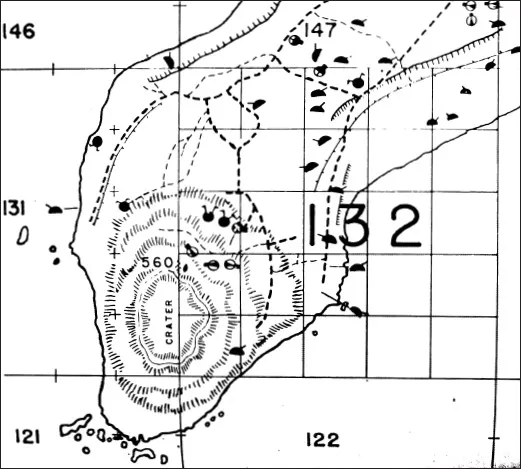
This map details part of the area around Mount Suribachi. Detailed as grid square ‘132’, the twenty-five subdivision grid squares can be seen.
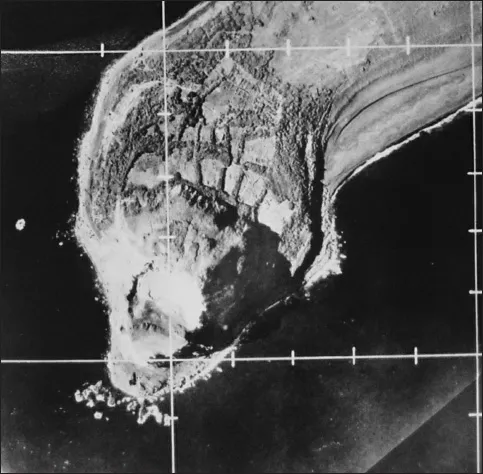
Each defined map area was accompanied by an aerial photograph. This image covers the same area to accompany the map of grid square ‘132’.
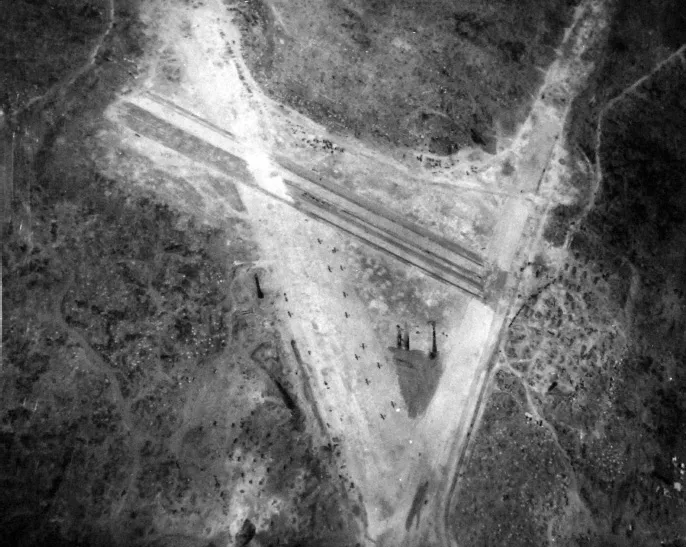
One of the many air photo reconnaissance photos taken prior to the assault on Iwo Jima details the southern end of Motoyama No.1 Airfield. Aircraft can be seen ranged on the airfield. Extensive preliminary bombardment eventually made it impractical for the Japanese to operate aircraft from Iwo Jima, and the last organized supply flight occurred on 10 February 1945. Five Mitsubishi G4M Betty bombers few in supplies and evacuated wounded men. Whilst on the ground they were attacked by six P-38 fighters of the 19th and 333rd fighter squadrons of the US 7th Air Force, which were conducting a photo reconnaissance and fighter sweep over the island. Two of the bombers were shot down and another damaged. (USN)
The architect of the defences of Iwo Jima was Lieutenant-General Tadamichi Kuribayashi. A pragmatic, experienced and professional soldier, Kuribayashi had served as deputy military attaché to Washington, D.C. in 1928.
Over a period of eight months, under his direction the island was turned into a formidable defensive fortress comprising of extensive subterranean facilities, more than 900 major gun installations and several thousand different types of defensive fighting positions.
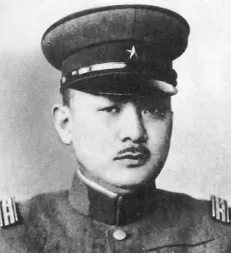
The brilliance of Kuribayashi’s defensive plan for the island is hard to overestimate. Each of Iwo Jima’s cross-island defensive belts contained several ‘anchor’ hills or ridges that had been hollowed out with reinforced caves, barracks, undetectable pillboxes, and blockhouses with multiple entrances. Positions in and around these anchor defenses were connected by subterranean passageways. Kuribayashi had hoped to dig seventeen miles of tunnels, connecting all of his defense sectors deep underground, but our arrival interrupted his work in progress. About eleven miles had been completed when we landed. The system allowed for the defenders when attacked from one direction to quickly shift to alternative positions; they could then lay down fire on the rear and flanks of the attackers. The approaches to these anchor defenses were also covered by mutually supporting machine-gun nests and riflemen hidden in spider holes.
Major General Fred Haynes USMC Retd.
General Kuribayashi planned to defend the island using a strategy of attrition. The enemy was not to be engaged whilst on the beaches, but when he came across the multiple defences behind the beaches. There would also be no suicidal charges (sometimes referred to as ‘General Attacks’). He regarded these as wasteful and self-defeating.
To the defenders of Iwo Jima, he issued a document titled The Oaths of Combat. This stated:
1)We will wield all of our strength to protect this island.
2)We will carry explosives and pulverize the enemy tanks into dust.
3)We will rush into the enemy’s midst as kirikoni-tai (a type of quick, rushing attack) to annihilate them.
4)We will hit our targets, killing an enemy with each shot.
5)We will not die until we have each taken ten enemy lives.
6)We will hold out using guerrilla warfare to harass the enemy.
A realist, Kuribayashi realized that there would be no victory for the Japanese garrison. For most it would be their tomb.
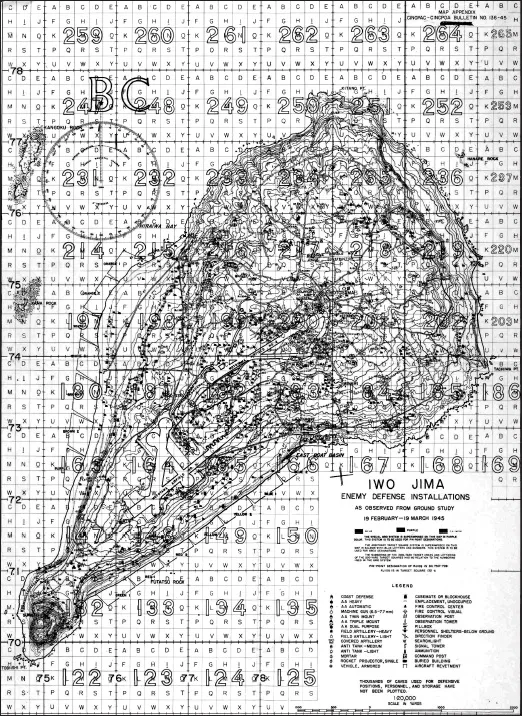
The scale of the Japanese defences can be seen from this map created as part of a ground study. Hundreds of positions have been plotted. The location of these defences utilized the terrain to provide interlocking fields of fire.
Chapter Two
The Photographers
Many of the images in this book were taken by United States Marine Corps combat cameramen. Marines first, cameramen second, they landed and took part in action at Iwo Jima. Approximately sixty marine combat cameramen landed with the US Marines. One of these cameramen was United States Marine Corps Staff Sergeant William Homer ‘Bill’ Genaust, pictured left in the image below on Iwo Jima with Corporal Atlee S. Tracey.
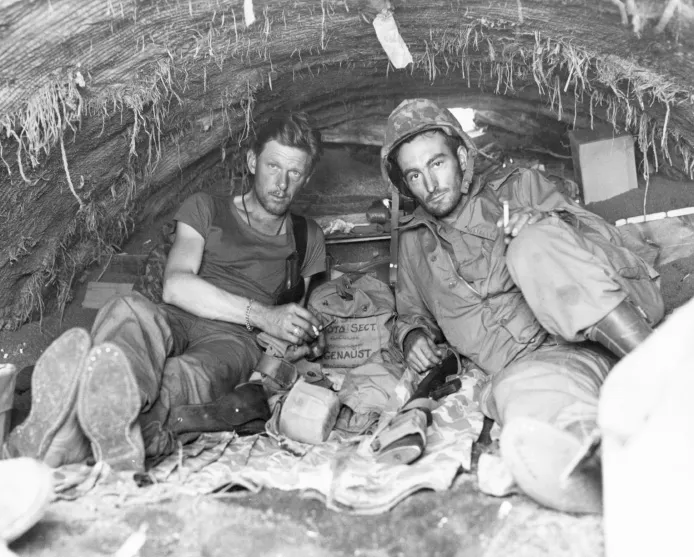
Bill Genaust enlisted in the Marine Corps on 11 February 1943. After training as a Marine at Quantico, Virginia, he went on to become a Marine Corps still photographer and motion picture camera photographer. Bill served with the Marines during the invasion of Saipan in July 1944 and was wounded in the leg. After an eight-month recovery period, he was given the chance of going home, but elected to stay and volunteered to take part in the amphibious assault on Iwo Jima. Bill landed on Iwo Jima with the 4th Marine Division on 19 February 1945, and captured what are now considered iconic moving picture images.
On 23 February a forty-man patrol consisting primarily of members of Third Platoon, Company E, 2nd Battalion, 28th Marines, 5th Marine Division led by 1st Lieutenant Harold Schrier climbed to the summit of Mount Suribachi and secured an American flag. This moment was captured by US Marine Corps Staff Sergeant Louis Lowery. A second larger flag was raised on Mount Suribachi later on the same day – this moment, captured as a still image by Associated Press photographer Joe Rosenthal, would become one of the iconic images of the battle for Iwo Jima. Bill Genaust was present during the second flag raising and captured the moment using colour cine film. Bill was later killed on Iwo Jima on 4 March by enemy small arms fire whilst entering a cave. His body has never been recovered. He was posthumously awarded a Bronze Star for his part in action during a firefight on Saipan on 9 July 1944. He was recommended for the Navy Cross by his photo section commander, but the nomination was turned down because Genaust was a cameraman and not an infantryman. Bill is commemorated along with 28,809 US servicemen listed as missing in action on the Honolulu Memorial in Hawaii.
The images captu...
Table of contents
- Cover
- Title
- Copyright
- Contents
- Introduction
- Chapter 1: The Island
- Chapter 2: The Photographers
- Chapter 3: Preparation
- Chapter 4: The Preparatory Bombardment
- Chapter 5: The Run-in
- Chapter 6: On the Beach
- Chapter 7: The Battle for the Island
- Chapter 8: Consolidation
- Chapter 9: The Human Cost
- Chapter 10: Faces of Iwo Jima
- Chapter 11: The Japanese
- Chapter 12: Strike Base and Safe Haven
- Chapter 13: Aftermath
- Chapter 14: Iwo Jima Today
- Appendix I: Key Dates Relating to the Battle of Iwo Jima
- Appendix II: V Amphibious Corps Order of Battle
- Appendix III: Weapons: Number, Type and Calibre Used During the Assault on Iwo Jima
- Appendix IV: Casualty Dedication
- Appendix V: Saved by Iwo Jima
Trusted by 375,005 students
Access to over 1.5 million titles for a fair monthly price.
Study more efficiently using our study tools.
Frequently asked questions
Yes, you can cancel anytime from the Subscription tab in your account settings on the Perlego website. Your subscription will stay active until the end of your current billing period. Learn how to cancel your subscription
No, books cannot be downloaded as external files, such as PDFs, for use outside of Perlego. However, you can download books within the Perlego app for offline reading on mobile or tablet. Learn how to download books offline
Perlego offers two plans: Essential and Complete
- Essential is ideal for learners and professionals who enjoy exploring a wide range of subjects. Access the Essential Library with 800,000+ trusted titles and best-sellers across business, personal growth, and the humanities. Includes unlimited reading time and Standard Read Aloud voice.
- Complete: Perfect for advanced learners and researchers needing full, unrestricted access. Unlock 1.5M+ books across hundreds of subjects, including academic and specialized titles. The Complete Plan also includes advanced features like Premium Read Aloud and Research Assistant.
We are an online textbook subscription service, where you can get access to an entire online library for less than the price of a single book per month. With over 1.5 million books across 990+ topics, we’ve got you covered! Learn about our mission
Look out for the read-aloud symbol on your next book to see if you can listen to it. The read-aloud tool reads text aloud for you, highlighting the text as it is being read. You can pause it, speed it up and slow it down. Learn more about Read Aloud
Yes! You can use the Perlego app on both iOS and Android devices to read anytime, anywhere — even offline. Perfect for commutes or when you’re on the go.
Please note we cannot support devices running on iOS 13 and Android 7 or earlier. Learn more about using the app
Please note we cannot support devices running on iOS 13 and Android 7 or earlier. Learn more about using the app
Yes, you can access The Battle of Iwo Jima by Mark Khan in PDF and/or ePUB format. We have over 1.5 million books available in our catalogue for you to explore.