- 64 pages
- English
- ePUB (mobile friendly)
- Available on iOS & Android
eBook - ePub
About this book
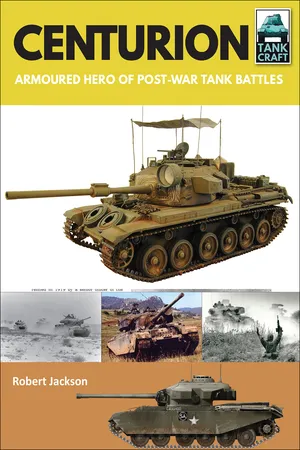
The fifty-ton British Centurion tank, developed during the darkest days of the Second World War, was designed to outgun and outperform the latest German tanks, such as the formidable Panzer V Panther. It was one of the most successful tanks ever produced, and this volume in the TankCraft series by Robert Jackson is the ideal introduction to it.The Centurion came into service too late to test its ability in action with German armor, but in the postwar world it earned a fearsome reputation in action during the many conflicts of the Cold War era, from the Middle East to Vietnam. Nearly 4,500 were built, serving with the armies of some twenty nations. The Centurions chassis was also adapted to fulfill a variety of tasks, including armored recovery, bridge-laying and guided weapons carrier.As well as tracing the history of the Centurion, Robert Jackson's book is an excellent source of reference for the modeler, providing details of available kits and photographs of award-winning models, together with artworks showing the color schemes applied to these tanks. Each section of the book is supported by a wealth of archive photographs.
Trusted by 375,005 students
Access to over 1.5 million titles for a fair monthly price.
Study more efficiently using our study tools.
Information
In Service and In Action
When the Centurion entered service in 1946, the forces of the western allies had already embarked on a programme of rapid demobilization that would only be reversed in 1948, when the Russians – who still maintained substantial forces in their zone of occupation and elsewhere in eastern Europe – closed the access routes to Berlin and precipitated a massive air resupply operation that became known as the Berlin Airlift. During this period, the main Soviet medium tank was still the T-34/85, which had spearheaded the drive to the German capital in 1945. The Centurion would easily have been able to cope with the T-34, but another Soviet tank, the heavy IS-3, with its 122mm gun, would have presented an altogether more difficult problem. To counter it, the British developed the 65-ton Conqueror, armed with a 120mm gun, and the two served alongside one another for a decade from 1955 in the British Army of the Rhine (BAOR). The weight of the Conqueror, however, meant that it was slow, and in addition many river bridges in Germany were incapable of supporting it. Apart from its hitting power, it offered no advantage over the Centurion, and the last examples were withdrawn in 1966.
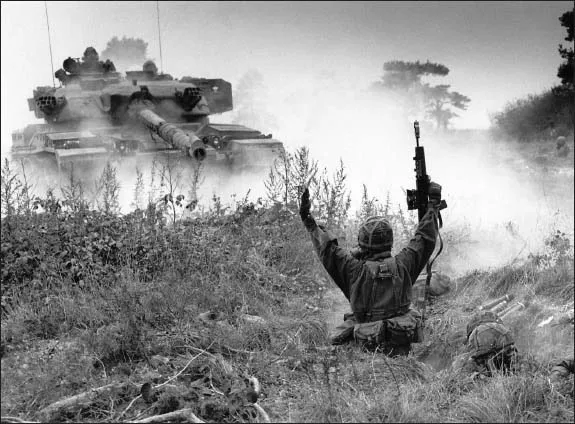
The receiving end! ‘Enemy’ troops surrendering at gunpoint to a BAOR Centurion during an exercise in Germany.
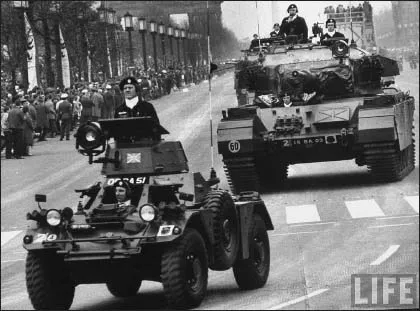
The Centurion served the British Army of the Rhine well during the most dangerous years of the Cold War. Led by a Ferret scout car, this Centurion is seen on parade in West Berlin.
By the mid-1950s, the majority of European armies assigned to NATO had rearmed with the Centurion under the auspices of the U.S. Mutual Defense Assistance Pact, and all were subjected to ongoing upgrades following the deployment of a formidable new Soviet main battle tank, the T-54/55. Yet when the Centurion went into action, it was to be in regions far remote from the plains of Central Europe
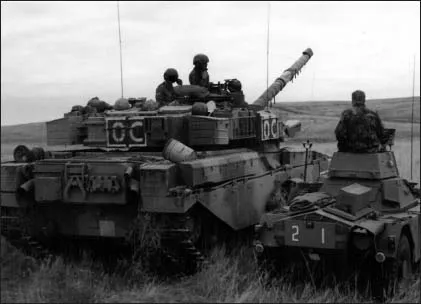
A Centurion on exercise, with an umpire in a Ferret scout car keeping a watchful eye on proceedings.
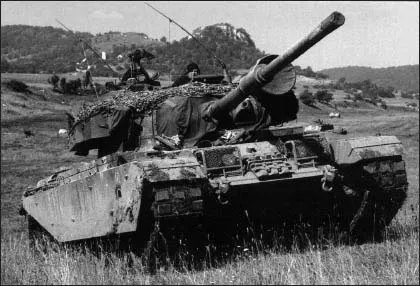
A Centurion on exercise with the British Army of the Rhine. Constant operational practice with other NATO nations was the key to successful defence against the ongoing threat from the Warsaw Pact.
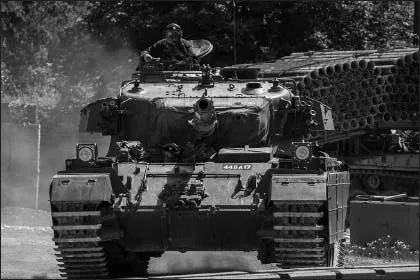
Built as a Mk XII, this Centurion entered service in 1955 and was converted to AVRE standard in 1981.
The Korean War
On 11 October 1950, three squadrons of the 8th King’s Royal Irish Hussars, which then formed part of the Strategic Reserve at Tidworth with Centurion Mk III tanks, sailed from Southampton on the HMT Empire Fowey and deployed to Korea to support the 29th Commonwealth Brigade. They disembarked at the port of Pusan on 14 November and headed for the battlefront north of Pyongyang, but were forced to retreat, along with other United Nations forces, in the face of massive enemy attacks. They regrouped on the Han River, where, during the bitter winter of 1950/1, operating in sub-zero temperatures, they experienced the rigours of winter warfare: their tanks had to be parked on straw to prevent the steel tracks from freezing to the ground. Engines had to be started every half hour, with each gear being engaged in turn to prevent them from being frozen into place.
During this period it was decided to return A and B squadrons of the 8th Hussars to the UK, and until they were rushed back from Japan it was C Squadron that was left to bear the brunt of the fighting when, on the night of 22 April 1951, communist forces launched a massive offensive all along the front. The Chinese scored an early success when, striking hard at the weakest part of the Allied line, they cut the Republic of Korea (ROK) 6th Division to pieces, leaving a dangerous gap between the U.S. Marine Division on its right flank and the 24th Infantry on the left. It was now clear that the main Chinese objective was to isolate Seoul with an enveloping movement from the north and northeast. On 26 April the Chinese offensive was checked in the eastern sector by the 27th Commonwealth Brigade and the attention now switched to the west, where six Chinese armies were throwing everything they had into a bid to reach the South Korean capital. The main weight of the offensive here fell on the British 29th Brigade, which held a 12,000-yard front and defended the vital river crossings over the Imjin River. The epic stand of the 29th Brigade – and particularly that of the 1st Battalion the Gloucester Regiment on Hill 235 above the hamlet of Solma-ri – has gone down in history. The brigade held on for three days against overwhelming odds before a general withdrawal was ordered to new positions north of Seoul. This holding action not only saved the left flank of the Eighth Army’s I Corps, making possible an orderly withdrawal down the road to Seoul, it also disrupted the entire timetable of the Chinese offensive, robbing it of its momentum. In addition, during three days of savage fighting, the 29th Brigade had destroyed an entire Chinese division.
None of this would have succeeded without the heroic action of the 8th Hussars, whose Centurions engaged the attacking Chinese over a period of several days in order to prevent the enemy from capturing the high ground defended by the infantry, the tanks making several sorties into overrun positions to rescue infantrymen who had been cut off by the Chinese advance. One British tank commander, Richard Napier, in his book From Horses to Chieftains, recalled: “The Chinese had infiltrated behind them and were swarming around them, shooting at the infantrymen on the tank. The crew resorted to lobbing grenades out of the hatches at the mass of Chinese infantry. On one occasion, the Centurion tanks of the 8th were swamped by Chinese soldiers who were attempting to prise open the hatches to throw grenades inside. The response of the Irish Hussars was to turn the turrets of their tanks towards each other, and ‘hose’ the enemy off with their Besa machine guns.”
In July 1951 the British Commonwealth forces in Korea, including the 8th Hussars, were banded together in a new formation designated the 1st Commonwealth Division, made up of fifty-eight per cent British forces, twenty-two per cent Canadian, fourteen per cent Australian, five per cent New Zealand and one per cent Indian. It formed an important component of the U.S. I Corps, which also included the U.S. 1st Cavalry Division, the U.S. 3rd and 25th Infantry divisions, and the ROK 1st Division. The division occupied the strategically important sector of front stretching from the Kimpo peninsula on the Yellow Sea coast to a point east of Kumhwa thirty miles from the South Korean capital, Seoul.
In December 1951 the 8th Hussars were relieved by the 5th Royal Inniskilling Dragoon Guards, and in November 1952 their Centurions, supporting the Black Watch, played a key part in driving Chinese forces from a position known as The Hook. In the following month the Inniskillings were in turn relieved by the 1st Royal Tank Regiment and redeployed to the Suez Canal Zone, just before its handover to the Egyptian government.
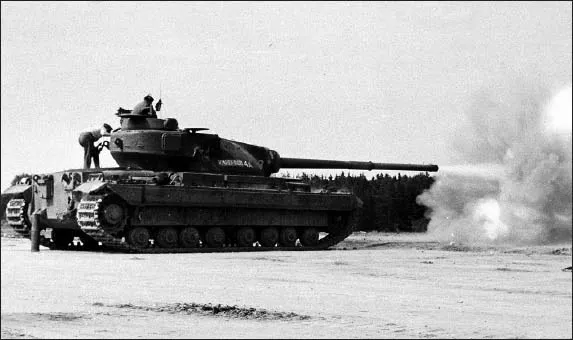
A Conqueror firing its 120mm main gun.
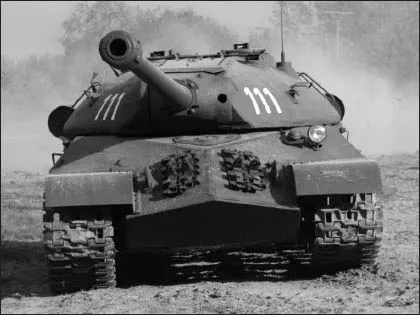
The formidable IS-3 presented a new challenge to NATO armoured forces. It retained the 122mm gun of the earlier IS-2 but had a redesigned, more rounded turret resembling an upturned soup bowl. The IS tanks were the spearhead of the final assault on Berlin in April 1945, their power and protection enabling them to break through the enemy defensive barriers.
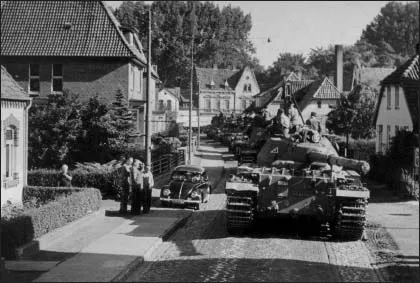
The Conqueror was developed in response to the threat posed by Soviet heavy armour like the IS-3, but apart from its firepower it offered no real advantage over the Centurion. The tank’s size made negotiating narrow roads difficult, like this one passing through a German village.
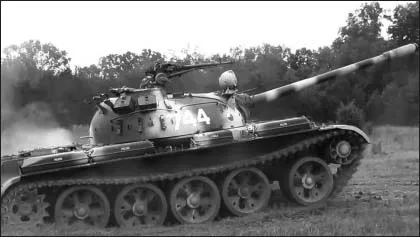
The Soviet T-55 main battle tank, seen here in Czech markings, remained the Centurion’s most formidable opponent throughout much of the British tank’s operational life.
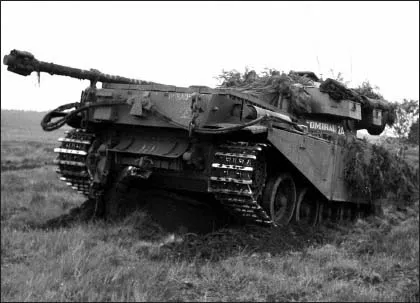
A heavily camouflaged Centurion of the 8th King’s Royal Irish Hussars, Korea.
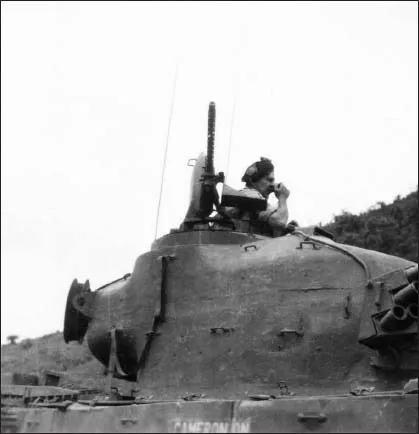
Centurion Mk III in Korea, showing commander’s position and smoke launchers.
Suez 1956: Operation Musketeer
Operation Musketeer, the Anglo-French land, sea and air operation launched in October and November 1956, was in response to Egyptian President Nasser’s seizure of British and French assets in the Suez Canal Zone earlier in the year. Much emphasis was laid on cooperation with tanks, as the plan called for the landing of an armoured regiment with the assault force. Since it was not t...
Table of contents
- Cover
- Title
- Contents
- Copyright
- Introduction
- Development and Design
- Centurion in Detail
- The Centurion in Foreign Service
- Camouflage and Markings
- Model Showcase
- Modelling Products
- Centurion Armoured Engineer Vehicles
- In Service and In Action
Frequently asked questions
Yes, you can cancel anytime from the Subscription tab in your account settings on the Perlego website. Your subscription will stay active until the end of your current billing period. Learn how to cancel your subscription
No, books cannot be downloaded as external files, such as PDFs, for use outside of Perlego. However, you can download books within the Perlego app for offline reading on mobile or tablet. Learn how to download books offline
Perlego offers two plans: Essential and Complete
- Essential is ideal for learners and professionals who enjoy exploring a wide range of subjects. Access the Essential Library with 800,000+ trusted titles and best-sellers across business, personal growth, and the humanities. Includes unlimited reading time and Standard Read Aloud voice.
- Complete: Perfect for advanced learners and researchers needing full, unrestricted access. Unlock 1.5M+ books across hundreds of subjects, including academic and specialized titles. The Complete Plan also includes advanced features like Premium Read Aloud and Research Assistant.
We are an online textbook subscription service, where you can get access to an entire online library for less than the price of a single book per month. With over 1.5 million books across 990+ topics, we’ve got you covered! Learn about our mission
Look out for the read-aloud symbol on your next book to see if you can listen to it. The read-aloud tool reads text aloud for you, highlighting the text as it is being read. You can pause it, speed it up and slow it down. Learn more about Read Aloud
Yes! You can use the Perlego app on both iOS and Android devices to read anytime, anywhere — even offline. Perfect for commutes or when you’re on the go.
Please note we cannot support devices running on iOS 13 and Android 7 or earlier. Learn more about using the app
Please note we cannot support devices running on iOS 13 and Android 7 or earlier. Learn more about using the app
Yes, you can access Centurion by Robert Jackson in PDF and/or ePUB format, as well as other popular books in History & Military & Maritime History. We have over 1.5 million books available in our catalogue for you to explore.