eBook - ePub
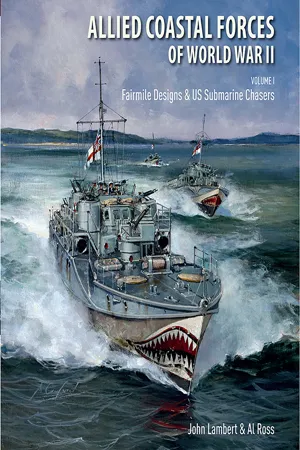
Allied Coastal Forces of World War II: Volume I
Fairmile Designs & US Submarine Chasers
- 256 pages
- English
- ePUB (mobile friendly)
- Available on iOS & Android
eBook - ePub
Allied Coastal Forces of World War II: Volume I
Fairmile Designs & US Submarine Chasers
About this book
The major contribution made by Coastal Forces to the Allied war effort has had surprisingly little coverage in the literature of the Second World War. Motor torpedo boats, PT boats, motor gunboats, launches and submarine chasers served with distinction throughout the War, and in every theatre. They performed invaluable service as patrol boats, convoy escorts, minelayers and minesweepers, harbour defence vessels, light landing craft, RAF rescue boats and transports for agents and clandestine missions.Allied Coastal Forces, now a recognised classic work and first published in 1990, remains the only publication to deal comprehensively in words, photographs and drawings with the technical detail of all these boats. Design, construction and subsequent development are all covered, and the builders, construction lists, fates and the technical data are given for each type. Separate sections cover armament and equipment, sea-going qualities and habitability.This first volume covers all the designs of the Fairmile Marine Company (including those craft built and equipped for Canada), together with the 72ft Harbour Defence Motor Launch and the US Navy 110ft subchaser.The authors, firmly established as the recognised authorities on small warships, unearthed a remarkable body of information now included in this major work, and their finely detailed drawings, redrawn form original builders plans, offer an unparalleled view of all these remarkable designs. The new editions of their work will be welcomed by naval enthusiasts and modellers alike.
Information
The Fairmile A type motor launch
The Fairmile A type was designed before war was declared, by Norman Hart, on the instructions of Noel Macklin. The hull form was based on that of the fishery protection boat Vaila, but no armament was indicated in the original proposal.
When the Admiralty declined to place an order, Macklin, convinced that his ideas for mass-production were sound, and that wooden motor launches would indeed be required in some numbers, undertook to have her built himself. She was ordered on 27 July 1939 from Woodnutt’s boatyard in St Helens, across from Bembridge on the Isle of Wight. Her keel was laid on 29 October.
While the prototype was still incomplete (and thus before sea trials had begun), the Admiralty had a change of heart. A severe shortage of anti-submarine motor launches was acknowledged. The Admiralty ordered twenty-four A type motor launches on 22 September 1939, soon after war was declared. Only after trials of the B had proven it to be far superior was the order for the A type reduced to twelve units.
Despite the rapid implementation of a vast training programme, to add these new craft to the operational fleet, ML 100 was not accepted until 19 May 1940, to be followed by her close sister ML 101 nine days later. (In fact ML 101 completed on 21 March, two months earlier, but was not accepted until steering problems were resolved.)
No official records exist, but part of the reason for the late commissioning of ML 100 was the fact that, as built originally, she had only a single rudder on the centreline; this can be verified from her original general arrangement drawings. It was found on sea trials that such a centre, skeg-supported rudder gave a very poor turning circle, especially in a triple-screwed vessel (which any big ship naval architect could have pointed out). ML 100 was modified by fitting two small balanced rudders in the wake of the two wing propellers, which improved matters, although not greatly. The centreline skeg, supporting the centre screw shaft, was also reduced. The design still had too much lateral stability, and the As apparently remained very difficult to manoeuvre at slow speed, and not much better even at speed.
The Coastal Forces Veterans Association official historian, Geoffrey Hudson, suggests that certain As had only two Hall-Scott engines fitted on completion, presumably due to non-delivery of engines from the USA. This was rectified as soon as possible when supply improved, or at least by the first refit period.
The twelve units were, with two exceptions, all constructed at different British yards, which accounts for slight differences within the class. (Woodnutt built two, 100 and 102, and James A Silver Ltd of Rosneath constructed Nos 101 and 111.) Notable were differences in the bridge layout. The original design specified a small ‘monkey’s island’ behind and above the very roomy wheelhouse, with a compass for the officer of the watch to con the ship simply via a voicepipe to the ship’s wheel and telegraph below. (Engine revolutions were also voicepiped to the engineroom). Later, larger and grander...
Table of contents
- Cover
- Title
- Copyright
- Contents
- Foreword
- Author’s note
- Acknowledgements
- Abbreviations
- The Fairmile Marine Company
- Equipment and training organisations
- The vessels
- Equipment and details
- Selected weapons systems
- Additional data
- Appendices
- Bibliography
- Plate section
Trusted by 375,005 students
Access to over 1.5 million titles for a fair monthly price.
Study more efficiently using our study tools.
Frequently asked questions
Yes, you can cancel anytime from the Subscription tab in your account settings on the Perlego website. Your subscription will stay active until the end of your current billing period. Learn how to cancel your subscription
No, books cannot be downloaded as external files, such as PDFs, for use outside of Perlego. However, you can download books within the Perlego app for offline reading on mobile or tablet. Learn how to download books offline
Perlego offers two plans: Essential and Complete
- Essential is ideal for learners and professionals who enjoy exploring a wide range of subjects. Access the Essential Library with 800,000+ trusted titles and best-sellers across business, personal growth, and the humanities. Includes unlimited reading time and Standard Read Aloud voice.
- Complete: Perfect for advanced learners and researchers needing full, unrestricted access. Unlock 1.5M+ books across hundreds of subjects, including academic and specialized titles. The Complete Plan also includes advanced features like Premium Read Aloud and Research Assistant.
We are an online textbook subscription service, where you can get access to an entire online library for less than the price of a single book per month. With over 1.5 million books across 990+ topics, we’ve got you covered! Learn about our mission
Look out for the read-aloud symbol on your next book to see if you can listen to it. The read-aloud tool reads text aloud for you, highlighting the text as it is being read. You can pause it, speed it up and slow it down. Learn more about Read Aloud
Yes! You can use the Perlego app on both iOS and Android devices to read anytime, anywhere — even offline. Perfect for commutes or when you’re on the go.
Please note we cannot support devices running on iOS 13 and Android 7 or earlier. Learn more about using the app
Please note we cannot support devices running on iOS 13 and Android 7 or earlier. Learn more about using the app
Yes, you can access Allied Coastal Forces of World War II: Volume I by John Lambert,Al Ross in PDF and/or ePUB format, as well as other popular books in History & Military & Maritime History. We have over 1.5 million books available in our catalogue for you to explore.