- 256 pages
- English
- ePUB (mobile friendly)
- Available on iOS & Android
eBook - ePub
About this book
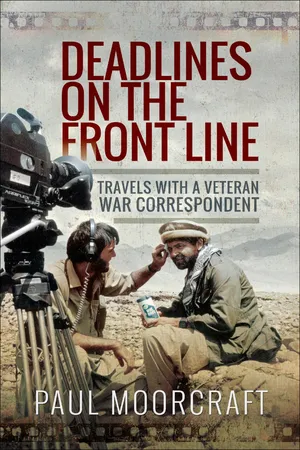
The author of this gritty memoir has lived life to the full and fortunately has the ability to recall his experiences in a graphic and entertaining manner.As a war correspondent and paramilitary policeman, Moorcraft was a magnet for drama and action. His descriptions of sometimes tragic and often hilarious escapades in war torn countries literally from A (Afghanistan) to Z (Zimbabwe) are self-effacingly entertaining. His light-hearted approach disguises a thoroughly perceptive and analytical mind. The reader will never be bored while accompanying Moorcraft reporting on wars in over thirty combat zones in Africa, Asia, the Middle East and Europe. This is his book of hazardous travels to strange, often little-known places meeting even stranger people who were often all too keen to lock him up or try and kill him.Deadlines on the Frontline is a delightful and invigorating read which offers an intelligent insight into the turbulent world of the late 20th and early 21st centuries
Trusted by 375,005 students
Access to over 1.5 million titles for a fair monthly price.
Study more efficiently using our study tools.
Information
Chapter 1
The Story so Far
I can’t really explain how I started on my long journey without maps. Despite my deep roots in Wales, perhaps I became addicted to exile, to always being a foreigner, a lone stranger in an unfamiliar setting. Maybe I found wandering more stimulating than belonging.
I began with all the keyboard courage of an academic. My degrees in politics and defence studies were of no practical use. True, I had been a senior civilian instructor teaching war studies at the Royal Military Academy, Sandhurst, where I played rugby, rode horses, and did some shooting, all equally badly. But I was the proverbial round peg in a square hole, almost convinced that I was the only sane man in a lunatic asylum. Looking back, Sandhurst appeared to be Hogwarts with lots of guns. One of the more polite names I was called in the officers’ mess was ‘rebel’. So moving back to Israel and then to a rebel colony, Rhodesia, seemed appropriate: I wanted to experience war, not talk about it.
I had first visited Israel in 1970 to indulge in an idealistic Kibbutz adventure. I returned to the country in 1975, funded by a scholarship to study the aftermath of the 1973 Yom Kippur war. I had some help from the Hebrew University, Jerusalem, and from General Arik Sharon, the then prime minister’s security adviser. I also took a few months off while I was there to enjoy the best job I ever had: working as a life-guard at a swimming pool. I did little except admire the tough gun-toting Lolitas from the Israeli army as they changed personality and became minxy civilians in bikinis.
I became interested in the idea of comparative siege cultures to include Israel, Rhodesia and South Africa, which I planned to work up into a doctoral thesis. My next trip would be to southern Africa.
The lure of Africa – Rhodesia
‘Rhodesia is a well-armed suburb masquerading as a country.’ The first sentence I ever wrote about the place just about summarized my political views on the rebel colony. I was intellectually curious about the rebellion against the British Crown. How could the white Rhodesians, outnumbered by blacks 25 to one and ostracized by the world, hang on to power for so long? How could they argue with arithmetic? Rhodesia and more especially South Africa had almost ceased to be geographical entities. To the outside world they were more a condition, a disease. South Africa was no longer a country but a map of the mind, in which anyone could find his/ her own place. What’s more, as a boy I had been seduced by the African tales of writers like Henry Rider Haggard. As a student I had been touched by Africa’s apparent mysticism. Armed with conventional wisdom, curiosity, and just a touch of romanticism, I set out for the continent in March 1976.

At Jan Smuts airport in Johannesburg I was met by Andy Gancewicz, a big, aggressive, kind-hearted Pole with whom I had worked briefly on the Western Mail in Cardiff. Andy thought I was demented when I said I was thinking about travelling to Rhodesia.
‘There are lots of jobs here in Jo’burg. Why go to a place where the Afs are knocking the hell out of the whites? There’s a war on.’
‘That’s precisely why I want to go. To find out why.’
A letter arrived from the University of Rhodesia offering me an interview for a temporary post teaching politics. They included a return airfare to the capital, Salisbury. For the previous two weeks the road linking Rhodesia with South Africa had been closed because of guerrilla attacks.
‘You must be mad to teach politics in the middle of a civil war,’ Andy said. ‘I hear that the last five white politics lecturers were deported.’
‘If they want a lunatic, I have the right qualifications.’
*****
Despite the war, Rhodesia was a very friendly place. In my five years of travelling throughout the country both blacks and whites were almost always courteous and easygoing, with little of the sullen black resentment and white aloofness I had encountered in South Africa. The historian Lord Blake put it well: ‘Apartheid south of the Limpopo was a religion, north of it a dubious and impractical expedient.’
UDI — the Unilateral Declaration of Independence in 1965 — was both a bluff and a blunder. Except for a few hotheads, the Rhodesian armed forces would not have resisted a British military intervention. Rhodesia broke away from Britain to avoid black rule, but Prime Minister Ian Douglas Smith became totally dependent on a South African government that eventually became more determined than London to establish a moderate black leader in Salisbury. Faced with its own pressures in the 1970s, Pretoria sought to distance itself from Rhodesia’s failing white government, but also wanted to show that sanctions didn’t work and couldn’t be seen publicly to ditch a white ally.
Until 1976 Rhodesia’s diplomatic history was a long melodrama punctuated by angry encounters on ships and trains, foolish estimates, and silly superlatives. The country’s fate would be decided largely on the battlefield. White Rhodesians were sucked into a war that by the late 1970s they were manifestly losing: if the 1979 Lancaster House talks in London had not intervened, military defeat was around the corner. I spent most of my five years there trying to understand why the whites couldn’t see that they were bound to lose.
I stayed mainly in Salisbury, where roughly half the white population of around 240,000 lived. I did travel around the country on convoys, in helicopters, occasionally on horseback, and very occasionally on foot, but it was a difficult war to get to grips with. Even when I switched to fulltime writing, few journalists were allowed near the actual fighting. There were few ‘battles’ and most of these were in cross-border raids into Mozambique and Zambia. The war was mainly one of fleeting skirmishes and death from the air by way of ‘Fireforce’ helicopters. Short of actually enlisting or accepting conscription, few hacks (as journalists called themselves) witnessed any real action. So I hung around the press bar: falling off the high bar stools and risking the stale sandwiches were not entirely ignoble introductions to the Rhodesian art of war.
Salisbury, now renamed Harare, became my favourite city in Africa. Like many writers based there, I wrote books and articles full of righteous indignation about racial injustice; like them I lived well and enjoyed myself. Two friends who wrote for the most liberal British newspapers, the Guardian and the Observer, regularly thundered on about opulent white lifestyles while themselves sitting comfortably surrounded by servants, a pool, and a tennis court.

Salisbury, the capital of the rebel Rhodesian republic. Jameson Avenue in the 1970s. ‘My favourite city in Africa’.
You could live in Salisbury and see very little of the war. The city was mesmerized by the killing in the countryside and yet, paradoxically, seemed entirely untouched by it. Salisbury was simultaneously remote, charming, claustrophobic, and seductive.
The conversation was often about the ‘situation’ — the war — but the ambience was of the colonial heydays of the 1950s: squash at the club, bridge and tennis parties, cocktails at the Reps theatre bar, racing at Borrowdale, and endless dinner parties with servants to do the washing up. Rugby and cricket were important even though South Africa was the only opponent.
Yet the polite ‘business as usual’ was often a deliberate act of temporary oblivion, especially for the men. By the end of the war the military call-up extended to age 60. Some younger men spent ‘six months in, six months out’ of the army every year; some were on continuous call-ups. One-man businesses collapsed. Many urban wives concentrated on pottery and bridge, but the women on the farms lived with the everyday reality of mined roads, cattle-maiming, poisoned wells, attacks at night, the Agric-Alert security system warning of a guerrilla raid on the next-door farm, the crash of broken glass, the rattle of AKs, the rush of adrenalin and the dash for weapons besides the bed, shouting at the children to lie down in the corridor between the bedrooms, the smell of fear, cordite … and eventually the awful, sickly sweet, overpowering stench of death. It was on isolated farms, half-sleeping, listening, waiting for different sounds amidst the drumming of the cicadas, that I learned about bush war.
The TV and radio harped hypnotically on a few basic themes: the chaos in black states, disorders elsewhere in the world (especially in countries such as Britain that attracted southern African émigrés), and the monolithic communist threat. Smith claimed to have ‘the happiest blacks in the world’, bar a few troublemakers misled by professional Moscow-trained agitators. Few whites could put themselves in the shoes of blacks and realize that they would fight too if they were deprived of an effective vote, given inferior schooling, medical services, and land, and treated as second- or third-class citizens.
Although the whites did fight long and hard, and despite the ubiquitous weaponry and uniforms, Rhodesia was not a militaristic society. They much preferred beer and braais (barbecues) to military parades. Later, as black rule became imminent, the whites looked back with sorrow and resignation rather than anger; with a bruised pride in having survived so long against the odds. Few outsiders could doubt their courage, or their stupidity.
As I explored the inequality of life in Rhodesia, I began to understand the reasons for the war. From a liberal perspective in the UK, it was as though a giant local bowls club – Surrey with the lunatic fringe on top – was defying the world. In many ways Rhodesia was unsophisticated and behind the times, a living museum. Rhodesians tended to look back to the days when Britain was Great; before socialism, as they saw it, gutted the bulldog spirit.

Rhodesia in the colonial period.
I started to understand the Rhodesians’ love affair with the land — the rolling hills of Inyanga, the majestic wildlife, the mysterious balancing rocks, the crystal-clear, champagne quality of the air, the invigorating climate, the sense of space, the sensual perfume of jasmine in the suburban gardens, and the rugged wild aromas of the bush — but not with its native people. White Rhodesians paid more attention to their roses, their Currie Cup cricket, horses, dogs, and the level of algae in their pools than to the black people whose land they shared in unequal proportions. Rhodesia may have appeared boundless to the white man because his 5 per cent of the population owned 50 per cent of the agricultural land and all the political power. It could not last.
The whites tried to tame Africa in their own image. Wherever the British settled they planted trees and gardens, built churches with neat rows of pews, and ran lending libraries. In Rhodesia, throughout 1977 and early 1978, Ian Smith tried to design a very complicated and tidy constitutional settlement that would establish the kind of majority rule with which whites were prepared to live. In short, tame blacks.
A racial Armageddon looked possible, so in trooped the ‘vultures’ of the foreign press corps. The run up to the first multi-racial election in April 1979 brought a wave of hacks. The ‘Gang of Four’ — Smith and his ‘moderate’ black allies — wanted maximum publicity, so for once it was relatively easy to get press accreditation. It was a time of madness for Rhodesia: wild press parties were the order of the day. The hacks had lots of real money, US dollars and British pounds, and liked a good time. Most of the indigenous white males were ‘out in the bush slotting gooks’, so the press corps attracted hordes of bored local females, many of them tanned, blonde Amazons. This did nothing to improve relations between the soldiers and the press.

A Fire Force trooper, Mtoko, 1977. By Chris Dehon.
Then I received my call-up papers. Technically, male residents under 38 could be conscripted if they had lived for two years in the country; as I had become a resident only a few months before, I was not theoretically eligible for call-up. In one respect I was quite keen to see the war from the inside, but on the other hand I could not fight for a lost, and immoral, cause I didn’t believe in. Besides, I had just started stringing for Time magazine and been elected vice-chairman of the Press Club. Many resident journalists did serve part-time in the police, but I told the call-up board I would leave the country.
They said they would imprison me.
‘Try it,’ I said. ‘Great publicity just before your damn election.’
The next morning I received a letter which said a mistake had been made. I was given a year’s deferment.
The war went on. I criss-crossed the country on behalf of Time with Peter Jordan, a daredevil photographer. Peter and I were in a vehicle that could ford rivers and travel cross-country: a hire car. We were stopped once by the ‘terrs’, but luckily and surprisingly our press passes – and a lot of cigarettes – persuaded them to let us go.
I also managed to survive an unpowered landing in an air force Alouette helicopter, a brilliant piece of flying that saved my life. I also came out of a crash landing in a Dakota which had lost some of its landing gear. I was beginning to earn my spurs as a war correspondent.
I was young, fit and busy and lots of pretty girls fluttered around. The wine was terrible – you could get bilharzia from it, it was said – but the beer was good. To echo William Wordsworth, not only was I alive, but I was young in that revolutionary frenzy. I mourned the deaths, not least of my friends, but I was entering that potentially fatal zone for a young correspondent: I started to believe that I was invincible, that only the people to my left or right would get ‘their’ bullet. The first and only white correspondent killed in Rhodesia was my occasional squash partner, Lord Richard Cecil. His forebear, Lord Salisbury, lent his name to the capital. Ironically, as a former Grenadier Guards officer, he was the most militarily competent correspondent. Richard...
Table of contents
- Cover
- Title
- Copyright
- Contents
- What the Critics said about Paul Moorcraft’s Previous Books on Travels in War Zones
- About the Author
- Timeline
- Foreword
- Chapter 1 The Story so Far
- Chapter 2 European Interlude
- Chapter 3 Australasia
- Chapter 4 My Second Antipodean Base
- Chapter 5 Whitehall Warrior
- Chapter 6 Asian Sideshows
- Chapter 7 Africa’s Longest War
- Conclusion
Frequently asked questions
Yes, you can cancel anytime from the Subscription tab in your account settings on the Perlego website. Your subscription will stay active until the end of your current billing period. Learn how to cancel your subscription
No, books cannot be downloaded as external files, such as PDFs, for use outside of Perlego. However, you can download books within the Perlego app for offline reading on mobile or tablet. Learn how to download books offline
Perlego offers two plans: Essential and Complete
- Essential is ideal for learners and professionals who enjoy exploring a wide range of subjects. Access the Essential Library with 800,000+ trusted titles and best-sellers across business, personal growth, and the humanities. Includes unlimited reading time and Standard Read Aloud voice.
- Complete: Perfect for advanced learners and researchers needing full, unrestricted access. Unlock 1.5M+ books across hundreds of subjects, including academic and specialized titles. The Complete Plan also includes advanced features like Premium Read Aloud and Research Assistant.
We are an online textbook subscription service, where you can get access to an entire online library for less than the price of a single book per month. With over 1.5 million books across 990+ topics, we’ve got you covered! Learn about our mission
Look out for the read-aloud symbol on your next book to see if you can listen to it. The read-aloud tool reads text aloud for you, highlighting the text as it is being read. You can pause it, speed it up and slow it down. Learn more about Read Aloud
Yes! You can use the Perlego app on both iOS and Android devices to read anytime, anywhere — even offline. Perfect for commutes or when you’re on the go.
Please note we cannot support devices running on iOS 13 and Android 7 or earlier. Learn more about using the app
Please note we cannot support devices running on iOS 13 and Android 7 or earlier. Learn more about using the app
Yes, you can access Deadlines on the Front Line by Paul L. Moorcraft in PDF and/or ePUB format, as well as other popular books in History & Military Biographies. We have over 1.5 million books available in our catalogue for you to explore.