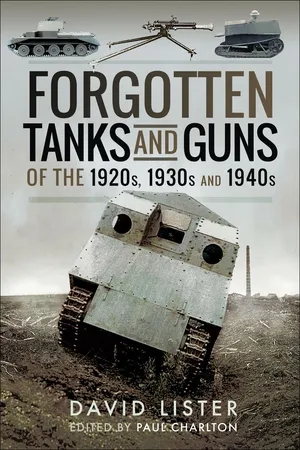
- 144 pages
- English
- ePUB (mobile friendly)
- Available on iOS & Android
eBook - ePub
Forgotten Tanks and Guns of the 1920s, 1930s and 1940s
About this book
History forgets. Files are lost and mislaid. But this book seeks to shine a light, offering a collection of cutting edge pieces of historical research detailing some of the most fascinating arms and armament projects from the 1920s to the end of the 1940s, nearly all of which had previously been lost to history.Included here are records from the UKs MI10 (the forerunner of GCHQ) which tell the story of the mighty Japanese heavy tanks and their service during the Second World War. Other chapters expand on the development of British armour, including the story of infantry tanks from the 1920s right through to the end of the Second World War and beyond.Other items placed beneath the microscope in this fascinating history include a wide variety of guns, rocket launchers, super heavy tanks and countless pieces of specialised armour. Previously overlooked, hidden under layers of dust in archives up and down the country, the histories of these objects has finally been uncovered.
Trusted by 375,005 students
Access to over 1.5 million titles for a fair monthly price.
Study more efficiently using our study tools.
Information
Chapter 1
Lurking in the Jungle
The work of an intelligence officer is not easy because of a mixture of enemy disinformation, the varying quality of material supplied to you and your own preconceived notions and prejudices. Take, for example, the subject of Japanese heavy tanks. The common perception today is that the Japanese heavy tank projects never progressed past a handful of experimental designs and one rather hopeful super-heavy project during the Second World War. Beyond that, it is commonly thought that the Japanese did not field any heavy tanks.
During the Second World War nearly every nation had some form of heavy tank, and it was known to the British, from reliable sources, that the Japanese had been experimenting on the class. It was expected that the Japanese would at some point start to use them, and British intelligence tried to keep a track on Japanese tank development.
Among the sources that fed information back to the UK was the British military attaché in Tokyo. One such report was about a Japanese tank exhibition between 10 and 16 February 1939. Held at the Yasukuni Shrine, the purpose was to allow the public to view tanks and armoured vehicles, some captured in China, others domestically built. The collection was drawn up in two rows on either side of the shrine and enclosed by barriers allowing people to get no closer than about six feet. Photography was banned and the area swamped with Kempeitai officers to make sure this was obeyed. The military attaché, Major T.G. Wards, however, visited the exhibition and filed a report on what he saw. Major Wards noted that, as a foreign observer, his actions were closely monitored and he was unable to give each tank more than a passing glance due to the presence of the Kempeitai.
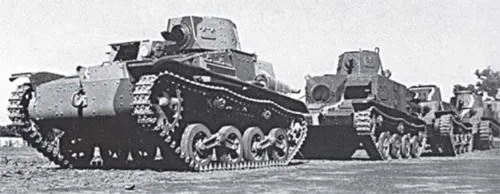
A line of tanks at a Japanese display, perhaps even the one at Yasukuni Shrine. The tank nearest the camera is a Type 94 tankette; next is a Type 92 heavy armoured car. The rearmost tank is a Type 89 of some variant, but in between it and the Type 92 is an unidentified tank. From the limited view of this picture it seems to match the Ishi 2598 (see Page 13).
The first exhibit was captured material, such as Chinese armoured cars, which were civilian trucks which had been armoured. Something referred to as an ‘Ansard’ light tank, which weighed three tons and had a crew of two and two machine guns, was possibly an Ansaldo CV.3, an Italian tankette.
Next came the Japanese tanks, starting with a heavy tank. The heavy tank Wards saw may have been the Experimental II with a main gun in both the turret and the hull, and a mini-turret at the rear housing a machine gun. One of the other exhibits was a Type 89 I-Go that had seen action in China. It had been taken under heavy small-arms fire and was claimed to have been hit about a thousand times.
After the war started sources became harder to come by. Intelligence officers had to make do with incomplete snippets of information, or information from prisoner of war interrogations. Some such interrogations seem to have muddied the waters, e.g. from these it appears that the Type 97 Chi-Ha was often mistaken for a heavy tank.
One prisoner of war was a lieutenant in the 1st Independent Mixed Regiment on Saipan, captured in July 1944. He stated that the Type 97 Chi-Ha had 15mm of armour and a twelve-cylinder diesel engine; his unit had trained on them in August 1941. He also claimed that all tanks had radios, air conditioning and twin 47mm guns, with one mounted in the standard turret and another in the hull and that they could fit thirty ammunition boxes in the tank, each box being 2-feet long, 1-foot tall and 1.5-feet wide. Finally, and most bizarrely, he claimed that, as well as one drive wheel at the front, it had two smaller drive wheels at the back, both 14 inches across. The intelligence report indicated that this might signify an earlier model suspension. The prisoner of war also gave a rundown of crew numbers: three men for this particular medium tank, two for a light tank and an unknown number for a heavy tank.
Another report was from a private who had been captured on Manus Island. Wounded, he sought help from natives who, unsurprisingly, promised to help but simply turned him over to the US forces sometime around 6 August 1944.
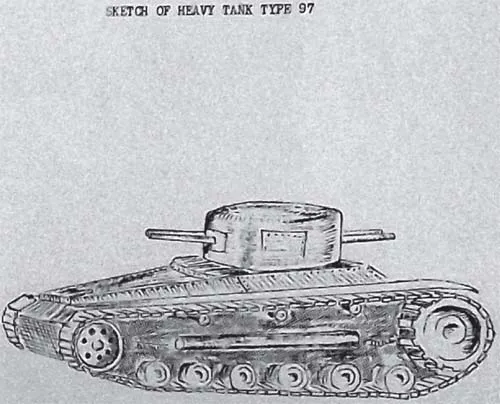
An example of a sketch drawn by a prisoner of war. This particular one accompanied the intelligence report about the Type 97 heavy tank.
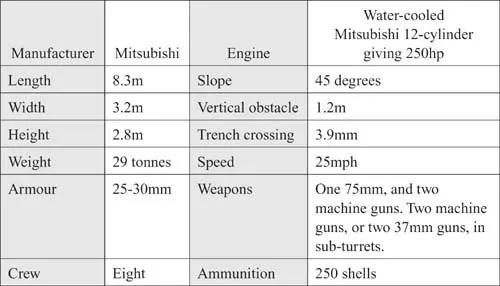
In civilian life he had been a foreman at the Hitachi forging plant at Kameari where he had been working up until at least November 1943. Whilst there, he had seen several of Japan’s heavy tank, the Type 97, and claimed that the Type 97 heavy was 22-feet long, 8.5-feet tall and 9-feet wide, weighing in at twenty-seven tons. Protected by 30mm of armour, its 300hp engine could move it at 15mph while it could climb a 35-degree slope and had a crew of six.
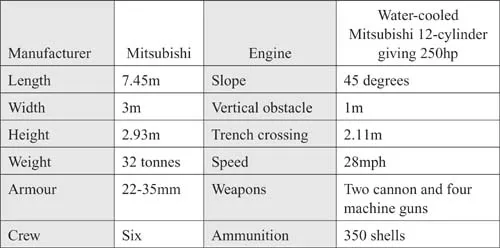
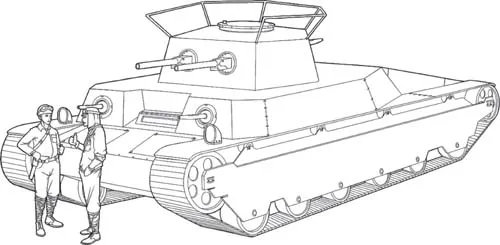
The Japanese did have plans for a Type 97 heavy tank but it was built by Mitsubishi, and was known as the Mitsu-97. The numbers given by the prisoner of war were very close to those for the tank. The British had obtained several plans of Japanese tanks, including the Mitsu-97 and the plans appear to be genuine. Even the type, finish and size of the paper matches that used by the Japanese, which is different from that used by the British at that time.
Type 97 Heavy Tank
(Mitsu-97 heavy tank)
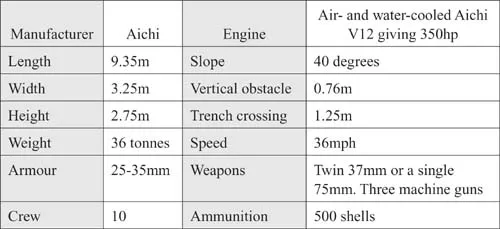
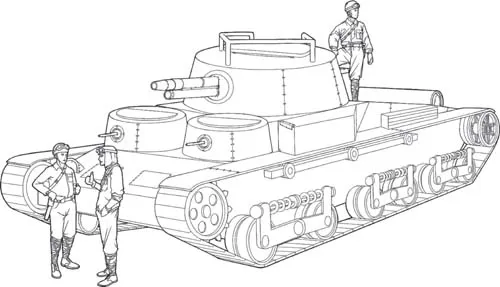
Ai-96
(Heavy tank)
Mitsu-104
(Heavy tank)
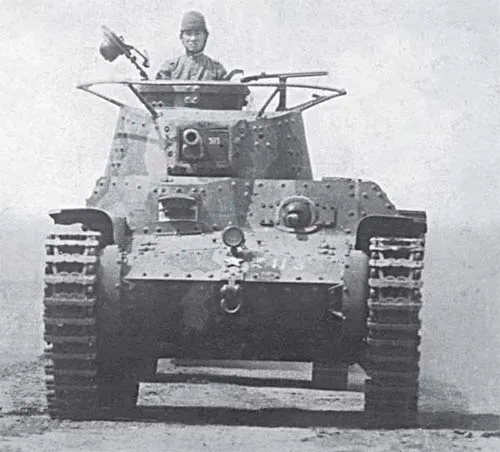
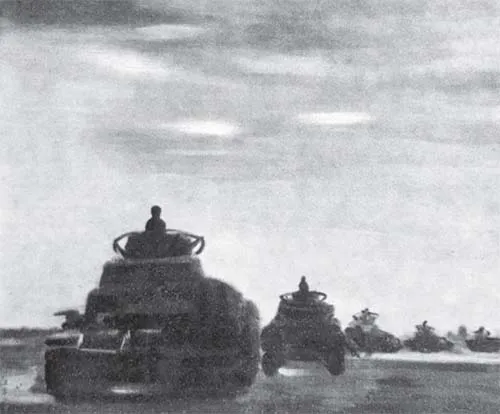
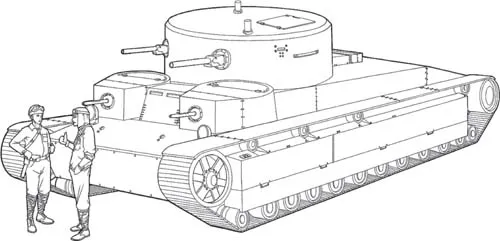
A Japanese postcard showing what is seems to be an Ai-96. Above it a Type 97 Chi-Ha for comparison. From this you can see that the silhouette and scale of the tank is very different.
The details of these tanks were all found in files stored in the UK, although some of the details were written in French. This might be because the documents were translated from Japanese to French first, due to French being the language of diplomacy. Several of the tanks had dates for their entry into service: the Mitsu-97, for example, had an in-service date of 9 November 1936, and the Ai-96’s date was 1 February 1937. If this is true, and the prisoner of war report suggests it might be, then these are two Japanese heavy tanks that have been forgotten about since the Second World War. Part of the problem is that even sources like the US Intelligence briefings, which seem to be drawn from UK sources, have mentioned Type 97 heavy tanks previously but for the last seventy years every historian, myself included, who has glanced at these documents discounted the information as mis-identifications. It is not helped by the Type 97 heavy tank sharing the same number as the Type 97 Chi-Ha medium tank.
As well as the prisoner of war eyewitness reports, there is other supporting evidence, including a late-1930s postcard that shows, in silhouette, what could be an Ai-96. Tantalisingly, as it is just the shape of the tank with a few tiny details, it is hard to get a full identification but the size of the crew indicated in the image does give credence to the idea that the tank was rather large. As well as the size of the tank, if it was a Type 97 Chi-Ha, then the turret would have been offset to one side rather than covering the full width of the hull.
Two other heavy tanks are mentioned in the UK sources. One, in 1934, was the ‘Showa 10’ but, apart from listing its armaments as two cannon and several machine guns, no ...
Table of contents
- Cover
- Title
- Copyright
- Contents
- Foreword
- Acknowledgement
- Chapter 1 Lurking in the Jungle
- Chapter 2 Battle Wing
- Chapter 3 From the Sea, through the Blood to the Green fields Beyond
- Chapter 4 You Disston my Tank?
- Chapter 5 The Smoking Gun
- Chapter 6 Hail Hydran!
- Chapter 7 The Cambridge Camal
- Chapter 8 Schwimmpanzer 36
- Chapter 9 Recoil Control
- Chapter 10 The Soldierless Tank
- Chapter 11 The Secret Life of the Infantry Tank
- Chapter 12 The Tanks without a War
- Postscript
- Sources
Frequently asked questions
Yes, you can cancel anytime from the Subscription tab in your account settings on the Perlego website. Your subscription will stay active until the end of your current billing period. Learn how to cancel your subscription
No, books cannot be downloaded as external files, such as PDFs, for use outside of Perlego. However, you can download books within the Perlego app for offline reading on mobile or tablet. Learn how to download books offline
Perlego offers two plans: Essential and Complete
- Essential is ideal for learners and professionals who enjoy exploring a wide range of subjects. Access the Essential Library with 800,000+ trusted titles and best-sellers across business, personal growth, and the humanities. Includes unlimited reading time and Standard Read Aloud voice.
- Complete: Perfect for advanced learners and researchers needing full, unrestricted access. Unlock 1.5M+ books across hundreds of subjects, including academic and specialized titles. The Complete Plan also includes advanced features like Premium Read Aloud and Research Assistant.
We are an online textbook subscription service, where you can get access to an entire online library for less than the price of a single book per month. With over 1.5 million books across 990+ topics, we’ve got you covered! Learn about our mission
Look out for the read-aloud symbol on your next book to see if you can listen to it. The read-aloud tool reads text aloud for you, highlighting the text as it is being read. You can pause it, speed it up and slow it down. Learn more about Read Aloud
Yes! You can use the Perlego app on both iOS and Android devices to read anytime, anywhere — even offline. Perfect for commutes or when you’re on the go.
Please note we cannot support devices running on iOS 13 and Android 7 or earlier. Learn more about using the app
Please note we cannot support devices running on iOS 13 and Android 7 or earlier. Learn more about using the app
Yes, you can access Forgotten Tanks and Guns of the 1920s, 1930s and 1940s by David Lister,Paul Charlton in PDF and/or ePUB format, as well as other popular books in History & 20th Century History. We have over 1.5 million books available in our catalogue for you to explore.