eBook - ePub
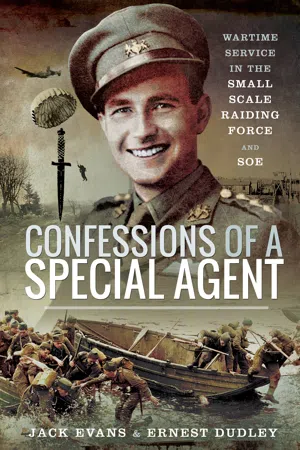
Confessions of a Special Agent
Wartime Service in the Small Scale Raiding Force and SOE
- 256 pages
- English
- ePUB (mobile friendly)
- Available on iOS & Android
eBook - ePub
Confessions of a Special Agent
Wartime Service in the Small Scale Raiding Force and SOE
About this book
Many are the tales of young men lying about their age to join the Army, yet Jack Evans sought far more at the age of just possibly just seventeen to act behind enemy lines as an agent of the Special Operations Executive.Evans had joined the RAF in 1940, despite being well under the legal age, and two years later was recruited into the SOE as a member of the Small Scale Raiding Force. Evans related his experiences with the SOE to author Ernest Dudley in the 1950s, in which he describes his training, including learning how to jump by parachute in preparation for an operation into France though he was withdrawn from the operation when his true age was disclosed. He then joined the SSRF, taking part in a number of raids upon Occupied France.Evans was then transferred to the Brandon Mission in Africa. This involved an eight-man team being parachuted into Tunisia to attack a railway line. In 1943 he was promoted to the rank of captain and parachuted into France, only to be captured by the Germans and imprisoned in Stalag Luft III for the remainder of the war.Evans suffered considerable mental trauma from his time behind enemy lines and his internment at the hands of the Germans and was unable to settle into normal civilian life. His astonishing story, written so soon after the end of the war, was considered in many respects to be ahead of its time.
Information
Chapter 1
‘Would I Like to Return to France?’
One mild evening in November 1940, after working our way in and out of most of Oxford Street’s pubs, two or three of the chaps and I found ourselves in the York Minster in Soho. The place was packed to suffocation with Free Frenchmen, soldiers, sailors and airmen, also Poles and other nationalities and their girl-friends. I had been there already several times, and had been fascinated by the proprietor’s enormous moustache, the array of photographs of famous actors, actresses and sportsmen which decorated the walls, and also the odd colourful civilian types, mostly French, who frequented the pub.
It was just on closing time when I felt a tap on my shoulder. I turned around. It was H. … H. was about the same height as myself, very athletic-looking, with blue eyes and dark hair. He was in civilian clothes and said something about being at the Admiralty in some job. He was the elder brother of a boy I had known at school.
It was difficult to talk properly with all the commotion going on around us, and H. was with some friends, while my chaps were shouting at me to be quick and have one for the road, before the pub shut. H. glanced at my R.A.F. uniform, and asked me what I was doing, and I pulled a wry face and said I was absolutely fed-up with life at Abbey Lodge, near Baker Street, where I had been posted, and where I was doing nothing more than an office-boy’s job. I, whose head was full of dreams of becoming a fighter pilot doing battle in the skies of France. H. gave me a sharp little look, and then he said: “Well, anyway, let’s meet again and have a chat.”
I said I would like to, and he said how about going to see the latest French film at the Studio One Cinema in Oxford Street? So, we made it for the following Saturday, at 14.00 hours, outside Studio One. Then my chaps grabbed me, and he went back to his party.
Next Saturday I was outside Studio One on the dot. A moment after I arrived H. turned up. He told me he had not had any lunch, and neither had I, since I had hurried to meet him on time. So, we went to Lyons’ Corner House in Tottenham Court Road.
Over food H. listened with interest to what had happened to me while escaping from France when the Nazis came; how my parents were now living at Isleworth and how, though I was only sixteen years old, I had persuaded them to let me give a false age and join the R.A.F. All my papers which could have been referred to by the authorities were in France, so there could have been no check on my real age. I told him again how dreary I found life in the R.A.F., and that I was longing to do something worthwhile and exciting.
H. said he had been in France with Field Security and had been evacuated, and on his return to England had gone to the Admiralty. I thought his tone was a bit guarded, so I did not ask any questions about his new job.
It was over coffee that H. gave me that sharp look which I had remembered in the pub. “Do you really want to do something exciting?” he said. “Something dangerous?” He saw the puzzled expression on my face. “I can’t tell you what it is now,” he said. “But you are interested?”
I told him that he knew how I felt about getting into the war and fighting for France and all the rest of it. “I don’t mind what it is I do,” I said. “So long as it’s a real job.”
He stared at me for a minute as if to make sure that I meant what I said. “Wait a minute,” he said, “I just want to make a ’phone call.”
He went off, leaving me to finish my coffee, my mind full of questioning thoughts. He was back in a few minutes. “You’ve got yourself an appointment next Monday evening at 18.00 hours.” He gave me the address I was to go to. “Just ring the bell and the rest is laid on for you.”
I started to fire questions at him, but he shut me up and told me I would find out all I wanted to know next Monday evening.
As he was paying the bill, H. turned to me with an exclamation. “Good God,” he said, “I have forgotten something: your age. Here I am thinking that you’re old enough, but you aren’t, of course.”
I was so terrified that his remembering I was under age would spoil everything that tears of frustration came to my eyes. He smiled and patted me on the shoulder, “Let’s forget it,” he said. “You seem much older, anyway, and you have obviously got guts, and that is what’s going to count.”
We went to Studio One, but I never remembered anything about the film we saw, my thoughts were so spinning round with the prospects of my rendezvous the following Monday.
All the rest of the week-end I was filled with excitement and speculation.
I came to the conclusion that it would turn out to be some job to do with the R.A.F. bombing chaps. No doubt, whoever it was I was going to see thought my knowledge of the French language and the terrain where I had spent most of my boyhood could be useful to the people planning bombing operations over France. This seemed to me to be the most likely outcome of my interview.
Would it mean, I wondered, that I should actually fly with the bombers, or be sat at a desk poring over maps and aerial-reconnaissance photographs? I hoped fervently that I’d fly on the bombing raids. But it would be just my luck, I told myself, if it turned out just another job at a desk after all. Anyway, I comforted myself, whatever it turns out to be it could not be duller, or more dreary, than what I was doing now.
At last Monday evening arrived.
I walked along the blacked-out streets, dodging the shadowy figures of people going home. At length I found myself outside the address H. had given me. It was a block of flats, vast and impressive-looking, its entrance from the street to the courtyard within appeared to me to look like some medieval castle.
I went down the slight, rubber-faced incline, with a row of pillars on either side, into the courtyard, which was gloomy and shadowed by the dark buildings which seemed to tower above it. I glanced up around me. There was only a faint glimmer of light round the edges of one or two darkened windows of the flats. Beyond them was a patch of night sky in which glimmered a handful of stars.
I crossed over to the left and went through the doorway and up luxuriously carpeted stairs. There was a hall-porter in the foyer, and before I could say anything, he beckoned me to follow him to the lift. Without saying a word, he took me up and then along to a door on which was the number ten.
I could feel my heart beating quickly as I rang the bell.
Whatever I had anticipated I certainly did not expect the door to be opened by a major. But there he was, a tallish figure with a faint smile. I managed to pull myself together enough to jump to attention and salute. “There’s nothing like that here,” he said. “Come in.”
He closed the door and helped me off with my overcoat. A major helping a mere A.C.2 off with his coat! The world had suddenly gone crazy. He introduced himself, and I gulped out my name. Though I was taken aback by the reception, I retained my wits sufficiently to notice that the doors leading off the hall of the flat were sound-proofed. The major led me into one of these sound-proofed rooms on the left of the hall. He offered me a cigarette and we sat down, and he began talking to me in French. He spoke French without a trace of an accent.
He asked me one or two questions about my parents and my home in France; but he already knew that my mother was French and my father Welsh, and that we had lived in a little village on the Somme, where Father had been employed by the War Graves Commission since the 1914-1918 War. He knew that my parents were devout Roman Catholics, that a year ago I had been sent to Cambridge Grammar School, as one of the teachers was a friend of my father, to study to become a teacher of languages. It was the school where I had known H.’s brother.
I told him how I had been back at home with my parents when the Nazis came, and how we had got out via Bordeaux by the skin of our teeth.
Then he asked me did I know why I was there?
I did not.
Would it be right to assume that I would like to return to France?
It would be right to assume so. I had only left France a few months ago and I would like to go back.
Under what circumstances would I like to return to France?
Any circumstances.
Dangerous circumstances?
Any circumstances.
The major’s firmly chiselled features had relaxed while we were talking, and I sensed we were getting on all right. Myself, I had taken an instant liking to him and was thrilled to be speaking what I always regarded as my first language.
Then the major’s face became grave as he went on to point out to me that if I was sent back to France I should go as a volunteer and entirely at my own risk. Did I understand that?
I understood, I said.
He asked me what sort of shape I was in physically. I told him I was in tip-top shape, I felt I could take on anything, or anybody. He made my nerves tingle with excitement, as he told me that my return to France was likely to be along somewhat unorthodox lines. “You’ll be parachuted in,” he said. Did I mind? I would be properly trained first, of course.
I was so excited I could barely answer him. He asked me one or two questions about myself and my family, and behind my excitement lay only the fear that he would ask me the one question I dreaded. How old was I? But he never did. Our meeting ended, and he told me I should be hearing from him very soon; meanwhile I was to return to Abbey Lodge and carry on as if nothing had happened. I was, of course, not to breathe a word to anyone, not even to my family or my closest friend.
I never remembered getting back to Abbey Lodge that night. All I know is that I walked on air, and that I missed being run over and knocking into people in the black-out half a dozen times.
I never closed my eyes that night, and the next morning my first impulse was to get hold of all the books I could on parachute-jumping and allied sports. On reflection, however, I decided that to start buying literature of this type might easily draw unwelcome attention to me and the activities in which I hoped to be engaged. From that moment I suppose my mental processes began to undergo the refinements appropriate to those of a special agent.
Although the major had counselled patience, I was full of expectation that at any moment a call would come from Flat No. 10. All that week I was on tenterhooks, which gradually gave place to a sense of disappointment and despair at the continued absence of news of the sort I was longing to hear.
Next week came and passed. Still no word from the major.
Sometimes I began to wonder if our meeting had ever taken place, if the whole thing had not been just a dream. I dared not try to get in touch with the major to find out what had happened so far as I was concerned, but I was tempted several times to contact H. at the Admiralty. But caution prevailed, I remembered that the major had warned me not to say anything to anybody about my interview. Anybody could include H.
And so, the days and weeks passed, and I began to give up all hope that I should ever hear another word from Flat No. 10. It was another of those frustrating efforts typical of the high-ups, who were running the war. I continued with my dull, soul-destroying office-boy tasks at Abbey Lodge, where the main topic of interest now seemed to be the approaching Christmas, with the prospect of leave, and the inevitable lashings of food and drink.
Just before Christmas I went home to Isleworth on a few days’ leave.
It was wonderful to see Father and Mother again, and to hear news of friends and relatives who were in unoccupied France, yet I found it difficult to join my thoughts with those of my parents. The religious aspect of Christmas, which had always dominated my home at this time, only jarred upon my nerves. I found myself thinking over and over again that if Our Lord, Who gave His Son to the World, really loved us, He would stop this stupid war. How could we at a time like this celebrate the festival of peace on earth, goodwill towards men? The whole idea was utterly hypocritical. The mouthing of the priests and the pious attitudinizing of the Church struck me as being nothing short of blasphemy.
I knew it was no use talking to Father and Mother on these lines, it would only shock them and hurt them. So, I had to keep my feelings bottled up inside me, wishing I was back in London, still nursing, as I was, a faint hope that the major had not forgotten me. At least in London I could drown my sorrows in drink, forget my confusion of mind at the futility and hopelessness of the world about me and which so sorely perplexed my spirit, in pub-crawls with the chaps.
When I got back to London there was still no news for me, and so I joined up with another chap for a Boxing Day party with two W.A.A.F.s who were sisters, and who had invited us to spend the day at their home at Tooting. It turned out to be a pretty sordid affair, all four of us got very drunk, and the climax the inevitable amorous performance, though what exactly happened in the end I never knew.
All I did know was that he and I woke up early the following morning in the sitting-room of the girls’ house. Apparently, we had been left to sleep it off, having missed the last train back to Abbey Lodge, where we were due by midnight. We got back to Abbey Lodge as early as we could, but on arrival we were greeted with the dismal information that there had been a check-up the night before, and that we were for it. Absent without leave, that was us, and we should be carpeted.
Sure enough, later that morning I received orders to report to the commanding officer, and make it snappy. Feeling desperately low and convinced that Life had nothing to offer me but disgrace and abysmal misery, I went along.
In his office the officer behind the desk gave me a narrow look, and then he told me in a puzzled tone, which he could not disguise, that he had just received a signal from the War Office.
It was top priority, and it said that A.C.2 Evans was to report immediately to Flat No. 10.
Chapter 2
‘This New, Mysterious Job’
Irushed straight from Abbey Lodge to Flat No. 10, where the major greeted me at the door as before, and he took me into his sound-proofed office, where there was another man, who was over six feet tall and always seemed to have a smile on his face.
This was Captain D., also of British Intelligence (French Section). To my delight I learned that I had been accepted for this new, mysterious job. The major told me first to return to Abbey Lodge, quietly collect my kit, and without saying a word to anyone, slip out with it and back to the flat....
Table of contents
- Cover
- Title
- Copyright
- Contents
- Introduction
- Chapter 1: ‘Would I Like to Return to France?’
- Chapter 2: ‘This New, Mysterious Job’
- Chapter 3: RAF Ringway
- Chapter 4: ‘Jump When You’re Ready.’
- Chapter 5: ‘Cloak-and-Dagger Stuff’
- Chapter 6: Captain Appleyard
- Chapter 7: The Casquets Lighthouse
- Chapter 8: Cher bourg and a Luftwaffe Airfield In Brittany
- Chapter 9: Christmas Leave
- Chapter 10: Algiers
- Chapter 11: Surrender
- Chapter 12: Stalag Luft III
- Chapter 13: Thoughts of Escape
- Chapter 14: The Americans
- Chapter 15: Back In Britain
- Chapter 16: Far East Assignment
- Chapter 17: ‘A Certain Crisis In My Life’
Trusted by 375,005 students
Access to over 1.5 million titles for a fair monthly price.
Study more efficiently using our study tools.
Frequently asked questions
Yes, you can cancel anytime from the Subscription tab in your account settings on the Perlego website. Your subscription will stay active until the end of your current billing period. Learn how to cancel your subscription
No, books cannot be downloaded as external files, such as PDFs, for use outside of Perlego. However, you can download books within the Perlego app for offline reading on mobile or tablet. Learn how to download books offline
Perlego offers two plans: Essential and Complete
- Essential is ideal for learners and professionals who enjoy exploring a wide range of subjects. Access the Essential Library with 800,000+ trusted titles and best-sellers across business, personal growth, and the humanities. Includes unlimited reading time and Standard Read Aloud voice.
- Complete: Perfect for advanced learners and researchers needing full, unrestricted access. Unlock 1.5M+ books across hundreds of subjects, including academic and specialized titles. The Complete Plan also includes advanced features like Premium Read Aloud and Research Assistant.
We are an online textbook subscription service, where you can get access to an entire online library for less than the price of a single book per month. With over 1.5 million books across 990+ topics, we’ve got you covered! Learn about our mission
Look out for the read-aloud symbol on your next book to see if you can listen to it. The read-aloud tool reads text aloud for you, highlighting the text as it is being read. You can pause it, speed it up and slow it down. Learn more about Read Aloud
Yes! You can use the Perlego app on both iOS and Android devices to read anytime, anywhere — even offline. Perfect for commutes or when you’re on the go.
Please note we cannot support devices running on iOS 13 and Android 7 or earlier. Learn more about using the app
Please note we cannot support devices running on iOS 13 and Android 7 or earlier. Learn more about using the app
Yes, you can access Confessions of a Special Agent by Jack Evans,Ernest Dudley in PDF and/or ePUB format, as well as other popular books in History & Historical Biographies. We have over 1.5 million books available in our catalogue for you to explore.