eBook - ePub
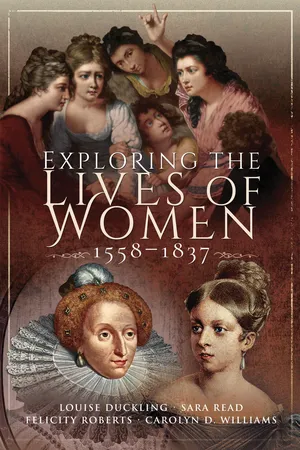
Exploring the Lives of Women, 1558–1837
- 248 pages
- English
- ePUB (mobile friendly)
- Available on iOS & Android
eBook - ePub
Exploring the Lives of Women, 1558–1837
About this book
Exploring the Lives of Women, 1558-1837' is an engaging and lively collection of original, thought-provoking essays. Its route from Lady Jane Greys nine-day reign to Queen Victorias accession provides ample opportunities to examine complex interactions between gender, rank, and power. Yet the books scope extends far beyond queens: its female cast includes servants, aristocrats, literary women, opera singers, actresses, fallen women, athletes and mine workers.The collection explores themes relating to female power and physical strength; infertility, motherhood, sexuality and exploitation; creativity and celebrity; marriage and female friendship. It draws upon a wide range of primary materials to explore diverse representations of women: illuminating accounts of real womens lives appear alongside fictional portrayals and ideological constructions of femininity. In exploring womens negotiations with patriarchal control, this book demonstrates how the lived experience of women did not always correspond to prescribed social and gendered norms, revealing the rich complexity of their lives.This volume has been published to commemorate the 30th anniversary of the Womens Studies Group 1558-1837. The group was formed to promote research into any aspect of womens lives as experienced or depicted within this period. The depth, range and creativity of the essays in this book reflect the myriad interests of its members.
Information
Chapter One
Michelangelo Florio and Lady Jane Grey: A Case Study of a Book Dedication to a Royal Tudor Lady
by Valerie Schutte
One aspect of the tightly-interwoven relationships connecting Mary I, Elizabeth I and Jane Grey has only recently become the focus of scholarly attention: book dedications.1 For centuries, authors in hope of patronage maintained the tradition of dedicating their works to royalty and nobility, a practice enabling clients and patrons to make connections, increase their prestige, and promote and give authority to books.2 Although the Tudor monarchs received numerous dedications, in manuscript and print, only one extant dedication survives for Lady Jane Grey. It was an undated manuscript entitled Regole et Institutioni della Lingua Thoscana (Rules and Precepts of the Tuscan Language) by Michelangelo Florio (1515– 72), her tutor in Latin and Italian.3 Discussion of this text will be preceded by a brief survey of the events that led to Jane’s death, and of relevant features in the culture of creating and giving books of which dedications formed a part; it will be followed by an account of its relationship with another manuscript by Florio, Regole de la Lingua Thoscana, dated 21 August 1553, dedicated to Jane’s brother-in-law Henry Herbert (after 1538–1601).4 Two points of interest emerge from this study: a tendency for the dedications to refer to influential male relatives, especially fathers, and the ways in which the authors’ choice of dedicatee, the books’ contents, and the texts of the dedications themselves reflect the religious and dynastic turmoil involving all three royal ladies.
The fates and reigns of the two queens regnant were closely intertwined with that of their cousin, Jane, who was proclaimed queen between the death of Edward VI and the coup that enabled Mary to take the throne. Jane derived her royal blood from her mother, Frances (1517–59), daughter of Mary (1496–1533), the younger sister of Henry VIII. Jane’s father, Henry Grey (1517–54), became Marquis of Dorset in 1530 and Duke of Suffolk in 1551. However, Jane’s prospects of succession were remote, since Henry VIII married six times and had three living children. One outcome of Henry’s marriages, besides his declaring himself head of the Church of England, was that Mary and Elizabeth were both bastardized. The 1536 Act of Succession made them both illegitimate and excluded them from the succession, thereby elevating the position of Frances.5 Henry VIII composed another Act of Succession in 1543, as he prepared for war with France. This particular act reinstated Mary and Elizabeth into the line of succession, after Edward and his heirs, although it did not change their bastardized status.6 When Henry VIII expressed his final intentions for the succession in his will, he made no mention of his elder sister and her descendants, and also excluded Frances but included the heirs of her body: in the event, these comprised three daughters, Jane, Katherine (1540–68) and Mary Grey (1545–78).7 Consequently, when Edward VI succeeded Henry VIII in 1547, Jane was third in line, preceded only by Henry VIII’s daughters, Mary and Elizabeth Tudor.
As Frances and Henry Grey had no son, they strongly supported their eldest daughter’s marriage potential, going so far as attempting to match her with Prince Edward, which required giving her an education befitting her potentially royal status.8 His failing health, however, precluded the possibility of any marriage. On 25 May 1553, Jane was married to Guildford Dudley (c.1535–54), fourth son of John, Duke of Northumberland (1504– 53), Lord President of the Council, who worked closely with Jane’s father. On the same day, her sister Katherine married Henry Herbert, son of William, Earl of Pembroke (c.1501–70), another powerful politician. Exactly six weeks later, on 6 July, Edward died. These events might have ended Jane’s royal destiny, were it not for a document drawn up by Edward entitled ‘My devise for the succession’: first in line came Lady Frances’ ‘heires masles’, followed by ‘L’ Jane and her heires masles’.9 Edward’s main concern appears in the statement that his chosen successors had all been ‘exercised in good and godly learninge’: in other words, they were reformists or, as we would say today, Protestants.10 Edward was determined to use any means he could find to prevent the Catholic Mary from inheriting the crown, even if Elizabeth was excluded in the process. At Edward’s death, this made Jane queen in her own right. Northumberland initially concealed Edward’s death, hoping to capture Mary before she realized what had happened and tried to claim the throne.11 On 10 July, Edward’s death was finally announced, and Jane proclaimed queen.12 Mary, however, outmanoeuvred Northumberland, strategically and politically, and was proclaimed queen in London on 19 July.13 She was initially inclined to mercy, but after the Wyatt Rebellion Jane was considered a dangerous focus of unrest and was beheaded on 12 February 1554.14
High-ranking parents of all religious views considered learning vitally important in preparing children for the exercise of power; daughters unlikely to become rulers in their own right might attract powerful husbands by their intellectual attainments. Carefully-chosen texts in a variety of ancient and modern languages were intended to inculcate virtue, provide examples of good and bad rule, and enable pupils to understand and defend their respective religious principles. As befitted the offspring of Henry VIII, Mary and Elizabeth received exceptional humanist educations at the hands of famous scholars: Mary’s tutors included Giles Duwes (d. 1535), while Elizabeth was taught by Roger Ascham (1515–68).15 Yet Jane was at least as well educated: Aysha Pollnitz suggests that Jane’s parents arranged her upbringing with an even more ‘focused ambition’ than that devoted to her cousins.16 Her father, a staunch reformist and patron of humanism, fostered a rich learning environment within his household, which included Ascham’s friend John Aylmer (1521–94), a future Bishop of London, who gave Jane tuition in Greek.17 The result was the emergence of ‘an intelligent, highly educated, evangelical princess’.18 She was a leading light among an assemblage of learned ladies who commanded respect at an international level. In a letter to Johannes Sturm (1507–89), the well-known educator from Strasbourg, Ascham conferred much praise on Elizabeth, but even more on Jane, whom he had once found reading Plato’s Phaedo with a degree of understanding and enjoyment that ‘mihi ipsi summam admirationem injiceret’ (‘inspired me with the greatest wonder’).19 He coupled her with the phenomenally-learned Mildred Cecil, née Cooke (c.1526–89), ‘quae haud aliter Graece intelligit et loquitur quam Anglice’ (‘who understands and speaks Greek almost as well as English’).20
Mildred Cecil may have even been the anonymous translator who sent Jane a gift of a translation of a book by Basil the Great (330–79), Bishop of Caesaria, accompanied by a letter in Greek.21 The book has disappeared but the letter, whose language indicates female composition, survives.22 The donor compares Jane to Basil in holiness and wisdom, noting that Jane should find this volume more valuable to her than gold or precious stones.23 Henry Parker, Lord Morley (1533–77), made a similar remark in a pre-accession manuscript dedication to Mary accompanying Richard Rolle of Hampole’s Latin Psalter, saying Mary would find it more valuable than precious stones or pearls.24 The ardently reformist John Bale (1495–1563) refers to Elizabeth’s book, ‘The Glasse of the Synnefull Soule’ (1545), originally a richly-bound manuscript presented to Catherine Parr (1512–48), as a ‘treasure’ when he dedicates a printed edition to her.25 Jane elaborates further on this trope in a letter written to her 13-year-old sister Katherine at the end of her Greek Testament, the night before her execution. She begins, ‘I Have heere sent you (good Sister Katherine) a booke, which although it be not outwardly trimmed with gold, yet inwardly it is more worth then precious stones’, then refers, appropriately, to the New Testament itself: ‘if you apply diligently this booke, seeking to direct your lyfe after it, you shall be an inheritour of such riches, as neither the covetous shall withdrawe from you, neither theefe shall steale, neyther yet the mothes corrupt.’26 This recalls Matthew 6, 20: ‘geather ye treasures to gether in heven where nether rust nor moulthes corrupte, & where theves nether breake up nor yet steale.’27 Katherine must, if necessary, prepare herself to ‘dye in the true Christian fayth’, from which she must ‘never swarve, neither for hope of life, nor for feare of death’.28 The journey from precious objects to spiritually valuable ideas has reached a point where all worldly goods, including life itself, have become expendable. Jane’s message cannot be called a dedication: it is, rather, an exceptionally stern gift tag. The appearance of the idea of text as treasure in such a variety of bibliographical contexts serves today as a reminder of the close relationships between the manuscripts, printed books, original texts, translations, copies, gifts of books written by others and dedications of books written by the donors that interacted with the lives of Mary, Elizabeth and Jane.
The giving and receiving of books, printed and in manuscript, with their attendant covering letters and dedications, was a mainstay of elite learned networks at this period; before their accessions, at least nineteen printed books and manuscripts were dedicated to Mary, while Elizabeth received at least seven. Although Jane makes a poor showing in comparison with only one dedication, it was not for lack of effort. In the course of her education, she was, like Mary and Elizabeth, closely connected to the English and foreign literary scene. She was represented not only as a learned and appreciative reader, but as a well-connected aristocrat with rich and influential male relatives and the best possible marriage prospects. The young Swiss student Conrad ab Ulmis, a protégé of Jane’s father, told the German Hebraist Konrad Pellican (1478–1556) that Jane, ‘a lady who is well versed both in Greek and Latin’, now wished to learn Hebrew; he made two requests on her behalf: ‘Write therefore a letter to her as soon as possible, in which you will briefly point out a method of learning the sacred language, and then honourably consecrate to her name your Latin translation of the Jewish Talmud.’29 He added strong inducements: ‘The young lady is the daughter of the marquis, and is to be married, as I hear, to the king.’30 Meanwhile, Ascham set his sights on Sturm, whose De Periodis (1550), a book on the composition of Latin oratory, had been dedicated to Elizabeth.31 He had been ‘cupidus’ (‘passionately desirous’) that Sturm should dedicate his edition of speeches by Aeschines and Demosthenes to Jane, and although this had not happened, possibly through a breakdown of communications, he still hoped that Sturm would dedicate something to this ‘lectissimae virgini’ (‘excellent virgin’).32 Ascham failed, but could not be accused of losing his point through excessive restraint: not only did he mention that Jane’s mind was cultivated by Plato’s doctrine and Demosthenes’ eloquence, but he invoked her royal descent, and added that the death of a rich uncle had made her personal wealth greater than ever.33
What is clear is Jane’s connection to a circle of prominent reformers who expected that eventually she would be a useful source o...
Table of contents
- Cover
- Title
- Copyright
- Contents
- List of Contributors
- List of Illustrations
- Preface Women’s Studies Group, 1558–1837: Exploring the Lives of Women Since 1987
- Acknowledgements
- Introduction Carolyn D. Williams
- Chapter One Michelangelo Florio and Lady Jane Grey: A Case Study of a Book Dedication to a Royal Tudor Lady - Valerie Schutte
- Chapter Two ‘The Wine much better then the Bush’: Thomas Lodge’s Address to the Reader in The Countesse of Lincolnes Nurserie - Sara Read
- Chapter Three God-GivenPleasure:Aphrodisiacs, Fertility and Sexual Pleasure in Early Modern England - Jennifer Evans
- Chapter Four Tweaking the Biography of Anne Finch - Yvonne Noble
- Chapter Five ‘For ever shaded by oblivion’s veil’: Obituarizing Women in the Eighteenth-Century Gentleman’s Magazine - Gillian Williamson
- Chapter Six Female Radicals in Bristol: The Three Marys and Mary Wollstonecraft’s ‘The Cave of Fancy’ - Marie Mulvey-Roberts
- Chapter Seven A Quest for Female Sexual Agency in the Eighteenth-Century Novel - Sarah Oliver
- Chapter Eight Scold, Punish, Pity or Seduce? The Confused Rhetoric of Advice to Unmarried Women (1791) - Tabitha Kenlon
- Chapter Nine Friendships: Commonalities across the Centuries - Julie Peakman
- Chapter Ten Rivalry, Camaraderie and the Prima Donnas: Elizabeth Billington and Gertrude Mara - Brianna E. Robertson-Kirkland
- Chapter Eleven Eliza O’Neill and the Art of Acting - Jacqueline Mulhallen
- Chapter Twelve Better than the Men: The Uses and Abuses of Women’s Strength, Speed, Skill and Endurance in the Long Eighteenth Century - Peter Radford
- Chapter Thirteen ‘Merely butterflies of a season’? The Halls, Ideology and Control in the Early Nineteenth-Century Annuals - Marion Durnin
- Conclusion Queens of Literature: Royals, Role Models and the Construction of Women’s History - Louise Duckling
- Endnotes
- Further Reading
- Plate section
Trusted by 375,005 students
Access to over 1.5 million titles for a fair monthly price.
Study more efficiently using our study tools.
Frequently asked questions
Yes, you can cancel anytime from the Subscription tab in your account settings on the Perlego website. Your subscription will stay active until the end of your current billing period. Learn how to cancel your subscription
No, books cannot be downloaded as external files, such as PDFs, for use outside of Perlego. However, you can download books within the Perlego app for offline reading on mobile or tablet. Learn how to download books offline
Perlego offers two plans: Essential and Complete
- Essential is ideal for learners and professionals who enjoy exploring a wide range of subjects. Access the Essential Library with 800,000+ trusted titles and best-sellers across business, personal growth, and the humanities. Includes unlimited reading time and Standard Read Aloud voice.
- Complete: Perfect for advanced learners and researchers needing full, unrestricted access. Unlock 1.5M+ books across hundreds of subjects, including academic and specialized titles. The Complete Plan also includes advanced features like Premium Read Aloud and Research Assistant.
We are an online textbook subscription service, where you can get access to an entire online library for less than the price of a single book per month. With over 1.5 million books across 990+ topics, we’ve got you covered! Learn about our mission
Look out for the read-aloud symbol on your next book to see if you can listen to it. The read-aloud tool reads text aloud for you, highlighting the text as it is being read. You can pause it, speed it up and slow it down. Learn more about Read Aloud
Yes! You can use the Perlego app on both iOS and Android devices to read anytime, anywhere — even offline. Perfect for commutes or when you’re on the go.
Please note we cannot support devices running on iOS 13 and Android 7 or earlier. Learn more about using the app
Please note we cannot support devices running on iOS 13 and Android 7 or earlier. Learn more about using the app
Yes, you can access Exploring the Lives of Women, 1558–1837 by Louise Duckling,Sara Read,Felicity Roberts,Carolyn D. Williams in PDF and/or ePUB format, as well as other popular books in Social Sciences & Women in History. We have over 1.5 million books available in our catalogue for you to explore.