- 248 pages
- English
- ePUB (mobile friendly)
- Available on iOS & Android
eBook - ePub
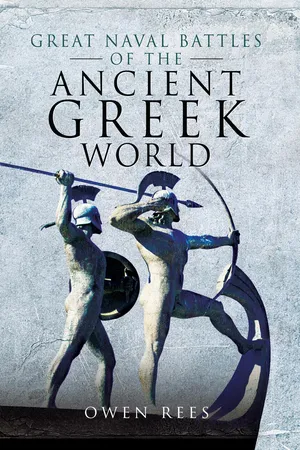
Great Naval Battles of the Ancient Greek World
About this book
Naval warfare is the unsung hero of ancient Greek military history, often overshadowed by the more glorified land battles. Owen Rees looks to redress the balance, giving naval battles their due attention. This book presents a selection of thirteen naval battles that span a defining century in ancient Greek history, from the Ionian Revolt and Persian Invasion to the rise of external naval powers in the Mediterranean Sea, such as the Carthaginians.Each battle is set in context. The background, wider military campaigns, and the opposing forces are discussed, followed by a narrative and analysis of the fighting. Finally, the aftermath of the battles are dealt with, looking at the strategic implications of the outcome for both the victor and the defeated. The battle narratives are supported by maps and tactical diagrams, showing the deployment of the fleets and the wider geographical factors involved in battle. Written in an accessible tone, this book successfully shows that Greek naval warfare did not start and end at the battle of Salamis.
Trusted by 375,005 students
Access to over 1.5 million titles for a fair monthly price.
Study more efficiently using our study tools.
Information
Part 1
THE PERSIAN CONFLICTS
At the turn of the sixth century BC, a vacuum of power had come into being, due to the catastrophic demise of the great Assyrian Empire. An alliance between the Babylonians and the Medes enabled the destruction of the ancient capital of Assyria, Nineveh, in 612 BC, leaving the Near East bereft of a single dominant power. By the 550s, the innocuous rise of one man would soon see an end to this vacuum.
Cyrus the Great was the architect for the Persian Empire, putting his Achaemenid Dynasty in a position of power to rule over this vast realm for over 200 years. In 550 BC, Cyrus won a great victory over the Medes, giving him control over the Iranian peoples; a tie that was so intrinsic to Persian power that Greek authors would regularly switch between the using the terms ‘Persians’ and ‘Medes’ when describing them. From here, Cyrus expanded west into the lands of Lydia, which at this time was almost all of Asia Minor.
The Lydian King, Croesus, was famous throughout the Greek-speaking world for his wealth, his opulence and, indeed, his arrogance. His failed resistance to Cyrus soon petered out and the expanding Persian Empire now contained the lands of Lydia. A failed uprising by another Lydian was quickly suppressed, but the rebel leader fled to the Greek cities in Ionia, taking with him the ire of Cyrus himself. The Persians were ruthless in their systematic punishment of the Ionian Greeks for the perceived support of the uprising, and Persia now held control over Greek cities. By the time Cyrus died, his empire stretched from the Aegean Sea in the west, to the northwestern border of India and included Babylon; already at this point, this was the largest empire ever seen in the Near East.
Cyrus’ successors showed very little interest in the Greek mainland as a place for expansion. It held little value in the way of resources or even food supplies, compared to the lands of Thrace for example. But in 507 BC the growing polis of Athens sent word to the Persian King Darius I for help and support against the growing aggression of many stronger poleis in Greece. Darius agreed to support them, in exchange for a symbolic offer of subjugation in the form of earth and water. The Athenians complied and, perhaps unwittingly, placed themselves under the imperial authority of Persia. This submission amounted to nothing in real terms, Athens was a tiny prize worthy of little attention for Darius, who had greater interest in consolidating his advances in Thrace, and on many of the islands in the Aegean. However, the relevance of this symbolic subjugation came to the fore in 499 BC when the Ionian Greeks revolted against the Persians and looked to Athens for support. Athens sent a small military force to aid the uprising and in so doing broke a diplomatic agreement and solemn oath as a subject of the Great King – whether or not Athens saw it in such a way.
The failed Ionian Revolt ended and Darius began to show more of an interest in the Greek mainland. In 490 BC Darius sent a fleet to secure the south Aegean, with particular attention paid to the Cycladic Islands. Once this was secure, the commanders of the fleet had a secondary objective of punishing the Athenians for their betrayal. The Persians landed at Marathon, to the northeast of Athens, and were defeated in an epic land battle by the Athenians and their allies. For Persia this was barely a setback, they had achieved their main objectives and the added bonus of punishing Athens would just have to wait. Unfortunately for Darius, he never got his chance to try again. He died in 486 BC and the mantle was taken up by his son, Xerxes I.
Once Xerxes had subdued numerous rebellions in his empire, mainly in Egypt and Babylon, he was finally able to resurrect Darius’ plans to attack Athens once again. Xerxes headed a gigantic army, the likes of which had never been seen in Greece. His brutal campaign lasted all of 480 BC, at the end of which he left to return to his capital, having fulfilled the expectation that he would lead the invasion for the first year. He left his forces in the capable hands of his general Mardonius, who continued the campaign into 490 BC when he was finally defeated and the Persian army was removed from Greece.
The Greek states, especially Athens, learned a great deal from their battles with the Persians. And the iconic naval victory at Salamis in 480 BC gave rise to Athens’ reputation as a strong naval power. The Persian navy contained the greatest of naval forces in the Mediterranean, the Phoenicians. They also had access to Greek ships and sailors as well, through Ionia, so the fact that the Persians were defeated at Salamis tells us a great deal about the naval capabilities of the Greek resistance.
During the Persian Wars, there were three major naval battles covering a fourteen-year period. The first was the Battle of Lade (494 BC), during the Ionian revolt. This is the first recorded naval battle between the Persians and the Greeks. In fact it is the first Greek naval battle that can be reconstructed with any confidence. The battle highlights the poor state of Greek military discipline, and shows that even with good tactics and a strong fleet, a naval battle is often decided by the will of the crewmen. It also reveals a major weakness with inter-Greek alliances, their propensity to be undermined by the enemy.
The second battle was during the invasion of Xerxes, at the Battle of Artemisium (480 BC). The naval battle was fought at the same time as the famous land battle at Thermopylae. The battle was a huge undertaking, and forced the Greeks to face a numerically superior force head on. The Greeks planned a defensive strategy which worked well, forming a tight circle and also showing an ability to counterattack from this formation, which shocked the Persians no end. The battle ended in a stalemate, but the Greeks took a lot more from the day than the Persians did.
The third and final battle is, possibly, one of the most famous sea battles in world history. The Battle of Salamis (480 BC) was a last throw of the dice for the Athenians and their allies, but the Athenians especially. They had lost their city and, unless they could turn the tide of Persian success, they would be homeless. The battle is difficult to reconstruct due to the contradictory accounts. Salamis would be the battle that would epitomize Athenian resilience and resolve, as well as cement their place as the superior naval power in the Aegean. Thus our Athenian sources offer some very biased accounts of the day, but that is not to take away from the overall achievement. Vastly outnumbered and facing an elite Persian fleet with a strong Phoenician contingent, the Greeks, led by Athens, were able to force a battle in a narrow seascape and win a monumental victory. In terms of the wider campaign it did not push back the Persians, nor undermine their position in Greece. Yet the victory brought with it two important benefits: it prevented the Persian navy from having free reign around the Greek shoreline, and it uplifted Greek morale to ultimately face the Persians the following year and win the final land battle at Plataea.
Defeat of the Persians gave rise to a new sense of Greek identity; they had united against a common enemy and shown that together they stood strongest. The resistance formalized its existence into a Hellenic league, which was led by the great heroes of the Persian Wars, the Athenians. As time passed, Athens took a more aggressive line against the Persians and made greater and greater demands for men and ships from their allies. Soon it became possible for members to send money instead of men, enabling the Athenians to fund a ship-building project that would provide them with the largest of all the Greek fleets. The Hellenic League morphed into the Delian League, with Athens well and truly in charge. In essence, Athens had created its own mini-empire through the league, but it was not until cities tried to renege on their obligations that they discovered they were not donating funds to a panhellenic cause, but were paying tribute to the Athenians themselves. Athenian rule was harsh and demanding, but it gave them access to enough funds so that they could cement themselves as one of the two most powerful poleis in all of Greece, alongside Sparta.
Chapter 1
Battle of Lade (494 BC)
Background (Herodotus, V.30-55; 97-VI.6)
By the turn of the fifth century Persia ruled over an empire which stretched from the Indus River to the Danube, and from the Red Sea to the Ural Mountains. With an empire as large as this, the Great Kings of Persia chose to support local rulers in many of the more distant cities under their control, rather than impose their own ruling infrastructure. Inside the great cities of Greek Ionia, on the western coast of Asia Minor, this meant supporting local tyrants who were thus indebted to the Persians for their authority.1
For a time this arrangement suited both the Ionians and the Persians, with the Greek cities beginning to flourish under foreign auspices.2 But, as affluence within certain Ionian cities began to outstretch their neighbours, one tyrant in particular became enamoured with the idea of extending his power outside of the city walls: Aristagoras of Miletus.3
Miletus sat on the southwesterly coast of Asia Minor and was by far the most prosperous city in Ionia. In the year 500 BC, Aristagoras, as tyrant, received a group of exiled aristocrats from the island of Naxos asking for military support to return to their homeland. Naxos was one of a group of south Aegean islands, called the Cycladic Islands, which had not yet been taken under the control of the Persians. Naxos was by far the most affluent island amongst them, so Aristagoras designed a plan to support the exiles, with the help of Persian man-power, and take control of the island for himself.
One small obstacle in Aristagoras’ way was that Naxos would be a powerful enemy; it called upon a defending army of up to 8,000 hoplites and a great many long boats, which made it a formidable defensive position to attack.4 However, there was a Greek social contract within the equation which forced Aristagoras to act.
Aristagoras was not the official tyrant of Miletus, he was an interim for his father-in-law, Histiaeus. Histiaeus had been a faithful servant of the Persians, but his loyalty had been called into question by the satrap Megabazus and so the Great King, Darius I, ‘invited’ the tyrant to stay with him in Susa indefinitely.5 In fact, the only reason why the Naxian exiles had fled to Miletus was to meet with Histiaeus who was their former guest-friend.6 This put Aristagoras in an interesting position. He was duty bound to uphold the exiles’ guest-friend agreement with his superior and was obliged to help them in their endeavour. So he offered to go to the powerful satrap Artaphernes, who ruled over most of the west coast of Asia Minor, and gather support.
Aristagoras went to Artaphernes’ capital in Sardis and presented the expedition to him as a way of making money; the exiles were offering to pay for the force’s upkeep and Naxos was itself a very affluent island. The Ionian also speculated on the benefit of taking control of the Cyclades, which would enable the Persians to have a platform from which to push their influence into Greece. At Aristagoras’ reckoning, the Persians needed to commit 100 ships. Artaphernes was convinced that the venture would be fruitful, but decided that 200 ships was a more realistic level of necessary forces.7
Word was sent to Darius for approval of the expedition, and with his approval Artaphernes supplied and equipped 200 triremes, while manning them with a vast mix of Persians and allies, and appointing Megabates to lead the fleet.8 The fleet sailed to Miletus to pick up Aristagoras, the exiles, and a small Ionian army that would assist in the expedition, before heading north to Chios. Once they reached the southern side of the island the fleet pulled in to harbour, waiting so that they could use the north wind to head south to Naxos.
While in harbour tension began to rise between the Ionians and the Persian commander. Megabates was only acquainted with the Persian military system and was not prepared for the Greek approach to discipline, or lack thereof. As the Persian made his rounds, inspecting the boats, he found that one belonging to the Ionian city of Myndos did not have anyone guarding it. In a fury, Megabates ordered his bodyguard to hunt down the lax commander of the vessel, a man named Scylax, and tie him up so that his head would protrude out of an oar-hole while his body remained inside the boat. When Scylax was secured a close friend implored Aristagoras to intervene.
Aristagoras went to Megabates to defend the poor Greek commander, but it fell on deaf ears. So Aristagoras stormed on the ship and freed Scylax himself. When Megabates received word of how he had been undermined he flew into an almighty rage against Aristagoras, but was met with arrogant defiance – while Megabates was the commander of the fleet, Aristagoras was the leader of this expedition.9 While he was still in a rage that night, Megabates sent a small dispatch to Naxos warning them of the impending attack.10
With the incoming intelligence, Naxos became a large hive of activity. Some Naxians brought all that they could within their defensive city walls, and prepared for a siege by stockpiling food, water, and wine, while others began to reinforce the walls. With preparations being made on the island, the Persian-led f...
Table of contents
- Cover
- Title
- Copyright
- Contents
- Acknowledgements
- Introduction
- Glossary
- PART 1 THE PERSIAN CONFLICTS
- PART 2 ARCHIDAMIAN WAR
- PART 3 THE IONIAN WAR
- PART 4 TURNING OF THE TIDE
- Conclusion
- Endnotes
- Select Bibliography
Frequently asked questions
Yes, you can cancel anytime from the Subscription tab in your account settings on the Perlego website. Your subscription will stay active until the end of your current billing period. Learn how to cancel your subscription
No, books cannot be downloaded as external files, such as PDFs, for use outside of Perlego. However, you can download books within the Perlego app for offline reading on mobile or tablet. Learn how to download books offline
We are an online textbook subscription service, where you can get access to an entire online library for less than the price of a single book per month. With over 1.5 million books across 990+ topics, we’ve got you covered! Learn about our mission
Look out for the read-aloud symbol on your next book to see if you can listen to it. The read-aloud tool reads text aloud for you, highlighting the text as it is being read. You can pause it, speed it up and slow it down. Learn more about Read Aloud
Yes! You can use the Perlego app on both iOS and Android devices to read anytime, anywhere — even offline. Perfect for commutes or when you’re on the go.
Please note we cannot support devices running on iOS 13 and Android 7 or earlier. Learn more about using the app
Please note we cannot support devices running on iOS 13 and Android 7 or earlier. Learn more about using the app
Yes, you can access Great Naval Battles of the Ancient Greek World by Owen Rees in PDF and/or ePUB format, as well as other popular books in History & European History. We have over 1.5 million books available in our catalogue for you to explore.