The Tony Award–winning playwright of
Hurlyburly "confronts the timely topic of assisted suicide . . . an affirmation of dignity that rings clear and true" (
Variety).
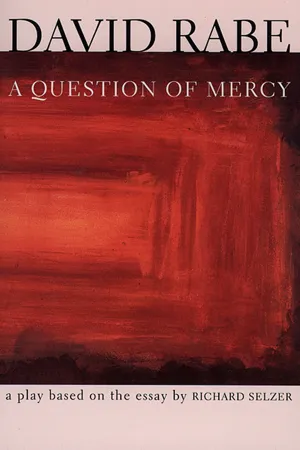
David Rabe is one of America's finest dramatists. In
A Question of Mercy, he explores the controversial and emotional issue of euthanasia, delving deep into the ties that bind friends and lovers. Thomas and Anthony are lovers struggling with Anthony's final, exhausting battle with AIDS. Joined by their friend Susanah and a retired doctor, whose help Thomas has requested, they fashion a heartbreaking friendship as they work through the stages of a plan to relieve Anthony of his illness and his life. Rabe creates a passionate depiction of four people confronted with the reality of a loved one's fight with death and a compelling dramatic event that poses the question: "What would you do?"
"A moving and enlightening experience." —
Backstage
"Completely gripping. This life and death tale questions the moral implications involved with assisted suicide, and the honor behind the action. A serious and provocative night at the theatre." —
Theasy
Praise for David Rabe
"Few contemporary dramatists have dealt with violence, physical and psychological, more impressively than Rabe." —
Kirkus Reviews
"A remarkable storyteller." —
Chicago Tribune
"Rabe's mastery of dialogue is the equal of Pinter and Mamet put together . . . full of a measured Mafia formality played against Jacobean terrors, blood lust, horror and revenge raised to an unlikely poetry dazed by equally unlikely insights." —
The Boston Globe
- 117 pages
- English
- ePUB (mobile friendly)
- Available on iOS & Android
eBook - ePub
About this book
Information
ACT ONE
The set is a raised, raked platform surrounded by a ground-level alley that runs along stage right and left and across the front. The backdrop is abstract. Perhaps it suggests an urban skyline. Downstage left on the ground-floor ramp stands a table with a phone on it.
There is music and a dreamy kind of light on DR. ROBERT CHAPMAN as he enters upstage left. He’s in his forties, tall, and he walks down toward the table and chair. He wears an overcoat, which he unbuttons, then removes. He looks out to the audience, taking them in. He speaks as if making a formal presentation on a supremely important issue.
DR. CHAPMAN: This overcoat—my overcoat was given to me ten—no. He’s twenty-three now and he was … so it’s … my overcoat is fifteen years old. It was a Christmas gift from my nephew. I’m sure it was really my sister who purchased it. But my nephew was the bearer, his little face a bright bulb above the festive package as he raced across the room. (Slightly puzzled, but still grand, he continues.) I don’t know why I’m saying this. But I wear it—the overcoat—when I go out in cold weather. (With the overcoat in one hand, he turns to a pair of pajamas on the chair.) These are my pajamas. (Grabbing them up.) At night, I wear them. They provide a kind of consoling formality. (He holds the pajamas in one hand, the overcoat in the other, both arms outstretched as he weighs the garments, his arms shifting like scales.) The boundary, the demarcation between waking and sleeping, between thought and dreams, benefits, I believe, from such an acknowledgment—a gesture of respect, of emphasis, I think.
The phone rings. The backdrop holds a projection, narrow and clear: JANUARY 9, 1990.
DR. CHAPMAN picks up a nearby leather-bound appointment book and looks at it. The phone rings again. He looks at it, grabs it up.
DR. CHAPMAN: Hello?
VOICE: Dr. Robert Chapman?
DR. CHAPMAN: Who is this?
VOICE: This is Thomas Ames. We met at the—at the fundraiser for—
DR. CHAPMAN: Oh, yes, of course.
THOMAS: Do you remember me?
Now on the stage right area, lights find THOMAS AMES, standing alone with a phone in his hand. He is handsome, slim, in his thirties.
DR. CHAPMAN: Yes, yes, at the Levines’ house. For the Franklin Coalition.
THOMAS: I was wondering if we might—I hate to intrude, but would you have time for a cup of coffee in the next few days? I wouldn’t take much of your time. But there’s something I need to discuss, and the phone doesn’t seem quite appropriate, but—
DR. CHAPMAN: Well, I’m actually quite busy.
THOMAS: I mean, I could do it on the phone, but—
DR. CHAPMAN: What am I saying? Of course. A cup of coffee? Tomorrow morning?
THOMAS: I’ll come to your neighborhood. Just name a place.
DR. CHAPMAN: Well, the Beacon is quite close by.
THOMAS: Oh, yes. Of course. I know it. What time shall we say?
DR. CHAPMAN: Is ten good for you?
THOMAS: Fine. Perfect. I’ll see you then.
DR. CHAPMAN: I look forward to it.
DR. CHAPMAN stands looking at the phone in his hand.
THOMAS (as the lights take him out of view): Good-bye. On the screen above and behind DR. CHAPMAN is projected: JANUARY 10, 1990.
DR. CHAPMAN (leafing through pages in his appointment book): January eighth, ninth, tenth, eleventh. They flow by. A haze. A confident haze. A sense of will. Intention. My life. I will do this. I will do that.
As the lights come up on the stage right area, we see THOMAS seated at a table with a flowered tablecloth spread over it. A pot of coffee stands on the table; there are two cups and saucers and some Danish on a plate, awaiting DR. CHAPMAN.
THOMAS (waving toward DR. CHAPMAN): Dr. Chapman! Here! Here I am!
DR. CHAPMAN waves back and heads to the table.
DR. CHAPMAN: Thomas, hello. Sorry I’m late.
THOMAS: No, no, I arrived a little early, I think.
DR. CHAPMAN: How are you? Busy, I bet.
THOMAS: Oh, yes. (Gesturing toward the coffee, the plate of Danish.) I took the liberty of ordering coffee and some Danish for us. I hope that’s all right.
DR. CHAPMAN: As long as there’s blueberry. Have you seen the Levines’ recently? (He seeks amid the Danish.)
THOMAS: No, no—not for some weeks now.
DR. CHAPMAN: I haven’t either. I should call them. For a slight uneasy pause, they look around.
THOMAS: This is awkward—isn’t it. I’m sorry.
DR. CHAPMAN: And slightly mysterious, I must admit.
THOMAS: I’m … how shall I put this? It’s just that I felt in our conversation at the Levines’ that day—we ended up in a small group, do you remember?
DR. CHAPMAN: Yes.
THOMAS: I mean, I don’t even remember the subject under discussion, but what I do remember emphatically was that something in your manner—it could have been something you said, an opinion you expressed. Anyway, what happened is I came away with the impression that you would be sympathetic to the issue about which—the issue that prompted my call—and of course I could be wrong, but—goodness, I don’t feel I’m handling this at all well, but you’re a doctor, right?
DR. CHAPMAN: Well, I was. I don’t practice anymore, if you’re—
THOMAS: But you’re still licensed, aren’t you? You are still licensed.
DR. CHAPMAN: So this is a medical matter?
THOMAS: Well, yes.
DR. CHAPMAN: Are you ill?
THOMAS: It’s not me. It’s a friend of mine. Though I’m certainly involved. A dear friend. It’s AIDS. He has AIDS.
DR. CHAPMAN: I see.
THOMAS: He was HIV for so many years, it all seemed—everything just seemed—it seemed … ! We were lulled into a kind of expectation that this almost normal health would just simply go on and on, but then it all changed. Seven months ago we went from our lives into—into—a nightmare.
DR. CHAPMAN: I’m not a doctor anymore. I don’t treat patients.
THOMAS: Well, I mean, treatment is not exactly what we were—what he and I were discussing.
DR. CHAPMAN: Well, treatment is what I administered as a doctor.
THOMAS: He thought you might—that you might be willing—he wanted me to ask if you would be willing to consider helping him.
DR. CHAPMAN: Help him in what way?
THOMAS: Well, if you would be willing to intervene on his behalf.
DR. CHAPMAN: I don’t understand, Thomas.
THOMAS: If you would intervene.
DR. CHAPMAN: I’m not practicing medicine at the moment, Thomas. (Glancing at his watch.) And I’m afraid I took you quite literally regarding the time we’d need fo...
Table of contents
- Cover Page
- Title Page
- Copyright Page
- Dedication
- CHARACTERS
- ACT ONE
- ACT TWO
Trusted by 375,005 students
Access to over 1.5 million titles for a fair monthly price.
Study more efficiently using our study tools.
Frequently asked questions
Yes, you can cancel anytime from the Subscription tab in your account settings on the Perlego website. Your subscription will stay active until the end of your current billing period. Learn how to cancel your subscription
No, books cannot be downloaded as external files, such as PDFs, for use outside of Perlego. However, you can download books within the Perlego app for offline reading on mobile or tablet. Learn how to download books offline
Perlego offers two plans: Essential and Complete
- Essential is ideal for learners and professionals who enjoy exploring a wide range of subjects. Access the Essential Library with 800,000+ trusted titles and best-sellers across business, personal growth, and the humanities. Includes unlimited reading time and Standard Read Aloud voice.
- Complete: Perfect for advanced learners and researchers needing full, unrestricted access. Unlock 1.5M+ books across hundreds of subjects, including academic and specialized titles. The Complete Plan also includes advanced features like Premium Read Aloud and Research Assistant.
We are an online textbook subscription service, where you can get access to an entire online library for less than the price of a single book per month. With over 1.5 million books across 990+ topics, we’ve got you covered! Learn about our mission
Look out for the read-aloud symbol on your next book to see if you can listen to it. The read-aloud tool reads text aloud for you, highlighting the text as it is being read. You can pause it, speed it up and slow it down. Learn more about Read Aloud
Yes! You can use the Perlego app on both iOS and Android devices to read anytime, anywhere — even offline. Perfect for commutes or when you’re on the go.
Please note we cannot support devices running on iOS 13 and Android 7 or earlier. Learn more about using the app
Please note we cannot support devices running on iOS 13 and Android 7 or earlier. Learn more about using the app
Yes, you can access A Question of Mercy by David Rabe in PDF and/or ePUB format, as well as other popular books in Literature & American Drama. We have over 1.5 million books available in our catalogue for you to explore.