A witty and formally versatile collection of poetry exploring life, faith, and history by the Witter Bynner Prize-winning poet.
With
Dead Men's Praise, Jacqueline Osherow gives us her fourth and most ambitious collection of poetry to date. Her hybrid inspiration ranges from Dante's terza rima, to free verse, to biblical psalms, all delivered in a casually conversational voice. Combining the self-mocking inflections of Yiddish jokes with the pure lyric inspiration of biblical verse, these poems range in theme from Italian hill towns to contemporary art installations in Los Angeles to the vanished Jewish world of the Ukraine. Her effortless humor and sharp insights take us from imaginings of the future to recovery of the past, and her distinctive voice becomes a fusion of the sublime and the down-to-earth.
"Like Elizabeth Bishop, who wove her voice into a sestina so effortlessly you forget the form is there, Osherow makes villanelles, sonnets, and even Dante's terza rima feel genuinely conversational." —David Yaffe,
The Village Voice
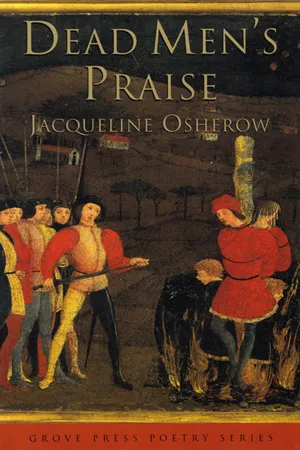
- 103 pages
- English
- ePUB (mobile friendly)
- Available on iOS & Android
eBook - ePub
Dead Men's Praise
About this book
Information
Ch’vil Schreiben a Poem auf Yiddish
I want to write a poem in Yiddish
and not any poem, but the poem
I am longing to write,
a poem so Yiddish, it would not
be possible to translate,
except from, say, my bubbe’s
Galizianer to my zayde’s Litvak
and even then it would lose a little something,
though, of course, it’s not the sort of poem
that relies on such trivialities, as,
for example, my knowing how to speak
its language—though, who knows?
Maybe I understand it perfectly;
maybe, in Yiddish, things aren’t any clearer
than the mumbling of rain on cast-off leaves.…
Being pure poem, pure Yiddish poem,
my Yiddish poem is above such meditations,
as I, were I fluent in Yiddish,
would be above wasting my time
pouring out my heart in Goyish metaphors.
Even Yiddish doesn’t have a word
for the greatness of my Yiddish poem,
a poem so exquisite that if Dante could rise from the dead
he would have to rend his clothes in mourning.
Oh, the drabness of his noisy,
futile little paradise
when it’s compared with my Yiddish poem.
His poems? They’re everywhere. A dime a dozen.
A photocopier can take them down in no time.
But my Yiddish poem can never be taken down,
not even by a pious scribe
who has fasted an entire year
to be pure enough to write my Yiddish poem,
which exists—doesn’t he realize?—
in no realm at all
unless the dead still manage to dream dreams.
It’s even a question
whether God Himself
can make out the text of my Yiddish poem.
If He can, He won’t be happy.
He’ll have to retract everything,
to re-create the universe
without banalities like firmament and light
but only out of words extracted
from the stingy tongues of strangers,
smuggled out in letters made of camels,
houses, eyes, to deafen
half a continent with argument
and exegesis, each refinement
purified in fire after
fire, singed almost beyond
recognition, but still
not quite consumed, not even
by the heat of my Yiddish poem.
Views of La Leggenda della Vera Croce
How will I ever get this in a poem,
When all I have to do is type AREZZO
And the name sidles up along a station platform,
The train I’m riding in begins to slow,
And—though I swore I wasn’t getting off this time—
I know a train comes every hour or so
To wherever I’m headed—Perugia? Rome?—
And suddenly I’m rushing off the train,
Depositing my bag, crossing the waiting room,
And striding up the Via Monaco again
As if I couldn’t see each fresco perfectly,
Couldn’t see them, now, against this screen.…
But in a minute, they’ll array themselves in front of me:
Soldiers, horses, placid ladies, kings,
All patient, in their places, not spinning crazily
Like the first time I saw them: unearthly beings
Breathing luminous pearl-green instead of air,
Horses and ladies-in-waiting flapping wings
Stolen from the eagle on the soldiers’ banner,
Their brocaded sleeves and bridles grazing spinning walls,
Hats twirling, armor flying, coils of hair
Unraveling into whirling manes and tails—
And that was before the winged arm’s appearance.…
When the Times ran an article about Stendhal’s
Famous nervous breakdown from the art in Florence,
Half a dozen friends sent it to me.
I suppose these tales of mine require forbearance.
Not that I had a breakdown, though I was dizzy,
Closed my eyes, leaned against a wall,
And told myself that there was time to see
Each panel—one by one—down to each detail:
Hats, sleeves, daggers, saddles, bits of lace;
I studied every panel: Adam’s Burial,
St. Helena’s Discovery of the Cross,
Solomon Meeting Sheba, The Annunciation,
The Dream of Constantine, The Torture of Judas,
Whose other name I learned from a machine
Which, with the help of a hundred-lire coin,
Supplies a telephone with information.
I did it for a laugh; I chose Italian.
I thought I heard the torture of the Jew
And was so stunned I played the thing again
(My Italian was, after all, fairly new
And the woman on the tape spoke very quickly
But she did say the torture of the Jew-
In Italian it’s ebreo—quite matter-of-factly)
The torture of the Jew who wouldn’t reveal
The location of the true cross—I got it exactly—
Put in a lot of coins to catch each syllable
(I also heard the English, which said Judas),
All the while not looking at the rope, the well;
Instead, I chose a saintly woman’s dress,
An angel’s finger pointing to a dream,
A single riveting, incongruous face—
What was I supposed to do? They were sublime.
The Inquisition wasn’t exactly news
And, while I did keep my eyes off that one frame,
I wasn’t about to give up on those frescoes.
In fact, I saw them again, a short while after
And again soon after—in those heady days,
Trains cost almost nothing and a drifter
Could easily cover quite a bit of Italy,
Though I tended to stay in Tuscany. The light was softer,
And—probably not coincidentally—
It had a higher density than any other place
Of things that could dazzle inexhaustibly.
And I was insatiable, avaricious
For what—even asleep—a person can’t see
From a slim back bedroom in a semidetached house
Like every other house in its vicinity
On a site whose inhabitants had been wiped out
To make room for spillover, like my family,
From the very continent I would have dreamed about
If I’d had even an inkling of the mastery
Of what its subtlest inhabitants had wrought
When they weren’t doing away with people like me.…
See how Solomon, listening, leans his head?
How the tired horseman leans against a tree—
How the guard beside the emperor’s makeshift bed
Can’t resist the sorcery of sleep—
So only we can catch the angel’s finger pointed
At the dreamer’s head, the horse’s sudden leap,
As if straight from that vision, to the battle scene:
Christianity’s triumph over Europe.…
I love the wing, the arm, the dreaming Constantine,
The moonlight casting shadows on the tent—
It is moonlight, though there is no moon—
Pale, as always, silvery and slant;
It’s coming from the angel’s pointing arm
Which I didn’t even notice that first moment—
All I saw was undiluted dream—
I didn’t really care what it ...
Table of contents
- Cover Page
- Title Page
- Copyright Page
- Dedication
- Contents
- Acknowledgments
- Part I
- Part II
- Part III
- Part IV
Trusted by 375,005 students
Access to over 1.5 million titles for a fair monthly price.
Study more efficiently using our study tools.
Frequently asked questions
Yes, you can cancel anytime from the Subscription tab in your account settings on the Perlego website. Your subscription will stay active until the end of your current billing period. Learn how to cancel your subscription
No, books cannot be downloaded as external files, such as PDFs, for use outside of Perlego. However, you can download books within the Perlego app for offline reading on mobile or tablet. Learn how to download books offline
Perlego offers two plans: Essential and Complete
- Essential is ideal for learners and professionals who enjoy exploring a wide range of subjects. Access the Essential Library with 800,000+ trusted titles and best-sellers across business, personal growth, and the humanities. Includes unlimited reading time and Standard Read Aloud voice.
- Complete: Perfect for advanced learners and researchers needing full, unrestricted access. Unlock 1.5M+ books across hundreds of subjects, including academic and specialized titles. The Complete Plan also includes advanced features like Premium Read Aloud and Research Assistant.
We are an online textbook subscription service, where you can get access to an entire online library for less than the price of a single book per month. With over 1.5 million books across 990+ topics, we’ve got you covered! Learn about our mission
Look out for the read-aloud symbol on your next book to see if you can listen to it. The read-aloud tool reads text aloud for you, highlighting the text as it is being read. You can pause it, speed it up and slow it down. Learn more about Read Aloud
Yes! You can use the Perlego app on both iOS and Android devices to read anytime, anywhere — even offline. Perfect for commutes or when you’re on the go.
Please note we cannot support devices running on iOS 13 and Android 7 or earlier. Learn more about using the app
Please note we cannot support devices running on iOS 13 and Android 7 or earlier. Learn more about using the app
Yes, you can access Dead Men's Praise by Jacqueline Osherow in PDF and/or ePUB format, as well as other popular books in Literature & American Poetry. We have over 1.5 million books available in our catalogue for you to explore.