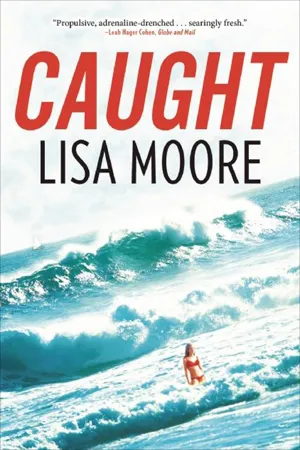
The acclaimed author of
February "combin[es] the complexity of the best literary fiction with the page-turning compulsive readability of a thriller" (
National Post).
Lisa Moore, a "Canada Reads" winner and a
New Yorker Best Book of the Year author, introduces a dangerously appealing new protagonist unlike any she's imagined before: a modern Billy the Kid . . .
Caught begins with a prison break. Twenty-five-year-old David Slaney, locked up on charges of marijuana possession, escapes his cell and sprints to the highway. There, he is picked up by a friend of his sister's and transported to a strip bar where he survives his first night on the run. But evading the cops isn't his only objective; Slaney intends to track down his old partner, Hearn, and get back into the drug business. Along the way, Slaney's fugitive journey across Canada rushes vibrantly to life as he visits an old flame and adopts numerous guises to outpace authorities: hitchhiker, houseguest, student, lover. When he finally reunites with Hearn just steps ahead of a detective hell-bent on making a high-profile arrest, their scheme sends Slaney to Mexico, Colombia, and back again on an epic quest fueled by luck, charm, and unbending conviction.
In
Caught, "Moore combines the propulsive storytelling of a beach-book thriller with the skilled use of language and penetrating insights of literary fiction. She pulls it off seamlessly, creating a vivid, compulsively readable tale" (
Penthouse).
"Propulsive, adrenalin-drenched."—
The Globe and Mail
"Exhilarating . . . a memorably oddball and alluring novel that's simultaneously breezy, taut, funny, and insightful."—
The Vancouver Sun
eBook - ePub
Caught
About this book
Information
Subtopic
Literature GeneralIndex
LiteratureDead
Man
Man
New Brunswick
Slaney hit the bell on the reception desk and the ding rang out in the empty lobby. It was after midnight. The sound of a radio on low volume broadcasting a big orchestra of violins and thundering drums came from a room in the back. Slaney waited and then hit the bell several times with the flat of his hand.
There was the loud thunk of the elevator behind him and a deep rumbling. It clanked and shuddered and the panel above it lit up. There was a folding cage-like door over the threshold but the elevator was empty.
Slaney hit the little bell again and he heard a woman’s rough voice yelling for him to hold his horses.
A minute later the woman bustled out from the backroom, patting her hair into place.
She was not more than five feet, with several soft mounds of fat beneath her bosom, and her skin was soap white. She stopped abruptly and held her hand out before her. She wrapped a fist around her index finger and drew it near her waist. The woman’s nails were long and bright red and the index fingernail had cracked off and hung on by a filament of skin.
Damn it, she said. Now I have to start growing it all over again. That’ll take me a good solid month.
She was wearing a limp black satin skirt that seemed to have been stained permanently by road salt and a sleeveless blouse of rustling taffeta. A faint moustache had been bleached and the skin above her eyes was hairless and inflamed, though she’d drawn on angled eyebrows that made her look sly and affronted. Her black crocheted shawl was smeared over her with static electricity.
What can I do for you, she said.
I was looking for a place to get in out of the cold for a couple of nights, Slaney said.
Oh, me too, she said.
Doesn’t have to be fancy, Slaney said. I’m short on cash at the moment. I’d be willing to do some work for it. I’d sleep standing up in a broom closet if I had to.
Wayne will be along in a minute, she said, lifting a hand to her shoulder and waving vaguely in the direction of the room with the radio. The orchestra halted in its tracks and a two-fingered piano tinkling began. The piano stopped abruptly too. Slaney and the woman stood in silence then, taking each other in.
Handsome bugger, aren’t you, she said.
Thank you, Slaney said.
Anybody ever tell you that? she asked.
A girlfriend once, Slaney said.
Anybody ever say those eyelashes are a bloody waste on a man? I’m not going to come out over this counter after you, don’t worry. I suppose you’re not long out of diapers.
Slaney said he wasn’t worried.
Let me touch something, she said.
Pardon? Slaney asked.
You got a handkerchief or piece of jewellery you keep on your person? I’d like to do a reading.
Are you a psychic? Slaney asked.
I am subject to visions, she said. Ever since I was a little girl. Sometimes I just touch a personal belonging and I get a whole life story.
Slaney worked his mother’s engagement ring out of his pocket and passed it to her. The orchestra had started tinkling again and the violins swayed back and forth like they were deciding about committing for the long haul. They were noncommittal but the drums were building up. One drum boomed hard and deep.
A tall, stooped man in black gabardine pants with shiny knees came out of the backroom behind her. He was shrugging on a red uniform jacket with gold braid on the sleeves. A yellow nicotine streak sluiced through his white hair. His eyes were the Nordic blue of a welder’s flame, and there was too much bone in the juts and crevices of his face. He had a forehead-led walk that caused him to look up under his eyebrows at Slaney. The look appeared incredulous but knowing. Slaney saw that part of the man’s shirttail was sticking out his open fly.
I got this, Izzy, he said.
He’s anxious to get settled, Wayne, she said. Out here hammering on that bell like there’s no tomorrow.
How can I help you, young man? he said.
Give him a bed, Wayne, the woman said. He don’t have any money.
I was thinking I could do some maintenance, Slaney said.
Just give him the room, Wayne, the woman said. She had his mother’s ring in her fist and she was holding the fist to her forehead with her eyes squeezed shut. She spoke as if reading off a teleprompter printing on the inside of her eyelids.
The man turned to a large board behind him with fifty keys hanging on it and after a long moment he took one down.
How long you planning to hang around? he asked.
Long enough to catch my breath, Slaney said. I could mop up this lobby for a couple of nights after the day’s activities.
Think you could tar a roof? I got a shed needs some tar.
I could do that, Slaney said.
You’ve got room 213, he said. You can stay in there until somebody else comes along. The shed is at the end of the field. I can show you where it leaks in the morning. How’d you hear about this place?
I just happened upon it, Slaney said. The elevator dinged and the doors shut again. There was an explosion of trumpets from the radio as the orchestra gathered power and every instrument was hammering and rang out and then stopped, allowing the solitary tinkle of a lone triangle.
You’re soaking wet, the woman said. Take my shawl.
No thank you, ma’am. I’ll be fine when I get up to my room.
Don’t be so foolish, take the shawl, she said. She walked to the end of the desk and lifted a hinged wooden inset and came out under it and pulled the shawl off and it crackled with electricity and sucked itself onto him. She reached up on tiptoe to arrange the shawl on Slaney’s shoulders.
We can’t have you dripping all over the lobby, she said. She handed him back the ring.
Did you see anything? Slaney said. She stood back with her hands on her hips.
I saw a journey, she said. If I could dissuade you, I would. You could turn back, but you’re not a man takes free advice.
There’s a few things I have to mention, the man behind the desk said.
Wayne, you don’t want this fellow tarring a roof, she said. Sure as shit he’ll fall off and ruin the hotel’s reputation. What are you putting him in a room with a thirteen in it for?
The man asked her not to start up. He reminded her it was late in the evening and everybody was tired.
There’s other rooms, the woman said. She crossed her arms under her chest and tilted her chin up.
I wouldn’t stay in room 213 if my life depended on it, she said. You know what goes on in there, Wayne. There’s ghosts in that room every night.
The man shut his eyes and his lids flickered.
At night blood seeps into the room through the light fixture in the ceiling and pours down the walls until the whole room is red.
Maybe I ought to tar that roof, Slaney said.
It’s 213 or nothing, the man said.
You got to have second sight to see that blood, the woman said. But it’s there.
I’m grateful for the room, Slaney said.
Toss some salt, the woman said. A little dash of salt in a circle around the bed.
I’m going to ask you not to do that, the man said. I got a hard time keeping the place clean already without somebody throwing salt all over the carpet.
Slaney thought he’d stay a couple of nights, long enough to give his picture a chance to fade out of the papers.
He thanked them both and headed for the elevators, the tassels of the shawl clinging to his knees.
Pulling Your Weight
Patterson shouldered his way through the crowd to the pay phone after Gulliver left the bar. He got O’Neill’s secretary and she sounded sweet and abrupt. Marcie or Martha.
Superintendent O’Neill is waiting for your call, she said. There was a pause. He heard her draw in a deep breath.
I’m going to transfer you, Staff-Sergeant Patterson, she said. You hold on there.
There was a kachunk and a silence long enough for Patterson to think he had been disconnected.
The woman in the red pantsuit was collecting her things to go. She was swaying on her platform sandals; all the intelligence in her expression had drained away. She looked stupefied and wayward.
Then O’Neill was on the line.
We lost Slaney, Patterson said. He heard O’Neill taking a sip of his coffee. Slurping, basically, in Patterson’s ear. It was an amplified susurration of scalding liquid.
You lost him, Patterson, O’Neill said. You lost him. He spoke in a measured, adenoidal drone. The false calm in his voice, Patterson knew, would be carrying through the frosted glass of his office door.
Patterson thought of his wife. He thought of Delores nudging the fridge door with her hip, the kiss of the rubber seal when it smacked shut.
Delores drank a ginger ale on the patio in the late afternoon with a fat biography or she read poetry. Sylvia Plath, or the other one she loved. Lowell or Larkin. She had been so happy when they gave Patterson the case.
Hurray for you, she’d said. She’d tossed her gardening hat in the air like Mary Tyler Moore and hugged him. The tip of the pruning shears, still in her hand, had jabbed him, puncturing the skin.
Slaney couldn’t have gone far, Patterson said. We’ve got three cars out there.
I spoke for you, O’Neill said. People didn’t think you were the guy, Patterson. I’m going to be honest. Your name came up: people didn’t jump. There was a deflated feeling at the table. You’re seen as too interior. A guy who keeps to himself. These were the comments. There were guys didn’t think you were the man for this.
Integrity, yes. Absolutely. Integrity, nobody argues, Patterson. A good guy, nobody argues.
Thank you, sir, Patterson said.
They were thinking initiative, though, see? Drive. Ambition. That little bit extra, Patterson, that makes a man stand out. Puts him just that tiny bit ahead of the crowd. Somebody said your name and a few guys expressed doubt. You want to know the truth? Nobody was jumping up and down. I would say nonplussed.
But I spoke for you on this occasion, Patterson. I said this is the guy. We give him a chance, he’ll come through.
We’ll find him, sir, Patterson said. We’re checking the hotels. He’s on foot. It’s all over the papers. He’s young; he’ll make a mistake.
O’Neill asked: What if Slaney walks away from all this?
He’s not going to walk away, sir, Patterson said.
Did you liaise?
I have alerted the local detachment to the sensitive nature.
We need Slaney on the move. We don’t want him stopping to contemplate.
We’ve got ghost cars out. We’ll trail him, offer him a ride to Montreal, Patterson said. We figure, Montreal, he’ll make contact with Hearn.
Don’t make me regret I spoke up, Patterson.
Slaney’s going back to Colombia, sir, there’s no question. And we’ll be on his tail.
If he walks away now, the whole thing goes down the toilet. We lose Hearn too. You lose Hearn.
He won’t walk, sir, Patterson said.
An hour later Patterson stood in the narrow hall at the back of the men’s clothing store, his arms hanging loosely by his sides. The hall had ...
Table of contents
- Cover
- Half Title
- Also by Lisa Moore
- Title
- Copyright
- Dedication
- The Break
- Dead Man
- Cyclops
- A New Velocity
- Rings within Rings
- Acknowledgements
- About the Author
Trusted by 375,005 students
Access to over 1.5 million titles for a fair monthly price.
Study more efficiently using our study tools.
Frequently asked questions
Yes, you can cancel anytime from the Subscription tab in your account settings on the Perlego website. Your subscription will stay active until the end of your current billing period. Learn how to cancel your subscription
No, books cannot be downloaded as external files, such as PDFs, for use outside of Perlego. However, you can download books within the Perlego app for offline reading on mobile or tablet. Learn how to download books offline
Perlego offers two plans: Essential and Complete
- Essential is ideal for learners and professionals who enjoy exploring a wide range of subjects. Access the Essential Library with 800,000+ trusted titles and best-sellers across business, personal growth, and the humanities. Includes unlimited reading time and Standard Read Aloud voice.
- Complete: Perfect for advanced learners and researchers needing full, unrestricted access. Unlock 1.5M+ books across hundreds of subjects, including academic and specialized titles. The Complete Plan also includes advanced features like Premium Read Aloud and Research Assistant.
We are an online textbook subscription service, where you can get access to an entire online library for less than the price of a single book per month. With over 1.5 million books across 990+ topics, we’ve got you covered! Learn about our mission
Look out for the read-aloud symbol on your next book to see if you can listen to it. The read-aloud tool reads text aloud for you, highlighting the text as it is being read. You can pause it, speed it up and slow it down. Learn more about Read Aloud
Yes! You can use the Perlego app on both iOS and Android devices to read anytime, anywhere — even offline. Perfect for commutes or when you’re on the go.
Please note we cannot support devices running on iOS 13 and Android 7 or earlier. Learn more about using the app
Please note we cannot support devices running on iOS 13 and Android 7 or earlier. Learn more about using the app
Yes, you can access Caught by Lisa Moore in PDF and/or ePUB format, as well as other popular books in Literature & Literature General. We have over 1.5 million books available in our catalogue for you to explore.