"A vital yet unfamiliar perspective on the ongoing Israeli-Palestinian conflict and a heartfelt, judicious invitation to dialogue" (Publishers Weekly).
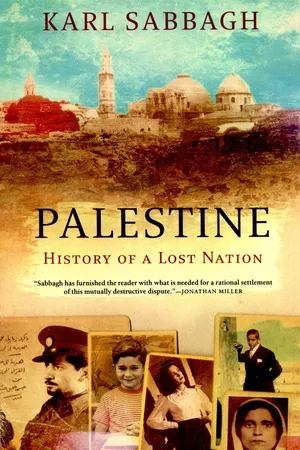
Palestinians feature regularly in news headlines, but their country is much less known. In this humane and deeply compelling book, Karl Sabbagh traces Palestine and Palestinians from their roots in the mélange of tribes, ethnic groups, and religions that have populated the region for centuries, and describes how, as a result of the interplay of global power politics, the majority of Palestinians were expelled from their home to make way for the new Jewish state of Israel.
Palestine: History of a Lost Nation offers a sympathetic portrait of the country's rich heritage, as well as evidence of the long-standing harmony between Arabs (Muslim and Christian) and the small indigenous Jewish population in Palestine. Karl Sabbagh has written both a transporting narrative and a meditation on a region that remains a flashpoint of conflict—a story of how past choices and actions reverberate in the present day.
"A powerful and graceful polemic." —
Kirkus Reviews
"A welcome addition to a new mini-genre of works on Israel and Palestine that focus on people rather than politicians . . . Sabbagh writes with an easy, engaging style . . . [a] poignant, often moving work." —
Guardian
"Sabbagh has furnished the reader with what is needed for a rational settlement of this mutually destructive dispute." —Jonathan Miller
"A uniquely intimate portrait of a vibrant land that has always known conflict but, for its people (including both Jews and Muslims), has nevertheless provided continuity, pride, and especially identity." —
Booklist
- 388 pages
- English
- ePUB (mobile friendly)
- Available on iOS & Android
eBook - ePub
About this book
Information
1
ANCIENT PALESTINE
• • •
Aleef Sabbagh, a cousin I had known for less than twenty-four hours, stretched his arms wide in an olive grove in the Galilee. He was showing me the width of the trunk of one of his family’s olive trees, wider than he could spread his arms. ‘Eight hundred years old,’ he said, with pride and a little exaggeration. The gnarled and twisted tree still bore a rich crop of olives each year. It was coming up to harvest time, and soon Aleef, his brothers, their wives, children and cousins would be in this grove picking the olives as he and our family had done for hundreds of years.
Where should one begin in assessing the competing claims of Arabs and Jews to Palestine? How far back in history should a claim be allowed legitimacy? There are fully fledged nations in existence today, members of the United Nations, which not only did not exist a hundred years ago but whose people had no national identity at that time. There are other peoples, the Armenians or the Kurds, for example, who have existed with a cultural and social unity for a thousand years or more, yet do not have independent nationhood free from the control of a superior power.
It sometimes seems that the argument between the Israelis and the Palestinians is fought on the basis that the further back in history either side can show residence in the area, the more entitled they are to the land today.
The key to understanding Israel,’ says a modern tourist guide to Israel, ‘is to understand that it was created as the modern reincarnation of an ancient Jewish state. Israel was the Promised Land of Abraham and Moses, the Israelite kingdom of David and Solomon, and the home of Jesus of Nazareth and the Jewish Talmudic sages. Although the Jewish presence in the country has been unbroken for more than 3,000 years, several massive exiles–first by the Babylonians in 586 BC and then by the Romans in AD 70–created a diaspora, a dispersion of the Jewish people throughout the world.’1 Or, to take a different view, ‘Jewish tenure of Palestine, in any real sense of the word “Palestine”, was never complete and it only lasted continuously, within its limits, for seventy years. It lasted, this vaunted possession, for no longer than the lifetime of one man, and that was three thousand years ago.’2 (This refers to the time of David and Solomon, from about 1016 BCE.)
The land of Palestine is a small territory in the eastern Mediterranean, about 250 miles from north to south and 70 miles at its widest from east to west. The southernmost third of the country, stretching down to the Red Sea, is largely desert, but the northern two thirds is dominated by a fertile plateau, separated from the Mediterranean by a coastal plain. Over the centuries it has changed from being a focus of world attention, a crossroads of great power conflict in pre-Christian times, to a backwater in the heyday of the Ottoman Empire, when the Turks ruled over the Middle East and parts of Eastern Europe.
In the north, the hilly region of Galilee stretches from the ports of Haifa and Acre to the beautiful town of Safad, where my family originated, and to Lake Tiberias, the New Testament Sea of Galilee. In the middle of the country, Tel Aviv and Jaffa are on the coast and forty miles south-east is the hill city of Jerusalem. Further east the hills drop steeply to the Jordan valley, the town of Jericho, and the Dead Sea. In the southern part of Palestine, the Mediterranean coast curves round towards Egypt, and a little way inland is the city of Gaza, while stretching further southwards towards the Red Sea is the Negev desert. Scattered throughout the 10,000 square miles of Palestine are ancient towns and villages, organized over the centuries into traditional allegiances and rivalries, with larger towns forming regional capitals and centres of trade and culture for the surrounding villages.
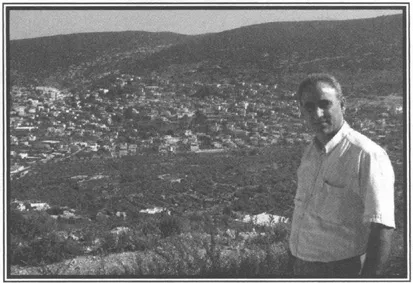
Aleef Sabbagh in the Galilee landscape his family has inhabited for many generations.
Many different ‘peoples’ have lived in Palestine over the centuries. I say ‘peoples’ in quotes because there is no really accurate way to determine from historical texts and excavations the precise connections or ethnicities of the groups who have left traces of their presence. A name given to one group may imply that its members are different from a group with another name, but in fact a combination of intermarriage, religious conversion and adoption of foreign customs and styles may mean that some groups with different names were ethnically identical.
Five thousand years ago, a succession of population groups migrated north from the Arabian peninsula into areas of the Middle East. These people are labelled together as Semites because their languages were all related and presumed to be derived from a common tongue. These groups were organized into tribes and founded civilizations in territories that stretched in a broad band across the modern states of Iraq, Jordan, Israel, Syria and Egypt. The group that populated the area of Palestine became known as Canaanites. Another group of Semites left the Arabian peninsula, arrived in Egypt and then, two thousand years after the Canaanites, travelled to Palestine, where they became known as Hebrews (from the word ‘habiru’ meaning ‘nomad’). Here they started out by adopting many of the characteristics of the Canaanites, including their culture, traditions and dialects and their polytheistic religion. But at some point the Hebrews adopted monotheism, an idea they had come across in Egypt, and the precursor of the Jewish religion was born.
Since the 1970s, on the basis of surveys by Israeli archaeologists in the West Bank, it has been concluded by most experts that the first communities that were to form the ancient states of Israel and Judah settled in the central highlands of Palestine in the late thirteenth or early twelfth century. Some elements of these people may have come-from elsewhere in Palestine, some from just over the Jordan; but they were local indigenous people. Whether some group joined them that had recently been in Egypt is an open question: there is absolutely no material proof of this, and the culture of these hill farmers was entirely ‘Canaanite’. It was to be a couple of centuries at least before these farming communities coagulated into a ‘nation’ and formed a political state.
In considerable detail, the Old Testament describes a series of events, some of them said to be divinely caused, from the birth of Abraham in 2050 BCE, through the Jews’ period of slavery in Egypt, entry into the ‘Promised Land’, reigns of various kings, including David and Solomon, over an area of Palestine they called Israel, and division of this area into two ‘kingdoms’, Judah and Israel. The books go on to describe how these two kingdoms met different fates, one falling to the Assyrians and the other to the Babylonians, who destroyed the temple in Jerusalem and shipped the people of the kingdom off to Babylon. These last events were said to have taken place between 720 and 586 BCE. After returning from exile, a group of Jews rebuilt their temple and continued to live and worship in the area. A priestly family known as the Maccabees or the Hasmoneans established an autonomous kingdom in the second century BCE which was, in one researcher’s words, ‘the nearest that Judah ever approached to the ideal enshrined in its literature, a monarchic state stretching over most of Palestine’.3 During many of the political upheavals, some Jews stayed on in their territory, which was under occupation by the Persians, then, after the conquests of Alexander the Great, by successive kingdoms based in Egypt and in Syria. Eventually, after a brief period of Jewish independence (c. 150–66 BCE), Palestine came under Roman rule, and the single Jewish state was broken up into several different territories. This was the case when Jesus of Nazareth was born.
What we are told today about the history of the period, and particularly the early history of the Jews, usually comes from biblical texts written centuries later, describing ‘kingdoms’, ‘empires’, ‘battles’ and ‘temples’ that may conjure up in the modern mind much grander events than were really the case. One researcher has described Palestine three to four thousand years ago as ‘an Egyptian province ruled by local princes who looked upon themselves as faithful vassals of their patron, the Pharaoh.’4 He goes on to describe these princes as more akin to ‘mayors’ of cities, instead of being the imposing monarchs we read about in the Bible. And since the descendants of the other inhabitants of the land– the Canaanites, the Phoenicians, the Philistines, the Aramaeans, the Edomites– have not left voluminous accounts of their kings and kingdoms, priests and prophets, it’s easy to believe, as many people do, that the whole area was dominated for a thousand years or more by Jews.
Over the centuries and up until the present day, many people have seen the presence of the ‘Israelites’ in Palestine, and the part they played in local history, as the predominant factor in determining modern claims to Palestine. Not only do they base this on the claims of the Old Testament, but also on prayer books and sacred writings, which tell in some detail of a ‘restoration’ of modern Jewry to ‘the Land of Israel’ after the arrival of a Messiah, a ‘promised one’ who will rebuild the kingdom. ‘An eighteenth-century story tells of a certain Rabbi Yitzhak of Berdichev in Poland who sent out invitations to his daughter’s wedding: “It will take place next Tuesday in the Holy City of Jerusalem. If, God forbid, the Messiah has not arrived by then, it will take place in the village square.”’5
To me and, I suspect, to many uncommitted people, using the map of the world as it might have been three or four or six thousand years ago is not a very appropriate basis for granting sovereignty in the modern world. It is difficult to think of a nation that exists today that would bear any similarity in borders or demography to the entity that existed on its territory three thousand years ago. The activities of neolithic farmers in Ireland, for example, contribute very little to an understanding of the conflict in Northern Ireland today.
And the situation is even more confusing when one takes into account the way in which names of groups and places change over centuries and across languages. Modern accounts of the history of the Jews and of where they lived in the past often blur the edges between places called ‘Israel’, people called ‘Israelites’ and an ethnic group called Jews. There are even doubts about whether there is any ethnic continuity between most Jews today and the Hebrews of the Old Testament. Philip Davies points out that the Bible describes a kingdom called Israel, some of whose inhabitants worship Yahweh, or Jehovah, and some who don’t, and where there is no ethnic correspondence to cultural affiliation and no ethnic reason for differentiating between Canaanites and Israelites. Indeed, some Canaanites also worship Yahweh. Israel was a culture and not an ethnicity. There’s some evidence that even in biblical times, many Jews did not see Palestine as their homeland. At the opening of the Christian era, there were nearly five million Jews in the Roman Empire, of which only 700,000, less than 15 per cent, were in Palestine.
One of the problems that obscures the truths about people and places in history is that names and historical identities are sometimes only tenuously related. The people that Scotland takes its name from are today’s Irish; the Scots themselves are descended from a people called the Picts. The British today are not descended from the British who were encountered by the Romans. Those British fled to Wales and Cornwall and were replaced by Angles and Saxons who came from Germany.6
From time to time even the history of the name ‘Palestine’ –which is now associated with Palestinian Arabs–is questioned. Some academics trace it back at least two thousand years: That grand old man of Greek history, Herodotus, had already used the expression Syria Palestine for the whole coastal region from Lebanon to Egypt, and it was taken over by the Roman emperors as a new name for Judea in the second century. Two centuries later, Palestine became an even more comprehensive designation. The Byzantine rulers had three Palestines, of which the Second was the northernmost, occupying the territory south of Lebanon around Haifa. The region around Jerusalem was named First Palestine, while Third Palestine incorporated a large piece of old Arabia–the Sinai, Negev, and the eastern bank of contemporary Jordan south of Amman. The term Palestine accordingly evokes an ancient geographical and administrative coherence, and for later antiquity it represents an even more unified pattern than the province of Arabia.’7
Golda Meir, Prime Minister of Israel from 1969 to 1974, disagreed. ‘There is no such thing as a Palestinian Arab nation,’ she said. ‘Palestine is a name the Romans gave to Eretz Yisrael with the express purpose of infuriating the Jews… Why should we use the spiteful name meant to humiliate us? The British chose to call the land they mandated Palestine, and the Arabs picked it up as their nation’s supposed ancient name, though they couldn’t even pronounce it correctly and turned it into Falastin, a fictional entity.’8
In fact there hasn’t been a period in the last two thousand years when the Arab inhabitants of the area, and those who came in contact with them, didn’t know their territory by the name ‘Palestine’. ‘Palestine became a predominately Arab and Islamic country by the end of the seventh century,’ writes Edward Said. ‘Almost immediately thereafter its boundaries and its characteristics–including its name in Arabic, Filastin–became known to the entire Islamic world, as much for its fertility and beauty as for its religious significance. In the late tenth century, for example, we find this passage in Arabic:9
Filastin is the westernmost of the provinces of Syria. In its greatest length from Rafah to the boundary of AI Lajjun (Legio) it would take a rider two days to travel over; and the like time to cross the province in its breadth from Yafa (Jaffa) to Riha (Jericho)…. Filastin is watered by the rains and the dew. Its trees and its ploughed lands do not need artificial irrigation; and it is only in Nablus that you find the running waters applied to this purpose. Filastin is the most fertile of the Syrian provinces. Its capital and largest town is Ar Ramlah, but the Holy City (of Jerusalem) comes very near this last in size. In the province of Filastin, despite its small extent there are about twenty mosques, with pulpits for the Friday prayer.10
Sixty per cent of the population in the tenth century was in agriculture and all of them believed themselves to belong in a land called Palestine.
Haim Gerber, a professor at the Hebrew University of Jerusalem, would also disagree with Golda Meir that ‘the Arabs picked up [Palestine] as their nation’s supposed ancient name’ from the British in the twentieth century. In his paper ‘Palestine and Other Territorial Concepts in the 17th Century’ Gerber provides a wealth of detail from seventeenth-century legal documents to show that there existed what he called ‘embryonic territorial awareness’ that went beyond mere naming of the place of one’s birth or home.11
In the seventeenth and eighteenth centuries people travelled from the west to ‘Palestine’ and wrote about it. The Turks conquered ‘Palestine’ along with Syria and then, a few years later, according to the historian Mosshe Sharon, ‘joined Palestine to the province of Syria, whose capital was Damascus. Palestine itself was divided into five districts, or Sanjaks, each named after its capital… Gaza… Jerusalem… Nablus… Lajjun… and Safed.’12 One legal text studied by Gerber deals with cases like ‘a man from a village of the villages of Palestine’ who swore an oath of divorce, and asks What if a year later he travelled outside of Palestine… was he to be clear of his oath?’ Indeed, Gerber quotes another authority describing the author of the legal text as ‘the great scholar of Palestine’.
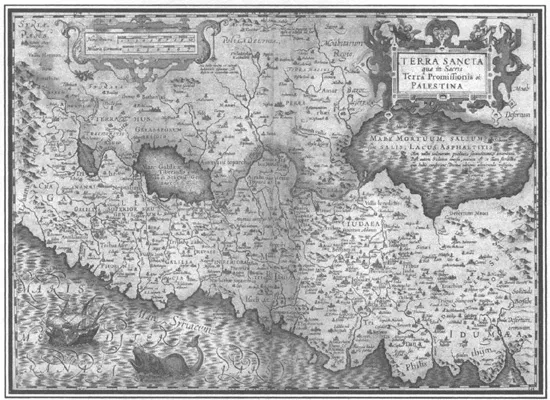
A sixteenth-century map of Palestine
A modern Palestinian historian has written: ‘The idea [of “Palestine”]… had regional and local roots. It was not a coincidence, for example, that the central Ottoman government established an administrative entity with borders practically identical to those of Mandate Palestine on three brief occasions during the nineteenth century: 1830, 1840 and 1872. Moreover, local economic networks that integrated the cities with their hinterlands, peasant mobility and clan relations; and commonly shared cultural practices, such as the annual ...
Table of contents
- Cover
- Title Page
- Copyright Page
- Dedication Page
- Contents
- Illustrations
- Acknowledgements
- Prologue
- 1 Ancient Palestine
- 2 The First King of Palestine’
- 3 Daher’s Decline
- 4 Palestine in the Nineteenth Century
- 5 Travellers’ Tales
- 6 Bible Stories
- 7 Balfour and Friends
- 8 A Letter to Lord Rothschild
- 9 Picking up the Peace
- 10 Mandate
- 11 Into the 1920s
- 12 Hostile Acts
- 13 Commissions Galore
- 14 Peel and Partition
- 15 ‘Lion-cub of Arabdom’
- 16 Love and War
- 17 Displaced Persons
- 18 UNSCOP and Robbers
- 19 The UN Vote, 29 November 1947
- 20 The End of History
- 21 Palestine Lost
- Epilogue
- Further Reading
- Notes
- Index
- Footnote
Trusted by 375,005 students
Access to over 1.5 million titles for a fair monthly price.
Study more efficiently using our study tools.
Frequently asked questions
Yes, you can cancel anytime from the Subscription tab in your account settings on the Perlego website. Your subscription will stay active until the end of your current billing period. Learn how to cancel your subscription
No, books cannot be downloaded as external files, such as PDFs, for use outside of Perlego. However, you can download books within the Perlego app for offline reading on mobile or tablet. Learn how to download books offline
Perlego offers two plans: Essential and Complete
- Essential is ideal for learners and professionals who enjoy exploring a wide range of subjects. Access the Essential Library with 800,000+ trusted titles and best-sellers across business, personal growth, and the humanities. Includes unlimited reading time and Standard Read Aloud voice.
- Complete: Perfect for advanced learners and researchers needing full, unrestricted access. Unlock 1.5M+ books across hundreds of subjects, including academic and specialized titles. The Complete Plan also includes advanced features like Premium Read Aloud and Research Assistant.
We are an online textbook subscription service, where you can get access to an entire online library for less than the price of a single book per month. With over 1.5 million books across 990+ topics, we’ve got you covered! Learn about our mission
Look out for the read-aloud symbol on your next book to see if you can listen to it. The read-aloud tool reads text aloud for you, highlighting the text as it is being read. You can pause it, speed it up and slow it down. Learn more about Read Aloud
Yes! You can use the Perlego app on both iOS and Android devices to read anytime, anywhere — even offline. Perfect for commutes or when you’re on the go.
Please note we cannot support devices running on iOS 13 and Android 7 or earlier. Learn more about using the app
Please note we cannot support devices running on iOS 13 and Android 7 or earlier. Learn more about using the app
Yes, you can access Palestine by Karl Sabbagh in PDF and/or ePUB format, as well as other popular books in History & Middle Eastern History. We have over 1.5 million books available in our catalogue for you to explore.