"Probably the best biography of Saddam Hussein…[it] presents a coherent view of a man who has generated a good deal of mythology" (Roger Hardy,
BBC World Service).
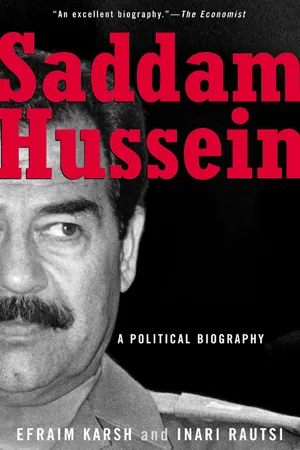
Authors Efraim Karsh and Inari Rautsi, experts on Middle East history and politics, have combined their expertise to write what is largely considered the definitive work on Iraq's fifth president. Drawing on a wealth of Iraqi, Arab, Western, and Israeli sources, including interviews with people who have had close contact with Saddam Hussein throughout his career, the authors trace the meteoric transformation of an ardent nationalist and obscure Ba'ath party member into a dictator and geopolitical player.
From Saddam's key role in the violent coup that brought the Ba'ath party to power, to the Iran-Iraq War, the Gulf War, and beyond, Karsh and Rautsi present a detailed biography that skillfully interweaves analysis of Gulf politics and history. Now with a new introduction and epilogue, this authoritative biography is essential for understanding the life and influence of this modern tyrant.
- 339 pages
- English
- ePUB (mobile friendly)
- Available on iOS & Android
eBook - ePub
About this book
Information

1
The Making of a Baʿthist
In 1394, as the Tartar hordes of Timurlane swept over Mesopotamia, they took the trouble of stopping at a small provincial town on the Tigris river, some hundred miles north of Baghdad, where they erected a pyramid with the skulls of their victims.1 The name of the town was Tikrit, and its choice as the site for demonstrating Timurlane's ferocity was not accidental. A small garrison protected by a formidable fortress, Tikrit had been a center of defiance to external invaders, leading the eighteenth-century English historian, Edward Gibbon, to define it as an “impregnable fortress of independent Arabs.”2 This was the place where Saladin, the legendary Muslim military commander who defeated the Crusaders in the renowned battle of Hittin and liberated Jerusalem from Christian rule, had been born in 1138. Exactly 800 years later, it was to become the birthplace of a modern Iraqi ruler, aspiring to don the mantle of his great predecessor: Saddam Hussein.
Saddam would always hold his birthplace in great affection and pride. The few men he would choose to trust and be his chieftains would, by and large, come from Tikrit and share his strong attachment for the home of their formative years.
Yet, despite his fond thoughts of Tikrit, Saddam's was a poverty-ridden and troubled childhood. According to official sources, he was born on April 28, 1937. His place of birth was a mud house belonging to his maternal uncle, Khairallah Talfah.3 His father, a poor landless peasant by the name of Hussein al-Majid, died before Saddam was born and his mother, Sabha, who could not support the orphan, left him to be raised by Khairallah's family. The child's name, Saddam, meaning, “one who confronts,” turned out to be strangely prophetic.
At the time of Saddam's birth, Iraq was a precarious constitutional monarchy, ruled by a non-Iraqi dynasty—the Hashemite family—originating from the Hijaz (part of today's Saudi Arabia). Established in the wake of the First World War by European great powers on the ruins of the Ottoman Empire, which had controlled the Middle East for nearly four centuries, Iraq was administered by Great Britain under a mandate from the League of Nations until 1932, when it joined the international organization as an independent state. The “founding father” of the Iraqi state, King Faisal I, who by virtue of his personality and astute leadership had managed to keep the various centrifugal forces in the country under control, died in 1933, and was succeeded by his only son, Ghazi. Faisal's premature death and Ghazi's inexperience (he was 21 years old upon ascending the throne) and weak personality ushered in a period of acute political instability. During a seven-year period between gaining independence and the outbreak of the Second World War in 1939, Iraq was governed by no fewer than 12 cabinets. In 1936 the country experienced its first military coup d'état; by 1941, six further coups had already taken place.4
The Iraq of Saddam's early years was marked by profound political instability, compounded by the gathering storm in Europe and the eventual outbreak of a general war. Resenting the continuation of British presence and influence in Iraq—despite its formal independence the country remained tied to Britain by a bilateral treaty signed in 1930, which gave the latter preferential political status and two military bases on Iraqi territory5—the militant Iraqi nationalists looked forward to the triumph of Nazi Germany and its allies. A Nazi victory, they believed, would dislodge Britain from the Middle East and render Iraq, and the other Arab lands of the Middle East, truly independent. As the Germans went from strength to strength, anti-British sentiments soared and Baghdad became one of the main regional centers for pro-Axis activities. A showdown between the nationalists, who enjoyed widespread support within the army, and the British seemed only a matter of time.
In April 1941 London approached Baghdad with a request to allow the landing and transfer of British troops through Iraqi territory in accordance with the 1930 Treaty. Iraq's pro-Nazi Prime Minister, Rashid Ali al-Kailani, who had come to power earlier that month through a military coup, viewed the request as a de facto occupation of Iraq. Yet, mindful that the real agenda behind the British demand was his own overthrow, he took care to profess his readiness to abide by the bilateral treaty. The British, nevertheless, did not take any chances, and in late April began landing their troops in southern Iraq. At this point Rashid Ali ordered his army to move on the British air base at Habbaniya, near Baghdad, and appealed for German support. In the ensuing hostilities the Iraqi army was decisively beaten by a British expeditionary force, and Rashid Ali and some of his supporters fled the country. The authority of the monarchy was restored by British bayonets. Many participants in the uprising were jailed and some of them executed by the old-new government.
These events had a profound effect on Saddam's life. His uncle and foster father Khairallah, an army officer and ardent Arab nationalist, participated in the ill-fated uprising and was subsequently dismissed from the military and jailed for five years. The young boy was thus forced to move to the small village of al-Shawish, near Tikrit, to live with his mother who had meanwhile remarried. Her new husband was Hasan Ibrahim, a brother of Saddam's late father. In the following years he was to ask his mother time and again where his uncle was, only to be given the routine answer: “Uncle Khairallah is in jail.” In Saddam's own account, his empathy with Khairallah had a crucial impact on the development of his nationalist sentiments in that it fueled a deep-seated hatred of the monarchy and the foreign power behind it, a feeling which he was to harbor for years to come.6 As he would write later: “Our children should be taught to beware of everything foreign and not to disclose any state or party secrets to foreigners … for foreigners are eyes for their countries, and some of them are counterrevolutionary instruments [in the hands of imperialism].”7
The move from Tikrit to al-Shawish was quite traumatic for Saddam. To be sure, there was nothing remarkable about the Tikrit into which he was born. Since its destruction at the hands of Timurlane's hordes, the town had fallen into decay. Nineteenth-century foreign travelers passing through it in the course of their journeys found a desolated place, remarkable only for the remains of a ruined castle on the high cliff that overlooked the town.8 The town's residents, Sunni Arabs notable for their garrulousness, earned their modest living by manufacturing kalaks, round rafts made of inflated animal skin.9 Yet, in comparison with al-Shawish, Tikrit was a bustling center. Like most Iraqi rural settlements at the time, life in Saddam's small village was filled with hardships. Not only did it lack paved roads, electricity, or running water, but the appalling health and sanitary conditions made physical survival a demanding task. According to Iraqi official statistics, infant mortality in the three major cities (Baghdad, Basra and Mosul) in 1937, the year Saddam was born, amounted to 228 per 1,000 births, and the rate was admittedly much higher in rural areas.10 This meant that one of every two or three babies in an Iraqi village was condemned to death before reaching one year of age, mainly from infirmity and malnutrition. The survival of the fittest was, literally, a reality for Saddam from the first moment of his life.
Those who were lucky enough to survive their early childhood, were to suffer throughout their lives from nutritional deficiencies and to be afflicted by numerous epidemic diseases such as malaria, bejel (a non-venereal form of syphilis), hookworm, tuberculosis, and trachoma.11 This difficult existence was further compounded by the miserable poverty which permeated every household in the village. In Saddam's own recollection, “life was difficult everywhere in Iraq. Very few people wore shoes. And in many cases they only wore them on special occasions. Some peasants would not put their shoes on until they had reached their destination, so they would look smart.”12
This was the environment into which the young Saddam was introduced upon moving to the village. Unlike Khairallah, who as a military officer enjoyed a relatively high social status, the Ibrahims were considered “local brigands.” Saddam was thus condemned to a lonely existence. He had no friends among the village boys, who often mocked him for being fatherless, and he used to carry an iron bar to protect himself against attacks.13 According to exiled Iraqi sources, Saddam often amused himself by putting such a bar on the fire and after heating it red, stabbing a passing animal in the stomach, splitting it in half. The living creature closest to his heart, as Saddam would later reveal, was his horse. Even at that early stage, he recognized the grim “reality” that “a relationship between man and animal can at times be more affectionate, intimate, and unselfish than relations between two human beings.” So profound was Saddam's affection for his horse that, according to him, upon learning about the death of the beloved creature, he experienced paralysis of his hand for over a week.14
To make things worse, nobody in the family showed great interest in Saddam, who had to look after himself from his first days in the village.15 His stepfather, “Hasan the liar” as he was known locally, was a brutish man who used to amuse himself by humiliating Saddam. His common punishment was to beat the youth with an asphalt-covered stick, forcing him to dance around to dodge the blows. He prevented Saddam from acquiring education, sending him instead to steal for him; the young boy was even reported to have spent some time in a juvenile detention center.16 Saddam learnt from firsthand experience, at a very early age the cruel law of homo homini lupus (man is a wolf to man). Its corollaries of suspicion and distrust of one's closest associates, a need for total self-reliance, and for intimidating others so as never to be seen as prey were to guide his thoughts and acts from that time forward.
Had Saddam spent his entire youth at his mother's secluded village, he would most probably have become an undistinguished Iraqi peasant. However, to his great excitement, in 1947, shortly after his uncle's release from prison, he left his mother and stepfather and returned to Khairallah's home in Tikrit where he began attending school. Studies were quite burdensome for the young boy, who at the age of ten did not know how to spell his name. He would rather amuse his classmates with practical jokes, such as embracing his old Koran teacher in a deceptively friendly hug and then inserting a snake beneath his robe.17 Yet, Khairallah's constant encouragement and guiding hand kept Saddam going through these difficult years. Another source of support was provided by Khairallah's son, Adnan, three years Saddam's junior and his best friend, who would later become Minister of Defense. In the fall of 1955, having graduated from primary school, Hussein followed his uncle to Baghdad where he enrolled at the Karkh high school. He was then 18 years old.18
Those were days of national fervor and the cafes of Baghdad were alive with intrigue and conspiracies. In 1955 Iraq joined Britain, Turkey, Iran and Pakistan in forming a regional defense organization, known as the Baghdad Pact. In taking this step, the Iraqi Prime Minister, Nuri Saʿid, was motivated by wider objectives than the containment of the “Soviet threat” which, ostensibly, constituted the raison d'être for the new security system. Faced by mounting public pressure for a unilateral abrogation of the 1930 Treaty with Britain, but reluctant to jeopardize Iraq's relations with its main international ally, Saʿid sought a magic formula that would allow him to have his cake and eat it too: to project himself as a staunch nationalist who freed his country from foreign influence, while keeping British support for Iraq intact. The Baghdad Pact, he reasoned, could offer such a solution by creating a multilateral framework that would put Anglo-Iraqi relations on a new footing, amenable to both Britain and Iraq. Besides, if joined by other Arab states, such as Jordan and Syria, the Baghdad Pact could give Iraq a springboard for outshining Egypt, its traditional rival for leadership of the Arab World. Since the ancient struggle for regional hegemony between Mesopotamia and Egypt, the relationship between Iraq and Egypt had been a competitive one.
These expectations turned sour. By the time the pact was established, it was already evident to Saʿid that he had lost the battle over the minds and souls of the Arab masses to the young and dynamic Egyptian President, Gamal Abd al-Nasser. In September 1955 Nasser dealt a blow to the West by concluding a large-scale arms deal with the Soviet Union (known as the “Czech deal” since Prague was the official signatory to the agreement), which gave Moscow a doorway to the Middle East, hitherto an almost exclusive Western “preserve.” (It was the Western great powers that had defeated the Ottoman Empire in the First World War and carved up the Middle East between them in a series of League of Nations mandates in accordance with the Sykes-Picot Agreement of 1916.) Ten months later Nasser publicly snubbed Great Britain by nationalizing the Suez Canal. The British response was not slow in coming: in October Egypt was attacked by an Anglo-French-Israeli war coalition. Even though the Egyptian army was defeated by the Israelis and suffered significant losses at the hands of the British and the French, and although it was the United States (and to a lesser extent, the Soviet Union) that saved the day for Nasser by forcing the invading forces to relinquish their gains, in Arab eyes Nasser was the hero of the Suez Crisis; the person who had taken on “world imperialism” single-handedly and managed to emerge victorious.
While Nasser was steadily establishing himself as the standard-bearer of the anti-imperialist struggle and the embodiment of Arab nationalism, the Iraqi leadership was increasingly viewed as a “lackey of Western imperialism,” a reactionary regime out of step with the historic march of Arab destiny. Hence, not only did Iraq fail to attract other Arab partners to the Baghdad Pact, finding itself in glaring regional isolation, but the formation of the pact met with considerable domestic disapproval. The left-wing factions resented Iraq's involvement in what they viewed as direct aggression against the USSR. The nationalists, for their part, considered the pact a submission to Western imperialism and a betrayal of the cause of pan-Arabism.19
Public dissatisfaction in Iraq reached its peak in the fall of 1956 when widespread riots engulfed Baghdad in reaction to the regime's passivity during the Suez Crisis. One of the many people who roamed the streets during those heated days was Saddam, who felt in his element in this turbulent environment. The political milieu was not daunting to him; indeed he was well suited to it. His uncle's example had inspired him to political activism and his lack of close, emotional ties in his early childhood had taught him to scheme and manipulate to survive. Finding anti-government activity far more gratifying than studies, he plunged wholeheartedly into the seething streets of the capital. In early 1957, at the age of 20, he joined the Baʿth Party.
The Baʿth Party, meaning the party of the Resurrection, or Renaissance, was established in Damascus in the early 1940s by two Syrian schoolteachers, Michel Aflaq, a Greek Orthodox Christian, and Salah al-Din al-Bitar, a Sunni Muslim. A radical, secular, modernizing party, its ideology is a patchy mixture of pan-Arabism and socialism, which can be reduced to three organizing principles: unity, liberation, and socialism. This “holy trinity,” as the Baʿthists tend to call it, constitutes a unified metaphysical whole. None can be fully achieved without the attainment of the other two; all are means to promote the ultimate goal of the spiritual rebirth of the Arab nation.
This rebirth, according to Baʿthi doctrine, should be a profound and revolutionary process, extending far beyond such practical considerations as international boundaries, to encompass the “liberation” of the individual from former tribal, religious, or regional loyalties. Yet, high ideals apart, from its early days of activity the Party's agenda has been essentially predicated on one issue: elimination of the “traces of colonialism” in the Middle East and unification of the Arab nation. Since, in Baʿthi thinking, the great powers carved up the Middle East in the early twentieth century in such a fashion as to satisfy their particular interests and keep the Arab nation divided and weak, this wrong has to be rectified. The colonial powers must be pushed out of the region, and the artificial boundaries left behind should be abolished to accommodate the advent of a unified Arab state. Israel, which in Baʿthi thinking was a colonialist creation designed to fragment the Arab nation, had to be eliminated altogether.
This pan-Arab agenda has been illustrated not only by the main Baʿthi motto—"One Arab Nation with an Eternal Mission"—but also by its organizational infrastructure. The Party's supreme decision-making body, the National Command, is international in composition, comprising representatives from branches in the various Arab countries. These local branches are called Regional Commands, implying that all Arab states are merely parts of the wider Arab nation.20
Baʿthi ideas began infiltrating Iraq in the late forties through Iraqi students studying in Syria and Lebanon, and Syrian students in Iraq. In 1952 the Iraqi branch of the Baʿth received official recognition from the Party's National Command, and Fuad Rikabi, a Shiʿite engineer from the southern Iraqi town of Nasiriya, was appointed Secretary of the Regional Command in Iraq. Yet, whereas the Syrian Baʿth developed into a significant political force during ...
Table of contents
- Half Title
- Title
- Copyright
- Contents
- Acknowledgments
- Introduction: The Man and His World
- 1 The Making of a Baʿthist
- 2 Second among Equals
- 3 The Ruthless Pragmatist
- 4 The Strong Man of Baghdad
- 5 President at Last
- 6 Deciding on War
- 7 Confronting the Ayatollah
- 8 The Rule of Fear
- 9 The Road to Kuwait
- 10 Against the World
- 11 The “Mother of All Battles”
- 12 Survival in Defeat
- Epilogue
- Notes
- Select Bibliography
- Index
Trusted by 375,005 students
Access to over 1.5 million titles for a fair monthly price.
Study more efficiently using our study tools.
Frequently asked questions
Yes, you can cancel anytime from the Subscription tab in your account settings on the Perlego website. Your subscription will stay active until the end of your current billing period. Learn how to cancel your subscription
No, books cannot be downloaded as external files, such as PDFs, for use outside of Perlego. However, you can download books within the Perlego app for offline reading on mobile or tablet. Learn how to download books offline
We are an online textbook subscription service, where you can get access to an entire online library for less than the price of a single book per month. With over 1.5 million books across 990+ topics, we’ve got you covered! Learn about our mission
Look out for the read-aloud symbol on your next book to see if you can listen to it. The read-aloud tool reads text aloud for you, highlighting the text as it is being read. You can pause it, speed it up and slow it down. Learn more about Read Aloud
Yes! You can use the Perlego app on both iOS and Android devices to read anytime, anywhere — even offline. Perfect for commutes or when you’re on the go.
Please note we cannot support devices running on iOS 13 and Android 7 or earlier. Learn more about using the app
Please note we cannot support devices running on iOS 13 and Android 7 or earlier. Learn more about using the app
Yes, you can access Saddam Hussein by Efraim Karsh,Inari Rautsi in PDF and/or ePUB format, as well as other popular books in Politics & International Relations & Political Biographies. We have over 1.5 million books available in our catalogue for you to explore.