A history focused on the monarchs' intimate daily lives that "furnishes readers with a 'Hey, did you know…?' on almost every page" (
The New York Times Book Review).
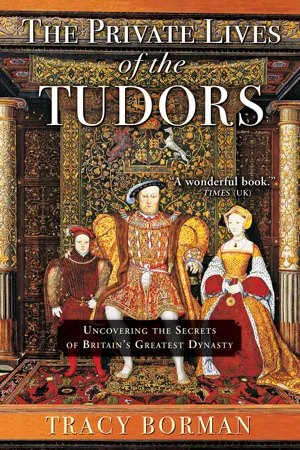
England's Tudor monarchs—Henry VII, Henry VIII, Edward VI, Mary I, and Elizabeth I—are perhaps the most celebrated of history's royal families. But for all we know about them, their lives away from the public eye remain largely beyond our grasp.
Here, an acclaimed historian delves deep behind the public facade of the monarchs, showing us what their lives were like beyond the stage of the court. Drawing on original material from those closest to them—courtiers like the "groom of the stool," a much-coveted position, surprisingly—Tracy Borman examines Tudor life in fine detail. What did the monarchs eat? What clothes did they wear, and how were they designed, bought, and cared for? How did they wield power? When sick, how were they treated? What games did they play? How did they practice their faith? And whom did they love, and how did they give birth to the all-important heirs?
Exploring their education, upbringing, and sexual lives, and taking us into the kitchens, bathrooms, schoolrooms, and bedrooms at court,
The Private Lives of the Tudors charts the course of the entire dynasty, surfacing new and fascinating insights into these celebrated figures.
"No royal family is better known…But there's still much to learn from
The Private Lives of the Tudors thanks to the expertise and persistence of Borman…The most captivating moments of
Private Lives, and there are plenty of them, bring the reader into other personal Tudor moments of strength, weakness, and heartache."?
Christian Science Monitor
"Comprehensively researched and compulsively readable…thoroughly entertaining."?
Minneapolis Star Tribune
eBook - ePub
The Private Lives of the Tudors
Uncovering the Secrets of Britain's Greatest Dynasty
- 464 pages
- English
- ePUB (mobile friendly)
- Available on iOS & Android
eBook - ePub
About this book
Information
Subtopic
Historical BiographiesIndex
History1
‘Infinitely suspicious’
WHEN THE TUDORS came to power in 1485, it signalled the closing stages of more than thirty years of bitter civil war. The Wars of the Roses, as they subsequently became known, were a series of dynastic conflicts between the rival branches of the royal House of Plantagenet, the Houses of York and Lancaster. Fought in several sporadic episodes rather than a continuous war, they lasted from 1455, when Richard, Duke of York, contested Henry VI’s authority as king at the Battle of St Albans, to 1487, when the Lancastrian Henry VII defeated the ‘pretender’ Lambert Simnel and his Yorkist supporters at the Battle of Stoke.
Henry Tudor’s ambitions for the throne had been galvanised by the death of Edward IV in 1483. Edward had left two sons but both were minors and were placed under the protection of their uncle, Richard, Duke of Gloucester. Richard subsequently declared their parents’ marriage invalid on the basis that Edward IV was already betrothed at the time of his marriage to Elizabeth Woodville. Their children were therefore declared illegitimate and removed from the line of succession, and Richard was free to seize the throne. His two nephews, who had been lodged in the Tower of London, disappeared in mysterious circumstances shortly afterwards, and it has long been assumed that they were put to death at Richard’s orders.
Spying his chance, Henry Tudor launched an invasion in summer 1485, landing off the coast of Pembrokeshire and rapidly marching towards England. Against the odds, his ragtag army of prisoners and mercenaries defeated the superior forces of King Richard at the Battle of Bosworth on 22 August, and Henry was proclaimed king. His coronation took place two months later in ‘triumph and glory’ at Westminster Abbey. Reunited with the son she had not seen for fourteen years, Lady Margaret Beaufort ‘wept marvellously’.1
Although Henry VII’s victory at Bosworth was seen as a decisive moment in the conflict, he came to the throne with credentials that were at best questionable. His Lancastrian blood flowed from his formidable mother, who was the great-granddaughter of Edward III’s son, John of Gaunt and Katherine Swynford. The trouble was, Margaret’s grandfather had been born a bastard, the result of a long-standing affair between John and Katherine before their marriage. Henry’s father, meanwhile, had been the child of Henry V’s queen, Catherine of Valois, by her Welsh page. That Henry Tudor was the best remaining Lancastrian claimant by 1485 is an indication of how desperate their cause had become. Few of his new subjects could have expected him to survive for long: there would surely be other, better claimants to take his place. In short, the Tudors had no business being on the throne of England at all.
Born in 1457, when his mother was just thirteen years old and his father had already been dead for two months, Henry had been separated from the former at an early age. He was raised first by his paternal uncle, Jasper, Earl of Pembroke and then, after Jasper’s flight abroad in 1461, by William, Lord Herbert, an ardent Yorkist supporter. It was a dangerous existence for this precious Lancastrian heir, who was obliged to be forever watchful of potential assassins. Confined in Wales for most of his young life, at the age of fourteen he fled into exile to Brittany with Jasper and remained there for the next fourteen years, until the time was right to stake his claim on the throne of England.
When Henry defeated Richard III in 1485, it was just the beginning of a long and bitter struggle to win the loyalty of his new subjects. In their eyes, he was an illegitimate usurper with no right to be king. Henry did himself few favours in this respect. Described by the contemporary Burgundian chronicler Jean Molinet as a ‘fine ornament’ of the Breton court, he had adopted French manners, worshipped Breton saints and spoke with a marked accent. He also lacked the natural charisma and flamboyance of his Yorkist predecessors. Introverted, paranoid and ‘infinitely suspicious’, he was arguably the most private of all the Tudor monarchs.2 He may have had good cause to be watchful – Yorkist rebels and claimants were everywhere – but Henry was of a naturally reticent disposition. He guarded his money and possessions as closely as his secrets and would soon gain a reputation as a miser. The contrast to the charismatic, open-handed Edward IV, whose memory his subjects still revered, could not have been greater.
But Henry Tudor also had a number of attributes that would stand him in good stead as king. He was a patient and sharp observer and, well trained by his uncle, always remained cool under pressure. Conscientious, methodical and shrewd, his ‘vast ability’ was acknowledged by his contemporaries.
According to the Italian humanist Polydore Vergil, who met the king on many occasions, Henry was ‘extremely attractive in appearance, his face was cheerful, especially when he was speaking.’3 Of a little above average height, Henry had a regal bearing and was slender, strong and blue-eyed, but with a sallow complexion. He had a cast in his left eye, which meant that ‘while one eye looked at you, the other searched for you.’4 This made his gaze even more disconcerting for those upon whom it was fixed.
Despite spending so much time among military men, Henry had lived a relatively chaste life and only had one bastard son, Roland de Velville, who was conceived during his exile in Brittany. Perhaps not surprisingly for the son of Lady Margaret Beaufort, who was renowned for her intense piety, Henry was observed to be ‘a most zealous supporter of religion, daily taking part, with great devotion, in divine service.’ Although piety was expected of a king, particularly one who needed to erase the stain of usurpation, Henry’s faith seems to have been genuine. Vergil revealed: ‘To those whom he knew were worthy priests, he often gave alms secretly in order that they might pray for his soul.’5
Henry VII has long had the reputation of a dour man, but he had a more light-hearted side. His household accounts reveal that he was fond of playing cards, even though he regularly suffered heavy losses – most notably in June 1492 when he was obliged to raid the royal coffers for £40 (equivalent to almost £20,000 today) in order to pay off his creditor. Physically fit from his years of campaigning, he held regular jousts and liked to play tennis. The latter was a particular favourite with the king and was commended by a contemporary expert on courtly refinement as a ‘noble sport which is very suitable for the courtier to play . . . for this shows how well he is built physically, how quick and agile he is in every member.’6 Later in his reign, Henry employed two professional players to act as coaches. Tudor tennis (or ‘real tennis’) was very different to the more common lawn tennis that was invented during the Victorian era. It was played in an enclosed court, and the ball could be hit against the walls, as well as over the net. The ball was also harder, heavier and less bouncy than its modern counterpart. It was made from tightly packed wool bound with tape and then covered in another tight layer of wool.
The king also employed a fool called Patch, paid ‘the foolish Duke of Lancaster’ for entertaining him, and rewarded minstrels, lute players, pipers, dancers and a group of singing children. But if Henry knew how to enjoy himself, he never lost sight of how much the various revelries cost. All of the expenses were carefully noted in his accounts, and he personally checked them, adding his countersignature next to each entry.7 He also deplored waste and, even though he was fond of the pastime himself, introduced heavy penalties for gambling. Servants and apprentices were specifically banned from playing card games except at Christmas. Few heeded the new legislation, however, and gambling became so commonplace at court and in aristocratic houses across the kingdom that certain officials were given responsibility for the profits that were generated.
Henry inherited an impressive suite of palaces in and around London from his Yorkist predecessors. The easternmost was Greenwich, originally built as ‘Bella Court’ by Humphrey, Duke of Gloucester, fourth son of Henry IV and regent to the young King Henry VI, in 1453. The duke lost his position and his life following a coup by Henry VI’s wife, Margaret of Anjou, who renamed the house ‘Placentia’ and carried out a number of substantial improvements. Henry VII later enlarged it, refacing the entire building with red brick and changing its name to Greenwich. It would become one of the favourite palaces of the Tudor monarchs.
Nearby, to the south-east, was another medieval palace, Eltham, set in a spacious park. Originally a rural manor house, it had become a royal residence at the beginning of the fourteenth century and had been frequently rebuilt and expanded thereafter. It was the favourite palace of Edward IV, who in 1480 built a new Great Hall complete with magnificent hammer-beam roof. By the time of Henry VII’s accession, it was one of the largest and most visited royal residences in England, but the new king thought the palace more suitable as a hunting lodge or royal nursery than as a venue for full-scale court entertainments.
By far the most imposing, and one of the most ancient of the royal residences of the city, was the Tower of London, originally built by William the Conqueror after 1066. It incorporated the southeast corner of the ancient Roman city walls, and the giant Norman keep that became known as the ‘White Tower’ dominated the skyline for miles around. A suite of royal lodgings was later built close to the White Tower, and Henry VII extended these to include a residential tower, a gallery and a garden. By the time of his accession, it was a well-established tradition that new monarchs spent the night before their coronation at the Tower.
Close to the west wall of the City of London, Baynard’s Castle commanded excellent views from its riverside location, close to where St Paul’s Cathedral now stands. The London headquarters of the House of York during the Wars of the Roses, it was more suited for defence than for comfort, so in 1500 Henry set about transforming it from a fortified castle into a ‘beautiful and commodious’ house.8 But the site was still rather constricted and soon fell out of favour, being used more as a royal storehouse than a residence.
York Place was the residence of the Archbishop of York and lay close to the centre of royal government at Westminster. It had been significantly extended during the decade before Henry Tudor seized the throne so that it was now an impressive palace, complete with a gatehouse, hall, chapel and private lodgings. During the 1530s, it would be extended further into a huge, sprawling mass of buildings, courtyards and gardens, and became known as Whitehall Palace.
To the west of London lay the manor of Sheen, which had been a royal residence since the early fourteenth century. It was largely rebuilt by Henry V in 1414 and became known as Sheen Palace. Further west was Windsor Castle, founded by William the Conqueror in the eleventh century. Three centuries later, Edward III transformed it from a fortress into a Gothic palace, with lavish new royal apartments and a magnificent new chapel, St George’s. As well as being a royal residence, Windsor was the home of the Order of the Garter, and new Garter knights were invested here.
The roads linking each of the principal residences were the best in the kingdom, but most of the palaces were on the river and easily accessed by barge. Transport was an important consideration, given that the court was still a peripatetic institution and moved between the main royal residences up to thirty times a year on average.
The new Tudor king was quick to take possession of these and the other royal residences that were now his by right. Naturally introspective, he preferred the company of a few trusted servants and advisers, but appreciated the need to surround himself with a court that was every bit as magnificent as that of his Yorkist predecessors. In order to create an impression of continuity, and therefore reinforce his rightful place in the succession, Henry retained most of the structure, personnel and traditions that he had inherited.
Having spent most of his adult life in exile in Brittany, Henry must have been staggered by the sheer scale of the court over which he now presided. The royal household was vast and comprised up to a thousand officers and servants. ...
Table of contents
- THE PRIVATE LIVES OF THE TUDORS
- Title Page
- Copyright Page
- Also by Tracy Borman
- Dedication
- Contents
- Preface
- Introduction
- 1 'Infinitely suspicious'
- 2 'Not admitting any near approach, either to his power or to his secrets'
- 3 'Closeted away like a girl'
- 4 'Their business is in many secrets'
- 5 'Lay hands upon his royal person'
- 6 'She excelled them all'
- 7 'A thin, old, and vicious hack'
- 8 'True carnal copulation'
- 9 'Kings and Emperors all be but mortal'
- 10 'Being yet but a child'
- Illustration Insert
- 11 'Thinking myself to be with child'
- 12 'We highly commend the single life'
- 13 'She seldom partakes before strangers'
- 14 'A thousand eyes see all I do'
- 15 'I am soft and made of melting snow'
- 16 'The crooked carcass'
- Epilogue 'Such lack of good order'
- Preview: Crown & Sceptre
- Acknowledgements
- Author's Note
- Abbreviations
- Bibliography
- Notes
- Index
- Illustrations Acknowledgements
- Back Cover
Trusted by 375,005 students
Access to over 1.5 million titles for a fair monthly price.
Study more efficiently using our study tools.
Frequently asked questions
Yes, you can cancel anytime from the Subscription tab in your account settings on the Perlego website. Your subscription will stay active until the end of your current billing period. Learn how to cancel your subscription
No, books cannot be downloaded as external files, such as PDFs, for use outside of Perlego. However, you can download books within the Perlego app for offline reading on mobile or tablet. Learn how to download books offline
Perlego offers two plans: Essential and Complete
- Essential is ideal for learners and professionals who enjoy exploring a wide range of subjects. Access the Essential Library with 800,000+ trusted titles and best-sellers across business, personal growth, and the humanities. Includes unlimited reading time and Standard Read Aloud voice.
- Complete: Perfect for advanced learners and researchers needing full, unrestricted access. Unlock 1.5M+ books across hundreds of subjects, including academic and specialized titles. The Complete Plan also includes advanced features like Premium Read Aloud and Research Assistant.
We are an online textbook subscription service, where you can get access to an entire online library for less than the price of a single book per month. With over 1.5 million books across 990+ topics, we’ve got you covered! Learn about our mission
Look out for the read-aloud symbol on your next book to see if you can listen to it. The read-aloud tool reads text aloud for you, highlighting the text as it is being read. You can pause it, speed it up and slow it down. Learn more about Read Aloud
Yes! You can use the Perlego app on both iOS and Android devices to read anytime, anywhere — even offline. Perfect for commutes or when you’re on the go.
Please note we cannot support devices running on iOS 13 and Android 7 or earlier. Learn more about using the app
Please note we cannot support devices running on iOS 13 and Android 7 or earlier. Learn more about using the app
Yes, you can access The Private Lives of the Tudors by Tracy Borman in PDF and/or ePUB format, as well as other popular books in History & Historical Biographies. We have over 1.5 million books available in our catalogue for you to explore.