"Both a tragic monument to the abused bar girls of Bombay and a celebration of their amazing resilience and spirit."—William Dalrymple, bestselling author of
The Anarchy
Published in India to great acclaim and named a
Time Out Subcontinental Book of the Year and an
Observer Book of the Year,
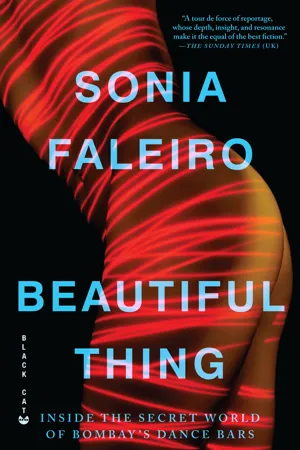
Beautiful Thing is a stunning piece of journalism that offers a rare firsthand glimpse into Bombay's notorious sex industry.
Sonia Faleiro was a reporter in search of a story when she met nineteen-year-old Leela, a charismatic exotic dancer with a story to tell. Leela introduced Sonia to the underworld of Bombay's dance bars: a world of glamorous women; of fierce love, sex, and violence; of gangsters, police, prostitutes, and pimps. When an ambitious politician cashed in on a tide of false morality and had Bombay's dance bars wiped out, Leela's proud independence faced its greatest test. In a city where almost everyone is certain that someone, somewhere, is worse off than them, she fights to survive—and to win.
In
Beautiful Thing, Sonia Faleiro has crafted one of the most original works about India in years, an "intimate and valuable book of literary reportage . . . [that] will break your heart several times over" (
The New York Times).
"Reporting at its best."—Junot Díaz,
The Rumpus
"A glimpse into a frightening subculture . . . In lesser hands, these young people could have come off as clichés, but the author makes sure we care for them and root for them to survive a life that most will never understand. Gritty, gripping, and often heartbreaking—an impressive piece of narrative nonfiction."—
Kirkus Reviews (starred review)
- 241 pages
- English
- ePUB (mobile friendly)
- Available on iOS & Android
eBook - ePub
About this book
Information
PART I
January 2005
{1}
‘Challenge me. Any man, any time’
Leela told me she was beautiful. And as she assessed herself in front of a full-length mirror in a vest and the boxer shorts of the customer asleep on the bed beside her, I had no reason to disagree.
She wasn’t tall, she admitted. And her breasts were make-believe; her bra was ‘imported-padded’. Her shoulder-length hair was streaked butterscotch and her eyes, unlike those of any girl from her hometown of Meerut up north, were a velvety mauve you might see in the sky on a day that promised rain. If a customer gestured, ‘Asli? Ya nakli?‘ Leela would pretend she didn’t know he was referring to the colour of her eyes and smirk, until the customer, flooded with nervous excitement, felt like he’d spied something he shouldn’t have—the creamy curve of her chocolate breast between the metal hooks of her sari blouse.
But Leela as Leela had been born was in there too, and it was this natural ‘booty’, ‘straight from the hand of God’, that she was most proud of. The other girls, she said, were ‘black, like Banglas’, and once they’d scrubbed their faces clean of the Dreamflower powder without which they wouldn’t leave home, they were no prettier than the beggar-monkeys snatching bananas out of the hands of devotees at the Hare Krishna temple down the street.
But not Leela. Stripped of everything, including her knickerbra, she was still a wonder, she said—not unlike the Taj Mahal of Agra city bathed in moonlight. Although I couldn’t attest to all of the above, this much I will say: Leela’s face was a perfect heart, the sort style magazines use to demonstrate make-up most suitable for different face shapes. Her hands and feet were shapely and smooth and, like her complexion, of a dark gold. Her bare fingers were tipped with hard, square nails that came in use when the dance floor got too crowded for her liking. And knowing well the elegance of her little nose, Leela would flaunt it like an engagement ring. On certain evenings at the dance bar, when she needed to increase the padding of hundred rupee notes in her bra, Leela would engage only in silhouette.
But beauty wasn’t everything. What you wore made the difference between a fifty and a five hundred.
What you said to your customer when he feigned reluctance to spend another evening merely watching you was crucial. So was how you said it. Remember the wise words of the legendary courtesan Umrao? ‘No one knows how to love more than we do: to heave deep sighs; to burst into tears at the slightest pretext; to go without food for days on end; to threaten to take arsenic . . .’
Umrao was a beauty, but it was her epic nakhra, pretence, that made her legend. Leela understood this immutable fact of her profession and so she stayed sharp, ‘sharp,’ she said, ‘as a double-edged razor blade’.
‘Challenge me,’ she would say, ‘any man, any time. A hi-fi man, your kind of man. I’ll snap him up, like a fisherman does a pomfret.’
‘Challenge me,’ she would demand, and on evenings when she talked drunk and stepped funny, when the roots of her hair, black as her real eye colour, showed up disloyally under the twenty-watt bulbs of her 1 Bedroom-Hall-Kitchen flat (BHK), there would be something like hope in her eyes.
Leela asked for trouble because trouble was free.
‘Challenge!’ Snapping my bra strap.
‘Challenge!’ Pretending to burn me with the ever-present Gold Flake between her fingers until I cried out, I believe you, Leela! You will win.

I wasn’t being conciliatory. Leela was the winning sort; the kind of girl you wanted by your side when you bought your stack of Friday morning lottery tickets outside Churchgate station.
She won against her lover Purshottam Shetty. The sharp-faced, short-legged, married father of two was her ‘husband’ and by any standard, even by those of the dance bar, she was his down low. And yet the value of what she received from him, Leela said, like a child insisting to her mother she could play in the rain and not catch cold, exceeded the value of what she gave up to be with him. She won against her mother, Apsara, though Leela’s tactics weren’t fair. ‘Apsara’ means ‘celestial nymph’, but Leela’s Apsara weighed over eighty kilograms and had a face like a cutting board. The orange stubs of her teeth stuck so far out they might have belonged to another face. When she spoke, the daughter said of her mother, mother sounded like an audio cassette someone had pressed the fast-forward button on. When she entered a room, Leela turned the screw, it was like night had descended. ‘You’re so fat!’ Leela would screech, caring neither that her joke, if it was that, was amusing, nor that her mother was not amused.
And Leela won against her father Manohar. But that was long after he started renting her out to the ghodas, the police, opposite her school. When they took her virginity from her, cursing that she’d knotted the drawstring of her salwar like it was a sack of atta she was saving for winter, all she saw were the peepal trees of the station compound. Their leaves had crowded together, it seemed to her, to gossip and wonder at her shame.
When I first met Leela, she was the highest-paid bar dancer in Night Lovers, the dance bar in which she worked, perhaps in all of Mira Road, the Bombay suburb in the crowded midst of which she then lived. I was a reporter researching an article on Bombay’s bar dancers. The story wasn’t published because it wasn’t considered ‘newsworthy’. No one wanted to read about a community of marginalized dancing girls who had been around, it seemed, forever. And yet, I found myself making excuses to meet with Leela, again and again.
Let me try to explain why.
Leela was paid to dance for men. And I, and most people I knew, had seen bar dancers only in Bollywood films—not as the protagonist, but as background entertainment, one-dimensional and on the margins; manipulated and mistreated. Because of what I’d seen on film, Leela’s success and optimism, her magnetic vivacity, revealed so vividly when we first met, was to me a mysterious thing.
Soon enough, I discovered how truly unlike we were. Leela was a free spirit. She lived by her own moral code; she followed no religious text; and to a customer she might say ‘gaand meri chaat’, kiss my ass. She was clearly no saint. But her flaws made her human; even her inconsistencies were beguiling. It took me six months to find out where she’d really been born. She said she was forced to sleep with men for money, even though she made more money than she knew where to hide. She said her feelings for Shetty were the real thing and wondered why he didn’t reciprocate in the manner she wished—in the doting, hen-pecked style of the husband character played by Amitabh Bachchan in the film that made her cry all through, Baghban.
All Leela wanted, Leela confided with a Meena Kumari in Pakeezah sigh, was to fall in love and become a housewife and mother.
From Leela’s point of view, our friendship was an adventure. She was seven years younger than me, but only she could teach me what I wanted to know—the truth about a world that fascinated me, intimidated me, and as I came to know it better, left me feeling frustrated and hopeless.
When we first met, I lived in Bombay’s Manhattan, in the southern tip of the city. Some people refer to South Bombay as ‘town’, a town within the city of Bombay, a place so special it deserves its own borders.
The British stamped South Bombay with regal buildings of limestone domes and sparkling white pillars. South Bombay has sweeping streets that get swept and ancient trees with fan-like leaves flurrying with pigeons. It has the Four Seasons, the Taj that was bombed, the Taj that wasn’t. It has sushi restaurants and cafés that bake thirty kinds of fudge brownies. It is owned by men in Cavalli and by women who favour Lanvin; couples who like to inform everyone they meet that Vogue magazine once referred to them as ‘Bombay’s beau monde’.
At the other end of this dazzling spectrum that defined not just South Bombay but India itself were the street kids in their barefooted, dust-smeared scruffiness selling pirated Gladwell, Rowling and Roy at one traffic light and cheekily begging a lift to the next.
Where Leela lived there were no domes, no pillars, no sushi restaurants. You didn’t carry a minaudiére, you carried a thaili, a plastic bag; if you were stylish, a pleather purse with chain links. There were restaurants and hotels, of course, but if you lived outside Mira Road it’s unlikely you would’ve heard of them, or that you would want to stop by.
The view was unusual—salt pans—but it was usual too—dinky cars stuttering over potholes, gangs of stray dogs chasing cyclists. Of residential buildings that resembled giant washing lines, their every window, every balcony enclosed by intricate grillwork, giving these buildings the appearance of prisons, and their occupants, when they peered through, appeared imprisoned.
Despite the apparent difference in our worlds, Leela had no curiosity about me. She once asked how much I earned and whether I ‘went’ with ‘boys’ and, if so, how much they earned. But she would never know much of my life outside of hers; she wouldn’t even know where I lived. Leela didn’t know, because Leela didn’t listen. Leela wanted only to be heard. And the best way to accomplish that, she knew, was not to change the subject if the subject was her.
So our often one-sided relationship may be characterized thus: I called Leela. She ‘missed-called’ me.
But for now let us return to that Tuesday fresh in the New Year, when Leela’s only worry was that the afternoon would end in a fight. I had dropped by to visit Leela and, having shaken my hand, she motioned silently to the figure sleeping off his excesses. ‘Dekho, lund-fakeer,‘ she said uncharitably. Check out the sex maniac.
I assessed the man’s face—scarred, pouchy, pocked with bristles—the way I might have a small animal discovered under the bed. I didn’t get close. I searched for signs of aggression. And I wondered if the man would leave voluntarily, or if Leela and I would have to take advantage of his stupor and kick him out of the flat.
What’s his name? I whispered.
Leela shrugged.
What should we do? I prodded.
She yawned.
We might as well have been talking about a stranger.
Then I realized we probably were talking about a stranger. Leela almost never asked questions of her customers—they didn’t interest her. And as a matter of principle, she always told them lies.
Then I recognized him, or I recognized rather the lumpy scar that ran from the side of his forehead all the way down to his chin. It was a scar Leela liked to believe had been earned in a ‘gangvar’, tackling an assassin’s .45. But if I recalled correctly, curled up before me was the manager of hotel Pure Vegetarian, a man referred to by his waiters as a bhonsdi ka, son of a whore, for pinching their tips; a man who had cut himself having fallen off the footboard of the local train attempting to spit out a mouthful of paan. If I was right then I was looking at the man whose wife, Leela and I righteously agreed, was a bit of a besharam, a shameless one. When visiting a friend in the building, she sashayed about in a nightgown and slippers, which was regular on their street, but she refused to cover her breasts with a chunni, thus revealing even to Feroze ‘Andha‘ Bashir, the neighbourhood’s cataract-eyed egg seller, that she fancied lime green bras from Thailand.
Leela wanted her customer out because she was ‘bijniss’-like. He’d done his bijniss and now, she believed, he should beat it patli gali se, by the quickest way. But she was also in a hurry because she had to leave for Night Lovers, which was owned and managed by Shetty.
Because they were ‘husband-wife’, Leela said to me, she had to be scrupulously professional. She couldn’t be late. But neither would she leave a customer in her flat, even though she referred to this particular customer as bhai, even though ‘brother’ probably knew Leela had never got around to fixing the broken latch on her door.
Despite this lapse Leela thought a great deal about her safety. She carried a piece of glass. She carried a plastic whistle she had, to date, used only to toot her favourite song, T...
Table of contents
- Cover
- Half Title
- Title
- Copyright
- Dedication
- Contents
- Part 1
- Part 2
- Acknowledgements
Trusted by 375,005 students
Access to over 1.5 million titles for a fair monthly price.
Study more efficiently using our study tools.
Frequently asked questions
Yes, you can cancel anytime from the Subscription tab in your account settings on the Perlego website. Your subscription will stay active until the end of your current billing period. Learn how to cancel your subscription
No, books cannot be downloaded as external files, such as PDFs, for use outside of Perlego. However, you can download books within the Perlego app for offline reading on mobile or tablet. Learn how to download books offline
Perlego offers two plans: Essential and Complete
- Essential is ideal for learners and professionals who enjoy exploring a wide range of subjects. Access the Essential Library with 800,000+ trusted titles and best-sellers across business, personal growth, and the humanities. Includes unlimited reading time and Standard Read Aloud voice.
- Complete: Perfect for advanced learners and researchers needing full, unrestricted access. Unlock 1.5M+ books across hundreds of subjects, including academic and specialized titles. The Complete Plan also includes advanced features like Premium Read Aloud and Research Assistant.
We are an online textbook subscription service, where you can get access to an entire online library for less than the price of a single book per month. With over 1.5 million books across 990+ topics, we’ve got you covered! Learn about our mission
Look out for the read-aloud symbol on your next book to see if you can listen to it. The read-aloud tool reads text aloud for you, highlighting the text as it is being read. You can pause it, speed it up and slow it down. Learn more about Read Aloud
Yes! You can use the Perlego app on both iOS and Android devices to read anytime, anywhere — even offline. Perfect for commutes or when you’re on the go.
Please note we cannot support devices running on iOS 13 and Android 7 or earlier. Learn more about using the app
Please note we cannot support devices running on iOS 13 and Android 7 or earlier. Learn more about using the app
Yes, you can access Beautiful Thing by Sonia Faleiro in PDF and/or ePUB format, as well as other popular books in Social Sciences & Social Science Biographies. We have over 1.5 million books available in our catalogue for you to explore.