A "riveting" biography of a Russian noblewoman turned revolutionary terrorist and accomplice in the assassination of a tsar (
The Soviet and Post-Soviet Review).
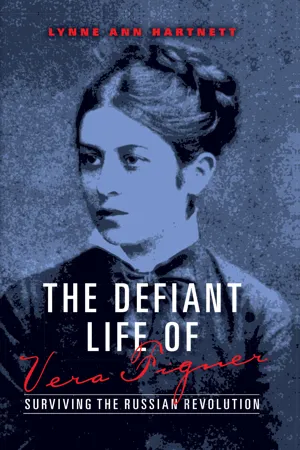
Born in 1852 in the last years of serfdom, Vera Figner came of age as Imperial Russian society was being rocked by the massive upheaval that culminated in the Bolshevik revolution of 1917. At first a champion of populist causes and women's higher education, which she herself pursued as a medical student in Zurich, Figner later became a leader of the terrorist party the People's Will—and was an accomplice in the assassination of Tsar Alexander II in 1881.
Drawing on extensive archival research and careful reading of Figner's copious memoirs, Lynne Ann Hartnett reveals how Figner survived the Bolshevik revolution and Stalin's Great Purges and died a lionized revolutionary legend as the Nazis bore down on Moscow in 1942.
- 346 pages
- English
- ePUB (mobile friendly)
- Available on iOS & Android
eBook - ePub
About this book
Information
1
IN THE TWILIGHT OF A FADING AGE
ON A LATE WINTER MORNING IN 1861, in sleepy villages, provincial towns, and bustling cities throughout the vast Russian Empire, somber-faced Russian Orthodox priests, conscious of the import of the moment, read an official proclamation penned in the imperial capital. After two centuries of legalized serfdom1—for all intents and purposes an institution that was indistinct from slavery—priests informed their congregations that the autocratic regime of Alexander II decreed the Russian serfs emancipated from their noble overlords. Although the details of the abolition of serfdom and the caveats contained within the decree made “freedom” a bitter pill to swallow,2 Russia entered a new age that morning. The new age that dawned, though, differed markedly from what the manifesto’s authors had hoped or expected. Fearful of a new round of intensified uprisings and rebellions against this legislated, unrelenting system of inequality and oppression, those who crafted the Emancipation Manifesto hoped that the abolition of serfdom would settle underlying social, economic, and political tensions in the land of the tsars. Yet in many respects the terms of emancipation ushered in a new period of destabilization and revolutionary activity that would culminate not in periodic localized rebellions but in a revolution that would ultimately destroy the imperial regime itself.
Almost eight hundred miles to the southeast of the gilded, pastel-hued palaces in which the emperor and his ministers delineated the terms of emancipation, a noble family found themselves on the precipice of this new age. None of its members had a hand in writing the Emancipation Manifesto, but the lives of everyone in the Figner household stood poised to change irreversibly once the dictates of the document were implemented. The decree that abolished serfdom in Russia was determined in formal governmental meeting rooms in sumptuous St. Petersburg mansions, but it was intended to alter centuries of tradition in the provinces and reconfigure life for both serfs and their noble owners in the Russian countryside. Thus, as the priests announced the end of serfdom in Russia, the Figner family found themselves on the front lines of the state-directed transformation of rural life that would bring both brief hope and unmitigated disappointment to millions.
In comparison to their slave-owning counterparts in the United States, the Figner family owned a substantial amount of land. Both Nikolai Alexandrovich Figner and his wife, Ekaterina Khristoforovna Kuprianova, had been born into the Russian nobility and inherited lands in a number of provinces in the empire. To these holdings, Nikolai added considerable acreage in the same village as the Kuprianovs’ estate when he took advantage of plummeting land prices after the abolition of serfdom was announced.3 Thus, as the terms of the emancipation were implemented, Nikolai and Ekaterina owned more than 500 desiatinas (1,350 acres) of land in the district of Tetiushi alone.4 Even though the family inherited acreage in other provinces as well, it must be recognized that this level of landowning was not impressive in the circles of the Russian nobility. Given the expanse of the Russian Empire and the often contentious soil and climate, which presented seemingly infinite agricultural challenges, Russian nobles amassed lands on a grandiose scale. Consequently, the Figners belonged to only the middle level of serf owners.5 Many memoirists lament the financial straits of the nobles at the socioeconomic level of the Figners. But as Peter Kolchin points out, those occupying the median rung of landowning wealth in pre-emancipation Russia earned between 3,000 and 20,000 rubles annually from their land, “far from trifling sums when a typical peasant family of eight got by on 75 to 100 rubles a year.”6
In many ways the Figner family was typical of the late Imperial Russian nobility. Although the Figners benefited from the privileges of their class, unlike the leading magnates in St. Petersburg, the opulence that defined the lives of nobles in the imperial capital eluded them.7 They lived comfortable lives but not luxurious ones. Servants tended to their needs within their home, but only by the handful, as opposed to the dozens or even hundreds who indulged the wealthiest Russian nobles’ every whim.8 While the grandees of Russian society spent the majority of their time in either St. Petersburg or Moscow, only temporarily retiring to one of their many provincial estates for brief respites each summer, the Figners’ lives were firmly rooted on their estate in the midst of the rolling hills of the Tetiushi district (uezd) in the province (guberniia) of Kazan.9 There Nikolai and his wife, Ekaterina, raised their family of four daughters and two sons in a comfortable two-story home surrounded by gardens, meadows, streams, and the huts and fields of the serfs whom they owned.
Unlike some of their more affluent neighbors who soaked up the social scene in the provincial capital of Kazan, a relatively large city with a population almost thirty times larger than that of the Figners’ local district capital of Tetiushi,10 the Figners lived rather secluded, socially constricted lives, except for Nikolai, who traveled in his various civil service posts. Fate would eventually carry the Figner children not only to the distant reaches of the Russian Empire but also to the far corners of Europe; however, as children they lived essentially as “country bumpkins” without access to the cultural pleasures and social delights afforded their wealthier noble counterparts.
Sheltered from the tumult besieging Russia as Alexander II succeeded Nicholas I to the throne and Russia’s humiliating defeat in the Crimean War dictated the need for immediate and drastic modernization and reform, the Figner children did not grasp the monumental historical significance of the abolition of serfdom;11 rather they understood this watershed moment in purely personal terms. When the Emancipation Manifesto was announced, the oldest of the Figner children, a little girl named Vera Nikolaevna, was only eight years old.12 Decades after the abolition of serfdom as Vera wrote several volumes of memoirs, she recalled that the decree that freed more than 23 million privately owned serfs was personally noteworthy for the moderating change it had seemed to effect in her strict, authoritarian, even despotic father.13 In her words, the emancipation of the serfs amounted to a “moral revolution” in her father.14 In addition, cherished servants, whom Vera thought of as permanent fixtures in her home, quickly left to establish their own lives, giving evidence that their years of service were rooted not in tender loyalty and mutual benefit but merely in the dictated system of serfdom. But as she grew and discovered the world beyond her family’s estate, Vera’s mounting disgust with the seemingly endless impoverishment and powerlessness of the Russian peasants, which emancipation did little to rectify, led her to view the conditions of the Russian peasantry as just one manifestation of a woefully corrupt and illegitimate political and social system. Her disillusionment with the regime and the institutions that bequeathed certain material and social advantages to her and her family in her youth, along with a measure of guilt for her family’s complicity in this system, ultimately led Vera Nikolaevna Figner down a long, winding road from her noble estate and the privileges of her station to the radical underground and the mortal challenges posed by a vengeful tsarist prison system.
But in 1861 the bare, foreboding solitary cells of the empire’s most notorious political prisons did not intrude on Vera’s wildest imagination. Instead, according to her own testimony, the future revolutionary lived a bucolic existence cavorting with her five younger siblings.15 On the day when millions of serfs learned of the emancipation decree, Vera lived with her parents, Nikolai and Ekaterina, and her siblings Lidia, Peter, Eugenia, and Nikolai on her mother’s family estate, Khristoforovka.16 According to Vera, Khristoforovka was an ideal gentry estate.17 The house itself was a sprawling wooden structure, its left side, from which a porch extended, rising to two stories while the remainder of the house rose to a mezzanine level. Around the back of the house stood several towering trees that offered the family shade during the warm summer months. Beyond the tree line a simple wooden fence separated the manor house from the fields. A “beautiful old garden” and a grove of fruit trees surrounded the house. Past the immediate gardens, there was a park, where the Figner children ran free and collected mushrooms, nuts, and berries.18 In the warmer months the siblings took long walks, fished, and swam in the estate’s ponds and streams.
Vera’s description of her carefree days on her family’s estate conforms to a pattern adopted by most gentry memoirists, in which young nobles’ provincial childhoods are romanticized for the degree of freedom and proximity to nature that their estates afforded.19 Given the dislocation and upheaval that characterized Vera’s life in the intervening years between her early days at Khristoforovka and the period when she recalled them in writing, it is understandable that she would have even more cause to recall this time in such an idealized fashion. But it must also be recognized that there was some justification for Vera’s romanticism. Khristoforovka, where the Figners lived from 1858 to 1862, was located in an area dotted with forests and countless valleys intersected by rivers, including the Volga, and their tributaries. Natural beauty abounded. Rolling hills traversed farmlands and meadows that were laden with beautiful flora native to the area.20
Although the soil was rich and the climate continental in Vera’s native district, in the nineteenth century agricultural production remained low. In this regard Tetiushi was typical of most Russian agricultural regions; neither the agricultural nor industrial revolution transformed lives here. Instead, the peasants in Tetiushi uezd farmed, as did most of the agricultural laborers in the Russian Empire, as their ancestors did before them. Even after the former serfs were emancipated, change and innovation were slow to come, farming methods remained rudimentary, and yields were consistently lower than the climate and soil might have allowed.
As children Vera and her siblings did not think about the agricultural yields of their family’s lands or the surrounding fields. Their material comfort was a privilege that was not analyzed and its basis never questioned. The Figner children looked at the land that encircled their estate not as a source of income but as a natural playground to be enjoyed, and they basked in the relative freedom afforded by its wide-open spaces. This was the children’s domain. With the exception of their peasant nanny, who trailed after the children to keep them out of harm’s way, once the youngsters ventured outside the four walls of their home, no adults materialized to chastise, deride, or reprimand. Instead the Figner girls and boys enjoyed the warm sunshine, gentle breezes, license, and abandon that could be found on the seemingly endless acres of their familial lands.
But if the grounds of the estate beckoned Vera and her siblings with their promise of liberty and proximity to natural delights, the house itself signaled decorum, order, and artificial propriety. Like most children of their class, Vera and her brothers and sisters dressed formally on a daily basis, used impeccable table manners, and followed the old adage that the youngest members of a proper household should be seen and not heard.21 Ensuring that order reigned were the exacting expectations of Nikolai A. Figner. Vera’s father was not an anomaly in this regard. Countless memoirists from the Russian gentry describe the strict, authoritarian behavior of their fathers that instilled terror and fear in their progeny.22 For her part, Vera remembered her father as a “stern, hot-tempered, and despotic” man whom she feared above all else.23 Like most Russian fathers of the age, Nikolai Figner dominated his wife, his children, and his servants and serfs. Although a harsh word or belittling glance usually sufficed, extraordinary examples of defiance or simple outbursts of independent thinking or behavior often necessitated corporal punishment. As Vera relates, her father’s “stick or belt always lay in wait in his office.”24
In this respect both Khristoforovka and Nikiforovo, the neighboring estate to which the family moved in 1862,25 functioned as a microcosm of the strict imperial state. Just as the tsarist autocracy utilized fear and repression to maintain a staunchly inequitable political and social order, Nikolai Figner’s despotism invariably reminded his underlings, including his wife, of their subordinate place in the household. As Michel Foucault argues, the ability to punish and to exercise control over a body is a function of power and an exercise in sovereignty.26 Thus, in the Figner home, as in other homes of the Russian gentry, each disapproving scowl, reprimand, slap, or beating that emanated from the male head of the household reaffirmed gender, class, and generational hierarchies. Such severity, as long as it did not verge into sadism, was expected as a legitimate tool that maintained order and censured outbursts of independence and nonconformity in both the home and society. As Barbara Alpern Engel contends, “By fostering discipline and respect for authority on the personal level, the patriarchal family prepared people for social discipline and respect for state authority.”27
Just as there appears a uniformity among memoirists in describing the harsh discipline and authoritarian behavior of noble fathers, there is a trend among many of these same authors that celebrates the tempering of their fathers’ moods and household despotism after the emancipation of the serfs. Although the consistency with which disillusioned and radicalized members of the Russian gentry describe the ferocity of their fathers before the abolition of serfdom and their ensuing moderation after the reforms in part results from an intentional literary device designed to indict the political and social system of the era, there is as much truth in their assertions as trope. To be sure, “the traditional social order survived the impact of reforms and the demographic effects of economic change, especially in the rural parts of the empire.”28 Yet the early 1860s were a period when the overarching results of the Abolition of Serfdom and the ensuing Great Reforms were not yet determined.29 Although the political, social, and cultural hierarchies of the preemancipation period survived the era primarily intact, thus driving the ensuing revolutionary movement, the immediate p...
Table of contents
- Cover
- Half title
- Title
- Copyright
- Dedication
- Contents
- Acknowledgments
- Introduction
- 1 In the Twilight of a Fading Age
- 2 Age of Consciousness
- 3 Pioneers Diverted
- 4 Town and Country
- 5 The Tsar’s Death Sentence
- 6 Revolutionary Iconography
- 7 Transformation
- 8 Life and Death
- 9 Resurrection in Exile
- 10 An Old Revolutionary in a New Revolution
- 11 Revolutionary Survivor
- Notes
- Bibliography
- Index
Trusted by 375,005 students
Access to over 1.5 million titles for a fair monthly price.
Study more efficiently using our study tools.
Frequently asked questions
Yes, you can cancel anytime from the Subscription tab in your account settings on the Perlego website. Your subscription will stay active until the end of your current billing period. Learn how to cancel your subscription
No, books cannot be downloaded as external files, such as PDFs, for use outside of Perlego. However, you can download books within the Perlego app for offline reading on mobile or tablet. Learn how to download books offline
Perlego offers two plans: Essential and Complete
- Essential is ideal for learners and professionals who enjoy exploring a wide range of subjects. Access the Essential Library with 800,000+ trusted titles and best-sellers across business, personal growth, and the humanities. Includes unlimited reading time and Standard Read Aloud voice.
- Complete: Perfect for advanced learners and researchers needing full, unrestricted access. Unlock 1.5M+ books across hundreds of subjects, including academic and specialized titles. The Complete Plan also includes advanced features like Premium Read Aloud and Research Assistant.
We are an online textbook subscription service, where you can get access to an entire online library for less than the price of a single book per month. With over 1.5 million books across 990+ topics, we’ve got you covered! Learn about our mission
Look out for the read-aloud symbol on your next book to see if you can listen to it. The read-aloud tool reads text aloud for you, highlighting the text as it is being read. You can pause it, speed it up and slow it down. Learn more about Read Aloud
Yes! You can use the Perlego app on both iOS and Android devices to read anytime, anywhere — even offline. Perfect for commutes or when you’re on the go.
Please note we cannot support devices running on iOS 13 and Android 7 or earlier. Learn more about using the app
Please note we cannot support devices running on iOS 13 and Android 7 or earlier. Learn more about using the app
Yes, you can access The Defiant Life of Vera Figner by Lynne Ann Hartnett in PDF and/or ePUB format, as well as other popular books in Política y relaciones internacionales & Biografías políticas. We have over 1.5 million books available in our catalogue for you to explore.