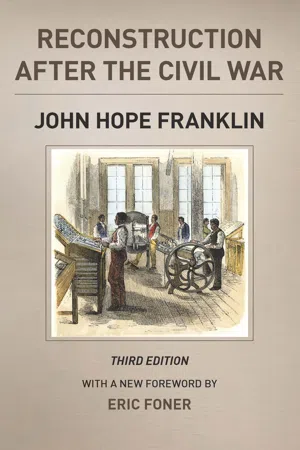
Reconstruction after the Civil War explores the role of former slaves during this period in American history. Looking past popular myths and controversial scholarship, John Hope Franklin uses his astute insight and careful research to provide an accurate, comprehensive portrait of the era. His arguments concerning the brevity of the North's occupation, the limited power wielded by former slaves, the influence of moderate southerners, the flawed constitutions of the radical state governments, and the downfall of Reconstruction remain compelling today. This new edition of Reconstruction after the Civil War also includes a foreword by Eric Foner and a perceptive essay by Michael W. Fitzgerald.
- 300 pages
- English
- ePUB (mobile friendly)
- Available on iOS & Android
eBook - ePub
Reconstruction after the Civil War, Third Edition
About this book
Information
1
The Aftermath of War
The roads from Appomattox led in many different directions. Along the way each of the roads held strange sights for the weary, homeward-bound warrior in 1865. If his home was in the North he saw few evidences of destruction, unless he traveled through the region around Gettysburg in southern Pennsylvania. But there were other evidences of change, some of them as fascinating as they were subtle; and they were as much the product of the war as the crumpled bridges or the battered buildings that now lay far behind. Traveling through the North, one could feel a new sense of satisfaction. Everywhere wartime industrialization had brought signs of growth. There was also the clear determination to fulfill the destiny of power and prosperity implicit in the forces that had culminated in the smashing Northern victory. What Union soldier could not quicken his pace as he moved not only nearer his loved ones but also closer to what would surely be a glorious future!
As the Confederate warrior made his way homeward he was reminded in countless ways of the extent of the holocaust that had engulfed his beloved land. At the end of the war scores of visitors from the North and other parts of the world swarmed over the South, and their descriptions of the prostrate South dwell upon the widespread devastation suffered by the Confederacy. Fields were laid waste, cities burned, bridges and roads destroyed. Even most of the woefully inadequate factories were leveled, as if to underscore the unchallenged industrial superiority of the North. And if the Union forces did not loot quite as many smokehouses and pantries as they were blamed for, what they did do emphasized the helplessness of the once proud Confederates.
Carl Schurz, with little sympathy for the South, was touched by the utter ruin that seemed to be everywhere. Traveling through the South on a mission for the President in 1865 he said that the countryside “looked for many miles like a broad black streak of ruin and desolation—the fences all gone; lonesome smoke stacks, surrounded by dark heaps of ashes and cinders, marking the spots where human habitations had stood; the fields along the road wildly overgrown by weeds, with here and there a sickly patch of cotton or corn cultivated by Negro squatters.” To another, Columbia was “a wilderness of crumbling walls, naked chimneys and trees killed by flames.” And for years to come many an hour would be spent in argument over who burned the proud Carolina town. But there was little room for debating the fact that a good deal of South Carolina had become a “howling waste,” as Captain Daniel Oakey described it.
It mattered little to the returning soldier in gray whether Sherman and Grant had wrought the havoc or whether a defensive “scorched earth policy” of the Confederates had brought it about. The damage was done—doubtless by both sides. What really mattered was the staggering magnitude of the task now challenging the responsible white Southerner. As he looked upon the broken and scattered pieces of the way of life he knew and loved, he hardly knew where or how to begin. Somehow, though, he must begin the heart-rending task of trying to put the pieces together again.
Eleven states were out of the Union, awaiting readmission at the pleasure and the mercy of the North. The economy of the South had been smashed, and local resources for rebuilding were meager indeed. Thousands of white refugees wandered over the land, not certain that they had a home and even less certain of the treatment they would receive if they returned. Numberless blacks, free at last, had run either with their masters ahead of the Union invasion or from their masters toward the Union lines. Others of the four million were merely moving about to “test” their freedom and, inadvertently, to cause grave apprehensions among their former masters.
Even before the war white Southerners had frequently entertained a wild, nightmarish fear that the slaves would rise up, slay them, and overthrow the institution of slavery. It had happened in Haiti. Perhaps it would happen here. In 1865 Southern whites “knew” that there was nothing to hold back the tide. Wild rumors flashed through the South that the freedmen would strike in vengeance. Some whites were even certain of the date. It would be New Year’s Day, 1866, they said. How could they keep their minds on rebuilding when their former slaves were poised to complete the destruction? That this was pure fantasy, born of a sense of guilt and despair, only the passage of time and the remarkable reserve of the freedmen could prove.
The vanquished people were not entirely without resources for rebuilding, however. Their recognition of defeat did not carry with it any acknowledgment of deficiency in leadership, self-respect, or the validity of their position. If anything, the crushing defeat on the field of battle had solidified the whites in their determination to preserve the integrity of their way of life. Four years of war, Wilbur Cash in The Mind of the South has said, “had left these Southerners . . . far more aware of their differences and of the line which divided what was Southern from what was not. And upon that line all their intensified patriotism and love, all their high pride in the knowledge that they had fought a good fight and had yielded only to irresistible force, was concentrated, to issue in a determination . . . to hold fast to their own, to maintain their divergences, to remain what they had been and were.” The young white Southerner who described the South in 1865 as conquered but not subdued was, perhaps, more accurate than he realized. And the sense of unity created by the war did much to perpetuate and strengthen the view that the Southern cause was not entirely lost.
The heart of the white Southerner had gone out of the war. His confidence in his leaders had been shaken. The Confederacy had collapsed, and the vast majority of the Confederates did accept military defeat. It did not follow, however, that they accepted the politics of Lincoln, the economics of Chase, or the moral principles of Garrison. It was a naïve Northerner, indeed, who expressed the belief in 1865 that Virginia would be “regenerated by Northern ideas and free institutions.” There would be regeneration of the entire section, white Southerners confidently believed, but only on the basis of Southern ideas and Southern institutions. Nothing had happened at Appomattox to change this fundamental conviction. The attachment of white Southerners to their way of life was as strong as ever, and they were determined to preserve it. To be sure, some were bitter that their lives had been spared in the glorious cause. Others, however, were determined to work and, if necessary, fight to preserve what was left. A Georgia editor spoke for many when he said, “to the hundreds of thousands of those descendant of high but broken-down families that are now bewailing their hard lot, we say, go to work!” The spirit and determination to survive were indeed powerful.
The economic resources of the South were its land and its labor. Land has always been immensely important in the economy, and the Southerners still had plenty of it. Although a small fraction had been confiscated by Union officials, much of this was shortly to be restored to the rightful owners or to other former Confederates. And despite the trail of destruction left in the wake of the armies, a good deal of the land had not been touched by the war. The Civil War years antedated “saturated destruction”—a concept born in the waging of total war in the twentieth century. No one spoke much of the areas bypassed by the Union and Confederate armies; newspaper reporters and inspection teams found nothing exciting to report about such places. They existed, nevertheless. Portions of Texas and Arkansas and even Mississippi, Georgia, Florida, and the other Confederate states heard no roaring of Union cannon. And once the fighting had ceased, even the burned-over land could be cultivated again, if labor was available.
But what if the freedman could not or would not work? Some ex-Confederates, believing that the former slaves would not work, entertained thoughts of luring white workers into the South. Ignoring the untold suffering that cut across racial lines, some saw in the destitution and disease among blacks a portent of their complete extinction. The editor of the Natchez Democrat declared, “The child is already born who will behold the last Negro in the State of Mississippi.” With almost equal prescience and precision the eminent Dr. C. K. Marshall expressed his views on this subject: “In all probability New Year’s Day, on the morning of the 1st of January, 1920, the colored population in the South will scarcely be counted.”
Most Southern whites seemed less pessimistic. Blacks would survive, with the benevolent assistance of whites. And their labors would be utilized for the rebuilding of the ravaged South. If there were any doubts about the ability or willingness of freedmen to work, these could be overcome with “adequate supervision.” Fixing a weather eye on the Southern economy, the editor of De Bow’s Review said that freedmen were working well on the plantations even during the first year of freedom. The great hope almost everywhere was that they would settle down to work as they had before the firing on Sumter. In the late summer of 1865 there was a strong chance that the great majority of them would do precisely that. The whites, anxious and confused, were quick to generalize. If they saw blacks idling away their time, they were inclined to conclude that they would not work. The plain fact was that some would work and some would not work. Some began immediately to look for jobs. Others delayed this unpleasant search as long as possible. Before the end of the year, it became clear to any who cared to look that in the black population the South still had a labor force and, for the most part, the South could employ this force on its own terms. But, as Leon Litwack has observed, “Even as they toiled in the same fields, performed the familiar tasks, and returned at dusk to the same cabins, scores of freedmen refused to resign themselves to the permanent status of a landless agricultural working class. Like most Americans, they aspired to something better and yearned for economic independence and self-employment.
To get off dead center, however, the South needed more than land and labor. It desperately needed capital. In earlier years capital outlay in the South, except for slaves, had always been quite limited. Farm machinery, for example, had been understandably scarce in an economy that placed such great reliance on slave labor. The war had demonstrated how pitifully inadequate the investments in industrial operations had been. Despite the desperate and surprisingly successful efforts of the Confederates to produce the goods they needed to carry on the war, the South remained no match for the North in this regard. There was more talk than action, more promotion than production. The Confederates were defeated in the Northern factories as decisively as they were defeated on the battlefields; and the first defeat made inevitable the second one. At the end of the war the ex-Confederates wanted not only to rehabilitate their old agricultural system but to strengthen their whole economic structure by moving toward greater industrialization. One of the most significant lessons of the war for them had been the importance of a vigorous, versatile economic order.
It was the North’s economy, of course, that served as an example for the South. The war had performed wonders on the Northern “home front.” Everywhere agricultural production had increased, while the industrial order had been practically revolutionized to meet the enormous demands. Labor-saving devices, such as the mechanical reaper and the sewing machine, released men for other pursuits while stepping up production tremendously. Meanwhile the use of steel and petroleum in countless ways merely suggested the direction the economic order would take in future years.
While the exigencies of war greatly stimulated economic growth in the North, government policies also did much to facilitate it. Liberal tariff and land policies, new banking and currency laws, and general laxity in the government’s dealings with businessmen helped usher in a period of unprecedented economic activity and prosperity. In the first two years of the war one railroad doubled its earnings. Savings-bank deposits rose during the war from $149,278,000 to $242,619,000. And if the laboring and white-collar classes were pinched by the inflationary spiral, the accumulation of great wealth in some hands produced the country’s first millionaire class. Patriotism and public morality were subordinated to greed. Unscrupulous businessmen and manufacturers seemed more interested in accumulating wealth than in achieving a Union victory. But widespread graft and corruption did not prevent the growth of the industrial order. In the wake of the new order emerged an incredibly large and powerful wealthy class. The wealthy had surplus capital, and they were looking for opportunities to invest it.
As preoccupation with material gain increased, zeal for reform declined. The garish display of wealth in gold, diamonds, and furs indicated the emergence from the war of new tastes and changed values. When the Secretary of the Treasury visited New York in the spring of 1864, he found that many businessmen gave more attention to the stock market than to the news of casualties from the battle front. “No one can fail to perceive,” declared one observer in 1864, “the danger that a real or even a professed patriotism may be made the cover for a multitude of sins and gallantry on the field of battle be regarded as a substitute for all the duties of the decalogue.” It would be difficult to focus the attention of such venal groups on some of the more basic needs of the majority of the people at the war’s end. They had had greater concern for new and larger profits than for new and constructive approaches to the problem of intersectional relations. They were more interested in using the government to further their selfish ends than in developing a public policy that would create new bases for human and race relations.
The climate that produced frauds approximating $17,000,000 out of $50,000,000 worth of government contracts could hardly be expected to encourage public or private morality. There was little room for the social reformers of the prewar period; and, weary from the long struggle or burdened with the cares of age, most of them passed from the stage. William Lloyd Garrison had begun to feel that his work of “Negro-uplift” was about over; and if Thaddeus Stevens still had considerable determination to carry the crusade to its logical conclusion, his energy was beginning to fade rapidly with age. Moving to the center of the stage were those deeply involved in the exciting alliance between government and business. New leaders like James G. Blaine of Maine and Roscoe Conkling of New York had less solicitude for humanitarian reform and the difficult problems of political reconstruction than for taking advantage of the peculiar postwar conditions to further the interests of themselves and their friends in the industrial and financial community. They would have much to do with shaping the course of history in the ensuing years.
The Yankee businessman, his pockets bulging with war profits, saw in the vanquished section a new and highly promising frontier. He continued to invest in western lands, mines, and railroads, as he had during the war. He was still working the mines in the region of the fabulous Comstock Lode and, with the generous help of the federal government, was building the first transcontinental railroad, the Union Pacific. The whole vast trans-Mississippi West became the scene of enormous activity, with investments running into hundreds of millions of dollars. The western frontier was rapidly disappearing under the systematic attack of the Yankee investor. But he still had some capital in reserve for the South.
Whitelaw Reid, Sidney Andrews, and other Northern visitors to the South encouraged the Yankee capitalist to do his part in “Northernizing” the Southern frontier. Even in the first few months after the war important representatives of the Northern business community were investing in Southern ventures ranging from plantations to railroads. In 1865 a syndicate of Northern men purchased extensive coal fields on the James River near Richmond. About the same time, several were investing capital in the turpentine and lumber business of North Carolina. These were among the first Yankees to set about the exciting—and profitable—task of “Northernizing” the postwar South.
The Northern businessman was as determined as the former Confederate to keep a firm hand on the future. He was anxious, of course, that the South resume normal relations with the rest of the country as soon as possible. But he was more than slightly skeptical about the possible effect of an unreconstructed Southern economic and social philosophy on his own position. Having come to regard the federal government as an indispensable ally in his business ventures, he shuddered at the thought that the relationship might be undermined by a renascent, uncontrollable South. He listened uneasily to rumors regarding Southern hostility toward the Yankee. If he was to invest in the South, he wanted to be certain that it would not spell defeat for him with the dissipation of his dearly earned capital.
During the first year of peace Thomas Conway, sometime agent for the Freedmen’s Bureau, made a survey for the chamber of commerce of the state of New York to determine what the possibilities were for investing capital in the South. He concluded that while there were many Northerners who wanted to advance loans on crops, to purchase lands, and to assist the South’s economic rehabilitation in other ways, there were serious impediments to such investments. The South’s “temper of hatred for the Northern people had not abated sufficiently,” nor was there “sufficient restoration of peace and order within her borders to justify men in the belief that they could live and safely transact business in any section of the South.” Conway and his associates hoped that peace and law would soon prevail so that the Northern investor could without hindrance facilitate the South’s economic recovery and transformation. Here, then, was one important reason for the strong interest manifested by the new Northern leadership in the South’s social and political problems.
In order to bring the postwar inflation under control, many Northern businessmen, in the role of creditors, favored some contraction of the currency. They were already having great difficulty carrying the day because of the opposition of labor and debtor groups in the North and West. Would not the Southern states, back in the Union, side with the debtor elements and oppose deflation? The new national banks had helped the business community in numerous ways during the war and were continuing to do so. Would the Southern states, which since Jackson’s day had hated any semblance of central banking, join the western state banking interests and the eastern debtors in their war on the national banks? A governmental policy of high tariffs was an important bulwark of the new industrial order. Would the South, traditionally opposed to tariffs, join the fight for reduction?
These major doubts and fears entertained by the Northern businessman regarding the future role of the South in determining governmental policy were joined by other questions. He wondered if the South, predominantly Democratic, would oppose a continuation of land grants to railroads. Many Northern Democrats were opposed. And where would the South stand in the frightening drive, under way by early 1865, to regulate railroads and other monopolies? What would the South do about the freedmen, and what would be the effect of this large new labor force on the already vexatious problem of workers in factories and business establishments of the North?
These fears loomed even larger when the Northern businessman thought of the possibility of the South’s increased political strength. Before the war only three-fifths of the slaves were counted in determining congressional representation. By the war’s end blacks were free not only by Lincol...
Table of contents
- Cover
- Copyright
- Title Page
- Series Page
- Dedication
- Contents
- Illustrations
- Foreword to the Third Edition by Eric Foner
- 1. The Aftermath of War
- 2. Presidential Peacemaking
- 3. Reconstruction: Confederate Style
- 4. Confederate Reconstruction Under Fire
- 5. Challenge by Congress
- 6. The South’s New Leaders
- 7. Constitution-making in the Radical South
- 8. Reconstruction—Black and White
- 9. Counter Reconstruction
- 10. Economic and Social Reconstruction
- 11. The Era Begins to End
- 12. The Aftermath of “Redemption”
- Important Dates
- Suggested Readings
- John Hope Franklin and His Reconstruction by Michael W. Fitzgerald
- Acknowledgments
- Index
Trusted by 375,005 students
Access to over 1.5 million titles for a fair monthly price.
Study more efficiently using our study tools.
Frequently asked questions
Yes, you can cancel anytime from the Subscription tab in your account settings on the Perlego website. Your subscription will stay active until the end of your current billing period. Learn how to cancel your subscription
No, books cannot be downloaded as external files, such as PDFs, for use outside of Perlego. However, you can download books within the Perlego app for offline reading on mobile or tablet. Learn how to download books offline
Perlego offers two plans: Essential and Complete
- Essential is ideal for learners and professionals who enjoy exploring a wide range of subjects. Access the Essential Library with 800,000+ trusted titles and best-sellers across business, personal growth, and the humanities. Includes unlimited reading time and Standard Read Aloud voice.
- Complete: Perfect for advanced learners and researchers needing full, unrestricted access. Unlock 1.5M+ books across hundreds of subjects, including academic and specialized titles. The Complete Plan also includes advanced features like Premium Read Aloud and Research Assistant.
We are an online textbook subscription service, where you can get access to an entire online library for less than the price of a single book per month. With over 1.5 million books across 990+ topics, we’ve got you covered! Learn about our mission
Look out for the read-aloud symbol on your next book to see if you can listen to it. The read-aloud tool reads text aloud for you, highlighting the text as it is being read. You can pause it, speed it up and slow it down. Learn more about Read Aloud
Yes! You can use the Perlego app on both iOS and Android devices to read anytime, anywhere — even offline. Perfect for commutes or when you’re on the go.
Please note we cannot support devices running on iOS 13 and Android 7 or earlier. Learn more about using the app
Please note we cannot support devices running on iOS 13 and Android 7 or earlier. Learn more about using the app
Yes, you can access Reconstruction after the Civil War, Third Edition by John Hope Franklin in PDF and/or ePUB format, as well as other popular books in History & American Civil War History. We have over 1.5 million books available in our catalogue for you to explore.