
eBook - ePub
Electing Judges
The Surprising Effects of Campaigning on Judicial Legitimacy
- 226 pages
- English
- ePUB (mobile friendly)
- Available on iOS & Android
eBook - ePub
About this book
In Electing Judges, leading judicial politics scholar James L. Gibson responds tothe growing chorus of critics who fear that the politics of running for office undermine judicial independence and even the rule of law. While many people have opinions on the topic, few have supported them with actual empirical evidence. Gibson rectifies this situation, offering the most systematic and comprehensive study to date of the impact of campaigns on public perceptions of fairness, impartiality, and the legitimacy of elected state courts—and his findings are both counterintuitive and controversial.
Gibson finds that ordinary Americans do not conclude from campaign promises that judges are incapable of making impartial decisions. Instead, he shows, they understand the process of deciding cases to be an exercise in policy making, rather than of simply applying laws to individual cases—and consequently think it's important for candidates to reveal where they stand on important issues. Negative advertising also turns out to have a limited effect on perceptions of judicial legitimacy, though the same cannot be said for widely hated campaign contributions.
Taking both the good and bad into consideration, Gibson argues persuasively that elections are ultimately beneficial in boosting the institutional legitimacy of courts, despite the slight negative effects of some campaign activities. Electing Judges will initiate a lively debate inside both the halls of justice and the academy.
Frequently asked questions
Yes, you can cancel anytime from the Subscription tab in your account settings on the Perlego website. Your subscription will stay active until the end of your current billing period. Learn how to cancel your subscription.
No, books cannot be downloaded as external files, such as PDFs, for use outside of Perlego. However, you can download books within the Perlego app for offline reading on mobile or tablet. Learn more here.
Perlego offers two plans: Essential and Complete
- Essential is ideal for learners and professionals who enjoy exploring a wide range of subjects. Access the Essential Library with 800,000+ trusted titles and best-sellers across business, personal growth, and the humanities. Includes unlimited reading time and Standard Read Aloud voice.
- Complete: Perfect for advanced learners and researchers needing full, unrestricted access. Unlock 1.4M+ books across hundreds of subjects, including academic and specialized titles. The Complete Plan also includes advanced features like Premium Read Aloud and Research Assistant.
We are an online textbook subscription service, where you can get access to an entire online library for less than the price of a single book per month. With over 1 million books across 1000+ topics, we’ve got you covered! Learn more here.
Look out for the read-aloud symbol on your next book to see if you can listen to it. The read-aloud tool reads text aloud for you, highlighting the text as it is being read. You can pause it, speed it up and slow it down. Learn more here.
Yes! You can use the Perlego app on both iOS or Android devices to read anytime, anywhere — even offline. Perfect for commutes or when you’re on the go.
Please note we cannot support devices running on iOS 13 and Android 7 or earlier. Learn more about using the app.
Yes, you can access Electing Judges by James L. Gibson in PDF and/or ePUB format, as well as other popular books in Politics & International Relations & American Government. We have over one million books available in our catalogue for you to explore.
Information
Publisher
University of Chicago PressYear
2012Print ISBN
9780226291086, 9780226291079eBook ISBN
9780226291109INDEX
abortion policy as an election issue, 59, 192–93nn1–4
ads. See attack ads and political ads
Alaska, 144
Alaska Right to Life Political Action Comm. v. Feldman, 144
Alito, Samuel, 16, 26, 68, 108, 203n4
American Association for Justice, 2
American National Election Study, 29
Ansolabehere, Stephen, 27, 184n18
Arkansas, 144
Aronson, Elliot, 189n20
attack ads and political ads: campaign activity’s influence on citizens’ opinions, 23–24, 27, 187nn6–8; evidence that attack ads have few consequences, 49, 53–54, 135; in experimental vignettes, 34; impact on court and legislative legitimacy, 41, 54; nature of, 27–28; reaction to ads politicized by interest groups, 63; respondents’ assessments of broadcasted ads, 62–63, 193nn6–7; text of ads, 61–62
authority versus legitimacy, 10, 86, 88, 183n8
Baird, Vanessa, 7–8, 197n15, 199–200n7, 201n18
Baum, Lawrence, 183n4, 183n7
Benesh, Sara, 14, 81, 90, 184n19, 185n27, 191n36, 191n38, 199n4
Bi-Partisan Campaign Reform Act (BCRA), 29
Bonneau, Chris, 128, 140, 187n9, 199n3, 199n5, 199n6, 203n6, 204n8
Bopp, James, 143, 144, 186n32
Bowler, Shaun, 184n19
Boyea, Brent, 188n16
Brace, Paul, 188n16
Brandenburg, Bert, 88
Brehm, John, 110
Brennan Center, NYU, 2, 107
Brooks, Deborah Jordan, 23–24
Bush v. Gore, 6, 9, 16, 26, 108
Bybee, Keith, 91, 199n12
Caldeira, Gregory, 5, 7–8, 9, 10, 11, 16, 35, 63, 68, 96, 108, 183n9, 185nn26–27, 186n30, 188n15, 196n12, 197n14, 198n5, 198n8, 199n1, 201n18, 203n4, 204n9
campaign activity crossing the line study: activities represented, 59–60, 192–93nn1–4; attack ads’ influence on citizens, 27–28, 187nn6–8; campaign content experiment, 64–69, 194nn8–11; campaign contributions’ influence on citizens, 28–29, 187–88nn9–15; conventional wisdom about, 23–24; hypothesis about the impact of politicized campaign activity, 27; hypothetical vignettes use, 58; impact of a candidate making a specific policy promise, 60–61, 193n5; policy commitments and prejudgments’ influence on citizens, 29; reaction to politicized ads by interest groups, 63; respondents’ assessments of broadcasted ads, 62–63, 193nn6–7; study design, 57–58; text of ads, 61–62; threats to impartiality from campaign activity, 58–61
campaign content appropriateness experiment: differences in judged appropriateness according to the importance of the issue, 66–67, 194n10; relevance of a particular institution on judgments of appropriateness, 67–68, 194n11; study design, 63–64, 194n8; study findings, 68; views of appropriateness of any candidate making policy promises, 64–66; why citizens object to policy promises, 64–66, 194n9
campaign contributions: appearance of corruption and, 28–29, 187–88nn9–15; belief in a connection to decisions, 28; evidence of negative consequences from, 135–36; in experimental vignettes, 31; impact on court legitimacy, 53; legal developments since the White decision, 143–45
Campaign Media Analysis Group (CMAG), 112, 183n6, 200n8, 201n19
Campbell, Donald, 189n18, 193n5
Cann, Damon, 14, 199n4
Canon 5B(1)(c), Kentucky Code of Judicial Conduct, 186n32
Carlson, Neil, 110
Caufield, Rachel Paine, 105, 144
Choi, Stephen, 139, 199n5
Citizens United, 107
CMAG (Campaign Media Analysis Group), 112, 183n6, 200n8, 201n19
Coleman, John, 188n14
commitment to an in...
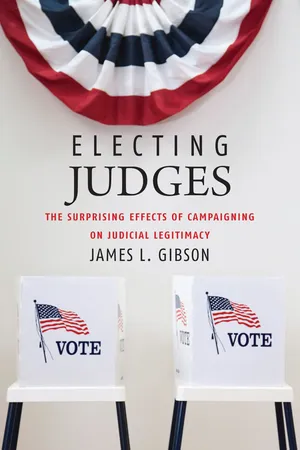
Table of contents
- Cover
- Copyright
- Title Page
- Series Page
- Dedication
- Contents
- Preface and Acknowledgments
- ONE The “New Style” Judicial Elections in the American States
- TWO Republican Party of Minnesota v. White and Perceptions of Judicial Impartiality
- THREE Can Campaign Activity Cross the Line?
- FOUR Diffuse Support for a State Supreme Court: Judicial Legitimacy in Kentucky
- FIVE Expectancy Theory and Judicial Legitimacy
- SIX Judges, Elections, and the American Mass Public: The Effects of Judicial Campaigns on the Legitimacy of Courts
- SEVEN Judicial Campaigns, Elections for Judges, and Court Legitimacy: Do Judicial Elections Really Stink?
- APPENDIX A Legal Developments Post-White
- APPENDIX B The Surveys
- APPENDIX C Experimental Vignettes
- APPENDIX D Question Wording
- APPENDIX E The Distributions of Key Analytical Variables
- APPENDIX F Interactive Analysis
- APPENDIX G Measuring Support for Democratic Institutions and Processes
- APPENDIX H Question Wording
- APPENDIX I Adding Control Variables
- Notes
- References
- Index